

What if sending more applications is the move keeping your tech job search stuck? If you’re feeling hopeless about finding a tech job after repeated applications and little response, it’s easy to question your skills, your resume, or whether you should change direction. The silence is draining, and comparing your progress with other people’s can make every delay feel like proof you’re falling behind.
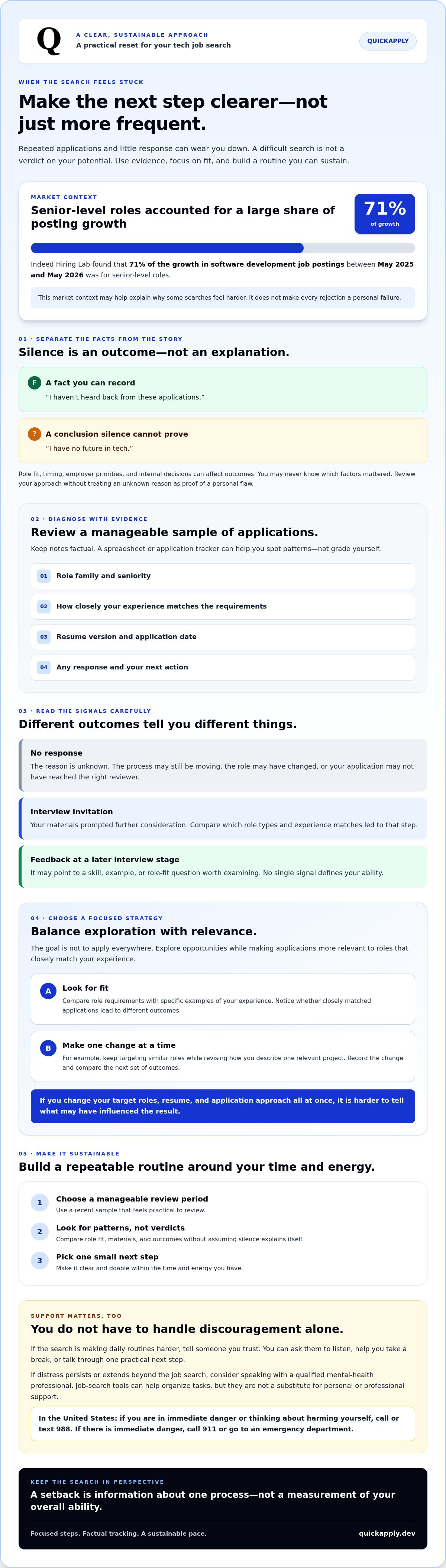
A difficult search, though, isn’t a verdict on your potential. The market is shifting: Indeed Hiring Lab found that 71% of the growth in software development job postings between May 2025 and May 2026 was for senior-level roles. That context may help explain why some searches feel harder, without turning every rejection into a personal failure.
This guide will help you identify why your search may feel stalled, build a plan you can sustain, and choose one or two changes to test. You’ll learn how to focus on better-fit roles, make your materials more relevant, and track what’s working without letting the search take over your life. The goal isn’t to do more at any cost. It’s to make each next step clearer and more useful.
Key Takeaways
- If you’re feeling hopeless about finding a tech job, separate the strain of a difficult search from assumptions about your worth or ability.
- Review a manageable sample of applications and record role fit, resume version, response, and next action to spot patterns.
- Balance exploring a wider range of opportunities with tailoring applications to roles that closely match your experience.
- Build a repeatable weekly routine around your available time and energy, then choose one small step to complete next.
Feeling hopeless about finding a tech job? Start by naming what is happening
Repeated rejections, unanswered applications, and uncertainty about what to change can wear you down. If you’re feeling hopeless about finding a tech job, that feeling deserves attention, but it isn’t a verdict on your technical ability or your future. Hiring outcomes can depend on role fit, timing, and decisions inside an employer’s process. When no one responds, you may never learn which factors mattered.
A job-search setback is information about one process, not a measurement of your overall ability. You can acknowledge how hard the search feels without treating silence as proof that you’re unqualified. You also don’t need to optimize every part of your search today. It’s reasonable to pause, narrow your focus, or talk things through with someone you trust before deciding what to do next.
Why repeated rejection can make a search feel personal
When applications go unanswered, your mind may fill in the missing explanation: perhaps your resume is weak, your skills are outdated, or you’re not cut out for the work. These are possibilities to investigate, not conclusions you can draw from silence alone. You can control which roles you target, how you present your experience, and whether you seek feedback. You can’t control an employer’s priorities, timing, or internal decisions.
Try separating facts from interpretations. “I haven’t heard back from these applications” is a fact. “I have no future in tech” is a much broader conclusion. Making that distinction leaves room to review your strategy without blaming yourself for factors you can’t see.
When job-search hopelessness needs more support
If discouragement is making daily routines harder, tell someone you trust what’s going on. You can ask them to listen, help you take a break, or talk through one practical next step. If distress persists or extends beyond the job search, consider speaking with a qualified mental-health professional. Job-search tools can help organize tasks, but they aren’t a substitute for personal or professional support.
Some people use “burnout” to describe exhaustion and reduced motivation. Occupational burnout refers to a work-related concept, so don’t treat the label as a diagnosis of what you’re experiencing. Focus on how you’re feeling and the support you need.
If you’re in the United States and in immediate danger or thinking about harming yourself, call or text 988 to reach the Suicide & Crisis Lifeline. If there’s immediate danger, call 911 or go to an emergency department. You don’t have to handle that moment alone.
Diagnose a stuck tech job search with evidence, not self-blame
When you’re feeling hopeless about finding a tech job, it’s easy for memory to turn every application into one discouraging result. Replace that summary with a small, recent sample you can review. The goal isn’t to grade yourself. It’s to find useful signals and decide whether there’s anything you want to test next.
For each application, record the role family, seniority, how closely your experience matches the requirements, which resume version you used, the application date, any response, and the next action. A spreadsheet works, as does an application tracker. Keep the notes factual: “No response yet” is more useful than “They rejected me because I’m not good enough.”
What application outcomes can and cannot tell you
Silence alone doesn’t explain why an employer didn’t respond. The role may have changed, the process may still be moving, or your application may not have reached the right reviewer. Since you usually can’t identify the reason from no response, treat it as unknown rather than evidence of a specific flaw.
Compare outcomes across role families and seniority levels. Do you hear back more often when the posting’s required skills closely match examples on your resume? Do applications for one role type lead to screens while another gets no response? Interview invitations offer a different signal from application silence: they suggest your materials prompted further consideration. Feedback at a later interview stage may point to a skill, example, or role-fit question worth examining. None of these signals alone defines your ability.
Build a simple job-search feedback loop
Choose a review period that feels manageable, then change one variable at a time. For example, keep targeting similar roles while revising how you describe one relevant project. Record the change and compare the next set of outcomes. If you change your target roles, resume, and application approach all at once, it’s harder to tell what may have influenced the result.
Look for patterns, not verdicts. If you rarely hear back for roles that require skills you haven’t demonstrated, try showing related experience more clearly or focus on closer-fit openings. If interviews progress but stall later, review the questions and feedback from those stages. A pattern is a hypothesis to test, not proof that you’re deficient.
For a broader walkthrough of each stage, read this comprehensive job application process guide. To make your own experiments easier to review, you can also use an application tracker for managing your search. Keep the process simple: log the evidence, make one adjustment, and reassess without turning every outcome into a personal score.
Choose a focused tech job-search strategy instead of applying everywhere
If you’re feeling hopeless about finding a tech job, sending more applications can seem like the fastest way to improve your odds. But volume has a trade-off: it can help you discover roles you hadn’t considered, while leaving less time to check fit and tailor each application. A focused search doesn’t mean applying to only one kind of job. It means putting effort where you can make a clear case for your skills.
Use your application history to choose a starting point, then compare the approaches:
| Approach | Effort | Useful for | Potential risk |
|---|---|---|---|
| Broad exploration | More applications to review and manage | Finding adjacent roles or unfamiliar employers | Applications may become generic or stretch beyond your evidence |
| Focused targeting | More time assessing and tailoring each application | Showing a close match between your experience and role requirements | A narrow scope may miss viable opportunities |
You can combine both approaches: explore broadly enough to identify options, then prioritize roles where your experience connects to the work.
Narrow roles without closing off realistic opportunities
Choose a small set of role families, seniority levels, or problem areas to explore. For example, a developer with scripting and test-automation experience might consider QA automation roles when the listed requirements match that background. Treat adjacent roles as options to evaluate, not automatic fits. If suitable openings or meaningful responses remain limited, widen or adjust your scope based on what you learn.
Tailor applications honestly and efficiently
For each priority role, identify the required skills you can substantiate. Bring relevant projects, tools, and outcomes forward, but don’t add skills or accomplishments you can’t support. AI-generated resume or cover letter text can speed up a first draft. Check every detail, personalize the language, and confirm that each claim reflects your actual experience. For more detailed tactics, read this guide to tailoring a resume to a job description.
To reduce repetitive editing, you can use resume tailoring for specific job descriptions as a drafting aid. Keep the final check in your hands. The goal is an accurate application that makes your fit easy to see, not a polished version of experience you don’t have.
Create a sustainable weekly plan for the tech job search
A useful job-search routine gives each task a place and gives you a reason to stop. If you’re feeling hopeless about finding a tech job, searching constantly can drain the energy you need to prepare strong applications. Build a repeatable sequence around your available time, not an arbitrary application quota.
Your week might follow this cycle:
- Identify roles: Review relevant openings and save those that match your target roles and experience.
- Tailor materials: Choose evidence from your projects and work history that addresses each role’s requirements.
- Apply: Submit applications after checking details, links, and claims for accuracy.
- Follow up: Review pending applications and take appropriate next steps where possible.
- Review: Note what you completed, what needs attention, and one adjustment to consider next week.
Scale the sequence to your capacity. One week might include a few focused sessions; another might be lighter. Make breaks and non-search time part of the plan, not rewards you have to earn. A sustainable routine is one you adjust to your capacity, not one that demands you exceed it.
Turn the plan into small, finishable actions
Break an application into four steps: review the role, choose relevant evidence, submit tailored materials, and record the status. Batch similar tasks, such as reviewing openings or updating application records, when that saves time. Leave room to research each role before applying. End each session with a clear stopping point, such as saving the next role to review, rather than scrolling until you feel depleted.
Use tools to reduce admin, not replace judgment
An application tracker can keep each role’s status, follow-up date, and lessons learned in one place, so you don’t have to reconstruct your progress from memory. AI-assisted tailoring can also help create an initial resume or cover letter draft from a job description. Treat that draft as raw material: verify every skill, accomplishment, and detail, then edit for accuracy, tone, and relevance.
Once your routine is clear, QuickApply can be an optional workflow tool for organizing applications and preparing tailored drafts. It can support the process, but it can’t decide which roles are right for you or validate your experience. Use QuickApply to organize your job-search workflow, then review each application yourself before submitting it.
Take the next step and rebuild momentum without expecting a quick fix
A reset doesn’t require a complete career overhaul. If you’re feeling hopeless about finding a tech job, make your next move small enough to feel doable. Choose one action you can finish today or this week, then use what you learn to decide what comes next.
Pick one next action that restores a sense of agency
Make the task specific: review one job description and mark the requirements you can demonstrate, update one project example on your resume, or contact one trusted person for feedback. You’re not committing to a complete search reset. You’re finishing one useful step.
Afterward, note what felt manageable and what took more energy than expected. That can help shape your next action. You might be ready to revise another project example, or it might make sense to pause and ask a peer, mentor, or relevant professional to review your approach. Adjusting your plan as your evidence, capacity, or personal circumstances change is part of making it work.
Use job-search technology as support, not a promise
Tools can reduce repetitive admin, but they can’t make an employer respond or control a hiring decision. QuickApply offers AI-assisted resume tailoring and cover letter generation, an application tracker, and interview practice. These features can help organize parts of your search and prepare materials, but they don’t guarantee interviews or employment.
Treat AI-generated text as a draft, not a finished account of your experience. Check every detail, remove anything you can’t support, and revise the wording until it sounds like you. Your projects, skills, and examples should remain accurate and in your own voice.
You can use a spreadsheet and your own documents, or choose a platform if it makes the workflow easier to manage. If you’d like to explore that option, explore QuickApply’s job-search tools for organizing applications and preparing materials. Choose only what supports your process. Then take the next manageable step, review how it went, and adjust from there.
Make your next move smaller, clearer, and sustainable
Feeling hopeless about finding a tech job doesn’t mean you need to overhaul your career or send out more applications today. Start with evidence: review what your search is telling you, focus on roles where you can show relevant skills, and adjust one part of your approach at a time.
Then build a routine that fits your actual capacity. A few focused, well-prepared applications and deliberate breaks may be more manageable than an endless search driven by arbitrary quotas. Track what you’ve tried, learn from the signals you receive, and revise the plan when your circumstances or energy change. No tool can control an employer’s decisions, but a useful workflow can make the work easier to organize.
QuickApply offers AI-assisted resume and cover letter tailoring, application tracking, and interview practice to support parts of your search. Review and personalize AI-generated drafts so they reflect your real experience. Explore QuickApply’s tools for a more organized job search.
You don’t need to solve the whole search at once. Choose one useful next step, complete it, and build from there.
Frequently Asked Questions
Is it normal to feel hopeless about finding a tech job?
Yes, feeling hopeless about finding a tech job can happen when applications go unanswered or repeated setbacks make the next step unclear. The feeling is real, but it doesn’t prove you lack ability or won’t find a role. Try separating what you know, such as which applications received replies, from assumptions about what silence means. If discouragement is affecting daily life, talk with someone you trust or seek qualified support.
What should I do first when my tech job search feels hopeless?
Start with one small action, not a complete search overhaul. Review a manageable sample of recent applications and note the roles, your fit, materials used, responses, and next steps. Then choose one item to examine, such as whether your resume shows evidence for a role’s key requirements. If even that feels like too much today, pause and reach out to someone you trust. You can return to the search when you’re ready.
Why am I not getting responses to my tech job applications?
No response doesn’t reveal the reason by itself. It could relate to role fit, how clearly your experience matches the requirements, timing, or an employer’s hiring process, among other factors. Review applications by role type and seniority to see whether patterns emerge. Also distinguish application silence from interview outcomes: an interview invitation shows your materials prompted further consideration, while later-stage feedback may offer more specific signals to evaluate.
Should I keep applying to more tech jobs or change my strategy?
Don’t assume that either more volume or a complete reset is the answer. Use your application history to decide what to test. If you’re applying across many role types with generic materials, focus on roles where you can show relevant skills and tailor each application. If your target is very narrow and suitable openings are scarce, cautiously explore adjacent roles where your experience matches the requirements. Change one variable at a time so you can review the results.
Can AI help when I feel stuck in my tech job search?
AI can help organize repetitive tasks and create starting drafts, but it can’t determine your best career direction or control hiring decisions. QuickApply offers AI-assisted resume tailoring and cover letter generation, plus application tracking and interview practice. Treat generated text as a draft: verify every skill, achievement, and detail against your actual experience, then edit the wording so it sounds like you. Use technology to support your judgment, not replace it.
How can I keep a tech job search from taking over my life?
Give the search defined work sessions and stopping points. For example, use one session to review roles, another to tailor materials, and a separate time to follow up or update your tracker. Set goals based on your available energy and responsibilities, not an arbitrary application quota. Schedule breaks and non-search time, too. At the end of a session, write down the next task so you can close the loop and step away.
What should I do if job-search hopelessness includes thoughts of self-harm?
If you’re in the United States and thinking about harming yourself, call or text 988 to reach the Suicide & Crisis Lifeline. If you’re in immediate danger, call 911 or go to an emergency department. If possible, tell someone you trust and ask them to stay with you while you seek help. Job-search tools aren’t crisis support, and you deserve immediate help from people equipped to support you.


