

A long employment gap needs context, not an apology. If you’re figuring out how to explain long term unemployment on resume, the goal isn’t to hide the dates or defend every month. It’s to make your timeline clear and direct attention to the skills and results you bring to the role.
It’s understandable to worry that an honest explanation could weaken your candidacy, especially if your recent experience feels difficult to summarize. But unexplained dates can raise more questions than a brief, factual note. You don’t need to overshare or make the gap the headline.
This guide shows you how to present an accurate timeline, bring relevant skills, projects, and accomplishments forward, and prepare a concise interview explanation. You’ll also learn how to tailor your resume to each role without stretching the truth, so employers can quickly see what you offer now.
Key Takeaways
- Learn how to explain long term unemployment on resume with a clear, factual timeline instead of an apology.
- Choose a resume format that keeps dates easy to scan and relevant qualifications visible.
- Identify genuine skills, projects, coursework, or other activities that support your fit for the role.
- Prepare a concise interview response that gives context, signals readiness, and protects your privacy.
- Tailor your resume to each opportunity and use a final checklist to keep your job search organized.
How to Explain Long-Term Unemployment on a Resume Without Apologizing
A gap can feel difficult to explain, especially if you’re concerned it will overshadow years of experience. But time away from paid work isn’t a personal failure, and your resume doesn’t need to defend it. The goal is straightforward: show an accurate timeline, then make your relevant qualifications easy to find.
That’s the practical answer to how to explain long term unemployment on resume: use truthful dates and concise context where it helps, without turning your resume into a personal account. You’re not required to explain every circumstance behind your time away. Share only what helps readers understand your work history and what you can contribute now.
What counts as a long employment gap on a resume?
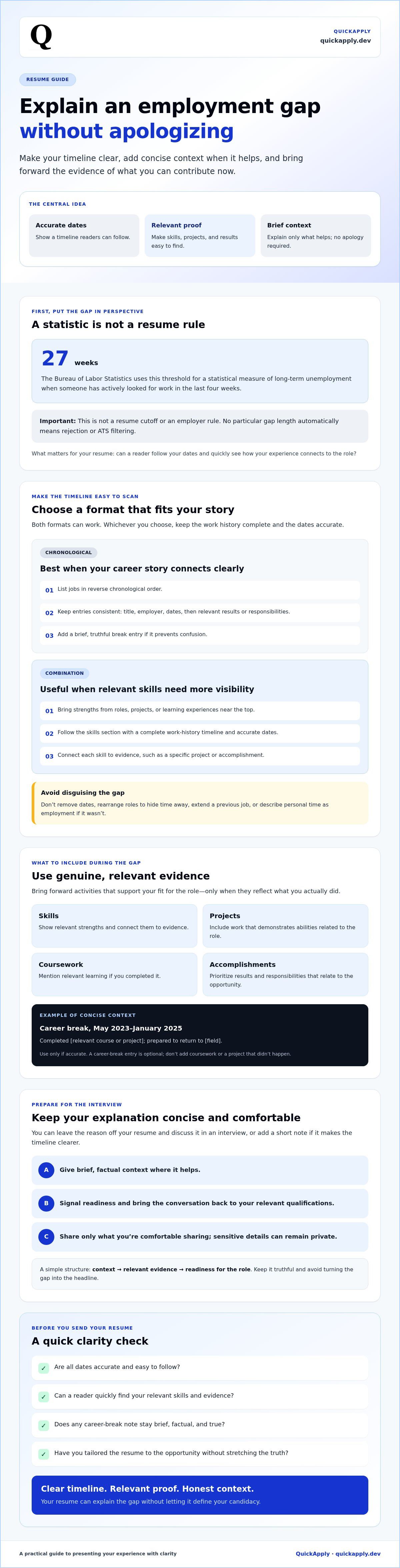
There’s no universal resume rule that defines a “long” gap. A recruiter’s questions may depend on the dates, the role, and how clearly the rest of your experience connects to the job. In the United States, the Bureau of Labor Statistics uses 27 weeks of unemployment as a statistical threshold when someone has actively looked for work in the last four weeks. That measure is not a resume cutoff or a rule for employers. For broader context, see Long-term unemployment.
Focus on whether your timeline is easy to follow. A noticeable stretch without context may prompt questions, but no particular length automatically means rejection or ATS filtering.
Do you need to explain unemployment directly on the resume?
Not always. You can leave the chronology clear and discuss the reason in an interview, or add a brief note if it would prevent confusion. Choose the approach that makes your resume easiest to scan and feels comfortable to you. Either way, use accurate dates. Don’t extend a previous role or label personal time as employment if it wasn’t.
You can keep sensitive details, including health information, private. If you choose to add context, keep it factual and brief. For example, an adaptable entry might read:
- Career break, May 2023-January 2025: Completed [relevant course or project]; prepared to return to [field].
Use that wording only if it reflects your experience. If caregiving, recovery, or another circumstance better describes the period, choose a concise, truthful label or leave the reason for a conversation. The right version keeps your timeline accurate and gives you wording you can comfortably explain.
Choose an Honest Resume Format That Makes Your Experience Easy to Scan
Your format should make two things easy to find: what you’ve done and when you did it. A skills-first layout can bring strengths forward, but it shouldn’t make employers reconstruct your timeline. For visual ideas, browse these good resume examples for 2026, then choose a structure that fits your experience and the role.
Both chronological and combination resumes can work. Choose based on whether your career history already tells a clear story or whether relevant skills need more visibility. Avoid removing dates or rearranging roles to make a gap less noticeable. That can create confusion and undermine trust. Fast Company also offers practical resume strategies for the long-term unemployed, including ways to present relevant activity during a break.
When is a chronological resume still the clearest choice?
Use a chronological format when your roles and accomplishments connect clearly to the target position. List jobs in reverse chronological order and keep each entry consistent: job title, employer, dates, then relevant results or responsibilities. A straightforward timeline is usually stronger than a layout designed to disguise a gap. If the break needs context, add a brief, accurate entry rather than distorting the dates around it.
When can a combination resume help explain a career break?
A combination format can help when your strongest qualifications come from several roles, projects, or learning experiences, and you want those skills near the top. Follow the skills section with a complete work-history timeline, including accurate dates. Don’t fill the top half with keywords alone. Connect each skill to specific evidence, such as a project or accomplishment, so readers can assess what you’ve actually done.
A short career-break entry may fit within the timeline if it adds useful context. For example: Career break, 2023-2025: Completed relevant coursework and developed a portfolio project. Use this only if it accurately describes your experience. If you didn’t complete coursework or a project, don’t add one just to make the gap look productive. The right format helps answer how to explain long term unemployment on resume without letting the gap dominate the page.
Before sending your resume, scan it as a recruiter would: Can you follow the dates quickly? Are the most relevant qualifications easy to spot? Does each skill have evidence behind it? If you’re tailoring truthful experience to a specific job description, resume tailoring to the role can help you foreground the strongest match while keeping your timeline clear.
What to Write During Long-Term Unemployment: Skills, Projects, and Career-Break Entries
Use the gap to show relevant evidence, not to manufacture a story. Make a quick inventory of what you genuinely did during the break: coursework, personal or volunteer projects, caregiving, community work, freelance assignments, or independent learning. You don’t need to list every activity. Include an activity only if it’s accurate, relevant to the role, and something you’re comfortable discussing.
For each activity, identify the skill it demonstrates and the evidence behind it. A completed project might show which tool you used, what problem you solved, or what you finished. Caregiving or volunteering can demonstrate organization, communication, or coordination when those skills connect to the target role. Describe the actual tasks and scope. Don’t present unpaid personal responsibilities as paid employment.
How do you list a career break on a resume?
A neutral label such as Career Break followed by accurate dates can make the chronology easier to understand. Add a short factual description only if it provides useful context or highlights relevant development. For example: “Career Break, April 2024-February 2025: Completed introductory data analytics coursework.” Adapt the wording to your circumstances, and use it only if you completed that coursework. If a description adds no relevant information, a clear label and dates may be enough.
Be precise about the nature of your activity. If you completed independent work, call it a project rather than freelance work unless you actually had clients or paid assignments. Never invent clients, credentials, job titles, or employment dates to make the gap look more active. A claim you can’t comfortably explain can weaken an otherwise credible resume.
How can you show skills gained while unemployed?
Start with the job requirements, then connect each relevant skill to something you actually completed. Name the tool, task, and result where possible. Keep finished work separate from goals or skills still in progress.
- Coursework: “Completed a SQL course; built queries to analyze a sample sales dataset.”
- Project: “Created a responsive portfolio site using HTML and CSS; published the code on GitHub.”
- Volunteer work: “Coordinated weekly schedules for a community program using shared planning tools.”
Link to a real portfolio or GitHub repository when it’s relevant and ready to review. Don’t imply a practice project was client work, or describe a planned certification as completed. This evidence-first approach makes how to explain long term unemployment on resume less about defending time away and more about showing what you can contribute now.
How to Prepare a Short, Confident Interview Explanation for an Employment Gap
A good answer gives enough context to make the timeline understandable, then shifts to your readiness and fit for the role. Use this simple structure: brief context, what you’re ready to do now, and how you can contribute next. Answer directly. Don’t apologize, criticize a former employer, or offer private details just to fill the silence.
These examples are starting points, not scripts. Adapt them to your actual circumstances and the details on your resume:
- Caregiving: “I stepped away from work to care for a family member. I’m ready to return, and my experience coordinating complex schedules strengthened skills I can use in this role.”
- Health-related absence: “I took time away for a personal health matter. I’m ready to return to work and am focused on bringing my experience in [relevant area] to this position.” You don’t need to disclose a diagnosis or medical history.
- Layoff: “My role ended during a company restructuring. Since then, I’ve focused on finding a position where I can apply my experience in [relevant skill], and this role is a strong match because [specific reason].”
- Career transition: “I took time to prepare for a move into [field]. I’ve completed [relevant course or project], and I’m ready to apply those skills to [role-related contribution].”
What should you say when asked why you were unemployed?
Keep the context brief and truthful, then connect your answer to the job. Share only what you choose to disclose and can discuss comfortably. Your explanation should match your resume’s dates and wording. If your gap involved personal circumstances, a simple statement that you took time away may be enough. Then describe your current readiness and relevant strengths.
How can you answer without oversharing or sounding defensive?
Practise a concise response, then stop. You don’t need to preempt every possible concern with more personal information. Prepare for reasonable follow-up questions, such as what you did to prepare for a return or why this role interests you. Avoid rehearsed claims that don’t sound like you, and never invent activities or accomplishments. Keep your spoken explanation consistent with the timeline and evidence in your application.
To make how to explain long term unemployment on resume feel manageable in an interview, practise saying your answer aloud and refine it until it sounds natural. QuickApply’s interview practice tools can help you rehearse clear, role-focused responses while keeping your facts intact.
Turn Your Resume into a Forward-Looking Job Search Plan
A clear resume is one part of a focused search. Use it as the starting point, then shape a version around each role rather than sending the same generic file everywhere. For practical editing steps, see this guide to tailoring a resume to a job description.
Before you apply, run this quick quality check:
- Dates: Confirm that employment and career-break dates are accurate and consistent.
- Evidence: Tie relevant accomplishments, projects, and skills to things you genuinely did.
- Readability: Make job titles, employers, dates, and key qualifications easy to scan.
- Interview language: Prepare a concise gap explanation that matches your resume and feels comfortable to say aloud.
- Role fit: Adjust the emphasis to the job description without changing the underlying facts.
This is the practical finish to how to explain long term unemployment on resume: make the timeline credible, make your fit visible, and be ready to speak about both.
How do you keep a long job search organized?
Use one consistent system to record each role, application date, resume version, follow-up, and next action. Before applying, review the job description and note which requirements match your actual experience. If a role isn’t a strong fit, prioritize a better match instead of treating application volume as the goal. An application tracker can help you manage applications and follow-ups, but it can’t guarantee a particular hiring outcome.
How can resume tools help without replacing your judgment?
AI resume tailoring can help you edit for a specific job description and bring relevant, truthful qualifications forward. Treat suggestions as drafts, not verified facts. Before submitting, review every phrase, skill, date, and accomplishment. Remove anything inaccurate, overstated, or unlike your voice. You own the final version.
QuickApply combines resume tailoring with application tracking to help keep role-specific materials and job-search activity organized. If that workflow would be useful, tailor your resume and organize applications with QuickApply.
Make Your Next Application Clear and Focused
A long employment gap doesn’t need to define your candidacy. The strongest approach to how to explain long term unemployment on resume is to keep your timeline accurate, connect relevant skills to real evidence, and prepare a short explanation you’re comfortable sharing.
Before you apply, check that your dates are clear, your most relevant qualifications are easy to scan, and your interview answer matches what you’ve written. Then tailor your resume to the specific role. A focused application helps employers see the connection between your experience and their needs, without exaggerating or hiding your history.
QuickApply offers AI-powered resume tailoring to job descriptions, plus application tracking and interview practice tools to help organize your search and prepare your responses. Review every suggestion to make sure it reflects your real experience and sounds like you.
Explore QuickApply’s resume and job-search tools to tailor your materials to the role, keep applications organized, and prepare for interviews. Your gap is one part of your timeline, not the measure of what you can contribute next.
Frequently Asked Questions
Should I put a long unemployment gap on my resume?
Usually, yes, if leaving it out would make your timeline unclear. Keep your employment dates accurate, then decide whether a brief, neutral career-break note adds useful context. You don’t need to list private circumstances or defend your time away. The goal in how to explain long term unemployment on resume is to make your work history easy to follow and your relevant qualifications easy to find.
How do I explain a two-year gap on my resume?
Show the accurate dates and add a short explanation only if it clarifies the timeline or highlights relevant experience. For example: “Career Break, 2023-2025: Completed coursework in [relevant subject].” Use this only if it’s true. If you’d rather keep the reason private, list the dates clearly and prepare a concise interview explanation that focuses on your readiness and fit for the role.
Can I leave dates off my resume because I was unemployed?
It’s usually clearer to include accurate dates than to remove them to hide a gap. Omitting dates may make it harder for an employer to understand your work history and can prompt more questions. Use a consistent month-and-year or year-only format across roles, and don’t alter employment dates. If you’re concerned about context, consider a brief career-break entry or prepare to discuss the gap in an interview.
Should I explain the reason for unemployment on my resume?
No, you don’t have to include the reason. A clear timeline may be enough, especially if personal context doesn’t strengthen your application. If a short note helps explain the break, keep it factual and limited to what you’re comfortable sharing. You can also leave the reason for an interview. Whichever approach you choose, make sure the dates are accurate and your explanation matches your resume.
How do I explain unemployment caused by a health issue?
You can keep medical details private. On your resume, use accurate dates and, if helpful, a neutral label such as “Career Break.” In an interview, you might say, “I took time away for a personal health matter. I’m ready to return and interested in contributing my experience in [relevant area].” Share only what you’re comfortable discussing, then bring the focus back to your qualifications for the role.
Can I include courses or personal projects from my time unemployed?
Yes, include completed courses or projects when they demonstrate skills relevant to the job. Be specific about what you learned, built, or used. For example, describe a finished project and link to a real portfolio or GitHub sample if it’s appropriate. Don’t present plans as completed work, imply a personal project was client work, or claim a credential you haven’t earned. Keep each entry accurate and ready to discuss.
What if I have no activities to list during my employment gap?
You don’t need to invent activities or fill every period with resume content. Keep your timeline honest, use a brief career-break label if it helps, and focus the rest of the document on relevant accomplishments from your actual work history. In interviews, give a concise explanation you’re comfortable sharing, then pivot to your readiness and fit. Your resume can make a strong case without presenting the gap as productive work.


