

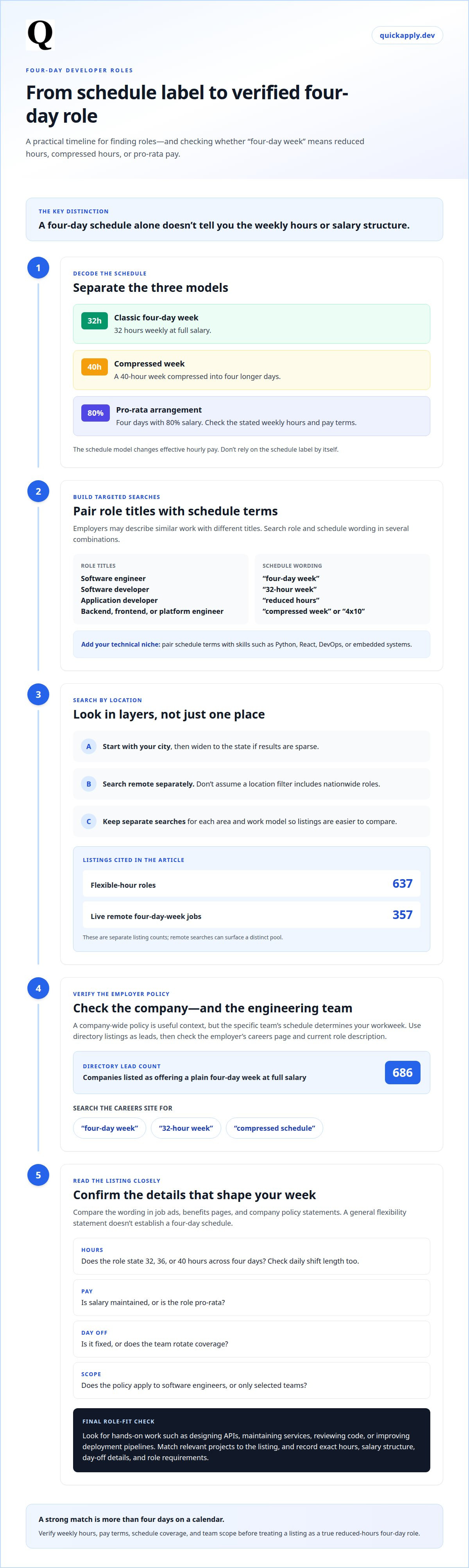
A four-day developer job can mean very different workloads and pay. Most software engineer roles schedule 32-40 hours across four days; a classic four-day week is 32 hours at full salary, while some employers compress 40 hours into four longer days or pay 80% for a pro-rata schedule. Knowing how to find a 4-day work week software developer job starts with telling these models apart.
If you’re drawn to the extra day off but wary of losing salary or benefits, compare the details, not just the schedule label. This guide shows you where to look by location, which search terms and filters can surface developer roles, and how to assess hours, pay, and benefits before applying. You’ll also learn what to clarify about fixed days off, core hours, and team communication, so you can focus your search on jobs that fit the way you want to work.
Key Takeaways
- Look for employers with a clear four-day policy, then assess whether the schedule is fixed or flexible.
- Combine location filters with schedule terms, and read listings closely to separate a true four-day week from compressed hours.
- Search across developer and software engineering job titles, then compare salary, benefits, core hours, and team communication expectations.
- Strengthen your application by linking your experience to the role, and raise a shorter schedule as a practical arrangement during hiring discussions.
What companies offer a 4-day work week?
Start with employers that state their schedule policy clearly. A job platform lists 686 companies offering a plain four-day week at 100% salary. Treat that directory as a lead list, then check each employer’s own careers page and current role description. A company-wide policy matters, but the specific software engineering team’s schedule determines your actual workweek.
Read the hours and pay together. A classic four-day week means 32 hours weekly at full salary, while a 40-hour schedule may compress five days into four longer shifts. Some roles instead offer 80% salary for four days and label the arrangement “pro-rata.” The distinction changes your effective hourly pay, so look for exact weekly hours and salary terms.
Use a consistent policy check for every employer. Search its careers site for “four-day week,” “32-hour week,” and “compressed schedule.” Then compare the wording across job ads, benefits pages, and company policy statements. A general flexibility statement doesn’t establish a four-day schedule; a developer listing that names weekly hours and a regular day off gives you more useful detail.
- Hours: Does the role specify 32, 36, or 40 hours across four days?
- Pay: Is the salary maintained, or is the role pro-rata?
- Schedule: Is the day off fixed, or does the team rotate coverage?
- Scope: Does the policy apply to software engineers, or only selected teams?
Research the company and engineering team before applying. Identify the product, the team’s technology stack, and the schedule language in the listing. Then connect your experience to its needs. If a posting emphasizes backend reliability, for example, highlight relevant systems work in your cover letter and refer directly to the stated four-day arrangement.
Keep the schedule policy separate from the job details in your notes. Record the employer’s exact hours, salary structure, and role requirements. This makes it easier to distinguish a genuinely reduced-hours week from four longer days and prioritize companies whose stated policy fits your preferred routine.
Filtering job listings by schedule type and location
To learn how to find a 4-day work week software developer job, build searches around both role titles and schedule terms. Start with “four-day week software engineer” and “four-day week developer,” then add your target city or state. For remote roles, search “remote” separately instead of assuming a location filter includes nationwide listings. Different combinations catch different job-title and schedule wording.
Use schedule filters carefully. A compressed 4-by-10-hour schedule may be categorized separately from a four-day week. Select the schedule type you want, then read each description for weekly hours, daily shift length, and how the day off works. Job platforms list 637 flexible-hour roles and 357 live remote four-day-week jobs, so remote searches can surface a distinct pool.
Search locations in layers. Enter your preferred city first, then widen to the state or remote options if results are sparse. For example, a developer in Austin might compare local listings with remote roles open across the United States. Keep separate saved searches for each area. That makes new listings easier to spot and helps prevent location settings from hiding relevant roles.
- Schedule: Search “four-day week,” “compressed week,” and “4x10” separately.
- Role: Try “software engineer,” “software developer,” and a specialty such as “backend.”
- Location: Filter by city, state, and remote status in separate passes.
- Listing: Confirm hours and schedule in the description, not just the filter label.
A useful way to find a 4-day work week software developer job is to compare each listing against your priorities before applying. Save searches with specific labels, such as “Remote backend, four-day week.” A role-specific application can help connect your technical experience to the listing’s requirements.
Finding software engineering and developer roles
Knowing how to find a 4-day work week software developer job starts with searching beyond one job title. Employers may use “application developer,” “backend engineer,” “frontend engineer,” or “platform engineer.” Pair each title with “four-day week” or “reduced hours.” Some employers describe schedules in benefits information rather than job titles, so search role and schedule terms separately.
Narrow results to your technical niche. Add skills such as Python, React, DevOps, or embedded systems to find work that fits your experience. A search like “backend engineer Python four-day week” is more specific than a broad developer query. Save promising searches and revisit them as listings change.
- Role titles: Try software engineer, application developer, and platform engineer.
- Technical skills: Pair a language or framework, such as Python or React, with schedule terms.
- Work model: Add remote, hybrid, or your preferred location.
- Employer research: Review product updates and technical posts for team context.
Check that each listing describes hands-on engineering work. Look for tasks such as designing APIs, maintaining services, reviewing code, or improving deployment pipelines, then match them to recent projects. For a React-focused role, lead with shipped interface work and explain your contribution instead of opening with unrelated infrastructure tasks.
If you’re learning how to find a 4-day work week software developer job, research the team before applying. Read product pages, engineering blogs, and release notes to identify its users and technical priorities. If the team discusses service reliability, connect that need to a relevant project you delivered. Prepare interview questions about code reviews, incident coverage, sprint planning, and handoffs on your weekly day off.
Negotiating a shorter workweek with a new employer
Raise the schedule once you understand the role’s priorities and can explain your value. A 30-hour workweek is one possible arrangement, but employers may also consider four days with different weekly hours. State your preferred days and hours clearly. Then explain how you’ll manage delivery, collaboration, and coverage within that schedule.
Build your proposal around the work, not just your personal preference. Identify projects you can own, outcomes you can deliver, and ways teammates can access handoffs. You might document deployment steps and coordinate incident coverage with the team. Explain how the arrangement supports concrete value, such as retaining domain knowledge or reducing hiring and training needs.
Prepare for concerns about sprint commitments, code reviews, or customer incidents on your day off. Address each with a practical plan: define your availability, document asynchronous updates, and agree on how urgent work will be covered. Don’t promise the same output in fewer hours without explaining how scope, priorities, or workflows would change.
- Define the model: Specify your weekly hours, workdays, and preferred day off.
- Connect it to delivery: Name the projects and responsibilities you can own.
- Plan team coverage: Explain handoffs, meeting availability, and incident support.
- Discuss compensation: Clarify how salary and benefits relate to the proposed hours.
Discuss compensation alongside the schedule. A four-day arrangement might mean reduced hours, compressed hours, or another agreed structure, and each affects the value of the offer differently. Ask how the employer will document the schedule, responsibilities, pay, and benefits. If the initial answer is no, consider whether a defined trial arrangement or narrower scope could address the concerns.
Prepare your compensation discussion with the Salary Negotiation Guide. Use it to organize your priorities, support your proposal with relevant contributions, and keep the conversation focused on a workable agreement.
QuickApply: Resume Tailoring
QuickApply helps you turn a relevant developer listing into a focused application. Its Resume Tailoring and Cover Letter Generation tools adapt your materials to a specific job description, highlighting skills that match the role. Use them when a four-day position calls for a technology stack or project experience that your current resume doesn’t emphasize.
QuickApply’s match score helps you identify suitable opportunities, and the Application Tracker keeps submissions organized. Interview Practice can help you prepare to explain your technical contributions and discuss schedule expectations. Keep each application aligned with the listing’s required skills, responsibilities, and workweek details.
Visit quickapply.dev to explore QuickApply.
Make Your Next Move Count
Turn your schedule preference into a clear search strategy. Decide which trade-offs you can accept, such as compressed hours or a fixed day off, and use those priorities to assess opportunities. Keep your search active and your applications organized so strong-fit roles don’t get lost.
If you’re refining how to find a 4-day work week software developer job, focus each application on the value you bring to that specific engineering team. QuickApply’s Application Tracker can help you keep your job search organized as you move from application to interview.
For focused support with your next application, contact QuickApply. Take the next step with a sharper search and confidence in the value you offer.
Frequently Asked Questions
Do these jobs pay the same salary and benefits?
Pay depends on the schedule model: some roles maintain full salary, while pro-rata roles pay less for reduced hours. Review benefits separately, since eligibility and coverage may depend on the employer’s policies or role terms. Compare the written offer’s salary, health coverage, paid leave, retirement contributions, and eligibility rules. A reduced-hours role, for instance, might preserve salary but define benefits differently.
How many hours and what schedules are available?
Four-day software engineering roles can span 32 to 40 weekly hours. A 32-hour schedule means shorter total weekly work, while a 40-hour schedule compresses the workload into longer days. Common patterns include Monday through Thursday or Tuesday through Friday. Check whether the day off stays fixed, rotates, or depends on team coverage before deciding whether the schedule fits.
Where can software developers find 4-day work week jobs in the United States?
Search national job listings, employer career pages, and remote-role results using both your specialty and schedule terms. Combine “DevOps engineer” with “four-day week,” then try “remote” as a separate search. Check employers’ engineering career pages for roles that broader searches may miss. If you’re open to hybrid work, search each location you’d consider and keep remote results separate.
Which job boards let you filter for four-day work weeks or compressed schedules?
Job-board filters vary, so use schedule filters where available and supplement them with exact phrases in the search field. Search “four-day week” and “4x10” separately because compressed schedules may be categorized differently. Add “software engineer” or a specialty such as “frontend developer,” then inspect each description. A schedule label alone won’t show total hours, shift length, or day-off rules.
Which U.S. tech companies offer permanent four-day work weeks to software developers?
Identify employers through current developer vacancies that state a permanent schedule, rather than assuming a company-wide policy applies to every team. Search employer career pages for engineering roles and terms such as “32-hour week” or “four-day schedule.” Then compare the specific job description with the company’s policy language. This approach helps distinguish ongoing arrangements from temporary pilots or compressed workweeks.
How can developers tell whether a four-day job is 32 hours or four 10-hour days?
Look for total weekly hours and daily shift length in the listing or offer. A 32-hour role states a reduced weekly total; a 4-by-10 schedule describes four ten-hour workdays. If the posting only says “four-day week,” examine its schedule details and compensation terms. For example, four days at ten hours each keeps a 40-hour week compressed into fewer workdays.


