

The hardest part of a senior tech application may not be the interview. It may be deciding whether your experience is enough to apply. Imposter syndrome when applying for senior tech roles can make you discount your results, fear being exposed as unqualified, or treat every unfamiliar requirement as proof you don’t belong.
That doubt can feel especially sharp when you’re used to being the person with answers. Senior roles bring broader expectations, more visible leadership, and comparisons with peers whose work you may see only from the outside. Consulting can add another reset: each new client, team, or problem may make established expertise feel temporarily out of date.
This guide explains what imposter syndrome is and how it can shape senior tech applications. It covers how overpreparation, perfectionism, self-doubt, and peer comparisons affect the process, and how consulting work can intensify those patterns. The aim isn’t to silence every doubtful thought. It’s to separate feelings from evidence so you can present your experience clearly and make a grounded decision about your next role.
Key Takeaways
- Overpreparing and perfectionism can turn self-doubt into extra work. Separate the feeling of being unqualified from evidence of what you’ve delivered.
- Peer comparisons show only part of the picture. Track your own progress and identify the strengths your experience has built.
- A job description is a starting point, not a verdict. Match your experience to the role’s outcomes and represent your skills honestly.
- In interviews, address unfamiliar technologies directly. Explain how you approach learning and how you’d work through the gap, including in a new consulting engagement.
1. Overpreparation, perfectionism, and chronic self-doubt
Imposter syndrome when applying for senior tech roles can make strong results feel undeserved. It involves devaluing your work and fearing others will expose you as a fraud. Jordan Cutler, a senior engineer, says he experiences these feelings at least every 3 months. A promotion or unfamiliar role can trigger doubt, even after years of experience.
Overpreparation can look productive, but perfectionism can turn it into a delay loop. You might rehearse every possible interview question, keep revising a project story, or study a technology you’ve never been asked to use. Instead, map the role’s core responsibilities to specific examples from your work. Practise explaining your decisions, trade-offs, and results rather than scripting every answer.
To manage application anxiety, keep a record of work you shipped, positive feedback, and problems you solved. Before an interview, review that evidence and prepare questions about areas where you need context. Treat a feeling of failure as a feeling, not proof that you lack the skills. Aim to be clear and accurate, not flawless.
Self-doubt can also reflect a hostile workplace, rather than a distorted view of yourself. If you’re consistently excluded from information or decisions, examine that pattern directly. Consistently receiving more negative feedback than male peers may point to bias, not incompetence. Compare concrete examples and expectations, rather than relying only on your private interpretation of events.
A new role or promotion can unsettle your sense of competence because the problems and expectations have changed. One commenter described feeling doubt when starting new positions, learning programming languages, and moving into management. Treat the transition as a learning phase. Clarify which outcomes define success and who influences decisions, especially when starting a client project.
Identify the source before trying to fix the feeling. Write down the thought, such as “I should already know this,” then ask whether the expectation is shared or assumed. State your assumptions explicitly and check them with the people who set expectations. If you’re stuck on a client call, prepare thoughtful questions instead of trying to sound perfect. That shifts preparation from performance to practical problem-solving.
Comparing skills with other senior engineers
Peer comparison can turn a career review into a false ranking. A Senior BI Engineer at Amazon said some teammates at the same level did as much as twice the work they did. That comparison describes output, not the full mix of scope, complexity, influence, or support behind each person’s results. Use it as a prompt to examine your own work, not as a verdict on whether you’re qualified.
Tool breadth can distort the picture too. One engineer said he had coded in about 10 different languages. That range may look intimidating, but a language count alone doesn’t show how deeply someone can design systems, make trade-offs, or help a team deliver. For a senior role, identify the skills the job actually needs, then connect them to projects where you used them.
Make the comparison useful with a simple review. Choose a recent project and record what you owned, what changed because of your work, and what you learned. Then compare that evidence with your earlier work, rather than another engineer’s public wins. A tech career adviser recommends measuring your own abilities every 6-12 months instead of anchoring goals to other people.
Career progress is uneven, too. One commenter described engineers who grow slowly at first, then earn promotions every year for several years, even at a top tech company. A peer’s current title can hide a different path, timeline, or opportunity. Review your own trajectory for expanded responsibility, stronger judgment, and broader impact before deciding you’ve fallen behind.
Use that evidence in applications. Describe your contribution precisely, including decisions you influenced and outcomes you helped produce. If a role emphasizes a skill you’re still building, explain the adjacent experience that supports your readiness. A focused cover letter tailored to the role can make that connection clear without turning your experience into a contest with someone else’s résumé.
3. How should I handle job descriptions that list more qualifications than I have?
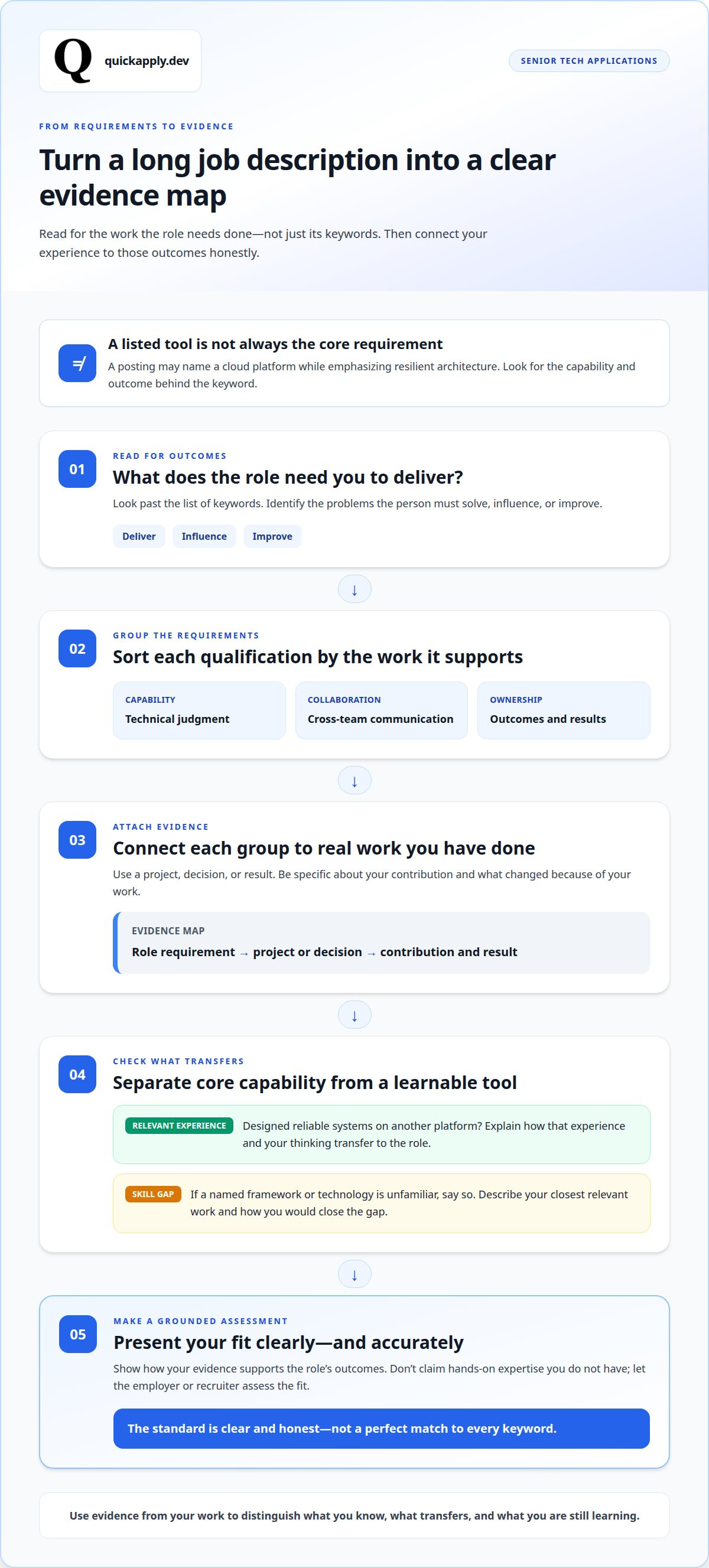
A long list of requirements can make one unfamiliar tool overshadow years of relevant work. Deloitte research describes employers redesigning work around skills and outcomes rather than fixed job descriptions. Read a role for the problems it needs solved, not just its keywords. Ask what the person must deliver, influence, or improve.
Build a quick evidence map before deciding whether to apply. Group the listed qualifications by the work they support, then connect each group to a project, decision, or result from your experience. For example, a posting may name a specific cloud platform while emphasizing resilient architecture. If you designed reliable systems on another platform, describe that experience accurately and explain how your thinking transfers.
Separate essential capabilities from tools you can learn. A senior role may require technical judgment, cross-team communication, and ownership of outcomes. A named framework might be one way to deliver that value, rather than the core capability the employer needs. Don’t claim hands-on expertise you lack. Describe your closest relevant work, name the gap, and explain how you would close it.
Represent yourself clearly and honestly. Your job as an applicant is to explain your skills and evidence. The employer or recruiter decides whether they fit the role’s needs. Use concrete examples: “I led a migration using a different cloud stack, owned the rollout plan, and addressed reliability risks.” That communicates your scope without implying experience with an unfamiliar platform.
Then decide based on the role’s central outcomes. If your experience supports those outcomes, apply even if you’re missing some listed qualifications. If a core responsibility depends on expertise you don’t have, identify that gap before investing time. A targeted application connects your strongest evidence to the employer’s priorities, rather than mirroring every line of the posting. This turns an intimidating checklist into a clear fit assessment.
4. How can I discuss gaps or unfamiliar technologies in senior-level interviews?
Don’t bluff when an interviewer names a technology you haven’t used. Jordan Cutler recommends acknowledging the gap and offering to work through the problem together. That response shows honesty and keeps the discussion focused on how you reason, not whether you can improvise expertise.
Use a clear three-part answer: name the gap, connect relevant experience, then describe how you’d learn. For example: “I haven’t deployed with that framework. I’ve handled similar service integrations using another stack. I’d start by reviewing its architecture and testing a small implementation.” This gives the interviewer a concrete view of your judgment.
Keep technical details accurate. If you know a concept but haven’t implemented it, say so. Jordan Cutler recommends treating knowledge gaps as expected because there’s always room to grow. “I don’t know” can start a useful exchange, not end one. Explain what you would investigate, test, or ask before choosing a solution.
Discomfort with learning is part of taking on unfamiliar work. A commenter described leaning into that discomfort as a sign of growth. Prepare by choosing a technology relevant to the role, then explain how you’d approach learning it. If you’ve implemented a similar technique, describe what you built and what you’d need to adapt. Don’t present high-level familiarity as hands-on experience.
For a consulting role, show how you’d establish context before advising a client. Ask about the system’s constraints, the decision to be made, and the outcome the team needs. Then explain how you’d validate assumptions before recommending an approach. These questions demonstrate practical judgment without pretending you already know the client’s environment.
Practise saying these answers aloud, especially the moment you acknowledge a gap. Practise senior-level interview answers so you can communicate what you know, what you’d learn, and how you’d move forward with confidence.
QuickApply: Resume Tailoring
QuickApply helps you turn your experience into a focused application with Resume Tailoring, which adapts your résumé to a specific job description. Use it when a role fits your direction but its requirements make it difficult to choose which achievements to emphasize. The goal is to make the connection between your experience and the role’s priorities clearer while keeping your claims accurate.
QuickApply also offers Cover Letter Generation, Interview Practice, and an Application Tracker. These tools support different stages of your search: shaping your application, preparing to explain your experience, and organizing applications. They don’t replace your judgment about whether a role fits, but they can reduce repetitive application work and help keep your evidence consistent.
Explore QuickApply at quickapply.dev when you’re ready to prepare your next application.
Make your next move with clearer evidence
Let the next application be a practical test of what you bring, not a verdict on your worth. Imposter syndrome when applying for senior tech roles can make every gap feel decisive. Choose one role that fits your direction, then make your experience easy to evaluate: show the work you owned, the decisions you shaped, and the value you added. You don’t need to claim expertise you haven’t built. You do need to give your real experience room to speak.
QuickApply can help you put that evidence to work with Resume Tailoring, Cover Letter Generation, and Interview Practice. Use these tools to shape a targeted application and prepare to discuss your experience with greater clarity. Explore QuickApply for application support, and take your next step with the skills you’ve earned.
Frequently Asked Questions
What is imposter syndrome?
Imposter syndrome is a pattern of questioning your competence despite evidence of your abilities. For example, a senior engineer might credit a successful system redesign to helpful teammates while treating one difficult code review as proof of inadequacy. The useful distinction is between a specific skill to develop and a broad conclusion that you don’t deserve your achievements. Review the evidence behind each thought.
Does not getting promoted to lead or manager mean I’m actually not senior?
No. A lead or manager title is only one signal of seniority. An engineer may demonstrate senior-level contribution through technical judgment, ownership of complex work, mentoring, or influence on team decisions without holding either title. Compare your responsibilities with the role you want, then prepare examples showing how your work shaped outcomes. If you want a promotion, ask your manager which capability would make the clearest next step.
How much should a senior IT consultant actually know before taking a new role?
You need enough relevant expertise to assess the work, explain your reasoning, and recognize when you need context. You don’t need to know every client system before starting. For example, a consultant experienced in cloud migrations can explain their approach while learning a client’s specific deployment workflow. Before accepting, clarify the role’s core deliverables and the technical decisions you’ll own, then compare them with your experience.
Is it normal to feel like an imposter as a senior IT consultant?
Yes, those feelings can return with new clients, unfamiliar systems, or higher-stakes decisions. One commenter described experiencing imposter feelings across career changes and while learning new languages, while another said such feelings can persist after decades in the field. Treat the emotion as a signal to examine, not a verdict. If expectations keep shifting or your contributions are repeatedly dismissed, document examples and consider the workplace context, too.
What should I do if I’m afraid of being “found out” on client calls?
Prepare a short call structure instead of trying to sound flawless. Write down the meeting goal, decisions already made, and the point you need clarified. If a client asks something you can’t answer, state what you understand, identify what needs investigation, and agree on a follow-up. For example: “I haven’t validated that dependency yet. I’ll review it before recommending a change.”
What should I tell my recruiter if I feel underqualified for the role they’re pitching?
Give the recruiter a precise fit assessment, not a blanket rejection. Name the role requirements you’ve handled, then identify the gap plainly: “I’ve led backend migrations, but haven’t worked with that platform. Is platform experience central, or is migration leadership the priority?” This helps the recruiter clarify the employer’s needs and describe your background accurately. Share evidence of related work rather than overstating your experience.


