

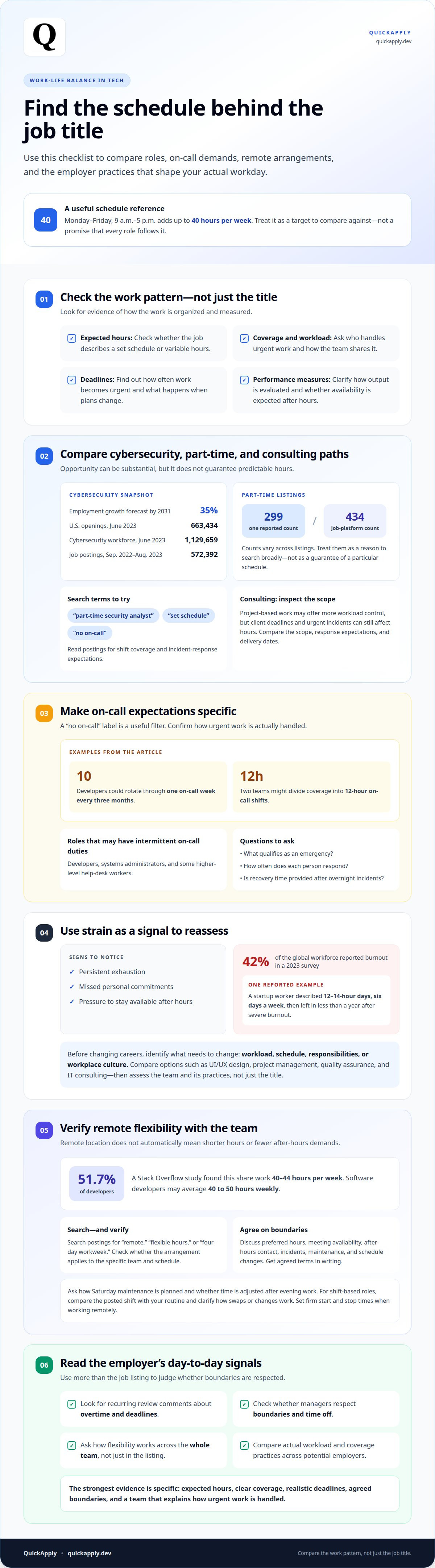
IT jobs can be stressful, but the title alone won’t tell you what the workday demands. The practical answer to how to find a job with better work-life balance in tech is to prioritize predictable hours, clear on-call expectations, and an employer that respects boundaries. A Monday-to-Friday, 9 a.m. to 5 p.m. schedule adds up to 40 hours per week.
That target is useful, but it’s only one part of the decision. Remote work doesn’t automatically mean shorter hours, and a flexible schedule can still include after-hours emergencies. Look closely at the workload, team coverage, deadlines, and how performance is measured.
This guide explains how to assess tech roles and employers, compare remote, part-time, and consulting options, and ask questions that reveal the schedule behind a job listing. You’ll have a practical way to focus your search on the balance you want, rather than assuming every tech role moves at the same pace.
Key Takeaways
- Compare cybersecurity, consulting, and part-time paths by schedule predictability and on-call demands, not job title alone.
- Use signs of burnout and your preferred work pattern to decide whether a role change makes sense.
- Assess remote tech jobs by workload and after-hours expectations, then set boundaries that protect your time.
- Evaluate employers across industries by how they measure performance, support flexibility, and respect time off.
1. Cybersecurity demand, part-time roles, and consultancy work
Cybersecurity demand can create options, but it doesn’t guarantee predictable hours. The U.S. Bureau of Labor Statistics forecast 35% employment growth for information security analysts by 2031. In June 2023, the United States had 663,434 cybersecurity job openings and 1,129,659 people employed in its cybersecurity workforce. Employers listed 572,392 cybersecurity job postings between September 2022 and August 2023.
Part-time roles exist, though counts vary across listings. One count reported 299 part-time cybersecurity jobs in the United States. Job platforms showed 434 part-time cybersecurity jobs. Treat these numbers as a prompt to search broadly, not a schedule guarantee. Try terms such as “part-time security analyst,” “set schedule,” and “no on-call.” Read each posting for shift coverage and incident-response expectations.
Consulting is another option. Project-based work can give you more control over your workload, but client deadlines and urgent incidents may still affect your hours. Before deciding whether a contract fits your routine, compare its scope, response expectations, and delivery dates.
On-call duties need close inspection. Developers, systems administrators, and some higher-level help-desk workers may be on call intermittently. For example, a team of 10 developers may rotate through one on-call week every three months. Two teams might divide coverage into 12-hour on-call shifts. Ask during interviews what qualifies as an emergency, how often each person responds, and whether recovery time follows overnight incidents. A “no on-call” listing can help narrow your search, but confirm how the team handles urgent work. These specifics reveal more about your likely workday than the cybersecurity title alone.
2. What is the best career for work–life balance?
Check job descriptions for stated hours, workload, on-call duties, and schedule flexibility. Compare these details with company reviews, noting recurring comments about overtime, deadlines, and whether managers respect boundaries.
Work-life imbalance can show up as persistent exhaustion, missed personal commitments, or pressure to stay available after hours. In one example, a startup worker reported 12–14-hour days, six days a week, then left in less than a year after severe burnout. A 2023 survey found 42% of the global workforce reported burnout. Treat repeated strain as a signal to examine the role, not as proof that every tech career will feel the same.
Before changing careers, identify what needs to change: workload, schedule, responsibilities, or workplace culture. Then compare options such as UI/UX design, project management, quality assurance, and IT consulting, which involve different kinds of work and projects. Project management and tech sales can also suit people seeking technology work with little or no coding. Every role depends on its team, deadlines, and operating practices, so look beyond the title.
A career pivot can involve a learning curve, a new portfolio, or translating existing experience into different job requirements. Certifications may help structure learning or demonstrate focused knowledge, but choose one based on the target role’s actual requirements. Map transferable skills first, then close specific gaps rather than collecting credentials without a clear goal. If your current experience needs a sharper story for a new role, use a focused cover letter to connect your skills with the position. Set a transition plan around the skills, evidence, and schedule you want next.
3. Can I really work remotely in IT?
Yes, remote IT work is possible, but flexibility depends on the role and team. There’s no dependable company-wide list of U.S. employers offering remote work, flexible hours, or four-day weeks. Search postings for those exact terms, then check whether flexibility applies to the whole team or only certain schedules. Software development is remote-friendly, but remote location alone doesn’t set the workload. A Stack Overflow study found 51.7% of developers work 40–44 hours per week; software developers may average 40 to 50 hours weekly.
Job outlook can help you compare paths, not predict a specific employer’s schedule. Software development can offer employment opportunities, but prospects vary by role and employer. Data analyst employment was projected to grow 23% over the same period. The average U.S. data analyst salary is $74,342 per year. Data analysis can suit project-based work when deliverables, meeting windows, and deadlines are clear. Ask how the team handles urgent requests and whether output matters more than desk time.
Discuss work boundaries before accepting an offer. State your preferred hours, remote arrangement, meeting availability, and limits on after-hours contact. Ask how the team handles incidents, maintenance, and schedule changes, and get agreed terms in writing. A remote role may still involve Saturday maintenance, so clarify how coverage is planned and whether time is adjusted after evening work.
To move toward predictable hours, map your current skills to roles with clearer schedules. Business analyst, technical writer, UI/UX designer, and help desk support positions are associated with predictable, flexible schedules. Build evidence for the target role through relevant projects, then tailor your application to show those skills. For a shift-based job, compare the posted shift with your preferred routine and ask how swaps or schedule changes work. Remote workers also need firm start and stop times to separate work from personal time.
Flexibility varies by role and team. Search postings for remote work, flexible hours, or four-day workweeks, then verify which arrangements apply to the specific team. Before accepting an offer, clarify expected hours, meeting windows, and after-hours coverage.
4. Choosing an industry and employer
No single U.S. tech employer guarantees better work-life balance across every team. Business analyst, technical writer, UI/UX designer, and help desk roles may offer predictable schedules, but conditions vary. IT jobs are available in healthcare, education, retail, manufacturing, and technology companies.
The U.S. Bureau of Labor Statistics anticipated 23% employment growth for web developers and digital designers, including UX designers, from 2021 to 2031. Growth signals opportunities, not a company’s day-to-day culture. Compare the specific team, workload, and manager alongside the job title.
Research employers by looking for recurring themes in employee reviews, such as overtime, flexibility, and time off. Look for concrete examples, including repeated weekend deadlines or managers who support planned leave. Compare those patterns with the job description’s schedule, remote or hybrid options, paid time off, wellness stipends, and career-development support. Reviews offer useful context, but they don’t replace questions about the specific role.
Then assess how the employer defines good performance. Ask how productivity is measured, how priorities change during urgent projects, and how often the role requires work outside its stated schedule. These questions expose whether expectations center on delivered work or constant availability. A startup may advertise flexibility while expecting long days; another employer may offer clearer boundaries through defined hours and coverage. Choose the environment that matches your priorities, not just the industry label. To make your fit clear, prepare a targeted application that connects your experience to the role’s requirements.
Business analyst, technical writer, UI/UX designer, and help desk roles may offer more predictable schedules, but the actual balance depends on the team and manager. Compare employers’ workloads, flexibility, time-off practices, and expectations for availability.
QuickApply: Resume Tailoring
QuickApply helps you turn your work-life priorities into a focused job search. Use Resume Tailoring to align your experience with roles that match your preferred hours, remote setup, and career direction. The platform tailors resumes to job descriptions and generates matching cover letters, helping you present relevant skills clearly.
Use the match score to identify opportunities that fit your background, then track applications in one place. Interview Practice can help you prepare to explain your priorities and ask about schedule expectations, workload, and team coverage. These tools support your search, while you decide which roles meet your needs.
Ready to organize your next application? Visit QuickApply and put your search into motion.
Set your next role’s operating requirements
Before your next application, define what a sustainable week looks like. Write down your preferred hours, availability limits, and ideal work setup, then separate non-negotiables from preferences. This gives you a clear filter for evaluating roles.
If you’re deciding how to find a job with better work-life balance in tech, use that filter to assess each opportunity. Picture a typical week, including focused work, meetings, and possible interruptions. Consider how the role changes during a busy project, not just a quiet week. Compare those expectations with your priorities before applying.
QuickApply can help you prepare applications and practice for interviews. Visit QuickApply to move your job search forward, and take the next step toward work that fits your life.
Frequently Asked Questions
Are IT jobs stressful?
Some IT jobs are stressful, especially when incidents, shifting priorities, or unclear ownership disrupt planned work. A practical first step in finding a job with better work-life balance in tech is identifying which pressures affect you most. If interruptions are the main strain, look for roles with clear escalation paths and defined support coverage instead of relying on the job title to predict the pace.
What is the best career for work–life balance?
There’s no single best career: the right fit depends on your strengths, preferred pace, and schedule needs. A technical writer may focus on documentation, while a business analyst coordinates requirements across teams. Compare everyday tasks and team practices, not just titles. In interviews, ask how managers set priorities and protect focused work time to judge whether the role fits your routine.
What interview questions reveal a tech team's workload, overtime, and on-call expectations?
Ask, “What does a typical busy week look like?” and “Which recent project required overtime, and why?” Then ask how the team resolves competing priorities and responds when workload exceeds capacity. For on-call roles, ask who provides backup and how incidents are escalated. Concrete examples help distinguish occasional crunch periods from a routine expectation of extra hours.
How do on-call rotations and incident response affect work-life balance in tech roles?
On-call coverage can make personal time less predictable, even when incidents are infrequent. Notifications may interrupt rest, and resolving an issue can displace planned work. Ask about response windows, escalation steps, backup coverage, and adjustments to workload after disruptions. For example, clarify whether a late-night incident changes the next day’s priorities instead of assuming the usual workload remains unchanged.
What salary trade-offs come with choosing a tech job with better work-life balance?
There’s no universal salary trade-off: compensation depends on the role, experience, employer, and responsibilities. Compare the full offer, including base pay, benefits, expected hours, and availability outside scheduled work. As you consider how to find a job with better work-life balance in tech, decide which compensation elements matter most alongside your schedule needs. A role with broader responsibilities may require more flexibility or after-hours attention.
What warning signs suggest a tech company has a poor work-life balance?
Recurring employee comments about chronic overtime, unclear priorities, or after-hours pressure are warning signs. In interviews, pay attention to vague workload answers or stories that present constant urgency as normal. Notice whether the job description combines unrelated duties without explaining priorities. Compare review patterns with interview responses, then use specific examples to judge whether the team’s expectations fit the boundaries you want.


