

A career break doesn’t erase your qualifications. To learn how to tailor your resume after an employment gap, acknowledge the break briefly, then bring role-matched skills and evidence near the top. Caregiving, volunteering, and independent learning can all demonstrate relevant strengths.
You may worry that time away will overshadow the work you’re ready to do now. A clear resume helps employers see your capabilities quickly, without hiding the break or letting it define your experience.
Use this guide to frame a career-break entry, choose skills that match the role, and connect caregiving or volunteer experience to job requirements. You’ll also learn how to foreground your strongest qualifications and describe your experience with concise, specific language. The goal is to make your fit easy to understand.
Key Takeaways
- Describe a career break briefly and clearly, then keep the focus on your readiness for the role.
- Place your most relevant strengths near the top so employers can quickly see your fit.
- Turn caregiving and volunteer responsibilities into evidence of skills that match the job description.
- Use concise, results-focused wording to connect your experience to the work you want to do next.
Acknowledging a career break on a résumé
Acknowledge the break with a brief, clear entry. Then make your recent qualifications and relevant experience easy to scan.
-
Choose a Resume Format
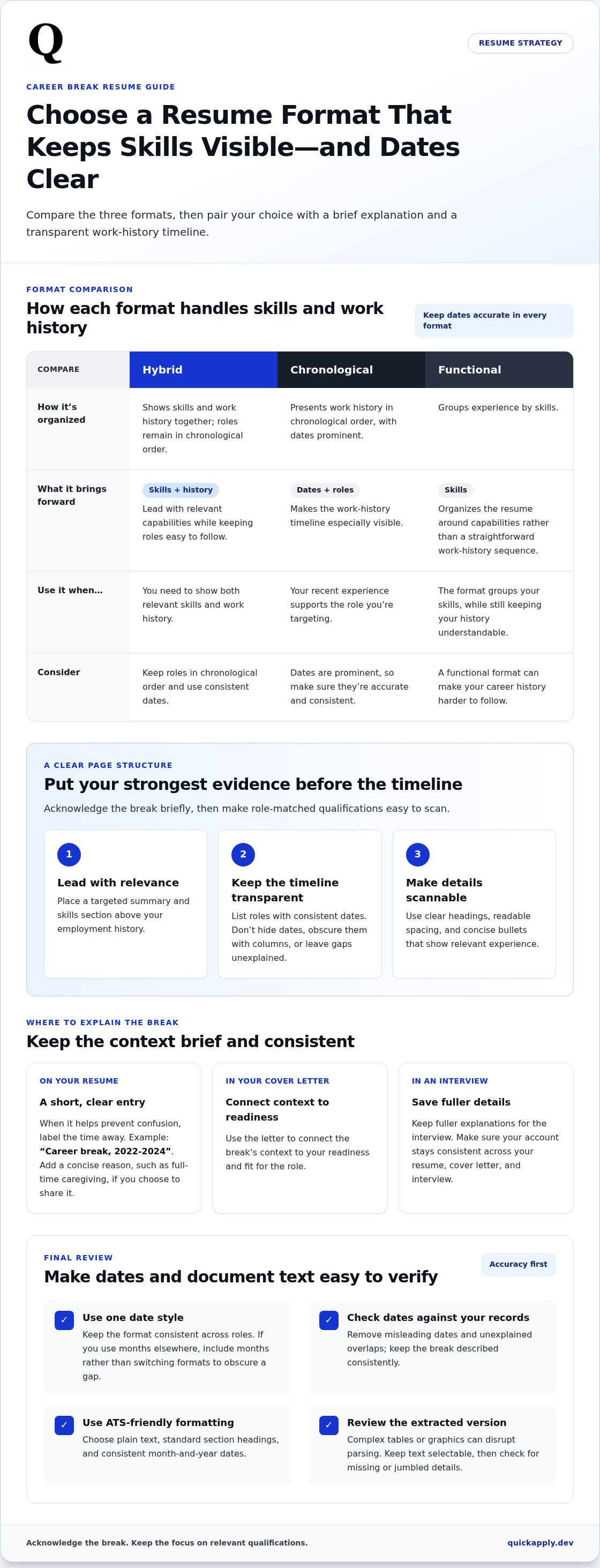
Choose a hybrid resume when you need to show both skills and work history. It lets you lead with relevant capabilities while keeping roles in chronological order. A chronological format makes dates prominent, so use it when your recent experience supports your target role. A functional format groups skills but can make your career history harder to follow. Keep dates accurate in every format.
-
Decide Where to Explain the Break
Address the break briefly on your resume when a clear entry will prevent confusion. For example, write “Career break, 2022-2024” and add a concise reason, such as full-time caregiving, if you choose to share it. Use a cover letter to connect that context to your readiness and role fit. Save fuller details for an interview, and keep each explanation consistent.
-
Arrange Sections to Deemphasize the Gap
Place a targeted summary and skills section above your employment history, then list roles with consistent dates. This directs attention to your capabilities before readers reach the timeline. Use clear headings, readable spacing, and concise bullets. Don’t hide dates, use columns to obscure them, or leave unexplained gaps. The goal is a transparent timeline with your strongest evidence first.
-
Avoid Common Gap-Related Resume Mistakes
Remove misleading dates, unexplained overlaps, and lengthy personal explanations. Check each role’s dates against your records, and describe the break consistently across your resume, cover letter, and interview. For applicant tracking systems, use plain text, standard section headings, and consistent month-and-year dates. Complex tables or graphics can disrupt parsing. Keep the text selectable, then review the extracted version for missing or jumbled details.
Keep the entry factual and concise, with a clear label that signals the time away without becoming a second personal statement. If you’re returning to work, add a brief career-break entry to your resume. Pair that acknowledgment with relevant qualifications and experience, so the break is noted while the focus remains on your readiness for the role.
Adding a professional summary or skills section
Place a concise summary or targeted skills section near the top. Use the job description to decide which qualifications belong there.
- Extract the role’s core requirements. Mark skills, tools, and responsibilities that appear repeatedly in the posting. For a project coordinator role, these might include scheduling, stakeholder communication, and tracking deliverables. Separate required capabilities from preferred ones. This gives your summary a clear focus instead of a generic career statement.
- Write a focused professional summary. Use two or three concise sentences to identify your specialty, strongest relevant skills, and the value you bring. For example: “Project coordinator skilled in cross-functional communication, timeline management, and documentation. Brings experience organizing complex workflows and keeping stakeholders aligned.” Don’t lead with an apology or explain the break here.
- Build a skills section from evidence. Choose capabilities you can support with employment, volunteering, caregiving, training, or personal projects. A software-support applicant might list troubleshooting, customer communication, and ticket documentation if those reflect real experience. Be specific, and remove skills that don’t connect to the target role.
- Match language without copying claims. Use the employer’s terminology when it accurately describes your experience. If a posting asks for “inventory management,” use that phrase only if you handled inventory tasks. Support each key skill elsewhere on the resume, for example with a bullet about a process you organized or a problem you resolved.
- Check the top section against each application. Compare your summary and skills with the role before submitting. Keep the strongest matching qualifications visible, and cut broad phrases such as “hard worker” that give no useful detail. A role-specific cover letter can reinforce the same fit; use cover letter generation to shape that message around the position.
Place a skills or summary section near the top of your resume to help recruiters understand your current qualifications. Use it to make your strengths easy to identify, especially when your recent experience doesn’t immediately show how it relates to the role. Choose direct wording that matches the evidence elsewhere on your resume. Review the section before each application so the most relevant qualifications stay prominent.
Career-break examples and résumé wording
Use consistent dates and concise descriptions to make your timeline easy to follow. The right wording gives context while keeping attention on your current fit.
- Keep employment dates consistent. Use the same date style for every role, such as “May 2019-August 2022.” Include months if your other entries use them; don’t switch to years only to obscure a gap. If you use years throughout, apply that format consistently and keep all dates accurate. Clear formatting supports a straightforward account of your work history.
- Name the break without overexplaining. Add a concise label such as “Career break, full-time caregiving” or “Career break, professional development.” For health-related time away, “Career break for personal health” gives context without disclosing private details. Describe a layoff plainly, such as “Position ended following company restructuring.” Knowing how to tailor your resume after an employment gap means choosing wording that is honest and focused.
- Describe relevant activities with evidence. State what you did, which skill you used, and what changed. For example: “Scheduled community volunteers and coordinated shift updates.” A freelance project might read, “Created a client onboarding guide to clarify service steps.” Include outcomes only when you can support them. This approach to how to tailor your resume after an employment gap connects the break period to capabilities relevant to your next role.
- Show learning accurately. Include coursework or self-directed study when it supports the position. Name the subject and practical work, such as “Studied spreadsheet analysis and built a sample reporting dashboard.” Don’t present study as employment or imply a credential you haven’t earned. Focus on skills you can explain in an interview.
- Choose how much context to share. Caregiving, education, health, and layoffs need only brief, truthful descriptions. Use the resume for essential context and save further explanation for a cover letter or interview when it helps clarify your transition. Keep your account consistent, and leave out personal details that don’t help employers assess your fit.
Connecting caregiving and volunteering skills to job requirements
Include freelance work, volunteering, training, or personal projects when they demonstrate relevant skills. Match truthful resume keywords to the job description, then support each with a concrete example.
-
Include Relevant Projects and Activities
Choose gap-period activities that show skills the target role needs. Freelance assignments can demonstrate client communication or independent delivery. Volunteer work may show event coordination, recordkeeping, or team support. Relevant training and personal projects can provide evidence of technical practice. State the activity, your contribution, and its outcome. Leave out activities that add no useful evidence, and label volunteer or personal work accurately.
-
Match Skills and Keywords to the Role
Compare the posting with tasks you handled through caregiving or volunteering. If the role requires scheduling, describe coordinating appointments, transport, or service providers. If it prioritizes communication, show how you shared updates with families, volunteers, or community members. Use the employer’s wording when it accurately fits your experience. Don’t claim professional experience or specialized expertise you didn’t gain.
- Translate responsibilities into evidence, not inflated job titles. For example, a volunteer who maintained donation records can describe organizing information and updating records accurately. A caregiver who coordinated multiple appointments can show planning, communication, and follow-through. Add a result when you can support it, such as completing a project or keeping schedules current. Keep personal responsibilities distinct from paid employment.
- Prioritize the examples that map most closely to the role. Put the strongest skill and evidence first, then use remaining bullets to show complementary strengths. If a posting asks for database experience, a relevant personal project may support that skill better than a general caregiving description. Tailor your resume to each position with resume tailoring, and keep every claim grounded in what you actually did.
QuickApply: Resume Tailoring
QuickApply can make role-specific resume edits part of a repeatable application workflow. Use Resume Tailoring to adapt your experience and skills to a particular job description. It tailors resumes to job descriptions and provides a match score to help you identify fitting opportunities.
Once your resume is ready, Cover Letter Generation can help align your application message with the same role. Use Interview Practice to prepare to discuss your experience, including the career break and relevant activities. The Application Tracker keeps your applications organized in one place.
Keep reviewing each document for accuracy and make sure every claim reflects your experience. Visit QuickApply to explore the tools.
Put Your Next Application in Motion
Your resume is a working document, not a verdict on your career. Treat each application as a chance to sharpen how your experience connects with the role. If a conversation reveals that an employer values a different strength, adjust your next version to make that strength easier to find. Keep your wording honest, specific, and focused on the work ahead.
Learning how to tailor your resume after an employment gap gives you a repeatable way to present your experience with purpose. You don’t need to explain every part of your career story. Make your fit clear and give employers a strong reason to continue the conversation.
When you’re ready to shape your next application, contact QuickApply for resume help. Take the next step with clarity, and let your skills lead the way.
Frequently Asked Questions
How should you explain an employment gap on a resume?
Use a short, truthful label that gives enough context without sharing private details. For example, write “Career break for family responsibilities” rather than leave an unexplained period or add a long personal account. If an interviewer asks, prepare a brief explanation that shifts naturally to your current focus, such as the type of role you’re ready to take on.


