

In 2026, your college degree is a legacy variable that no longer dictates your professional ceiling. While traditional job descriptions still cling to degree inflation, the market has shifted toward a skills-first reality where proof-of-work is the only currency that matters. You've likely felt the sting of being invisible to recruiters or the crushing fatigue of manual application cycles. Getting a tech job without a degree isn't just possible; it's the most efficient path for digital natives who value optimization over academic tradition.
This blueprint provides the high-tech strategy you need to bypass academic gatekeepers and leverage AI automation to land high-paying roles. You'll learn how to navigate a landscape where 40% of companies are restructuring around AI and entry-level hiring at major firms has tightened by 25%. We'll show you how to use Resume Tailoring and Application Trackers to outpace the competition. This guide covers everything from mastering in-demand AI skills to using a Salary Negotiation Guide, ensuring you enter the market with the confidence of a mid-level professional.
Key Takeaways
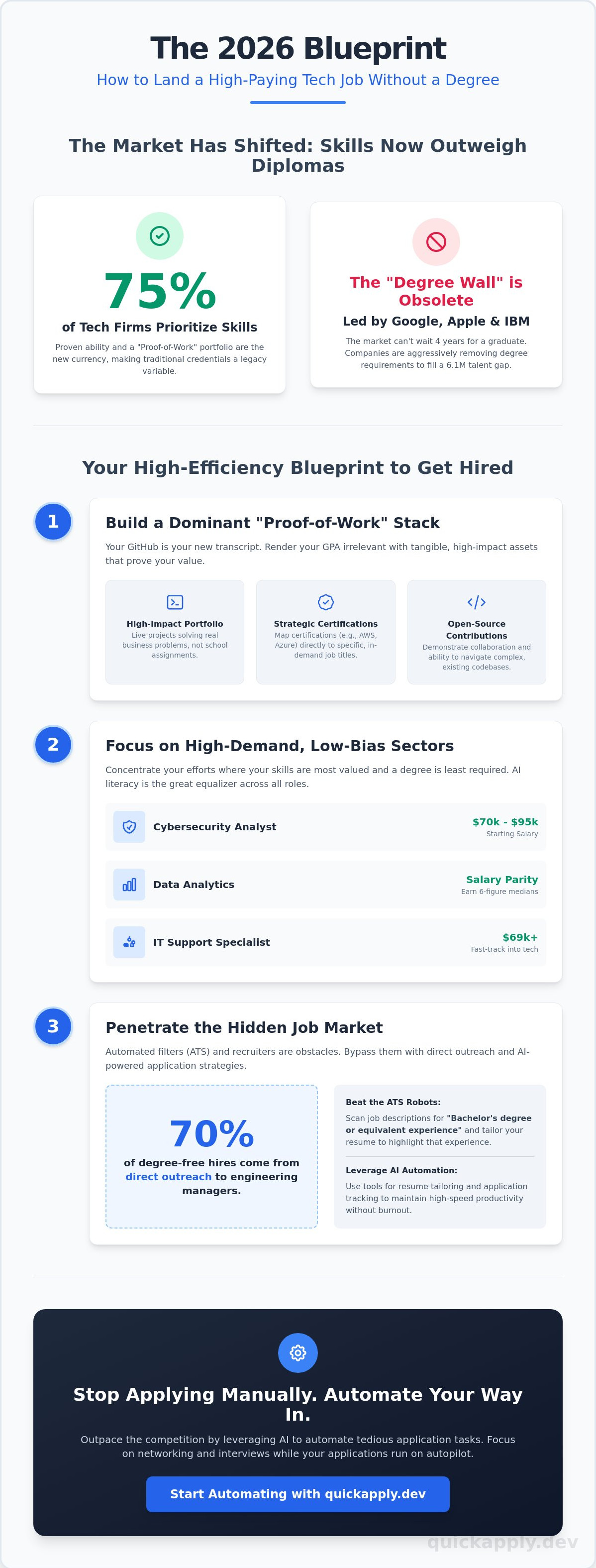
- Capitalize on the skills-first revolution. 75% of tech firms now prioritize proven ability over traditional credentials.
- Build a dominant "Proof-of-Work" stack. Use GitHub and technical certifications to render your GPA irrelevant.
- Bypass automated filters. Master the specific tactics for getting a tech job without a degree by highlighting equivalent experience in your resume.
- Penetrate the hidden job market. 70% of degree-free hires happen through direct outreach to engineering managers.
- Automate your application volume. Leverage Resume Tailoring and an Application Tracker to maintain high-speed productivity without manual fatigue.
The Skills-First Revolution: Why Tech Degrees are Optional in 2026
The era of the credential gatekeeper is over. Degrees are legacy code in a market that demands real-time execution. In 2026, the industry has pivoted toward skills-based hiring, a systemic shift where 75% of tech firms now prioritize proven ability over academic history. This isn't a trend; it's a survival mechanism for companies facing a 6.1 million talent shortfall in computer and mathematics occupations. They can't afford to wait four years for a graduate when they need a solution today.
You must stop viewing yourself as a student and start operating as a technical solution provider. Companies are aggressively stripping away the "Legacy Filter" of the four-year degree to maintain their competitive edge. They've realized that a diploma doesn't guarantee AI fluency or production-ready coding skills. Getting a tech job without a degree requires you to exploit this gap. By focusing on high-volume output and verifiable projects, you position yourself as the low-risk, high-impact hire that modern engineering teams crave.
The Death of the CS Degree Requirement
Industry titans like Google, Apple, and IBM have officially dismantled the degree wall. Their hiring data proves that non-traditional candidates often possess higher adaptability in rapidly evolving environments. When you scan job descriptions, look closely at the language. "Bachelor's degree or equivalent experience" is the new standard. In 2026, "equivalent experience" is defined by your portfolio and your ability to automate complex workflows. This is the optimal year for non-degree applicants because the barrier to entry has shifted from "where did you go?" to "what can you build?"
Identifying High-Growth Roles for Non-Degree Seekers
Focus your energy where the demand is highest and the degree bias is lowest. Cybersecurity, Data Analytics, and Full-Stack Development are currently the most accessible sectors for self-taught professionals.
- Cybersecurity: Junior Security Analysts can command starting salaries between $70,000 and $95,000 without a degree.
- Data Analytics: Companies prioritize your ability to interpret complex datasets over your academic background.
- IT Support: Roles like IT Support Specialists start at approximately $69,237, providing a fast track into the ecosystem.
AI literacy is the great equalizer. Whether you're applying for a developer role or a data position, demonstrating fluency in AI-augmented development puts you ahead of degree-holders who rely on outdated curriculum. Salary parity is now a reality; skilled professionals without degrees are earning the same six-figure medians as their counterparts. The market doesn't care about your pedigree. It cares about your uptime and your ability to ship clean, efficient code.
Building Your Proof of Competence: Beyond the Classroom
A diploma is a static document. Your GitHub profile is a living record of your ability to ship code. In 2026, hiring managers for mid-level roles prioritize your commit history over your graduation date. Getting a tech job without a degree is about building a 'Proof-of-Work' stack that renders academic credentials obsolete. This stack consists of a high-impact portfolio, strategic certifications, and visible open-source contributions. Major educational platforms like Coursera have already documented the massive shift toward skills-first hiring in tech, proving that your output is your most valuable asset.
The Portfolio as Your Digital Transcript
Stop treating your portfolio like a school project. It needs to look like professional work. Focus on three essential project types to demonstrate versatility. First, build a 'Real World' application that solves a specific business problem. Second, document a 'Bug Fix' in a popular open-source repository to prove you can navigate complex, existing codebases. Third, create a 'System Architecture' document that outlines how you scaled a service. A live project that handles actual traffic is worth more than a thousand theoretical essays. Document your process as much as your code. Show how you handled edge cases, optimized performance, and utilized AI-augmented development tools. This level of transparency signals senior-level thinking to potential employers.
Strategic Certification Mapping
Certifications are only useful if they provide a direct return on investment. Don't collect badges; map them to specific job titles. For foundational cloud roles, prioritize AWS Certified Solutions Architect or Azure Administrator Associate. If you're targeting infrastructure, CompTIA Security+ remains a non-negotiable benchmark. Vendor-neutral certs provide a solid foundation, while vendor-specific ones demonstrate deep expertise in the tools companies actually use. Avoid the trap of 'certification chasing' where you accumulate paper without building anything. Use micro-credentials to validate niche skills like agentic AI or data engineering. These smaller, targeted validations show you're staying current with 2026 technical requirements. Once your portfolio is live, use Resume Tailoring to ensure your technical achievements hit the top of the pile. This approach ensures your skills are the first thing a recruiter sees, proving that getting a tech job without a degree is a matter of technical strategy, not luck.
Overcoming the 'Degree Required' Filter: Beating the ATS
The Applicant Tracking System (ATS) is your first technical hurdle. It doesn't care about your potential; it cares about data points. Most systems are programmed to scan for specific education keywords. If those variables are missing, you're often discarded before a human ever sees your name. Getting a tech job without a degree requires you to hack this logic. You must feed the machine the right signals to prove your "Equivalent Experience" matches their academic requirements. This isn't about deception. It's about translation.
Stop worrying about being flagged for a missing diploma. In 2026, companies use filters to manage application volume, not to exclude talent. If your technical keyword density is high enough, your lack of a degree becomes a secondary detail. The ATS prioritizes the stack. It looks for specific languages, frameworks, and deployment tools. By front-loading these technical markers, you ensure your profile scores high enough to trigger a manual review. You are optimizing your resume the same way you optimize code for performance.
Resume Architecture for Non-Degree Professionals
Your layout must prioritize output over history. Lead with a robust 'Technical Skills' summary. Follow this immediately with a 'Key Projects' section that mirrors the 'Proof-of-Work' stack discussed in the previous section. This forces the recruiter and the ATS to engage with your capabilities first. When you reach the education section, don't leave it blank. List 'Self-Directed Study' or 'Relevant Coursework' from specialized platforms. This populates the education field with relevant keywords without misrepresenting your credentials. You can check these good resume examples to see how to structure this priority for maximum impact.
The AI Tailoring Advantage
Manual resume updates are a productivity bottleneck. In a high-volume market where 60% of companies are planning layoffs while simultaneously seeking AI-fluent talent, you cannot afford to move slowly. You need a system that translates your self-taught projects into the specific industry-standard terminology each job description demands. This isn't just about keyword stuffing; it's about semantic matching. Use an 2026 AI strategy for resume tailoring to ensure every application is optimized for the specific ATS logic of that firm. This level of automation allows you to maintain high output while ensuring your technical skills overshadow the lack of a traditional credential.
Strategic Networking and High-Efficiency Job Searching
The hidden job market is the most efficient route for non-degree candidates. Statistical data suggests that 70% of degree-free hires occur through networking rather than standard portal submissions. This happens because a personal referral bypasses the automated filters designed to flag missing credentials. When an engineering manager vouches for your technical ability, the HR degree requirement becomes a secondary concern. Getting a tech job without a degree requires you to stop applying blindly and start building a high-volume outreach pipeline that targets decision-makers directly.
You must shift your focus from HR departments to the people actually building the product. LinkedIn is your primary tool for direct outreach to engineering leads and senior developers. These individuals value technical output and problem-solving skills over academic history. To manage this high-speed outreach without losing momentum, you need a system to organize your leads. Using an automated job application tracker allows you to monitor 50 or more active leads simultaneously, ensuring no follow-up falls through the cracks. Efficiency in the search phase is just as critical as efficiency in your code.
Reverse Engineering the Referral
Referrals are most effective when they come from people who share your background. Use LinkedIn filters to find alumni of your specific bootcamp or self-taught developers who successfully transitioned into target companies. When you reach out, don't ask for a job immediately. Request a 15-minute technical feedback session or a code review. In the 2026 remote work environment, asking for specific technical critiques is a high-signal move. It proves you're committed to growth and allows you to demonstrate your competence in real-time. If they're impressed by your logic and "Proof-of-Work" stack, the referral often happens organically.
Managing Your Career Transition Pipeline
Treat your job search like a software development lifecycle. You need a funnel that consists of leads, outreach, interviews, and offers. Without a degree, your volume must be higher to overcome systemic biases. Implement the '10-10-10' Rule to maintain momentum: submit 10 tailored applications, initiate 10 LinkedIn connections, and dedicate 10 hours to building new technical skills every week. This structured approach prevents burnout and ensures a steady stream of opportunities. In a tech job search, consistent output always beats sporadic intensity. By treating the search as a technical problem to be optimized, you remove the emotional weight of the process. Ready to scale your search? Start tracking your applications now to turn your networking efforts into a streamlined hiring machine.
QuickApply: Automating Your Entry into Tech
Efficiency is the ultimate competitive advantage. While others spend hours manually tweaking bullet points, you need a system that scales with the market. QuickApply serves as the technical bridge between your self-taught skills and the hiring manager's desk. Getting a tech job without a degree requires you to outpace the traditional candidate pool through high-volume precision. Our AI resume tailor doesn't just reword your experience; it re-engineers your profile to highlight projects that render the degree requirement irrelevant. It forces the recruiter to look at your technical output first.
Application friction is the silent killer of career transitions. Our platform automates the cover letter process by generating skill-based value propositions that speak directly to technical pain points. By removing the manual drafting bottleneck, you can dedicate your time to building your portfolio while the system handles the heavy lifting of outreach. You'll apply to more roles in less time, maintaining higher match scores across your entire pipeline. This isn't just about sending more applications. It's about ensuring every application you send is a high-signal asset that demands attention.
Precision Tailoring for Technical Roles
Standard resumes are too static for the 2026 market. You need a dynamic document that adapts to the specific logic of every job description. QuickApply uses a proprietary Match Score to identify exactly where your technical skills align with employer needs. The tool generates unlimited versions of your resume, ensuring every submission is optimized for the specific ATS it will encounter. If you want to see how this fits into the broader ecosystem, you can explore the best AI resume builders of 2026 to understand why tailoring beats building every single time.
From Application to Offer
The journey doesn't end with a submitted form. Once you've bypassed the filters, you must execute during the evaluation phase. Our Interview Practice module prepares you for the high-pressure technical screenings common in mid-level roles. When the offer arrives, our Salary Negotiation Guide ensures you're compensated based on your technical value, not your academic pedigree. Use the Application Tracker to maintain a clear view of your sales funnel, ensuring no lead goes cold. Getting a tech job without a degree is a solved problem when you have the right stack. Start your degree-free tech journey with QuickApply today.
Execute Your Professional Pivot
The technical landscape has shifted permanently. Success in 2026 doesn't depend on a legacy credential but on your ability to demonstrate verifiable "Proof-of-Work" and navigate automated hiring systems with precision. By prioritizing high-impact projects and strategic networking, you effectively dismantle the academic barriers that once stalled non-traditional applicants. Getting a tech job without a degree is no longer a statistical anomaly; it's a matter of technical execution and pipeline optimization.
Stop fighting the system and start leveraging it to your advantage. You need a stack that works as hard as your code. Scale your tech career with AI-powered resume tailoring to access AI-powered match scoring, automated application tracking, and tailored cover letters generated in seconds. These tools ensure your skills hit the top of the pile every time, regardless of your educational background. The market is ready for solution providers who can ship clean code and solve complex problems. It's time to stop waiting for permission and start shipping your career.
Frequently Asked Questions
Can I really get a software engineering job without a degree in 2026?
Yes, you can secure a software engineering role without a degree because the market now values execution over credentials. With a projected 6.1 million talent shortfall in technical roles, major firms have removed degree requirements to maintain their competitive edge. Focus on building a verifiable portfolio that proves you can ship production-ready code. Your ability to solve real-world problems is the only currency that matters in a skills-first economy.
Which tech certifications are most valuable for someone without a degree?
Prioritize high-ROI certifications like AWS Certified Solutions Architect, Azure Administrator Associate, or CompTIA Security+. These validations provide a standardized benchmark for your skills that recruiters recognize instantly. Choose certifications that align directly with your target job title to maximize your market value. This strategic mapping ensures your resume passes automated filters and proves you have mastered the tools companies actually use in production.
How do I list my self-taught skills on a resume to get past the ATS?
Lead with a "Technical Skills" summary and use the education field to list relevant coursework or specialized certifications. Getting a tech job without a degree requires optimizing your resume for ATS semantic matching. Focus on high keyword density for specific frameworks and deployment tools to trigger a manual review. This approach populates the required data fields without misrepresenting your background, ensuring your profile scores high in the system.
Do I need to attend a coding bootcamp to get into tech?
No, a coding bootcamp is a viable path but not a mandatory requirement for entry. While 79% of bootcamp alumni report finding programming jobs, self-taught developers with strong "Proof-of-Work" stacks are equally successful. The industry cares about your ability to solve complex problems and your fluency in AI-augmented development. You can achieve the same results through independent study if you maintain a high-volume output of verifiable projects.
How many projects should I have in my portfolio before applying?
Target three high-impact projects that demonstrate versatility and senior-level thinking. Include a "Real World" application solving a business problem, an open-source "Bug Fix," and a detailed "System Architecture" document. Quality and production-readiness always beat a high volume of basic tutorial projects. Demonstrating that your code can handle actual traffic and edge cases proves you are a technical solution provider, not just a student.
What should I say when an interviewer asks why I don't have a degree?
Reframe the lack of a degree as a strategic decision to master modern systems through direct execution. Explain that you chose a skills-first path to stay current with 2026 technical requirements like agentic AI and cloud architecture. Direct their attention back to your live projects and verifiable technical achievements. This confidence signals that you value efficiency and up-to-date knowledge over legacy academic traditions.
Is it harder to get a remote tech job without a degree?
Remote roles often have a lower degree bias because they prioritize measurable output and clear communication over physical presence. In the 2026 remote work environment, your ability to manage your own productivity and contribute to distributed teams is the primary metric. A strong GitHub profile and clear documentation prove you can thrive in a remote technical ecosystem. Output is the ultimate equalizer in a borderless job market.
How can QuickApply help me if I'm self-taught?
QuickApply automates the tedious parts of your job search so you can focus on skill-building. Our Resume Tailoring and Cover Letter Generation tools translate your self-taught projects into industry-standard terminology. Use the Application Tracker to manage your sales funnel and ensure your technical profile hits the top of the pile. This system allows you to maintain high-volume outreach without the burnout of manual application cycles.


