

With Microsoft predicting that 95% of programming code will be AI-generated by 2030, a resume that merely lists languages is obsolete. You've spent over a decade architecting complex distributed systems, yet your applications still vanish into the ATS void. It's a common frustration for high-level talent: your qualifications are elite, but your resume format for senior software engineer roles is unoptimized. You shouldn't have to waste hours manually tweaking bullet points for every Staff or Lead role while Tier-1 opportunities slip away.
This guide delivers the high-impact architecture required to pass 2026's aggressive filters and prove your technical leadership in seconds. We're moving beyond traditional layouts to treat your career history as a high-performance data structure. You'll learn how to condense a decade of impact into a clean, two-page layout that prioritizes system design and quantifiable metrics like latency reduction or revenue growth. We'll provide a system to apply to roles faster and secure the response rates your expertise deserves. Stop fighting the system and start outperforming it.
Key Takeaways
- Adopt a Hybrid-Chronological layout that prioritizes architectural impact and leadership outcomes over a simple list of previous duties.
- Master the resume format for senior software engineer roles by defining a "North Star" tech stack and focusing exclusively on your last decade of high-level experience.
- Engineer your bullet points to showcase technical authority by replacing "implemented" with "architected" and backing claims with hard engineering metrics.
- Future-proof your application against 2026 LLM-based screening algorithms that analyze technical context and project complexity rather than basic keyword density.
- Eliminate the manual tailoring bottleneck by adopting a streamlined system to generate high-fidelity, role-specific resumes in seconds.
What is the Best Resume Format for Senior Software Engineers in 2026?
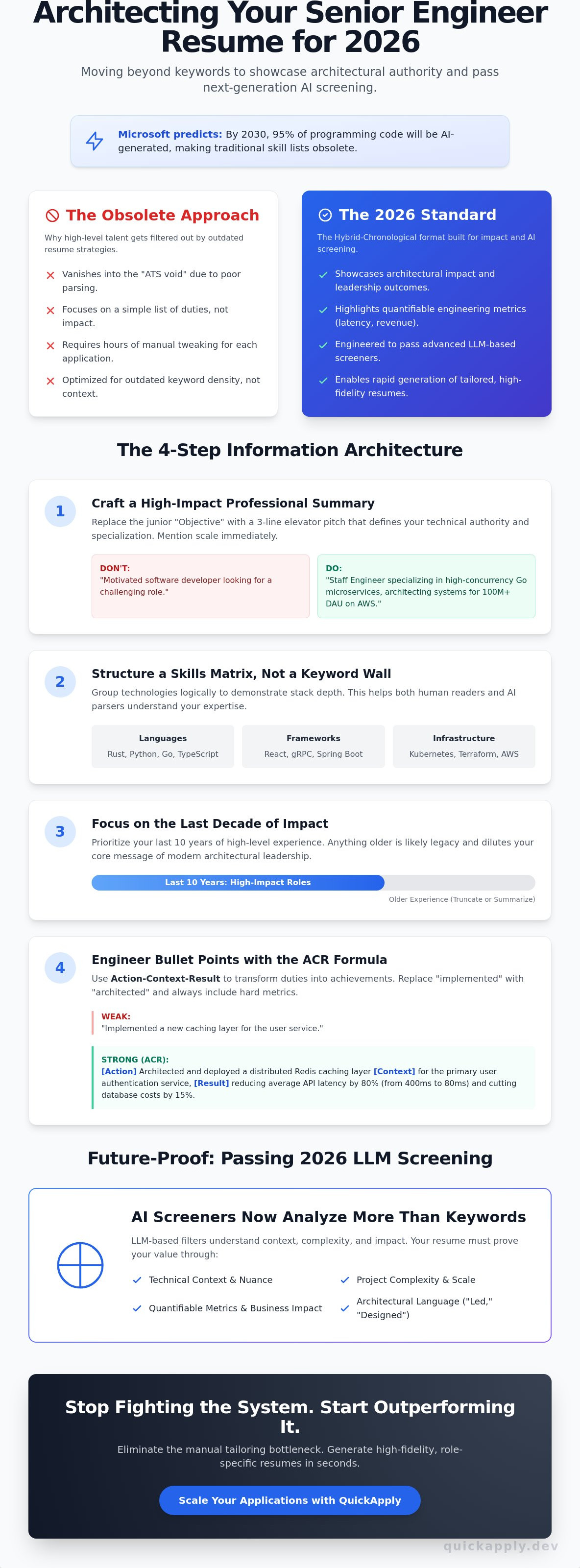
In 2026, recruiters don't want a history lesson. They want proof of architectural authority. The optimal resume format for senior software engineer candidates is the Hybrid-Chronological structure. This layout prioritizes high-impact technical outcomes over simple tenure. While the traditional definition of What is a Resume? focuses on a broad summary of employment, the senior engineer's version must function as a high-density technical brief. You aren't just listing tasks anymore. You're architecting outcomes.
The 2-page limit remains the industry standard, even for those with 10 or 15 years of experience. High-level leadership is about prioritization. If you can't condense your impact into two pages, you're signaling a lack of focus. Your goal is to find the Goldilocks zone: enough visual design to look professional, but enough structural simplicity to ensure 100% ATS readability. If you're struggling to condense a decade of code, professional Resume Tailoring can help you identify which metrics to prioritize for specific Tier-1 roles.
The Core Components of a Senior-Level Layout
Every pixel on your resume must earn its place. Start with a clean header containing your essential contact info and direct links to your LinkedIn, GitHub, and portfolio. Follow this with a Professional Summary. This is your three-line elevator pitch. It defines your technical identity instantly. Don't say you're a "motivated developer." Say you're a "Staff Engineer specializing in high-concurrency Go microservices and AWS infrastructure."
Your Technical Skills Matrix should follow. Don't just dump a list of 50 keywords. Group them logically. This helps both human readers and AI filters understand your stack depth. Categorize by:
- Languages: e.g., Rust, Python, TypeScript.
- Frameworks: e.g., React, Node.js, Spring Boot.
- Infrastructure: e.g., Kubernetes, Terraform, AWS, Azure.
Why Format Matters More Than Content Initially
Recruiters spend seconds scanning your profile. They follow an "F-Pattern," looking at the top header and then down the left margin. Visual noise is technical debt. Use white space as a tool to guide their eyes toward your most significant leadership roles. If the page is cluttered, your architectural achievements will get lost in the noise.
Font choice is also a technical decision. Stick to modern sans-serif fonts like Arial, Calibri, or Roboto. These fonts survive PDF-to-text conversion in 2026 systems without losing formatting. Avoid complex multi-column layouts. While they look great to humans, they often break the logical flow for screening algorithms. A clean, single-column resume format for senior software engineer applications ensures your data remains structured and searchable across all platforms.
Building the Information Architecture: A Step-by-Step Layout Guide
Designing your resume is like designing a high-scale system. It requires a rigid schema and a clear data hierarchy. Recruiter attention is a limited resource. You have roughly six seconds to prove relevance. Follow this step-by-step layout guide to optimize your resume format for senior software engineer applications.
First, define your "North Star" tech stack. Align your resume with the specific role you want next, not just what you've done. Second, implement a reverse-chronological work history. Focus on the last 10 years. Anything older is likely legacy code and should be truncated. Third, group your technical skills into Core Tech, Tools, and Leadership. Fourth, apply the Action-Context-Result (ACR) formula to every bullet point. Finally, validate the layout through an ATS parser. This prevents "runtime errors" in the screening process.
The Professional Summary: Your Executive Summary
Stop using "Objective" statements. They're for juniors. Senior engineers need a Professional Summary or Profile. This is a one-sentence technical identity. Mention scale immediately. Writing "Managed 100M+ DAU" carries more weight than "Writing high-quality code." Use this space to anchor your expertise in specific domains like Distributed Systems or Cloud Infrastructure. If you're struggling to condense your experience, using Resume Tailoring can help distill your career into a high-impact summary.
The Technical Skills Matrix
A massive wall of keywords is a red flag. It suggests a lack of depth. Instead, categorize your skills to show mastery levels. Group by "Expert" or "Proficient" to help recruiters understand your actual capabilities. This approach follows standard developer resume advice by making your technical claims verifiable. Link these skills to your professional experience. If you list Kubernetes as an expert skill, your work history must show where you deployed and managed clusters. This builds credibility and proves you've moved beyond surface-level implementation.
The ACR formula is critical for your bullet points. "Built a microservice" is weak. "Architected a Go microservice that handled 50k requests per second, reducing latency by 30%" is senior-level. This provides the context and measurable results that hiring managers crave. Before you hit submit, run your file through an ATS parser. It's your pre-deployment check. Ensure your headers and bullet points remain intact when converted to plain text. A broken layout is a failed application.
Experience vs. Impact: Engineering Your Bullet Points
Stop treating your experience section like a Jira ticket history. At the senior level, the market assumes you can code. They're hiring you for your architectural judgment. The most effective resume format for senior software engineer applications shifts the focus from "what you did" to "what you changed." If your bullet points start with "Implemented feature X" or "Fixed bugs in Y," you're marketing yourself as a junior. You must pivot to "Architected system Y to solve problem Z."
Quantify everything. Use metrics that stakeholders care about. Focus on latency reduction, team velocity, or cloud spend optimization. For instance, reducing infrastructure costs by 22% through container orchestration is a senior-level achievement. Bug fixing and unit testing are baseline expectations; they don't belong on a senior resume. Instead, highlight how you established testing standards that reduced production incidents by 40%. This proves you're a force multiplier who improves the entire engineering organization.
The Google XYZ Formula for Senior Engineers
This formula is the gold standard for high-impact bullet points. It follows a simple logic: Accomplished [X] as measured by [Y], by doing [Z]. This structure forces you to lead with the result. Look at Software engineer resume examples to see how this translates across different tech stacks. A high-impact example for a senior role would be: "Increased system throughput by 45% (Y) by re-engineering the data ingestion pipeline (Z) to support 100k concurrent users (X)." This single sentence communicates scale, technical depth, and business value simultaneously.
Showcasing Leadership Without a 'Manager' Title
You don't need a manager title to prove leadership. Seniority is about influence. The optimal resume format for senior software engineer profiles highlights RFC (Request for Comments) ownership and design doc leadership. These artifacts prove you can align multiple teams toward a single technical vision. Mention stakeholder management. Explain how you translated complex technical constraints into product-aligned goals. If you've mentored junior engineers, don't just say "mentored." State that you "accelerated onboarding for five junior developers, reducing time-to-first-commit by 50%."
Scaling your impact requires a shift in mindset. If you're struggling to translate your technical wins into these high-level metrics, professional Resume Tailoring can bridge that gap. It ensures your most complex projects are framed as business-critical successes. Your resume should reflect a professional who has mastered the balance between deep technical execution and high-level strategic alignment.
ATS-Native Engineering: Passing the 2026 Screening Algorithms
Your resume is a payload. If the parser can't read it, your experience doesn't exist. In 2026, Applicant Tracking Systems (ATS) have evolved beyond simple string matching. They now utilize Large Language Models (LLMs) to evaluate the context of your achievements. A generic resume format for senior software engineer that relies on keyword stuffing is a red flag. These modern systems detect forced terminology and prioritize semantic relevance instead. They look for the relationship between your tools and your outcomes.
Technical debt in your layout will kill your application. Avoid tables, multi-column designs, and complex graphics. While these elements look sophisticated to a human, they often break the logical flow for a parser. Standardize your section titles. Stick to "Experience" and "Education." Don't use creative headers like "My Journey" or "Where I've Been." The algorithm expects a specific schema. If you deviate, your data gets misclassified or ignored entirely. Use clean, linear structures to ensure your technical authority remains intact during the screening process.
Contextual Keyword Integration
Modern screening requires a surgical approach to keywords. You must tailor your resume to a job description for every single role. This isn't about lying; it's about mapping your existing tech stack to the employer's specific dialect. Look for hidden keywords in senior job posts. Terms like "Scalability," "Observability," and "High-Availability" are often more important than specific language names. These words signal that you understand the challenges of enterprise-grade engineering. If you need to scale this process, professional Resume Tailoring can automate the alignment between your history and the job requirements.
The Technical Review: PDF vs. Docx
PDF is the 2026 industry standard. It preserves layout integrity across different systems. However, your PDF must be text-based, not an image scan. If you can't select the text with your cursor, the ATS can't read it either. Perform a pre-submission check. Copy the entire content of your resume and paste it into a plain text editor. If the text is garbled or the order is scrambled, your resume format for senior software engineer applications will fail. Fix the structure before you hit send. Consistency in your file format is the final gate between your talent and an interview invite.
Scaling Your Applications: The QuickApply Methodology
Mastering the resume format for senior software engineer roles is only the first phase of a successful search. The real challenge is deployment. Manual tailoring is the ultimate performance bottleneck for high-level talent. Spending hours rewriting bullet points for a single Staff or Principal role kills your momentum. In a market where Tier-1 tech firms receive thousands of applications within hours, speed is a competitive advantage. You need a system that functions like a CI/CD pipeline for your career.
The solution is a decoupled strategy: maintain one Master Resume as your source of truth and generate Application Versions for every specific role. This approach ensures you never sacrifice quality for volume. By utilizing a high-fidelity AI resume builder, you can instantly align your architectural history with specific job description requirements. This isn't about generic automation. It's about surgical precision. You maintain your senior technical voice while the system handles the heavy lifting of keyword alignment and semantic optimization.
Automating the Tedious Parts of the Search
Efficiency requires data. QuickApply identifies the Match Score between your professional profile and the target role before you hit submit. This allows you to prioritize high-probability opportunities and ignore roles that don't align with your North Star tech stack. The system also generates context-aware cover letters that reflect the seniority and technical depth expected at the Lead or Staff level. Forget manual spreadsheets. Use an automated job application tracker to monitor 50 or more applications simultaneously. This visibility ensures you never lose track of a follow-up or an interview request.
Future-Proofing Your Career
Your resume is a tool for today, but your career requires a long-term strategy. Beyond the initial application, you must plan for the next leap. Use a promotion roadmap to identify the skills and leadership milestones needed for your next move, whether that's an Individual Contributor path or a pivot into engineering management. Prepare for high-stakes technical screens with AI-driven interview practice tools that simulate real-world system design challenges. Don't let a manual process hold back your earning potential. Optimize your senior resume with QuickApply today and secure the response rates your expertise deserves.
Deploy Your Professional Upgrade
Your seniority is defined by the impact you architect, not the number of years you've spent in a terminal. We've established that the optimal resume format for senior software engineer success in 2026 relies on semantic context and measurable engineering wins. By prioritizing architectural leadership over a list of daily tasks, you ensure your profile resonates with both human recruiters and LLM based screening algorithms. Stop letting manual formatting bottlenecks slow down your career progression. It is time to treat your job search with the same efficiency you apply to your code.
Use a system designed for high performance engineers. Start tailoring your senior resume for free with QuickApply to access ATS optimized templates and AI powered JD matching. Join the thousands of engineers at top tech firms who have already automated the tedious parts of the application process. You've mastered complex technical systems. Now, master the system that connects you to your next Lead or Staff role. Take control of your trajectory and outpace the competition. Your next leadership opportunity is ready for deployment.
Frequently Asked Questions
What is the best resume length for a senior software engineer with 10+ years of experience?
Two pages is the industry standard for senior roles. You need enough space to quantify your architectural impact and leadership outcomes, but exceeding two pages often signals a lack of prioritization. Use the first page for your most recent, high impact roles and condense older experience to maintain a high density of relevant information.
Should I include a Skills section at the top or bottom of my senior resume?
Place your Technical Skills Matrix at the top, immediately following your Professional Summary. Recruiters and screening algorithms need to validate your tech stack depth within seconds. Grouping your skills by category, such as Languages, Frameworks, and Infrastructure, allows for rapid parsing and proves you possess the specific tools required for the role.
Is it better to use a functional or chronological resume format for senior roles?
The reverse-chronological resume format for senior software engineer applications is always superior. Functional formats are often viewed with suspicion by recruiters as they can hide employment gaps or a lack of recent hands on experience. A chronological layout demonstrates a clear trajectory of increasing responsibility and technical complexity over your career.
How do I show leadership on my resume if I want to stay an Individual Contributor (IC)?
Focus on your role as a force multiplier within the engineering organization. Highlight your ownership of RFCs, design documents, and cross team architectural decisions. Mentioning how you mentored junior developers or established new coding standards proves leadership through influence. You don't need a manager title to demonstrate that you've scaled your technical impact across multiple squads.
Should I list all my technical certifications on my senior software engineer resume?
Only list high level, relevant certifications that add architectural credibility. In 2026, certifications like AWS Certified Developer or Certified Kubernetes Application Developer (CKAD) remain valuable. Omit entry level certs or those that are no longer relevant to your "North Star" tech stack. Your professional experience should always be the primary evidence of your technical mastery.
How do I handle older experience (15+ years ago) on a modern resume format?
Truncate or omit experience that is older than 10 to 12 years. If the experience is at a prestigious firm, list the company, title, and dates in a "Previous Experience" section without detailed bullet points. Technology moves too fast for 2010-era projects to carry weight. Focus your page real estate on the modern distributed systems you've built recently.
Can ATS systems read multi-column resume layouts in 2026?
Avoid multi-column layouts to ensure 100% parsing accuracy. While 2026 ATS systems are more sophisticated, complex designs still risk scrambling your data during the conversion process. Use a linear, single column resume format for senior software engineer submissions to guarantee your technical history remains structured and searchable. Design for the algorithm first to ensure a human actually sees your work.
How much should I tailor my resume for each senior engineering application?
You must align your technical wins with the specific job description for every application. You don't need a complete rewrite, but mapping your existing bullet points to the employer's specific dialect is essential. Use automated Resume Tailoring to adjust your keywords and metrics in seconds. This ensures your profile reflects the exact scalability and observability challenges the company is currently facing.


