

Why are you spending three hours manually tailoring a single application when an AI script rejects it in three milliseconds? It's a massive drain on your productivity. You're qualified, but your current document likely fails to speak the language of modern recruitment algorithms. The old method of simple keyword stuffing is dead. To land elite interviews in this cycle, you need a sophisticated strategy for product manager resume keywords that demonstrates a true product mindset through semantic clusters and quantified outcomes.
It's frustrating to feel like you're shouting into a void despite your technical expertise. We're here to bridge that gap. This guide empowers you to master the exact keyword clusters and semantic strategies required to clear AI filters in 2026. You'll gain access to a clear taxonomy of high-impact PM keywords designed to boost your efficiency. Expect faster application turnaround times and a higher interview-to-application ratio. Stop guessing what recruiters value and start using a system built for the modern web. We've mapped the most efficient path through the noise so you can focus on what matters: building great products.
Key Takeaways
- Shift from legacy keyword stuffing to semantic intent analysis to bypass sophisticated 2026 AI filters.
- Master a specific taxonomy of product manager resume keywords that balances high-level strategy with technical execution.
- Apply the "Action-Result" framework to quantify your achievements and make your professional impact instantly searchable.
- Optimize your professional summary and experience sections by placing high-impact clusters where they get noticed first.
- Leverage automated resume tailoring to identify hidden job requirements and secure a high match score in seconds.
Why Product Manager Resume Keywords Matter More in 2026
The 2026 job market operates on a different logic. Legacy systems used to count how many times you wrote "Agile" on your PDF. Those days are over. Modern Applicant Tracking Systems (ATS) now utilize Large Language Models to evaluate the semantic intent behind your experience. If you're still relying on basic product manager resume keywords without context, you're invisible. Efficiency is the new standard. You can't afford to waste time on tactics that worked five years ago.
Keyword stuffing is officially a liability. It triggers sophisticated spam filters designed to weed out low-effort applications. These systems don't just see words; they see patterns. They look for a specific "Product Mindset" by analyzing how you describe your impact. A generic resume is an immediate rejection because it fails to demonstrate the nuance required for high-level product management roles. You need a document that speaks to both the machine and the human gatekeeper. One-size-fits-all is a recipe for a 0% response rate. Optimization is the only path forward.
The Shift to Semantic Relevance
Modern systems group related terms into clusters. If you mention "Sprint Planning," the algorithm expects to see "Backlog Grooming" or "Velocity" nearby. Context proves competency. AI recruiters now understand that "Agile" and "Scrum" are semantically linked. Using only one term makes your profile look incomplete. Varying your terminology to match specific job descriptions is no longer optional. It's the only way to prove you understand the professional ecosystem. This isn't about tricking a computer. It's about demonstrating your depth of knowledge through precise, high-impact language.
The Recruiter vs. The Algorithm
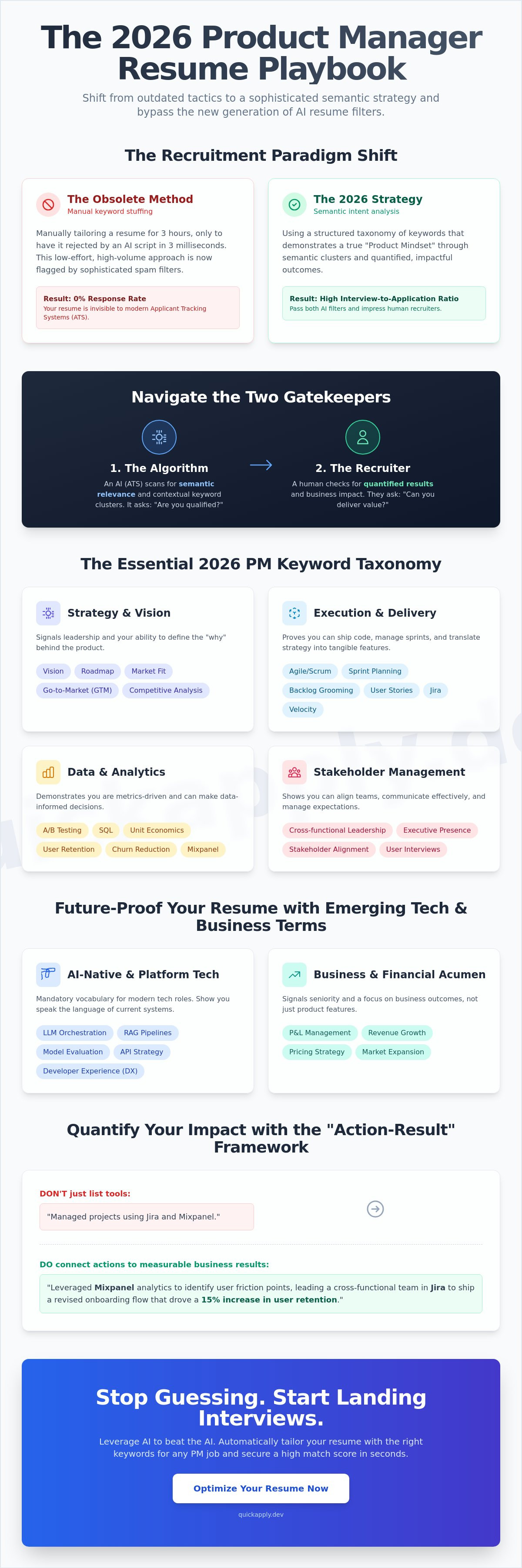
Your resume has two gatekeepers. The algorithm checks for relevance. The recruiter checks for results. You must balance technical jargon with high-impact business language. Don't just list tools like Jira or Mixpanel. Explain how those tools drove a 15% increase in user retention or a 10% reduction in churn. This dual-layer approach ensures you pass the automated filter and impress the human reader. You're building a bridge between your talent and their opportunity. Do it with precision. Use product manager resume keywords to anchor your narrative in reality.
Semantic keyword optimization is the strategic use of related professional terms to demonstrate deep domain expertise to both AI scanners and human hiring managers.
The Essential 2026 Product Management Keyword Taxonomy
Stop treating your skills list like a junk drawer. In 2026, effective product manager resume keywords are organized into logical clusters that mirror the product development lifecycle. If you mix high-level strategy with granular execution without a clear structure, the ATS will flag your profile as unfocused. You need a taxonomy that proves you can handle both the "why" and the "how." For a deeper dive into foundational structures, this Product Manager Resume Guide offers additional context on traditional formatting that still holds weight.
Your strategy cluster should anchor your resume. Use terms like Vision, Roadmap, and Market Fit to signal leadership. Follow this with execution keywords such as Backlog Grooming, Sprint Planning, and User Stories to prove you can ship code. Data proficiency is no longer a "nice to have." Include A/B Testing, SQL, and Unit Economics to show you're driven by metrics. Finally, bridge the gap with stakeholder keywords like Cross-functional Leadership and Executive Presence. This structured approach ensures you hit every semantic trigger the algorithm expects.
Emerging Tech & AI PM Keywords
The 2026 market demands AI literacy. If you're applying for modern tech roles, "AI-Native" vocabulary is mandatory. Terms like LLM Orchestration, RAG Pipelines, and Model Evaluation show you understand the infrastructure of the current decade. For platform roles, focus on API Strategy and Developer Experience (DX). These aren't just buzzwords. They're the specific technical markers that separate legacy managers from future-proof leaders. You don't need to be an engineer, but you must speak the language of the systems you're managing.
Business & Financial Acumen Terms
Seniority is signaled through financial literacy. Move beyond "features" and start talking about P&L Management and GTM Strategy. If you're in a Product-Led Growth (PLG) environment, keywords like Customer Acquisition Cost (CAC) and LTV/CAC Ratio are essential. They translate technical output into Business Value and ROI. This is how you prove to executive leadership that your product isn't just a project, but a profit center. You can use automated resume tailoring to ensure these high-impact clusters align perfectly with the specific job description you're targeting.
Precision matters. Every word on your resume should earn its place by serving a specific semantic purpose. When you deploy the right product manager resume keywords in the right categories, you stop being a candidate and start being the solution. Efficiency in your application process starts with a clear taxonomy. Don't leave your career to chance when you can use a blueprint.
Hard Skills vs. Soft Skills: Quantifying Your PM Impact
Don't fall for the trap of listing skills in a vacuum. In 2026, every entry on your resume serves as a data point for an algorithm. The distinction between hard and soft skills has blurred into a single requirement: quantifiable impact. To clear the filter, you must integrate product manager resume keywords into an Action-Result framework. This turns passive descriptions into searchable achievements that prove your value instantly. Efficiency is the priority here; if a skill doesn't lead to a result, it doesn't belong on the page.
Technical fluency is no longer a niche specialization for "Technical PMs." It's the baseline requirement for the entire field. Whether you're managing a consumer app or an enterprise API platform, you need to speak the language of the stack. Listing tools like Jira, Mixpanel, Figma, or Python isn't about proving you can do the work of a designer or dev. It's about showing you can navigate the modern development environment without a translator. You're a force multiplier, not just a task manager.
Quantifying Hard Skills
Validation requires numbers. Modern ATS systems prioritize "Outcome" keywords over "Output" keywords. Instead of saying you "managed a roadmap," state that you "prioritized a 12-month roadmap that increased user retention by 22%." This approach uses product manager resume keywords to anchor specific data points. Mention your tech stack within the context of these wins. If you used SQL to identify a drop-off point in the funnel, lead with the discovery and the fix, not just the tool name. This demonstrates high-level strategic thinking rather than basic software proficiency.
Encoding Soft Skills for the ATS
Soft skills are notoriously difficult for legacy systems to parse. You must encode them into professional terminology that algorithms recognize. Stop using vague words like "Empathy" or "Creativity." Map those concepts to Cross-functional Alignment, Product Innovation, or Ideation Frameworks. These terms are semantically dense and trigger positive responses in modern filters. Stakeholder Management remains the #1 soft skill keyword for 2026. It signals that you can handle executive pressure and resolve team conflicts. Prove it by detailing how you aligned three different departments to ship a high-priority MVP under a tight deadline.
Your resume should be a high-performance document. Every bullet point must justify its existence through data. By quantifying your impact, you transform a list of buzzwords into a compelling narrative of success. This is how you outpace the competition and secure the interviews you actually want.
Strategic Keyword Placement: Where to Optimize
Placement is just as critical as selection. While some suggest burying your skills at the bottom, 2026 AI scanners prioritize the top of your document. You need a top-heavy strategy. Your most potent product manager resume keywords must appear in the first third of the page to establish immediate relevance. This isn't just about searchability. It's about establishing a narrative of expertise before the algorithm even reaches your experience section. Efficiency in design leads to efficiency in results.
The Experience section serves as the evidence layer. Don't just list your tasks. Weave your keywords into narrative bullet points that follow the Action-Result framework discussed earlier. If you claim expertise in "Market Fit," prove it within your tenure at a specific company. This contextual placement validates your claims to both the machine and the human recruiter. It ensures your document isn't just a list of buzzwords but a coherent professional story that flows logically through your career progression.
The Summary Hook
Your professional summary is your 3-second elevator pitch. Lead with a "Power Keyword" that matches the specific job title in the posting. If the role asks for a "Growth Product Manager," that exact phrase must be your opening anchor. This immediate alignment signals to the ATS that you're a high-match candidate. You can master this process by using the 2026 AI strategy for tailoring to ensure your summary hits every mark without wasting your time on manual edits.
Formatting for Machine Readability
Sophisticated technology requires simple inputs. Avoid tables, columns, and graphics that break ATS parsing. These elements often cause keyword extraction to fail, turning your high-impact resume into a garbled mess of characters. Use standard fonts like Arial or Calibri. A clean, single-column layout ensures the algorithm identifies every instance of your product manager resume keywords correctly. Check out our guide to beating the ATS for more on why complex prompting and over-engineered layouts are legacy mistakes in the modern market.
Don't overlook secondary filters like Education and Certifications. While they rarely serve as primary keywords, terms like "Agile," "Scrum Master," or "PMP" act as essential verification markers. They provide the final layer of credibility the system needs to move you to the interview pile. Efficiency means getting it right the first time. You can automate your resume tailoring to ensure your keywords are placed exactly where they'll have the most impact.
Automate Your PM Resume Tailoring with QuickApply
Stop guessing. Manual tailoring is a legacy bottleneck that drains your most valuable resource: time. Some industry veterans still suggest spending sixty minutes on every single application; that's an inefficient strategy in a high-volume 2026 market. You need a system that identifies "Hidden Keywords" in seconds. QuickApply utilizes advanced AI to scan job descriptions and extract the exact product manager resume keywords that hiring algorithms prioritize. It's about working smarter. It's about results. You're a product leader, so start managing your career like a high-performance roadmap.
Real-time Match Scores provide instant feedback. You'll know if your document will clear the filter before you ever hit the apply button. This removes the crushing uncertainty of automated rejections. By generating context-aware bullet points instantly, our platform moves you from the tedious phase of "Applying" to the high-leverage phase of "Interviewing." Systemic automation is the bridge between your technical talent and elite professional opportunities. Don't let a legacy process hold back your career trajectory. Precision is the new standard for the modern job search.
The QuickApply Advantage
Our platform handles the heavy lifting of semantic optimization. It maps your existing experience to the specific requirements of each role without losing your authentic voice. You don't have to choose between being a machine-readable candidate and a human professional. You can manage your entire PM pipeline through our integrated Application Tracker. This centralized hub ensures you never lose track of a high-priority lead. It's a tool built by experts who value efficiency and expect the same from their software. Optimization isn't just a feature; it's the core of the experience.
Beyond the Resume
Your strategy shouldn't end with a PDF. Use our AI to perform Cover Letter Generation that echoes your product manager resume keywords for a consistent professional narrative. Once you land the meeting, use our Interview Practice tool to prepare for technical and behavioral questions based on the specific skills you've highlighted. This end-to-end system ensures you're prepared for every stage of the hiring lifecycle. Optimize your PM resume with QuickApply now and take control of your professional future through the power of smart automation.
Master Your 2026 Career Trajectory
The 2026 job market has no room for manual inefficiency. You've learned that mastering product manager resume keywords requires a shift from simple word counting to semantic intent and quantified results. By aligning your strategy and execution clusters with the Action-Result framework, you transform your resume into a high-performance asset. Strategic placement ensures the algorithm identifies your value instantly. This isn't just about passing a filter; it's about demonstrating a sophisticated product mindset that resonates with both machines and human recruiters.
Don't waste another hour on manual edits. Use a system built for speed and precision. QuickApply is trusted by tech professionals at FAANG and top startups to bridge the gap between talent and opportunity. Access AI-powered match scoring and unlimited resume tailoring versions to secure your competitive advantage today. Tailor your PM resume for 2026 with QuickApply. You've got the expertise. It's time to ensure the world sees it. Your next elite interview is just one optimized application away.
Frequently Asked Questions
What are the most important keywords for a Product Manager resume?
Focus on semantic clusters that represent the full product lifecycle. High-impact product manager resume keywords include Vision, Roadmap, GTM Strategy, and KPI Optimization. You should also include execution-focused terms like Backlog Grooming and Sprint Planning. These words shouldn't stand alone; they must be tied to specific, quantified achievements within your experience bullets to satisfy modern semantic filters.
Should I list specific tools like Jira or Trello as keywords?
Yes, include these tools to validate your technical fluency. Listing specific software like Jira, Mixpanel, Figma, or SQL proves you can operate within a modern development stack without a learning curve. Don't just create a list in the footer. Instead, mention how you used these tools to drive results, such as using Mixpanel to identify a 15% drop-off in your user onboarding funnel.
How do I identify which keywords to use for a specific PM job?
Analyze the job description for recurring technical requirements and core responsibilities. Look for terms that describe the company's current stage, such as "Scaling" or "Market Fit." Pay close attention to the "Minimum Qualifications" section, as these often serve as the primary filters for the ATS. Using automated tools to scan for these patterns is the most efficient way to ensure your document aligns with the posting.
Is keyword stuffing still effective for passing the ATS in 2026?
No, keyword stuffing is a legacy mistake that now triggers sophisticated spam filters. Modern LLM-based systems prioritize the context surrounding a word rather than simple frequency. If you repeat a term like "Agile" without explaining your specific role in the process, the algorithm will likely flag your profile as low-quality. Focus on building a narrative of expertise rather than hitting a word count quota.
Can I use AI to help me find the best keywords for my resume?
Absolutely, utilizing AI is the most effective way to achieve high match scores in the current market. AI tools can identify the semantic intent of a job description and suggest product manager resume keywords you might have overlooked. This removes the guesswork from the tailoring process. It allows you to optimize your document at scale while maintaining the authentic professional voice that human recruiters expect to see.
How many keywords should I aim for on a single resume?
Target 15 to 20 high-impact keyword clusters distributed throughout your document. You don't need to overload every sentence; you need strategic placement in your summary, skills matrix, and experience bullets. Quality beats quantity in 2026. A dense, well-organized profile that uses professional terminology naturally will outperform a longer document that lacks focus. Keep your document punchy and results-driven to maintain interest.
Do soft skills count as keywords for Product Managers?
Soft skills count only if you translate them into professional terminology recognized by algorithms. Avoid vague words like "leadership" or "communication." Instead, use semantically dense terms like Cross-functional Alignment, Stakeholder Management, or Ideation Frameworks. These phrases provide the specific markers that AI systems use to identify leadership potential. They prove you have the "Product Mindset" required for senior-level roles in modern tech environments.
How do I include AI and Machine Learning keywords if I’m not a technical PM?
Focus on the business application and strategic management of the technology rather than the underlying code. Use terms like Model Evaluation, AI Product Strategy, or User-Facing AI Features. This demonstrates that you understand the infrastructure of AI-driven products and can lead a technical team through the development lifecycle. It signals that you're an AI-literate manager who can drive ROI without needing to write the algorithms yourself.


