
Wait for the employer’s promised response date to pass, then allow a 1-2 day buffer before following up. If no timeline was given, wait at least 4-5 business days. That’s a practical starting point for deciding how long to wait before following up after an interview.
It’s tempting to read silence as a verdict, but don’t assume the worst. Hiring decisions can slow down because of internal approvals, scheduling issues, or shifting priorities. A delay doesn’t necessarily mean you’re out of the running.
Use the employer’s timeline as your guide, not the urge to send another message. This guide explains when to follow up if you were given a date, what to do when there’s no timeline, and how to write a concise note that restates your interest and qualifications. You’ll also learn how to handle continued silence while keeping other applications moving. Follow a clear sequence, keep your message professional, and make each follow-up count.
Key Takeaways
- Use the employer’s stated response date to guide your follow-up, and leave a short buffer if it passes without an update.
- If no timeline was given, wait at least 4-5 business days before sending a polite follow-up.
- According to the U.S. Bureau of Labor Statistics, send a thank-you letter preferably within 2 days of the interview.
- Keep your follow-up positive and concise: reaffirm your interest and qualifications, and offer any useful additional information.
1. Allowing a buffer after a promised response date
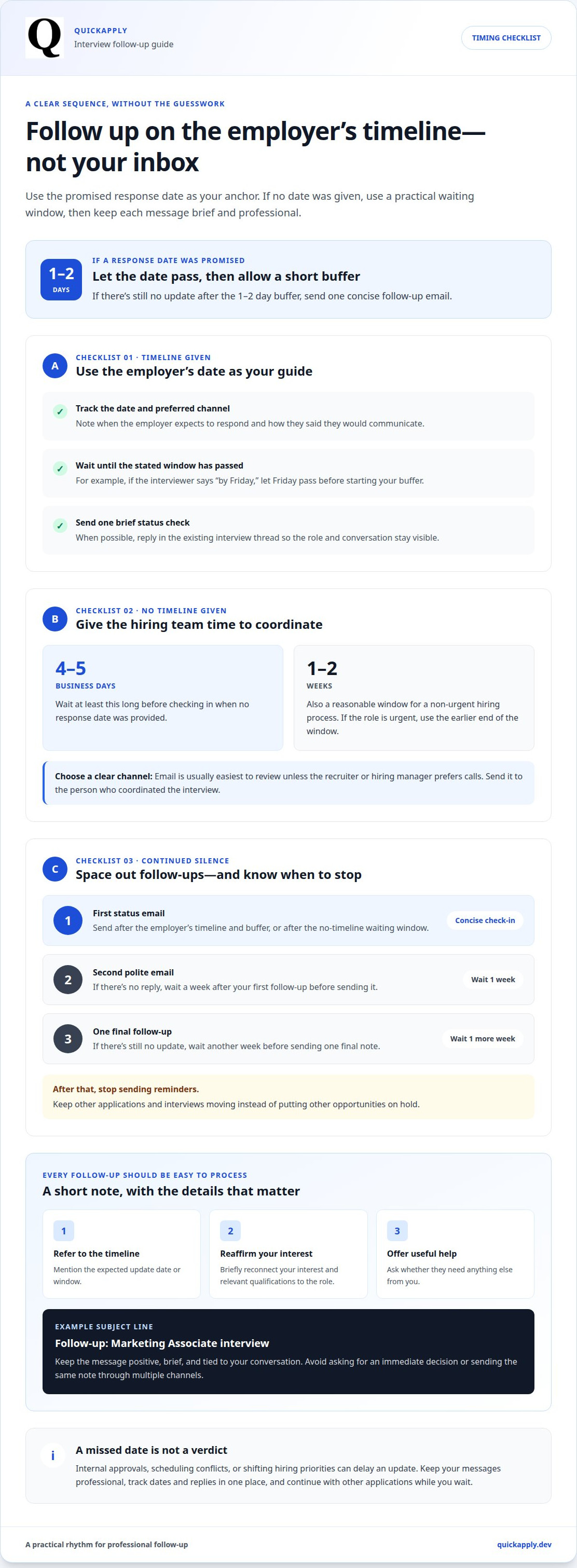
Use the employer’s promised response date as your anchor. If the interviewer says “by Friday,” let that date pass before starting your buffer. Allow a 1-2 day buffer after the timeline ends, then send one concise follow-up email if no update arrives. This pause gives the hiring team a little room to complete its next step without leaving you waiting indefinitely.
Keep your message brief and tied to the conversation. For example: “Thank you again for discussing the product analyst role. You mentioned an update by Friday, so I’m checking in and remain interested. Please let me know if you need anything else from me.” Replace the role and date with details from your interview. Avoid asking for an immediate decision or sending the same note through multiple channels.
Send a separate thank-you letter soon after the interview. The U.S. Bureau of Labor Statistics recommends sending it preferably within 2 days of the interview. Use that message to thank the interviewer for their time and mention a specific discussion point, such as a project goal or team priority. It serves a different purpose from a later status check, so don’t treat it as a substitute for following up after the promised date.
If the employer doesn’t respond to your first follow-up, wait a week before sending a second, polite email. If there’s still no reply, wait another week before sending one final follow-up. Keep each note short, professional, and useful. After that, focus on other applications instead of continuing to send reminders.
A missed date doesn’t automatically mean rejection. Internal approvals, scheduling conflicts, or changed hiring priorities can delay an update. Keep other applications and interviews moving while you wait. Use the interviewer’s preferred contact method; if they didn’t name one, email is easy to review and respond to. Track the promised date, your messages, and any replies in one place. This prevents duplicate emails and makes your next step clear.
2. How soon is too soon to follow up on the interview?
If the employer gave no response date, wait at least 4-5 business days before checking in. For a non-urgent hiring process, following up within one to two weeks is also a reasonable window. About five business days gives the team time to coordinate next steps without leaving your application idle. If the interviewer said the role needed an urgent hire, use that context to choose the earlier end of the window.
Email is usually the clearest channel for a post-interview follow-up, unless the recruiter or hiring manager prefers calls. It gives them a written reference to your name, the role, and your interview date. Use a specific subject line, such as “Follow-up: Marketing Associate interview,” and send your note to the person who coordinated the interview.
Send a thank-you email within 24 hours of the interview. Mention one detail from the conversation, thank the interviewer, and briefly reaffirm your interest. A thank-you note is separate from a later status request, so don’t use it to press for a decision before the employer’s process has had time to move.
After a second or final-round interview, tailor your note to the latest conversation. Refer to a specific topic raised by the panel, such as the team’s launch priorities, and connect it to a relevant strength or work example. If the interviewers gave you a decision date, follow that timeline. If they didn’t, use the same waiting window as after an earlier interview.
How many times should you follow up? Send a first status email, then wait a week before sending a second if there’s no reply. If there’s still no update after another week, one final follow-up is reasonable. Keep each message professional and distinct. Daily emails won’t add useful information.
Use the waiting period to prepare for another interview, not just refresh your inbox. Interview practice can help you sharpen responses and prepare relevant examples for the next conversation.
3. Following up when the employer gives a timeline
Use the employer’s stated timeline to decide when to follow up. During the interview, ask, “What are the next steps, and when should I expect an update?” This gives you a date to track and helps you avoid requesting a status update while the hiring team is still within its stated window. Note the date and the communication channel they mention. That makes deciding how long to wait before following up after an interview a timeline-based choice, not a guess.
If the interviewer says a decision will be made within a week, let the full week pass. If there’s no update, follow up on the next business day. For example, if you hear “within a week” on Tuesday, wait through the following Tuesday, then email on Wednesday if there’s no news. Use the employer’s timeline, not your preferred schedule, as your reference point.
Make your follow-up easy to process. When possible, reply to the existing interview thread so the role and earlier conversation stay visible. Open by referring to the timeline: “You mentioned the team expected to decide this week, so I’m checking in on the role.” Then restate your interest and ask whether there’s an update or anything else you can provide. This keeps the message direct and shows you’ve paid attention to the process.
A stated date can shift because of approvals, interview scheduling, or changing hiring priorities. A missed estimate alone doesn’t tell you the outcome. Send one concise message after the timeline has passed, then keep other applications moving instead of treating the estimate as a confirmed decision date. Knowing how long to wait before following up after an interview helps you stay professional without putting other opportunities on hold.
If another employer makes an offer before this timeline concludes, tell the recruiter promptly and professionally. State the date by which you need to respond, then ask whether they can share an update on this role’s hiring timeline. Keep your note factual. This gives the team useful context without demanding a decision or suggesting the other opportunity is a negotiating tactic.
4. Reaffirming interest and qualifications
A strong follow-up does more than ask for an update. Thank the interviewer, name the role, reaffirm your interest, and connect one relevant qualification to the team’s needs. Keep the message positive and focused. For example, an applicant for a customer onboarding role could mention experience explaining technical processes to new users.
What should you include in a post-interview follow-up email? Thank the interviewer for something specific, clearly express your interest, and briefly remind them of a relevant skill. Ask whether the hiring team needs anything else, such as a work sample or reference, and close professionally.
Make your qualification concrete. Instead of writing “I’m a great fit,” mention a skill or example discussed during the interview. If the employer described improving customer setup, you could mention a project where you simplified instructions for new users. Connect the example to the role’s stated needs rather than making a general claim about your abilities.
Keep the email focused on the employer’s decision. Offer a work example or additional reference only if it could clarify your fit. Don’t attach extra materials without context. Explain what the item demonstrates and why it relates to the position. A short, relevant offer is easier to act on than a long list of achievements.
Use a simple structure: thank the interviewer, refer to one conversation detail, restate your interest, and offer useful follow-up information. Then proofread the recipient’s name, role title, and attachment before sending. A concise message shows care and makes your strongest qualification easy to find. Practice presenting your qualifications clearly before your next interview follow-up.
QuickApply: Interview Practice
QuickApply’s Interview Practice helps you prepare for upcoming conversations while you wait for an employer’s update. Use it to sharpen how you explain your qualifications, organize relevant examples, or prepare clear answers for another interview.
A follow-up email can reaffirm your fit, but preparing for your next opportunity keeps your search moving too. Practice describing a relevant project, explaining your contribution, and connecting your experience to an employer’s needs. As you apply elsewhere, QuickApply’s Resume Tailoring and Cover Letter Generation help you prepare application materials, while the Application Tracker keeps your job search organized.
Choose the tool that fits your next step, whether you’re preparing for another interview or managing active applications. Start using QuickApply to support your job search.
Turn the waiting period into forward momentum
Knowing how long to wait before following up after an interview is one part of managing your search with intention. Keep building options instead of letting one employer’s decision dictate your pace. Use each conversation to sharpen how you describe your experience, then apply those insights to your next application.
QuickApply supports your job search with Interview Practice, Resume Tailoring, and Cover Letter Generation. Use these tools to prepare for upcoming interviews and shape application materials around the roles you’re pursuing. A focused process helps you stay organized and ready to act when a new opportunity appears.
You’ve already taken the time to make a thoughtful follow-up. Keep your momentum, prepare for what comes next, and contact QuickApply for help with your job search.
Frequently Asked Questions
How Long Should I Wait to Follow Up After a Job Interview?
Start with the employer’s stated timeline, then follow up after it passes and you’ve allowed a brief buffer. If no date was given, wait 4-5 business days before checking in. For example, after a Thursday interview with no next-step date, count business days rather than treating the weekend as interview time. Keep pursuing other applications while you wait, so one decision doesn’t stall your search.
How soon is too soon to follow up on the interview?
A status request sent immediately after an interview is usually too soon if the employer hasn’t invited you to follow up. An early message can thank the interviewer or share something they requested. For example, if you promised a portfolio link, send it promptly with a short note. Save a separate status check for the appropriate follow-up window.
How long should you wait to follow up after a job interview?
Use the employer’s estimate if they gave one. Otherwise, allow at least 4-5 business days before sending a first status email. After a final-round conversation, address the recruiter or lead contact and refer to a relevant panel discussion, such as a project priority. Reaching the final stage doesn’t remove the value of a clear, measured follow-up.
How long to wait after the interviewer’s promised decision date before following up?
After the promised date passes, allow a 1-2 day buffer before sending a status email. Mention the date neutrally rather than framing the delay as a broken promise: “You expected an update by Tuesday, so I’m checking whether the timeline has changed.” This wording invites a simple update and keeps the focus on next steps, not blame.
How to follow up after an interview if no timeline was given?
Wait at least 4-5 business days, then email the recruiter or hiring manager who coordinated the interview. Use a subject line that includes the role and interview, and ask for an update without demanding a decision. For example: “I’m following up on the data analyst role. I enjoyed discussing the reporting workflow and would welcome any update on next steps.”
How to follow up after an interview without seeming pushy?
Keep your tone neutral, send one message at a time, and give the employer room to reply. Avoid phrases like “I’ve been waiting” or sending the same request by email and phone. A concise note that names the role, thanks the recipient, and asks whether there’s an update stays professional. If there’s no reply, leave space before sending another message.


