

Being unemployed doesn’t mean your job search should run without a plan. To organize your job search while unemployed, set a focused schedule, track applications and follow-ups, and assess which roles fit your skills and priorities. You might begin with two hours of search work a day and ten applications a week, then adjust those targets to the roles you’re pursuing.
It’s easy to spend hours applying and still feel unsure about what’s moving forward. A clear system gives each task a place and helps you focus on progress, not just activity. This checklist covers setting goals, planning your week, tracking opportunities, updating your resume and other professional materials, and reviewing your career direction. Use it to build a repeatable routine that keeps your search focused while leaving room to adjust your next steps.
Key Takeaways
- Set a focused routine with clear weekly goals so your search has structure without turning every day into an endless application sprint.
- Log each application, conversation, interview, and follow-up to keep next steps visible and prevent promising opportunities from slipping through.
- Refresh your resume and other professional materials to reflect the roles you’re targeting and the strengths you want employers to notice.
- Use your skills, interests, and values to assess which career directions fit, then prioritize opportunities that align with your goals.
Setting job-search goals and schedules
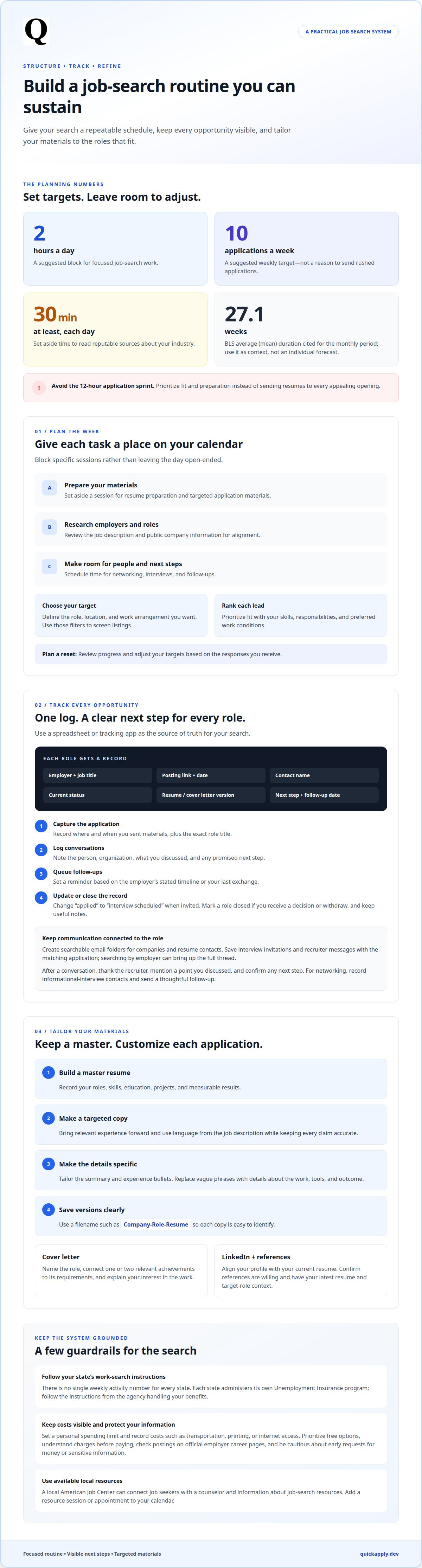
Start with a schedule you can repeat. Set aside two hours a day for focused search work and consider a goal of ten applications a week. Treat those as planning targets, not a reason to send rushed applications. The U.S. Bureau of Labor Statistics reports an average (mean) duration of 27.1 weeks for the monthly period, so build a routine you can sustain while your search develops.
Block specific tasks on your calendar instead of leaving the day open-ended. For example, reserve one session for resume preparation, another for researching employers, and time for networking, interviews, and follow-ups. Set aside at least 30 minutes each day to read reputable sources about your industry. Avoid spending 12 hours sending resumes to any appealing opening; prioritize fit and preparation.
- Choose a target: Define the role, location, and work arrangement you want, then use those filters to screen listings.
- Rank each lead: Prioritize roles that match your skills, responsibilities, and preferred work conditions. Review the employer’s job description and public company information for alignment.
- Plan a reset: Leave space in your schedule to review progress and adjust your targets based on the responses you receive.
There is no single number of weekly job-search activities that applies in every state. Each state administers its own Unemployment Insurance program, so follow the work-search instructions from the state agency handling your benefits.
Manage search expenses by setting a personal spending limit and recording costs such as transportation, printing, or internet access. Prioritize free options, reuse digital materials when appropriate, and understand what a charge covers before paying for an opportunity.
To reduce scam risk, check whether a posting appears on the employer’s official careers page, research the company, and be cautious about early requests for money or sensitive personal information. Don’t share financial details or pay to secure a job.
A local American Job Center can connect job seekers with a counselor and information about available job-search resources, according to the U.S. Department of Labor, Employment and Training Administration. Add an appointment or resource session to your calendar as a scheduled search task.
Tracking applications, interviews, and follow-ups
Use one log as the source of truth for your job search. A spreadsheet works well for a simple setup, while a job application tracking app can organize the same details in one place. Add a row for every role and record the employer, job title, posting link, application date, contact name, and current status.
Make every entry actionable. Note which resume or cover letter version you submitted, the next step, and any agreed follow-up date. For example, change “applied” to “interview scheduled” after an invitation, then add the interview date, interviewer’s name, and preparation notes. Update the status after each conversation so your log reflects what’s actually happening.
- Capture the application: Record where and when you sent materials, plus the exact role title.
- Log each conversation: Add the person’s name, their organization, what you discussed, and any promised next step.
- Queue follow-ups: Set a reminder based on the employer’s stated timeline or your last exchange.
- Close the loop: Mark a role as closed when you receive a decision or withdraw, and retain useful notes.
Keep communications easy to search. Create email folders for companies you’ve applied to and contacts who received your resume. Use consistent subject lines and save interview invitations or recruiter messages with the matching application. Searching by employer can then bring up the full thread without digging through your inbox.
A spreadsheet and organized email folders are practical free options for tracking applications and communications. If you use an app, look for a clear way to record status, contacts, interviews, and follow-up tasks.
Build recruiter relationships with concise, specific messages. After a conversation, thank the recruiter, mention a point you discussed, and confirm any next step. For networking, request an informational interview to learn about someone’s field or experience; record the contact and send a thoughtful follow-up afterward. Keep each message relevant rather than sending repeated generic check-ins. A consistent application organization workflow makes those conversations easier to manage.
Updating resumes and professional materials
Start with a master resume that records your roles, skills, education, projects, and measurable results. For each application, create a targeted copy rather than editing the master. Use relevant language from the job description, but keep every claim accurate. For example, a software developer can move a relevant programming project higher when the posting emphasizes that skill.
Tailor the opening summary and experience bullets to the role. Replace general phrases like “handled projects” with clear details about the work, tools, and outcome. Make the most relevant information easy to find, and remove outdated or unrelated details that distract from your fit. Save each version with a clear filename, such as “Company-Role-Resume.”
Build each cover letter around the employer’s needs rather than using a generic introduction. Name the role, connect one or two relevant achievements to its requirements, and explain your interest in the work. Keep the examples consistent with your resume. A focused letter can add context that a short resume bullet cannot.
- Refresh your LinkedIn profile: Align its headline, experience, and skills with your current resume, then review the profile as an employer might.
- Prepare references: Confirm that each person is willing to serve as a reference and has your latest resume and target-role context.
- Assemble supporting materials: Update a writing sample when the role calls for one, and request recommendations or testimonials from supervisors, coworkers, or professional colleagues.
- Review your public presence: Check social profiles and voicemail greeting so they present a professional impression to employers and contacts.
Before sending an application, compare your resume and cover letter with the posting. Check the role title, employer name, dates, contact details, spelling, and attachment names. Remove any text left over from another application. A final review catches mismatches that can make otherwise strong materials look rushed.
Keep current materials in an organized folder, along with a separate copy of each version you submit. That record helps you prepare for interviews and answer questions about the experience you highlighted.
Assessing career goals, skills, interests, and values
Use your job search to test whether your next role fits, not just whether it resembles your last one. Write down the work you want more of, the tasks you want less of, and the conditions you need. For example, a project manager might enjoy solving complex problems but prefer fewer late-day meetings. These preferences become practical filters for reviewing openings.
A useful way to organize your job search while unemployed is to connect your skills to evidence. List technical abilities, communication strengths, and transferable experience, then add a specific example for each. A retail supervisor might identify scheduling, conflict resolution, and inventory coordination as strengths for operations roles. Separate skills you can demonstrate now from those you want to develop.
- Define a role goal: Focus on responsibilities and work environment, because job titles can vary between employers.
- Rank proven skills: Choose strengths backed by projects or past work, so applications can show concrete evidence.
- Identify energizing tasks: Note whether analysis, building, writing, or customer support holds your attention.
- Set value filters: Prioritize flexibility, collaboration, autonomy, or stability based on what matters in your day-to-day work.
- Find skill gaps: Compare target postings, then identify repeated requirements you could realistically develop.
To make your plan for organizing a job search while unemployed clearer, define a strong-fit role and an adjacent option that uses transferable skills. A teacher interested in learning design, for instance, could explore training roles alongside classroom positions. Compare both paths by the work involved, the skills required, and how well each matches your priorities. Then use conversations with professionals to test your assumptions and refine your direction. A focused cover letter can connect your evidence and interests to a specific role.
Build a more focused application around the strengths and priorities you’ve identified.
QuickApply
QuickApply helps make your job-search plan a more manageable application workflow. Use it when you’re ready to tailor materials to specific openings, organize applications, or prepare for interviews. Its tools include Resume Tailoring, Cover Letter Generation, Interview Practice, and an Application Tracker.
For example, tailor your resume and cover letter to a role, then track the application and its next steps in one place. Interview Practice can help you prepare when an employer responds. These tools support your process, while your career priorities and application decisions remain yours.
If you’d like help organizing your applications, contact QuickApply.
Make Your Next Move Deliberate
A job search can also help you test your assumptions about the work you want. Notice which opportunities make you curious, which conversations reveal useful information, and where your experience gets the strongest response. Treat those signals as input for your next career decision, not as a measure of your personal worth.
To organize your job search while unemployed, set a review point and ask what you’ve learned. Are the roles you’re pursuing aligned with your priorities? Do conversations suggest a skill or industry worth exploring further? Use what you discover to refine your direction instead of repeating the same approach by default.
If you want support turning your next step into stronger application materials and interview preparation, contact QuickApply for job-search help. Keep your focus on the choices you can shape, and let each considered move bring your next opportunity into clearer view.
Frequently Asked Questions
How to create a weekly job search schedule while unemployed?
Assign a primary focus to each workday, then set aside a short weekly review to adjust priorities. For example, Monday can be for identifying suitable openings, Tuesday for preparing applications, and Wednesday for networking. Keep another block open for interviews or employer requests. If a day changes unexpectedly, move the task to the next available block instead of abandoning the plan.
How many jobs should you apply to each week?
Ten applications a week can be a useful target if you can submit thoughtful applications for roles that fit. Treat it as a planning benchmark, not a quota that overrides quality. If specialized roles need more preparation, fewer well-matched applications may be more practical. Review your progress weekly and adjust the target to reflect the time each application takes and the opportunities available.
How do you track job applications and follow-ups in a spreadsheet?
Create one row for each opening and use consistent status labels, such as saved, submitted, interview, or closed. Add columns for the employer, role, application date, source, next action, and reminder date. Use filters to see only applications needing attention. For example, sort by reminder date each morning, then update the row as soon as you send a message or receive a decision.
How do you tailor a resume and cover letter efficiently for each application?
Start by identifying the employer’s core requirements, then choose the most relevant evidence from your experience. Keep a reusable master document, but create a separate, clearly named copy for each application. Align your opening and examples with the specific role, and check that the employer name and job title are correct. In a final review, confirm that every claim is accurate and relevant.
How do you prepare for interviews and track interview stages?
Before each interview, review the job description and prepare concise examples that demonstrate relevant skills. Practice explaining your contribution and the outcome aloud, then prepare questions about the role’s priorities. In your tracker, record each stage, date, interviewer, topics discussed, and promised next step. Afterward, note what you learned and any follow-up task, so preparation for later conversations builds on earlier rounds.


