

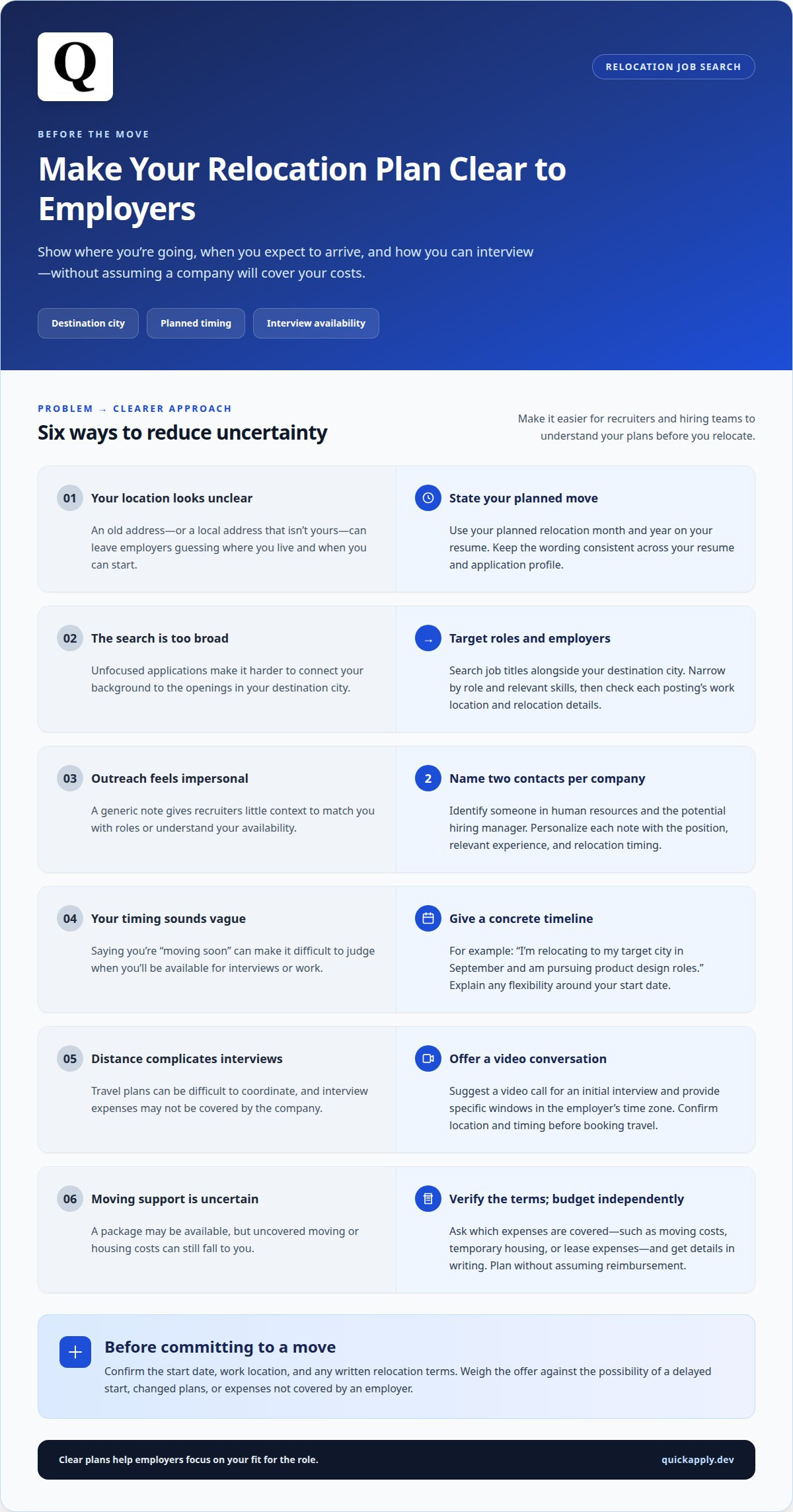
You can apply for jobs in your destination city before you move. To understand how to get a job in a new city before you move, make your relocation plan clear: tailor each application to the role, state when you expect to relocate, and offer a video interview for an initial conversation. Ask whether relocation assistance is available, but don’t build your budget around it.
Moving first can make local interviews easier, but it also means searching before you have a new paycheck. You can start building momentum from where you are. This guide explains how to approach employers and recruiters, describe your move in a cover letter, handle your resume address, and plan interview logistics. It also covers what to ask about relocation support so you can make a more informed decision before committing. A clear, credible plan helps employers focus on your fit for the role, not the distance between you and their office.
Key Takeaways
- Ask about relocation assistance early, and plan your budget without assuming an employer will cover moving costs.
- Contact recruiters and hiring managers in your target city, and suggest video interviews to simplify first-round conversations.
- Make your resume address clear by showing your planned relocation timing instead of implying you already live locally.
- Use your cover letter to state your relocation plans, timing, and readiness to interview remotely or in person.
Checking whether an employer offers relocation assistance
- Check the job posting, employer careers page, and benefits information for relocation details. Search for terms such as “relocation assistance,” “moving expenses,” and “housing support.” Some employers offer packages that cover moving expenses, a housing deposit, or lease-related costs. Treat each benefit as specific to the role, not automatic.
- Ask the recruiter about support once you’ve discussed the role and location. Be direct: “Does this position include relocation assistance, and what expenses does it cover?” Ask whether it applies to moving costs, temporary housing, or lease expenses. Get the details in writing before including them in your moving budget.
- Plan for the move without assuming you’ll be reimbursed. Relocating for work can cost thousands of dollars, especially over a long distance. An employer may offer a package, but you could still need to cover expenses yourself. Include moving and housing costs in your personal plan before accepting an offer.
- Search for destination-city roles using job-board location filters and employers’ careers pages. Set the location to your destination city, then narrow results by role title and relevant skills. Before applying, check each posting for the work location and relocation details. A remote listing may not mean the job is based there.
- Offer a video call for an initial interview and state your availability clearly. If the employer requests an in-person meeting, confirm the location and timing before booking travel. Don’t assume the company will cover interview expenses. A concise plan helps both sides coordinate without treating travel costs as relocation assistance.
- Before accepting, weigh the offer against the risks of moving before your new role begins. A delayed start, changed plans, or uncovered expenses could leave you paying for housing and moving costs without the income you expected. Confirm the start date, work location, and any written relocation terms before committing.
Contacting recruiters and prospective employers
- Build a target list by searching job titles alongside your destination city. Add employers with openings that match your skills, then review their careers pages for current roles. Track each position, hiring contact, application date, and follow-up in one spreadsheet. This keeps your outreach specific and helps prevent promising conversations from disappearing in your inbox.
- Identify two contacts at each target company: someone in human resources and the potential hiring manager. Use the company’s staff pages and professional profiles to verify their roles. Send each a concise, personalized note that names the position, summarizes your relevant experience, and states your planned relocation timing.
- Contact recruiters who specialize in your field and work in your destination city. Explain where you’re moving, which roles you’re targeting, and when you expect to be available. Ask whether they’re recruiting for positions suited to your background. A clear brief helps them match your experience to local openings.
- Make your move concrete. For example, write, “I’m relocating to my target city in September and am pursuing product design roles.” Share your timing with recruiters and employers, then explain any flexibility around your start date. Don’t imply you already live nearby if you haven’t moved.
- Offer a video call for an initial interview, and propose specific time windows in the employer’s time zone. If you’ll be in town, suggest an in-person meeting or informational interview. When explaining travel logistics, say plainly if you can reach the office within 24 hours, but only if that’s realistic for you.
- Grow your local network before arrival through alumni groups, professional associations, and industry events in your destination city. Ask a local contact for a short informational conversation, not a job referral. After each meeting, send a brief thank-you that refers to one useful detail. A focused relocation-focused cover letter can reinforce the same timing and location message across applications.
Deciding whether to include a local address
- Replace your current resume address with your planned relocation month and year. This makes your timeline clear without suggesting you already live in your destination city. For example, write “Relocating to Austin, Texas in October 2026” in the contact section. Keep your email and phone number easy to find so employers can reach you directly.
- Use a city-specific address only if it accurately describes your situation. Don’t list a friend’s or relative’s address as your own if you don’t live there. It can cause confusion when a recruiter asks about your commute, interview availability, or start date. A brief relocation line gives employers useful context without disguising where you currently live.
- Keep your relocation wording consistent across your resume and application profile. If your resume says you’re moving to the city, don’t leave an old location in another application field without explanation. Update each profile when your plans change, and use the same month and year wherever a form asks when you’ll be local.
- Check what each application form asks for. If it requires a current mailing address, provide one where you can receive correspondence. If it asks for your intended work location, enter the destination city. These fields have different purposes, so don’t use one address to answer both questions.
- Use your cover letter to explain the move if your resume header doesn’t provide enough context. State your destination and planned timing, then connect that plan to your interview and work availability. For instance, clarify whether you can interview remotely before relocating. This gives hiring teams a concrete timeline instead of leaving them to infer one from your address.
Explaining relocation plans in a cover letter
- State your relocation commitment near the opening, after naming the role. For example: “I’m committed to relocating to your area and am applying for the product analyst position.” This answers the location question right away and lets the hiring manager focus on your qualifications rather than wondering whether your application is serious.
- Give a realistic timeline. If your plans are firm, name the month and year you expect to move. If the timing depends on an offer, say so plainly and explain your availability to discuss a start date. Employers may expect a new hire to relocate quickly, so don’t promise a timeline you can’t meet.
- Connect the move to your candidacy, not just your personal plans. Explain why the role, team, or work in that area suits your experience. For instance, describe how your healthcare technology background aligns with the employer’s operations. Keep your reason specific to the position.
- Address the distance with a practical interview plan. Say you’re available for a video interview and can discuss in-person scheduling if needed. Don’t fill the letter with travel logistics. Living out of state does not necessarily prevent a qualified candidate from being hired, so keep the focus on your fit and readiness.
- Keep your relocation message consistent across your cover letter, resume, and application. If your resume says you’re moving in October, don’t describe an immediate move elsewhere. Review each document before sending it, and make sure the employer sees one clear timeline rather than conflicting signals.
- Make the final paragraph reinforce your interest and invite a next conversation. Keep it direct: “I’d welcome the chance to discuss how my experience fits this role and my relocation timeline.” For a polished draft, use cover letter generation for your relocation plans to shape the message around the position.
QuickApply
QuickApply helps you keep a cross-city job search focused while you prepare to relocate. Use Resume Tailoring and Cover Letter Generation to align application materials with each role, then organize opportunities with the Application Tracker. Interview Practice can help you prepare for conversations with employers before you arrive. These tools support the application workflow; your relocation timeline, employer conversations, and final decisions remain yours to manage. Turn to QuickApply when you’re applying to multiple roles and need a more organized way to prepare and track each one. If you’d like support streamlining your applications as you plan your move, contact QuickApply.
Turn your relocation plan into your next career move
A practical approach to how to get a job in a new city before you move is to treat the transition as a project with clear milestones. Choose your target roles, set a steady application rhythm, and keep your relocation timeline consistent in every conversation. Review your progress regularly. If employers aren’t responding, adjust how you present your fit or clarify your availability. Small, deliberate updates can strengthen your next application.
You don’t need to solve every part of the move at once. Focus on the next useful action, whether that’s refining an application or preparing for an interview. For support with your job search, connect with QuickApply. Keep moving forward, one focused step at a time.
Frequently Asked Questions
How do I get a job in a different city before moving?
Start by narrowing your search to roles that closely match your experience, then apply while you’re still planning the move. To get a job in a new city before you move, make your application easy to assess: connect each key qualification to a specific project, result, or responsibility. Track follow-ups and interview dates so relocation planning doesn’t disrupt active hiring conversations.
How do I get a job in a new city with no connections?
Build visibility through professional communities, alumni groups, and online industry discussions, even if you don’t know anyone in your destination city. Contribute a useful comment or share a relevant project before reaching out. Then send a brief message asking about the person’s field or team, not for an immediate referral. This gives a new contact a clear reason to respond and starts a relationship around your expertise.
What is the fastest way to get a job in a new city?
Focus first on openings that closely match your skills and have a clear application process. Prepare a strong base resume, then adjust its evidence and emphasis for each position instead of rebuilding it from scratch. Set aside regular time to apply and respond to employer messages. A focused search reduces delays caused by pursuing roles that don’t fit your experience.
Best job search websites for a specific city
Use job-board location filters to search your destination city, then narrow results by role title and relevant skills. Check employers’ careers pages too, and review each posting’s work location and relocation details.
How to handle address and work authorization questions when applying out of state
For your address, show your planned relocation month and year rather than implying you already live locally. If a form requires a current mailing address, provide one where you can receive correspondence. Enter the destination city when asked for your intended work location.


