

Your peers’ timelines are not a reliable measure of your progress. To stop comparing my job search to my peers, I can set goals that fit my priorities, focus on actions within my control, and treat other people’s success as information, not a verdict on my prospects. A polished announcement rarely reveals the rejections, detours, or personal circumstances behind it.
It’s understandable to feel behind when someone lands a role or shares a career milestone. But constant comparison can chip away at your confidence and push you toward jobs that don’t fit, or away from opportunities you’re qualified for. Reset your benchmarks, turn comparison into useful insight, and keep your search moving with practical steps. Trusted support can also add perspective and accountability, so your next move reflects your goals, not someone else’s timeline.
Key Takeaways
- Use trusted mentors, career services, and peers for perspective, while setting boundaries around career updates that leave you feeling behind.
- Notice when comparison starts steering your choices, weakening interview confidence, or pushing you toward roles that don’t fit.
- Set benchmarks around your priorities, strengths, and circumstances instead of someone else’s timeline or career milestones.
- Track progress through practical steps you control, and use application tools to organize materials and keep your search focused.
1. Seeking support from career services, mentors, and peers
Why is it common to compare your job search with peers? People naturally assess their abilities and progress in relation to others. A former classmate’s new role can become an easy reference point, especially when social media highlights announcements but leaves out rejections, referrals, and career detours. Treat that post as one visible outcome, not the full story of someone’s search.
Industry, experience, location, and timing all shape a job search. Fields differ in hiring cycles, entry barriers, and expectations; access to opportunities and professional networks also affects who hears about openings. A peer with relevant experience or a stronger industry network may move faster for reasons unrelated to your potential. Compare your progress with people whose roles and backgrounds resemble yours, not someone in an unrelated field.
Use career services, a mentor, or a trusted peer to add structure. Ask a campus career adviser to review your target roles, then ask a mentor how they built a skill you want to develop. When a friend shares career success, ask what steps helped them and whether any lesson applies to your goals. A peer can also help you stay accountable to a specific task, such as revising an application or preparing for an interview.
People in unrelated fields can still inspire you, but they aren’t reliable benchmarks for your timeline. If your preferred path is taking time, explore bridge roles that build relevant experience. An internship, contract role, part-time position, or service opportunity can help you test a direction and keep your search moving.
Set boundaries around career-related content. Mute accounts that trigger unhelpful comparisons, or choose a set time to check social media. Replace extra scrolling with one useful career action: polish your LinkedIn profile, sign up for a professional workshop, or add a project to your online portfolio. These steps shift your attention from someone else’s highlight to your next move.
2. Effects of comparison on confidence and job-search decisions
Comparing yourself with peers can shift your attention from your own evidence to someone else’s visible outcome. Social comparison theory describes how people evaluate their abilities and attitudes in relation to others. When a former classmate posts a new title, you might assume everyone else is advancing faster, even without knowing their circumstances. That assumption can make a normal job-search delay feel like proof that you lack ability.
Comparison can affect your decisions. You might apply for a role because a peer accepted a similar one, even when its hours, responsibilities, or growth path don’t fit your needs. Or you might skip a position you’re qualified for because another applicant seems more accomplished. In an interview, thinking about a friend’s promotion can distract you from your own examples and make it harder to explain your strengths clearly.
Repeated upward comparisons can fuel envy, fear of missing out, and a negative view of your progress. A friend’s offer may start to feel like evidence of competition rather than a milestone in their career. That reaction can lead to disengagement: you delay applications, stop following up, or lose interest in relevant roles. Notice your behavior, not just the feeling. Ask whether comparison is changing a specific choice you planned to make.
Use a quick reset before acting on that feeling. Name what triggered it, such as a promotion post or a peer’s interview update. Separate facts from assumptions: you know they received an offer, but you may not know their search history or priorities. Then review your own recent actions, such as completing an application or improving an interview answer. Friendly competition can motivate you when it prompts a useful next step; it becomes unproductive when it defines your worth or dictates your target role.
If comparison makes it harder to explain your fit for a role, generate a tailored cover letter that focuses on your relevant experience.
3. Using personal goals and constraints as benchmarks
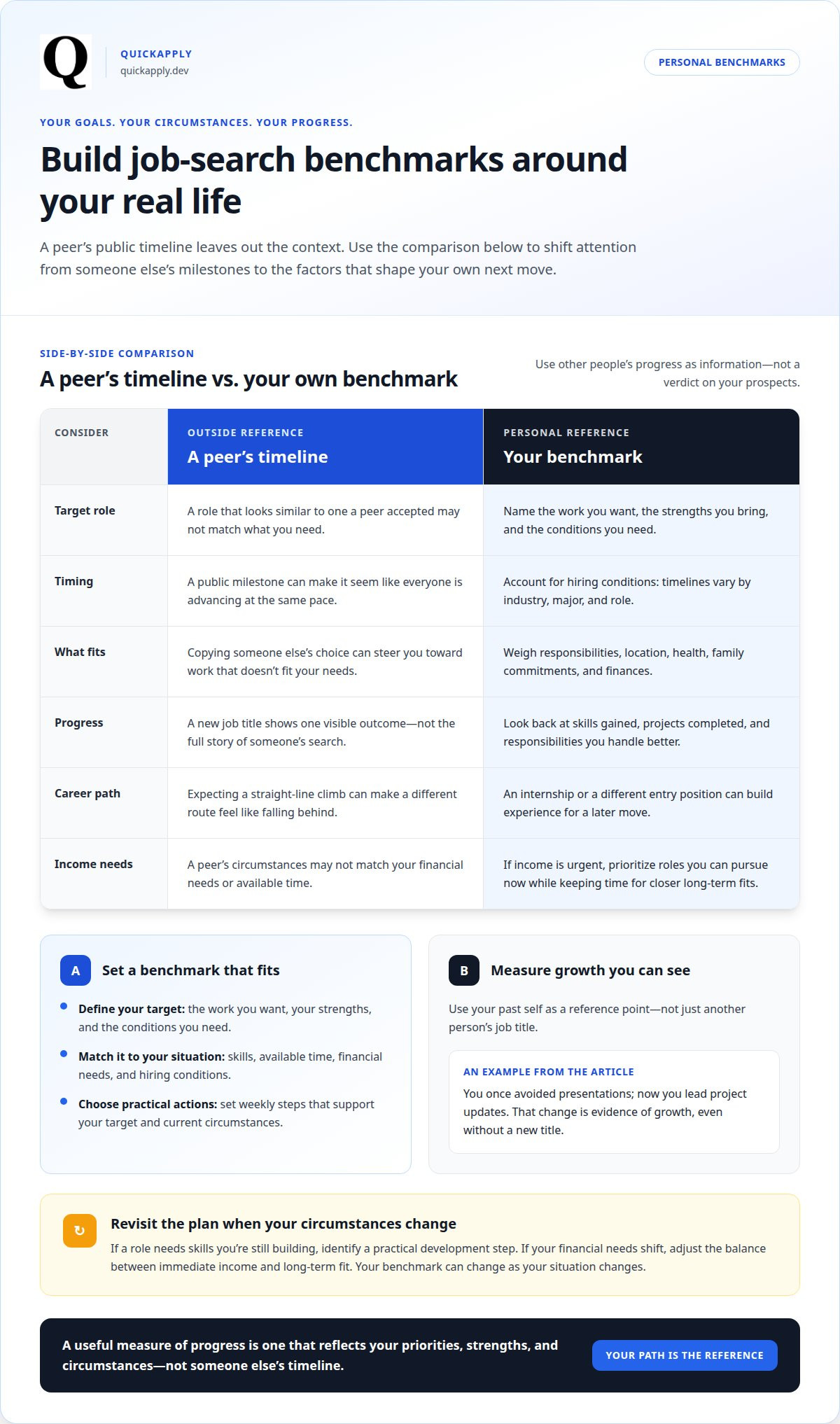
Set realistic goals by matching target positions and weekly actions to your skills, available time, financial needs, and field’s hiring conditions. If income is urgent, prioritize roles you can pursue now while reserving time for positions closer to your long-term direction. Your plan should fit your situation, not a peer’s public timeline. If you’re asking how to stop comparing my job search to my peers, start by defining what “progress” means for you.
Start with a clear career target: name the work you want, the strengths you bring, and the conditions you need. Someone who values stable hours, for example, may choose a different role from someone prioritizing rapid advancement. Consider responsibilities, location, health, family commitments, and finances. These factors shape which opportunities are practical and whether you can wait for a closer fit.
Hiring timelines vary by industry, major, and role because expectations, hiring cycles, and entry barriers differ. Early-career jobs can help you identify the work you enjoy, the skills you use well, and the environments that suit you. Progress may take a nonlinear route: an internship or a different entry position can build experience for a later move. A constant, straight-line climb isn’t the only useful career path.
Use your own past as a reference point. Write down a skill you lacked earlier, a project you completed, or a responsibility you handle better now. Compare that evidence with your current goals. If you once avoided presentations but now lead project updates, for example, that change shows growth even without a new job title. Your less experienced past self can reveal progress that a peer’s milestone can’t measure.
Review your goals when your circumstances change. If a position requires skills you’re still building, identify one practical development step instead of judging your whole career. If your financial needs shift, adjust the balance between immediate income and long-term fit. Career success can also include satisfying work, supportive relationships, health, and happiness. Decide what matters most, then measure progress against those priorities. A practical answer to how to stop comparing my job search to my peers is to use benchmarks that reflect your life.
4. Focusing on controllable job-search actions
Turn comparison into a short action plan. Choose target roles, identify one skill to strengthen, and update your application materials to show relevant experience. If a job description emphasizes project coordination, highlight a project where you organized tasks or solved a delivery problem. Focus on evidence you can improve, not someone else’s hiring outcome.
Break your search into trackable milestones. Record when you revise your resume, contact a professional connection, submit an application, receive an interview, or get targeted feedback. An offer is one outcome, not the only sign of progress. For each application, note the role, submission date, and next step. This simple tracking habit helps keep opportunities from slipping out of view.
Use job descriptions to make skill-building specific. Review roles one or two levels above your current position and note recurring requirements. If they call for data analysis, choose a relevant project or learning activity that builds evidence of that skill. Keep a running list of achievements, such as a completed project or improved workflow, then use those examples to strengthen your resume and interview answers.
Rejections and delays can reflect factors outside your control, including hiring needs or timing. Don’t respond by re-doing every application from scratch. Instead, review one useful signal, such as feedback on your resume, and make a focused adjustment. If interviews feel difficult, practice explaining a project, your contribution, and its result. Practice interview answers for the roles you’re targeting.
Protect a healthy pace by setting a job-search routine you can sustain. Reserve focused time for applications, skill development, and follow-ups, then stop when your planned tasks are complete. A routine won’t control hiring decisions, but it helps you measure your effort consistently and choose your next move based on your own progress.
QuickApply
QuickApply helps you keep job-search work organized and focused on your goals. Use Resume Tailoring and Cover Letter Generation to prepare materials for specific roles, then practice interviews and track applications in one place. These tools can reduce repetitive tasks and make it easier to measure your progress instead of watching someone else’s timeline.
Turn to QuickApply when you’re ready to move from reflection to action, whether you’re preparing an application or organizing active opportunities. Use the tools that fit your current step and keep your search aligned with the roles you want.
Contact QuickApply to explore how it can support your job search.
Make your next move your own
Your next career step doesn’t need to match anyone else’s timeline. Treat comparison as a signal to pause, then choose an action that supports the work and life you want. If you’re wondering how to stop comparing my job search to my peers, direct your attention back to a goal you can act on today.
QuickApply can help turn that focus into practical job-search work. Use Resume Tailoring and Cover Letter Generation to shape applications for specific roles, then build interview confidence with Interview Practice. These tools support your process; your priorities and decisions remain yours.
Contact QuickApply for support with your job search. Keep moving at a pace that fits your goals, and let each purposeful step define progress.
Frequently Asked Questions
How does social comparison affect job-search confidence and mental health?
Repeated comparison can make a peer’s career update feel like a judgment on your abilities. That can increase self-doubt, envy, or pressure to make rushed choices. Notice what changes after seeing an update: your mood, focus, or willingness to apply. Naming that effect can help you decide whether the content is useful or whether you need distance from it.
How can you limit LinkedIn and social media comparisons during a job search?
Use LinkedIn with a specific task in mind, such as researching an employer or finding a contact, then leave the feed. Turn off notifications that draw you into checking updates throughout the day. If you want to stay connected, prioritize posts about skills, hiring practices, or industry insights over announcements that prompt unhelpful self-judgment.
How can you track your own job-search progress instead of comparing yourself with peers?
Keep a private log of both actions and lessons. After an interview, note which questions went well and what you’d refine next time. After a rejection, record any useful feedback and whether the role still matched your priorities. Review the log regularly to spot patterns, such as stronger answers or clearer role preferences, that a list of offers alone wouldn’t show.
What should you do when friends or peers share job offers and career successes?
Respond in a way that respects both their achievement and your own feelings. You might say, “Congratulations, I’m glad this worked out for you,” without asking for details if you’re not ready. If you’re curious, ask what they learned from the process. You can also tell a friend you’d rather avoid frequent job-search comparisons while you focus on your next step.
When should job-search stress or comparison lead you to seek professional support?
Consider professional support if job-search stress feels persistent, affects your everyday routines, or makes it hard to manage emotions or decisions. A mental health professional can help you work through distress; a campus counseling service may be an option for students. For practical job-search planning, career services or a trusted mentor may be a better fit. Choose support based on what you need help with.


