

A strong site reliability engineer resume puts relevant experience and skills first, supported by a concise summary, education, and applicable certifications. To understand how to write a resume for a site reliability engineer, focus on evidence of reliability work: the systems you supported, tools you used, incidents you handled, and outcomes you achieved.
Listing every technology you’ve touched may seem like the safest choice, but a focused resume makes your strongest SRE and DevOps experience easier to spot. This guide explains which sections to include and how to shape each one, from your summary and skills to work history, education, coursework, and certifications. You’ll also learn how to turn hands-on work into specific examples that connect technical decisions to reliability outcomes.
Key Takeaways
- Prioritize SRE tools and reliability work that match the role, and connect technical skills to clear outcomes.
- Shape your summary around your experience, system scope, and the value you bring to reliability and DevOps teams.
- Keep education focused, then highlight relevant coursework and certifications that support your technical experience.
- Tailor each application to the job description so your strongest qualifications are easy to spot.
What sections should go on a site reliability engineer resume?
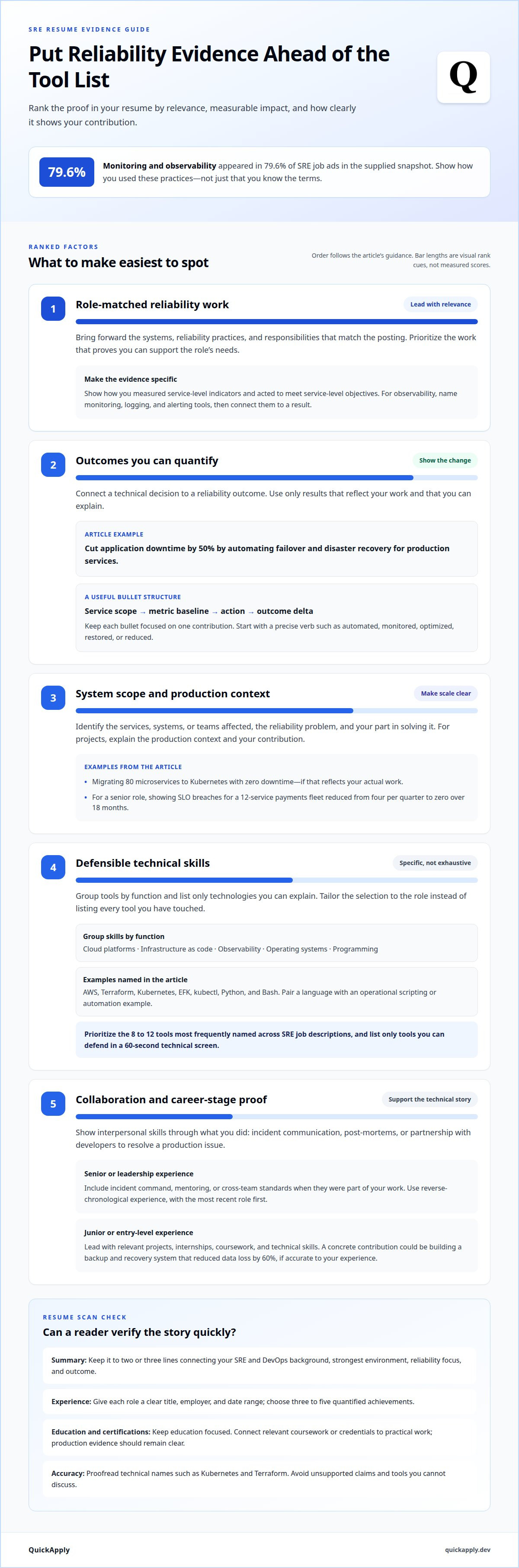
Build the resume around contact details, a focused summary, technical skills, experience, education, and relevant certifications. Put the most role-relevant evidence near the top. Monitoring and observability appeared in 79.6% of the SRE job ads in the supplied snapshot, so show how you use them, not just that you know the terms.
Make your skills section specific and defensible. Group tools by function, such as cloud platforms, infrastructure as code, observability, operating systems, and programming. List AWS, Terraform, Kubernetes, EFK, or kubectl only if you can explain how you used them. Include Python or Bash if you’ve used them to script operational tasks. Show interpersonal skills through evidence, such as coordinating incident response or working with developers to resolve a production issue.
- Reliability: Show how you measured service-level indicators and acted to meet service-level objectives.
- Observability: Name monitoring, logging, and alerting tools, then connect them to a result.
- Programming: Pair Python, Bash, or another language with an automation example.
- Collaboration: Describe incident communication, post-mortems, or partnership with a development team.
Use concise experience bullets with four elements: service scope, metric baseline, action, and outcome delta. For example, “Cut application downtime by 50% by automating failover and disaster recovery for production services.” Start with precise action verbs such as automated, monitored, optimized, restored, or reduced. Keep each bullet focused on one contribution.
A reverse-chronological format is usually effective for a site reliability engineer resume, especially for senior and leadership roles. Put your most recent experience first, followed by earlier roles, with dates and clear headings. This helps hiring teams quickly scan your career progression and the scope of your reliability work.
For a junior or entry-level SRE resume, lead with relevant projects, internships, coursework, and technical skills. Show a concrete contribution, such as building a backup and recovery system that reduced data loss by 60%, if that accurately reflects your work.
Avoid copying sample resumes, listing tools you can’t discuss, or leaving typos in technical terms. Proofread names such as Kubernetes and Terraform, and make sure every claimed result reflects your own experience.
Professional summary emphasizing SRE and DevOps experience
Keep your professional summary brief and specific. Use two or three lines to connect your SRE and DevOps background to the role’s needs. Name your strongest environment, reliability focus, and outcome. For example: “SRE with 5+ years scaling high-traffic applications on AWS, maintaining 99.99% uptime and reducing critical incidents by 35%.” Use only results you can explain in an interview.
Make career progression visible in your experience section. Give each role a clear title, employer, and date range, then select three to five quantified achievements. For example, describe how you used observability modernization and runbook automation to reduce mean time to repair from 47 minutes to 11 minutes. A strong bullet starts with an action, identifies the system or technology, and ends with a result.
What SRE projects should be included on a resume? Choose projects that demonstrate reliability engineering, such as infrastructure migration, deployment automation, incident recovery, or capacity improvements. Explain the production context and your contribution; for example, describe migrating 80 microservices to Kubernetes with zero downtime if that reflects your actual work.
Senior SREs should show both technical scope and leadership. Describe the services or teams affected, the reliability problem, and how you drove the response. For example, a senior candidate could show how they reduced SLO breaches for a 12-service payments fleet from four per quarter to zero over 18 months. Include incident command, mentoring, or cross-team standards when those were part of your work.
Tailor experience bullets to the job description. Bring matching work to the top, then use the posting’s language for relevant responsibilities without copying claims that aren’t yours. Prioritize the 8 to 12 tools most frequently named across SRE job descriptions, and list only tools you can defend in a 60-second technical screen. A project is useful when it proves the capability the role requires.
If adapting each version takes time, use resume tailoring for specific roles to align your experience with the job description.
Education, coursework, and certifications
Keep education focused on the technical foundation behind your SRE work. List your degree, institution, and graduation year, then add coursework directly tied to infrastructure, software systems, networking, or distributed computing. For example, a Bachelor of Science in Computer Science earned in 2018 gives a clear credential and date without crowding out hands-on experience.
For candidates with 3+ years of SRE-relevant experience, keep the education section lean. Put production work and demonstrated reliability skills ahead of older coursework. If you’re earlier in your career, use relevant classes, labs, and projects to show applied knowledge. A useful entry connects what you studied to what you did: after learning Terraform in a cloud infrastructure course, you used it to automate a deployment lab and improved repeatability.
Choose certifications that support the role’s technical focus. Kubernetes credentials can reinforce cluster experience, while cloud or DevOps certifications can support infrastructure automation and incident response. A credential adds context, but your resume still needs evidence of how you used the technology. Pair each certification with a project or job bullet that shows its practical application.
For 2026 planning, the listed study-time estimates are 40 to 60 hours for CKAD, 60 to 90 hours for CKA, and 80 to 120 hours for AWS Certified DevOps Engineer Professional. Use those estimates to plan preparation, not as resume achievements. List a completed certification with its exact name and status; keep in-progress study separate so readers can distinguish earned credentials from planned ones.
Make every entry useful. If your coursework covered observability, explain how a lab helped you detect and analyze incidents. If a certification supported your cloud operations knowledge, connect it to an infrastructure change you worked on. For example, you might describe studying Kubernetes, applying that knowledge in a deployment project, and documenting how the change improved recovery. This links learning, action, and operational value without overstating your experience.
Professional summary
Use a resume headline to identify your role and strongest focus. “Site Reliability Engineer | Kubernetes | Distributed Systems” signals your technical fit before hiring teams reach your experience. Keep the headline aligned with the target role instead of listing every platform you’ve used.
How should you write an SRE resume summary or objective? Aim for three to four sentences, kept to three or four lines, that explain your scope, strongest contribution, and interest in SRE. Experienced candidates should use a summary; candidates without direct SRE experience can use an objective that connects relevant work to reliability operations. A practical approach to how to write a resume for a site reliability engineer starts with the role’s priorities.
Make the first sentence specific. For example, an SRE with 8 years supporting distributed platforms could name Kubernetes, production operations, and reliability improvements. Then add a measurable result that belongs to your own record. A statement such as “reduced incident rates by 40%” works only when you can explain the baseline, action, and measurement period in your experience bullets.
Technical context makes broad claims easier to evaluate. One example describes managing 120 microservices across 8 Kubernetes clusters at 3,000 requests per second. That scope communicates more than “managed large-scale systems.” Add the responsibilities you personally owned, such as alerting, capacity planning, or recovery processes.
Tailor the summary to each job description. If the role emphasizes a CI/CD pipeline, bring relevant deployment work forward. If it prioritizes automation, name the scripting language or platform you used, such as Python or Kubernetes. When deciding how to write a resume for a site reliability engineer, make each summary detail relevant to the target role. Be precise: say what you built or improved rather than calling yourself “passionate about technology.”
For an entry-level objective, connect a specific project to the role. For example, describe a Python monitoring project, the production-like problem it addressed, and what its alerts helped identify. Avoid generic goals, unsupported uptime claims, and keyword lists without evidence. Hiring teams should understand your focus and value from the summary alone.
Make each version fit the position with resume tailoring for SRE roles.
QuickApply: Resume Tailoring
QuickApply helps tailor your resume to a specific SRE job description in seconds. Use it when you’re applying for roles with different priorities, such as Kubernetes operations, cloud infrastructure, or incident response. Its match score can help identify how closely your resume fits each opportunity.
QuickApply also offers cover letter generation, interview practice, and application tracking. Keep your application materials aligned, prepare to discuss the experience you’ve highlighted, and manage active applications in one place.
Start tailoring your resume to your SRE applications with QuickApply.
Keep Your Next Application Moving
Your resume should evolve with your work. Each new project, incident, or operational improvement gives you fresh evidence to highlight. Treat every application as a focused release: align your message with the role, keep your claims accurate, and make your next step clear.
Knowing how to write a resume for a site reliability engineer means more than documenting past work. It means presenting your strengths clearly for the role ahead and preparing to discuss them with confidence. QuickApply supports that process with Resume Tailoring, Cover Letter Generation, and Interview Practice.
Contact QuickApply for resume help and take your next application forward. Your experience has value; make it count in the opportunities you pursue.
Frequently Asked Questions
How do you highlight on-call experience on an SRE resume?
Describe your on-call rotation, incident responsibilities, and what changed after incidents. State the schedule, such as one week out of four, then explain how you triaged alerts, coordinated responders, or updated runbooks. Include incident volume and mean time to recovery when you have reliable figures. Close with a specific follow-up, such as improving an alert or documenting a recurring failure pattern.
Should an SRE Engineer include development experience on their resume?
Yes. Development experience shows you can understand application behavior and improve operations through code. Highlight work such as building deployment scripts, adding health checks, or debugging production failures with developers. Name the language and system involved, then describe the operational result. For example, explain how a Python utility replaced manual log review and helped responders find relevant errors faster.
What's the difference between a DevOps resume and an SRE resume?
A DevOps resume often emphasizes delivery workflows, infrastructure automation, and collaboration between development and operations. An SRE resume should foreground reliability outcomes, incident response, service objectives, and production system health. The roles overlap, so adjust the emphasis rather than hiding shared experience. For a reliability-focused opening, describe how a pipeline change affected deployment safety or how operational feedback informed engineering work.
What skills and keywords should an SRE resume include?
Use terms that accurately reflect the role and your experience. Common SRE themes include service-level indicators, service-level objectives, incident response, observability, capacity planning, cloud infrastructure, automation, and continuous delivery. Connect each keyword to evidence rather than presenting a detached list. For example, explain how you tuned alerts to distinguish actionable signals from routine system noise.
How can SREs describe their experience using measurable impact and metrics?
Choose metrics that reflect the system’s starting point and the results of your work. Useful measures include uptime, incident frequency, recovery time, deployment errors, and services supported. State the timeframe and scope so readers can interpret the result. If exact baselines aren’t available, use a conservative estimate and clearly describe the period. Don’t imply greater precision than your records support.
What tools and technologies should SREs list on their resume?
Prioritize tools that appear in the target role and that you can explain through hands-on examples. Organize them by purpose, such as monitoring, logging, CI/CD, cloud platforms, infrastructure as code, containers, and scripting. Prometheus, Grafana, Jenkins, and Docker may be relevant when they reflect your actual work. Describe the task each tool supported, not just its name.


