

No job is fully recession-proof. A strong 2026 job search strategy for a recession focuses on roles tied to essential work, skills that are harder to automate, and evidence that you can adapt when priorities shift.
When hiring slows and employers become more selective, it makes sense to look for stability. But a familiar job title alone won’t show how secure a role is. Look at the work behind it, the employer’s hiring signals, and how clearly your experience matches the team’s needs.
This guide shows you how to assess role stability, read hiring signals, position your resume around strategic impact, and estimate when recession-resistant skills may pay off. You’ll leave with a practical way to focus your search and make your next move more deliberately.
Key Takeaways
- Prioritize skills linked to essential work, and pair complementary capabilities to stay adaptable across roles.
- Read hiring plans and unemployment trends as signals, then assess each employer’s priorities and the role’s contribution.
- Evaluate public-sector roles by the work they support and how closely your experience fits their needs.
- Tailor your resume to each job description and show measurable ownership of outcomes, not just assigned tasks.
Q: How quickly do these “recession-resistant” skills pay off?
Skill-building can move faster than a degree program. Many AI, analytics, and operations skills can reach a job-ready level in 3-6 months or less. The payoff depends on whether employers need that capability and whether you can show its practical effect. Build a work sample, such as a KPI dashboard or an automated reporting workflow, to connect learning with business outcomes.
Build complementary skills rather than collecting unrelated credentials. Pair data literacy with project management so you can explain performance and coordinate a response. Develop AI literacy by practicing how to prompt tools, assess their output, automate repetitive tasks, and integrate AI into workflows. For operations roles, focus on process improvement, workflow design, standard operating procedures, resource planning, and cross-functional coordination.
Target essential functions, not supposedly “recession-proof” titles. Healthcare is one example: the U.S. Bureau of Labor Statistics projects healthcare occupations to grow much faster than the average for all jobs over the decade. Infrastructure, cybersecurity, and operations can also involve work that organizations need to maintain. Assess each role’s core duties and how difficult those tasks are to automate.
For a job search during a slowdown, combine networking, referrals, recruiters, and online applications. Referrals and direct introductions can connect you with hiring managers, while specialized recruiters may know openings that aren’t publicly posted. Identify 5-10 people in your target field, request a 15-20-minute coffee chat, and send thanks within 24 hours.
There’s no universal weekly application target. Base yours on the number of relevant openings, then track tailored applications, follow-ups, referrals, and interview responses. If applications aren’t leading to interviews, revise your resume or target roles before increasing volume.
Temporary, contract, part-time, and gig work can build relevant experience and sometimes lead to full-time roles. Contract and project-based work is common in marketing, creative fields, and technology. Prioritize assignments that give you concrete examples to discuss, such as a completed analytics project or a documented process improvement.
Protect yourself from job scams and financial pressure. Don’t pay upfront to secure a job, and treat requests for sensitive information before a credible hiring process as a warning sign. Verify the employer and role through official company channels before sharing personal details. Consider essential expenses when weighing unpaid training or gig work.
Hiring plans and unemployment
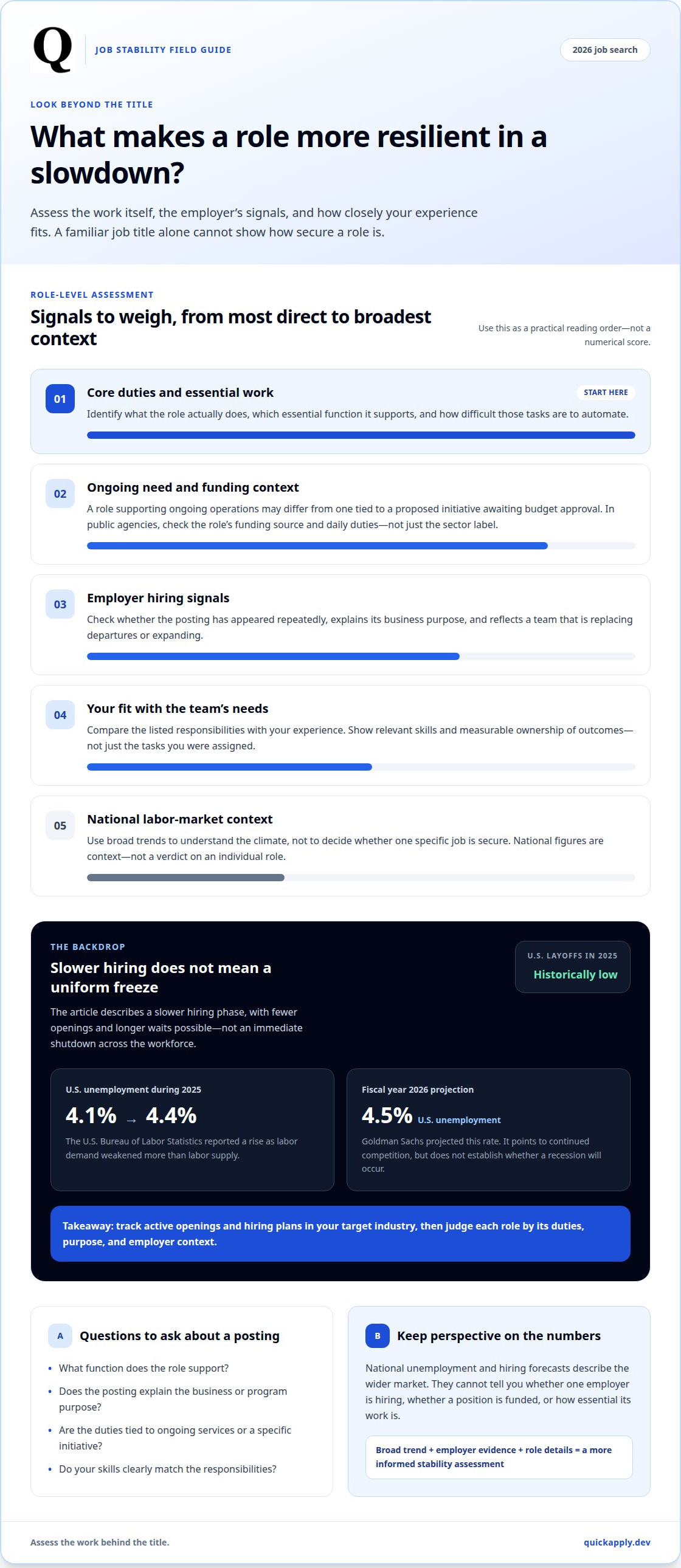
The U.S. labor market entered a slower hiring phase, not a uniform hiring freeze. According to the U.S. Bureau of Labor Statistics, unemployment rose from 4.1% to 4.4% during 2025 as labor demand weakened more than labor supply. Layoffs remained historically low that year, even as employers slowed hiring. For job seekers, that can mean fewer openings and longer waits, rather than an immediate shutdown across the workforce. A job search strategy for a recession 2026 should account for that uneven pace.
For 2026, most forecasters expected modest U.S. job growth. Goldman Sachs projected a 4.5% U.S. unemployment rate for fiscal year 2026. That points to continued competition, but it doesn’t establish whether the economy will enter a recession. Track hiring plans in your target industry, active openings, and whether employers are replacing departing workers or expanding teams. National figures offer context, not a verdict on one role.
Look for employer signals before prioritizing an application. Check whether the role has appeared repeatedly, whether the posting explains its business purpose, and whether the team has changed recently. A position supporting ongoing operations may be different from one tied to a proposed initiative awaiting budget approval. Identify the function it supports, such as customer service, administration, or education, and compare that with the employer’s hiring activity and the listed responsibilities.
When employers hold more leverage, negotiate with a clear range and evidence of your contribution. Research comparable roles, then connect your request to relevant skills, scope, and results. In a 2026 slowdown, consider whether a salary below peak market rates fits your needs. Weigh the full offer, including responsibilities and growth potential. A salary negotiation guide can help you prepare talking points and evaluate tradeoffs. Use a job search strategy for a recession 2026 to define your priorities before negotiating, so your choices align with both immediate needs and longer-term goals.
Public-sector employment stability
Government work has a different stability profile, but it isn’t immune to budget pressure. Public agencies deliver essential services such as public health, transportation, education, and emergency response. Those services may remain priorities during a slowdown, while particular programs or vacancies can still be affected by funding changes. Assess a role’s funding source and daily duties, not just its public-sector label.
Compare roles at the federal, state, and local levels. For example, a transportation department may need operations staff to keep services running, while a project role may depend on a specific infrastructure program. Read the posting for the program’s purpose and funding context, and check whether the duties support ongoing services. These details show how closely the job connects to the agency’s core work.
Public employment depends on public budgets and priorities. A change in administration can shift program emphasis, while budget decisions can affect hiring timelines and team plans. Before applying, review the agency’s current priorities and recent announcements. Then connect your experience to the work it identifies, such as maintaining systems, serving residents, or improving program delivery.
Translate private-sector experience into public-service outcomes. If you managed vendor operations, explain how you coordinated deadlines, documented processes, and resolved delivery issues. For an education agency role, highlight program coordination, data reporting, or communication with schools. Use specific examples to show how your work supported reliable services, responsible resource use, or measurable operational improvements.
Tailor each application to the government role. Match your resume to the listed duties, use the agency’s terminology accurately, and address required qualifications directly. In your cover letter, explain how your experience fits the specific program or operation. Keep claims verifiable: identify the process you improved, the stakeholders involved, and the outcome you can document.
Weigh stability against your own priorities. A public position may offer meaningful work, but hiring can be structured and program needs can change. Compare the role’s responsibilities, funding context, location, and employment terms with your financial and career goals. Treat government employment as one option in a broader job market, not a guarantee against change.
Resume positioning and strategic ownership
In a tighter job market, your resume needs to show how your work supports the employer’s priorities and budget. Start with the role’s needs, then connect each one to a relevant result. If the posting calls for workflow improvement, describe the process you changed, the teams involved, and the outcome. Replace broad claims such as “strong communicator” with a specific example of a project you led.
Use the job description as a guide for tailoring your resume. Align its language with the role’s core skills and responsibilities, especially when employers use automated screening. If the job calls for dashboard reporting, name the tools you used and the decisions your reports informed. Keep every term accurate and tied to real experience. Then align your LinkedIn profile with the same career story so both present a consistent picture.
Show strategic ownership by explaining your decisions, not just your assignments. Describe what you noticed, what you did, and how the work changed. For example, a project coordinator might explain how they identified recurring approval delays, redesigned handoffs, and helped teams move work forward. Include the scope, stakeholders, and documented outcomes when available. This shows how you contribute beyond routine execution as automation reshapes tasks.
Make the resume easy to scan. Put the most relevant skills and projects near the top, then use concise bullets that connect action to impact. Tailor the summary for each target role, whether it emphasizes operations, analytics, or team leadership. Avoid presenting every past duty as equally important. A role-specific version helps recruiters see how your experience remains useful under changing priorities. Tailor your resume to each role and keep your strongest evidence visible.
QuickApply
QuickApply helps make a recession-era job search more focused and organized. Use Resume Tailoring and Cover Letter Generation to align each application with the role’s requirements. Prepare with Interview Practice, then use the Application Tracker to manage applications and follow-ups.
Use QuickApply once you’ve identified target roles and want to present your experience clearly across applications. The platform supports the application process; you choose the roles, assess their stability, and decide which opportunities fit your priorities.
Start with QuickApply to organize your application process.
Make your next move deliberate
Build your job search strategy for a recession in 2026 around a clear target, not activity for its own sake. Choose the roles that fit your strengths, then make each application show how you can solve a real business need. Keep refining your approach as you learn which messages earn responses and which priorities appear consistently in the openings you pursue.
Build momentum with a repeatable routine: focus your applications, prepare for interviews, and keep your materials aligned with the roles you want. QuickApply helps organize those steps, leaving you more time to make deliberate career decisions.
Contact QuickApply for job search support and take the next step with a clearer, more organized search. You can move forward with focus, one strong application at a time.
Frequently Asked Questions
What Makes a Job Truly Recession-Proof?
No job is completely recession-proof. Roles may be more resilient when they support work an organization must continue, such as maintaining essential systems or delivering a required service. Look beyond the title: consider the tasks, who depends on them, and whether they require judgment, coordination, or specialized expertise. For example, resolving complex system failures may be harder to automate than routine data entry.
Do these skills guarantee job security?
No skill guarantees that a position will remain secure. Strong skills can expand your options, but employers may still shift priorities, restructure teams, or cut spending. Make your capabilities transferable by documenting work samples and outcomes. A data analyst, for instance, can show how a dashboard informed decisions and adapt that evidence for employers in other sectors.
What if I want to future-proof my career but don’t know where to start?
Start by reviewing descriptions for roles you would realistically pursue. Note the skills that appear repeatedly, then choose one that builds on your experience. Set a small, concrete goal to demonstrate it, such as creating a sample process map or analyzing public data. This gives your learning direction and produces evidence to discuss in applications.
Which industries and occupations are hiring most during a U.S. recession in 2026?
Healthcare is worth investigating, though no industry is guaranteed to keep hiring during a downturn. The U.S. Bureau of Labor Statistics projects healthcare occupations to grow much faster than the average for all jobs over the decade. Narrow your search to specific occupations and employers, then assess current openings and the duties each role supports.
How can job seekers identify recession-resistant employers and roles?
Prioritize roles connected to an employer’s ongoing services, then test that connection during interviews. Ask what the team needs to deliver, how the role supports those priorities, and which outcomes define success. Compare the answers with the posting. A clear link between daily duties and core operations is more useful evidence than a broad claim about company stability.


