

Your friend’s FAANG offer is not a verdict on your career. If you’re thinking, “my friend got a FAANG offer and I feel left behind,” remember that one person’s milestone doesn’t define your potential or set your timeline. Feeling envy or disappointment doesn’t make you a bad friend; it may simply mean comparison is drowning out your own goals.
It’s understandable that a high-profile offer can prompt doubts about your progress. You don’t have to suppress those feelings or turn them into a race. Acknowledge the sting, then decide what you want your career to mean.
This article looks at ways to step back from peer comparisons, respect your own timeline, define success by your values, and recognize the progress you’ve made. The goal isn’t to diminish your friend’s achievement. It’s to stop treating it as the benchmark for your life.
Key Takeaways
- Separate your friend’s career milestone from your own worth, and notice when comparison is steering your decisions.
- Build your career around the pace and priorities that fit your life, not an assumed schedule.
- Use your personal values to define success beyond job titles, salary, or status.
- Make your progress visible by recognizing what you’ve achieved and choosing a practical next step for your job search.
Comparing yourself with peers
A friend’s FAANG offer can make career progress feel like a scoreboard, especially when you’ve known each other for years. If you’re thinking, “my friend got a FAANG offer and I feel left behind,” take it as a prompt to examine what you want, not as a verdict on your future.
Coping With Feeling Left Behind
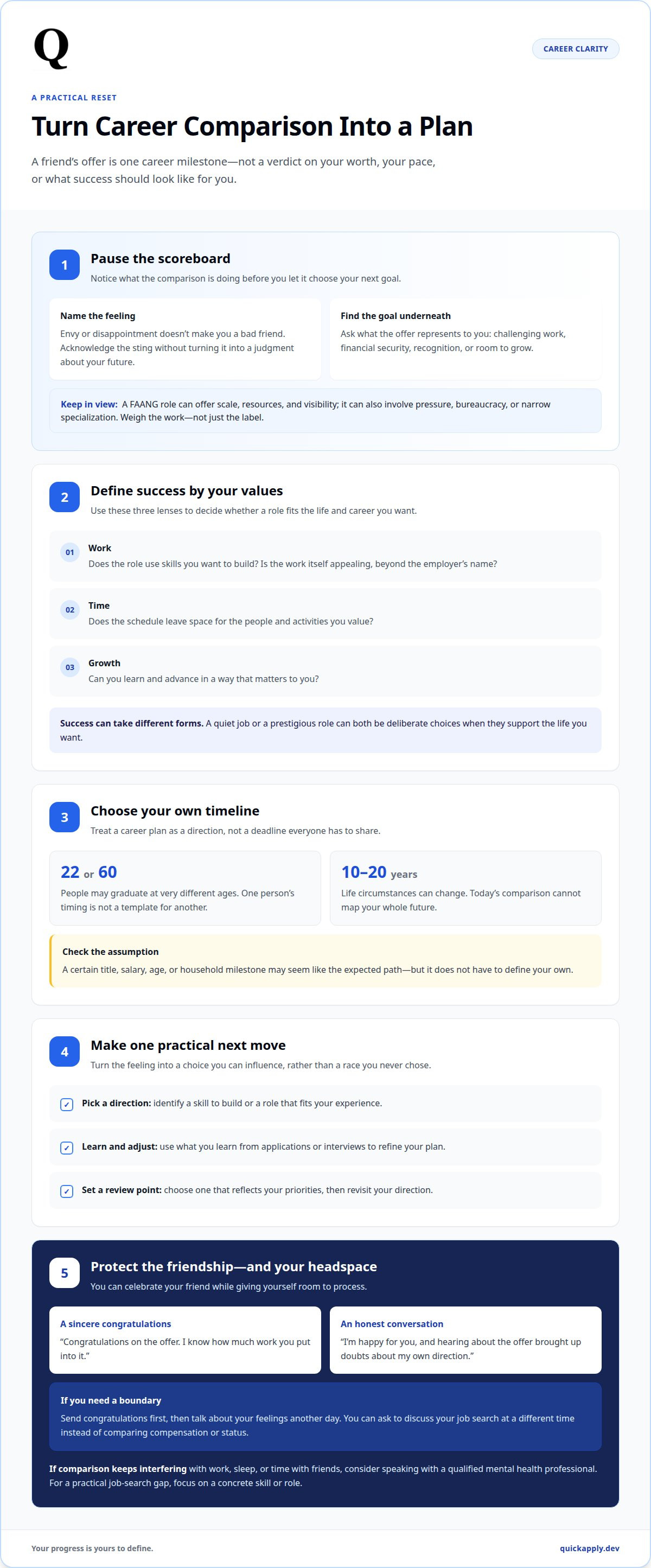
Feeling left behind means believing a friend’s success proves your own career is behind schedule. That belief matters because comparison can push you toward goals you never chose. Name the feeling, then identify one skill or opportunity you genuinely want to pursue.
Friends who have known each other for 5-6 years can still take different routes. One commenter spent three years at a smaller company before Meta returned with a two-level promotion. FAANG roles can offer scale, resources, and visibility; they can also involve pressure, bureaucracy, or narrow specialization. Weigh the work itself, not just the label.
Congratulating a Friend While Feeling Jealous
A sincere congratulations recognizes your friend’s achievement without pretending you feel nothing. An honest response can protect the friendship while leaving you room to process envy.
Try, “Congratulations on the offer. I know how much work you put into it.” If you need time, send that message first and discuss your feelings later. Avoid turning their celebration into a comparison of compensation or status. One commenter earning $250,000 still compared their pay with friends earning two or three times more, showing how the target can keep shifting.
Talking About Career Envy Without Resentment
A direct conversation lets you describe your feelings without blaming your friend. It can keep unspoken frustration from shaping the relationship.
Try: “I’m happy for you, and hearing about the offer brought up doubts about my own direction.” Keep the focus on your experience, then ask for a practical adjustment, such as talking about your job search another day. Saying “my friend got a FAANG offer and I feel left behind” can open the conversation, but explain what support would help instead of making your friend responsible for fixing the feeling.
Seeking Support for Career Envy
Consider mental health support if career comparison becomes hard to manage alone or starts affecting your daily life. Support can give you space to understand recurring thoughts and develop coping strategies.
If thoughts about the offer repeatedly interfere with work, sleep, or time with friends, consider speaking with a qualified mental health professional. If your concern is mainly a practical job-search gap, choose a concrete next step, such as identifying a skill to build or a role to pursue.
Different career and life timelines
A career plan is a direction, not a deadline shared by every friend. One person may graduate college at 22; another may graduate at 60. Those examples show how differently education and work can fit into a life. A FAANG offer marks one career event, not proof that everyone else missed their window.
Fixed milestones can make a personal timeline feel like a failing schedule. Cultural expectations often imply that people should have progressed on their chosen path by their 30s. Someone turning 30 may compare a friend’s offer with peers who seem to have children or mortgages. Those impressions can feel like rules, but they don’t determine what your own life should contain.
After a disappointing job search, make a plan around what you can influence. First, acknowledge the setback without turning it into a verdict on your future. Then choose a direction, such as building a skill or targeting roles that fit your experience. Set a review point based on your priorities, and adjust your plan using what you learn from each application or interview.
Letting go of a fixed timeline means choosing an order that works for you. A household with two children may represent success to one person; another may prefer a quiet job and more time outside work. Circumstances can change over the next 10 to 20 years, so today’s comparison can’t map your whole future. Ask whether getting into FAANG has become your life mission, or whether it represents something else, such as growth, security, or recognition. Pursue that underlying goal on a timeline that fits your life.
There is no single correct order for life events; people can find an order that works for them. For example, 22-year-olds who were high-school sweethearts and are now happily married illustrate one possible path, not a template that everyone must follow.
A Fishbowl commenter suggests considering whether getting into FAANG has become the job seeker’s life mission. The author estimates that 50% of their peers have children and 75% have mortgages. Those figures describe the author’s peers rather than a universal checklist. A household with 2 children is another example of a conventional image of success, but it need not define what a meaningful life looks like for someone else.
Defining success according to personal values
A FAANG title can look like a universal scorecard, but success depends on what you value. Define it through your priorities, not a salary figure or location. Someone who wants time for family may make different choices from someone who values rapid advancement. Both can be deliberate and successful.
Separate the visible reward from the need underneath it. If your friend’s offer sparks envy, ask what you want it to represent: challenging work, financial security, recognition, or room to grow. Then consider whether you need a FAANG role to meet that need, or whether another path could work. This keeps one company’s name from becoming your entire career filter.
- Work: Does the role use skills you want to build?
- Time: Does the schedule leave space for people and activities you value?
- Growth: Can you learn and advance in a way that matters to you?
A quiet 9-to-5 job can be a valid choice if it supports the life you want. So can living alone with ten cats, if that life brings you contentment. These examples challenge the assumption that status, a prestigious employer, or a conventional household must define achievement. The useful test is whether your daily choices align with your priorities, not whether they impress your peers.
Values can differ even within one friendship. One commenter described having a three-year-old son and valuing work breaks that let them spend time with him. That priority may matter more than a title or faster promotion. Write down what you want more of, such as autonomy, learning, stability, or time with loved ones, and use those priorities to evaluate opportunities. A job offer is one data point, not a verdict. Your definition of success should guide your next move, even when a friend’s path looks more impressive.
Recognizing personal accomplishments
A friend’s offer can dominate your mental dashboard and hide your own milestones. Reset your view by listing achievements you control, such as completing a project, learning a tool, or asking for feedback. Earning a four-year college degree is one meaningful accomplishment, but progress also includes skills developed and responsibilities handled.
After a rejection, acknowledge the disappointment instead of treating it as a final verdict on your career. Separate the hiring decision from your self-worth: the employer chose one candidate for one role, but your experience remains yours. Try writing about a recent challenge you handled, or reread a colleague’s compliment that reflects a real strength.
Set realistic career goals by choosing a specific action within your control, such as revising a project example or preparing for an interview. Track applications, conversations, and practice completed, then review what you learn. That record makes progress visible without using a friend’s offer as the benchmark.
- Evidence: Save a compliment that names a skill you demonstrated.
- Effort: Note a challenging task you completed or improved.
- Learning: Record one insight from an application or interview.
Your own achievements are a more useful comparison point than a friend’s résumé. One commenter advised focusing on personal accomplishments rather than obsessing over friends’ success. That shift doesn’t erase their achievement; it gives you evidence about your own progress. For example, finishing a difficult project while searching for work shows follow-through, even without a new title.
Make the evidence easy to retrieve. An application tracker can organize roles and next steps, helping you see activity beyond offer announcements. Use an application tracker to keep your job-search progress visible and turn your next move into a manageable task.
QuickApply
QuickApply can help turn your next career move into a focused application workflow. When you’re ready to pursue roles that fit your goals, use Resume Tailoring and Cover Letter Generation to adapt your materials to specific job descriptions. Interview Practice can help you prepare your responses, while the Application Tracker keeps your search organized in one place.
These tools support practical job-search tasks. They won’t decide what success means to you, but they can help you act on the direction you choose. Start with the role you want to target, then use the relevant tools to prepare and track your applications.
Contact QuickApply to discuss using it for your job search.
Make your next move your own
Your friend’s offer can prompt a useful question: what do you want your next role to make possible? Let your answer shape your search instead of turning someone else’s career into your performance metric. If the thought “my friend got a FAANG offer and I feel left behind” returns, treat it as a cue to reconnect with the goals you chose for yourself.
Then turn that direction into action. QuickApply supports your job search with Resume Tailoring, Cover Letter Generation, and Interview Practice, helping you prepare materials and practice for roles that fit your priorities. Use the tools that match your next step, whether you’re applying or preparing to talk about your experience.
Contact QuickApply for support with your job search. Your path doesn’t need to match your friend’s to move forward. Choose the next step that fits, and keep building from there.
Frequently Asked Questions
Why do I compare my career progress to my friends?
You may compare careers because friends are familiar reference points for judging your own progress. A new FAANG offer is visible and easy to measure, while skills you’ve gained or work you enjoy can be less obvious. For example, hearing that a friend was promoted may make your steady role feel stagnant, even if you’re learning valuable systems or taking on meaningful responsibilities.
How can I stop comparing myself to others professionally?
Reduce triggers and give your attention a more useful target. If career updates in a group chat leave you spiraling, mute the conversation temporarily and check it when you feel grounded. When comparison returns, write down what caught your attention, such as the title or company, then decide whether it reflects a goal you actually want. This turns automatic comparison into a deliberate choice.


