

What if your family’s repeated “Any updates?” questions are meant to help, but make every application feel like a progress report? If you’re figuring out how to handle job search pressure from family, you’re not wrong to want both encouragement and room to run your search your way. Concern can come from love, but unsolicited advice and constant check-ins can still drain your focus.
You don’t have to choose between setting boundaries and keeping your family close. A predictable update rhythm can reassure them while protecting your time and confidence. The goal is clear communication, not shutting people out.
This guide covers ways to respond calmly to intrusive or discouraging questions, agree on support that’s actually useful, and build a realistic job-search routine. You’ll find practical scripts for tricky conversations and ways to share progress without turning your search into a performance. If tracking applications helps, use it to keep your next update concise and grounded in what you’ve done.
Key Takeaways
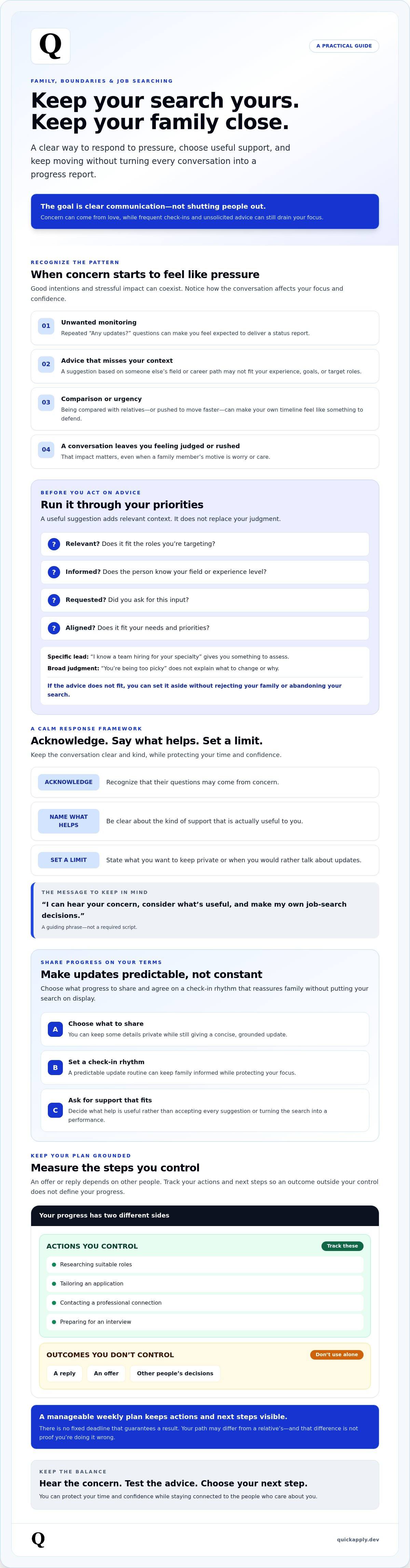
- Recognize when concern has turned into unwanted monitoring, comparison, or urgency, and name what’s making the search harder.
- Before acting on family advice, check whether it’s relevant, informed, requested, and aligned with your priorities.
- Learn how to handle job search pressure from family with a calm response that acknowledges their concern, states what would help, and sets a clear limit.
- Choose what progress to share and set a check-in rhythm that keeps family informed without putting your search on display.
- Use a manageable weekly plan to track actions and next steps, so outcomes outside your control don’t define your progress.
Why Job Search Pressure from Family Can Feel So Overwhelming
A job search already involves uncertainty: you choose roles, prepare applications, and wait for decisions you can’t control. Frequent questions can add another layer of work. Instead of focusing on your next step, you may find yourself preparing a status report or defending why the process is taking time. To decide how to handle job search pressure from family, first identify what the pressure looks like in practice.
It might be unwanted monitoring, unsolicited advice, comparisons with other people, or demands to move faster. Supportive curiosity leaves you room to answer honestly, or to keep some details private. Pressure feels different: you leave the conversation feeling judged, rushed, or expected to follow someone else’s plan. Good intentions and stressful impact can coexist.
What family members may be reacting to
Relatives may connect employment with security, independence, or a predictable future. If they’re worried, they might ask for updates often or suggest the first available role, even when it doesn’t match your goals. Their own career path can shape what they consider a sensible timeline or a successful job. You can recognize that concern without treating every suggestion as useful. A motive may explain a comment, but it doesn’t make the advice right for you.
How pressure can affect the job-search experience
Being scrutinized can make each unanswered application feel like evidence you need to defend yourself. You might second-guess your target roles, feel ashamed about needing more time, or lose focus after a tense conversation. That reaction doesn’t mean you’re ungrateful or unwilling to work. Pressure can also trigger psychological reactance, a negative response to feeling that your choices are being restricted.
Unsolicited advice may miss important context. A relative might recommend a role based on what worked in their field, while your experience, priorities, or target industry call for a different approach. Advice is more useful when it reflects your goals and the realities of the roles you’re pursuing. If it doesn’t, you can set it aside without rejecting your family or abandoning your search.
Separate Your Family’s Fears from Your Own Job-Search Decisions
Before responding to someone else’s timeline, get clear on your own. What roles are you targeting? Which priorities matter most right now, such as pay, flexibility, or room to grow? What steps are you already taking? Writing down a few answers can help you distinguish a relative’s anxiety from your actual plan.
Someone else’s fear is real to them, but it isn’t evidence about your prospects. You can acknowledge that a family member wants you to feel secure without taking responsibility for calming every worry or changing your search to meet their preferred deadline. Understanding their concern doesn’t mean they get to make your decisions.
Check whether advice fits your situation
Use a quick filter before acting on advice. Is it relevant to your target role? Is the person familiar with your experience level or field? Did you ask for input? Does the suggestion fit your needs and priorities? If most answers are no, you can listen politely and choose not to follow it.
Separate useful leads from broad judgments. “I know a team hiring for your specialty” gives you something specific to assess. “You’re being too picky” doesn’t explain what to change or why. For career decisions, compare suggestions with information from trusted, relevant sources, such as people familiar with the role or hiring practices in your field. Advice should add context, not replace your judgment.
Define progress on terms you can control
An offer or reply depends on other people, so it can’t be your only measure of effort. Track actions you control instead: researching suitable roles, tailoring an application, contacting a professional connection, or preparing for an interview. These steps give you a clearer view of whether your process is moving forward, even during a quiet stretch.
There’s no fixed deadline that guarantees a result. Your search may take a different path from a sibling’s, a parent’s, or a relative’s memory of their own career. That difference isn’t proof you’re doing it wrong. If a record helps you see your actions clearly, a job application tracker can keep applications organized and make it easier to review your progress.
This distinction is central to how to handle job search pressure from family: hear the concern, test the advice, then choose based on your goals and the facts you can verify. You don’t need to win an argument to take ownership of your next step.
What to Say When Family Pressures You About Finding a Job
You don’t need a perfect speech. Use a simple sequence: acknowledge their concern, say what would help, set a limit, then redirect the conversation. Keep your wording calm and specific. You’re not required to predict when you’ll get an offer or promise an outcome that depends on employers.
“I appreciate that you care. I’m happy to keep you in the loop, and I’d like us to talk about my search without setting a deadline I can’t control.” This recognizes the relationship while making the limit clear.
Scripts for repeated questions and unsolicited advice
Adjust how much detail you share based on the person and the moment. A short, steady answer is often easier to repeat than a new explanation each time.
- For “Any updates?”: “I’m still applying and following up. I’ll share more when there’s news I’m ready to discuss.”
- For advice that doesn’t fit: “Thanks for thinking of me. I’m focusing on roles that match my experience and goals, so that route isn’t the right fit for me.”
- For comparisons: “I know everyone’s search looks different. I’d rather focus on the steps I’m taking than compare timelines.”
- For useful support: “If you’d like to help, could you review this specific application for clarity?”
That last redirect turns vague advice into a concrete request. If you don’t want input on an application, offer another useful option, such as listening while you talk through your plan. You get to choose whether support means feedback, practical help, or simply a change of subject.
How to respond when comments become discouraging
If a conversation shifts into criticism, avoid defending every choice. Repeating the boundary keeps the exchange focused: “I hear that you disagree. I’m not discussing my timeline right now.” You can acknowledge the person without reopening a decision you’ve already made.
If the comments continue, end the conversation respectfully: “I care about staying connected, but this is becoming stressful. Let’s pause and talk about something else.” If emotions are rising, take a break rather than forcing a resolution on the spot. Return to the topic later only if you’re both calmer and willing to keep the conversation constructive.
Practicing these lines can help you decide how to handle job search pressure from family before the next check-in. Keep your response brief, repeat it as needed, and share only what you’re comfortable sharing.
Set Job-Search Boundaries Without Rejecting Family Support
A boundary doesn’t have to mean shutting your family out. It can define what you’re comfortable sharing, who you want involved, and when you’re willing to talk about the search. Choose an update rhythm that feels manageable for you and realistic for the relationship. You might prefer a brief conversation every week, a check-in after a milestone, or updates only when you have news to share.
You also get to keep details private. You don’t have to name every employer, share application materials, or report on each interview. Decide what information feels okay to share before the next conversation, so you’re not making that call under pressure.
Create a simple update agreement
Make the routine clear and specific. For example: “I know you want to stay updated. Let’s check in on Sunday evenings. I’ll share the steps I’m taking and anything I’m ready to discuss, but I’m keeping employer names and interview details private for now.” A predictable plan can reduce surprise questions while giving you control over how much you share.
Think of this as a communication agreement, not a punishment. If the schedule stops working, adjust it. You might move check-ins to a quieter day, share less during a stressful stretch, or invite a relative to ask whether you’re open to talking before launching into questions. The goal is a routine that protects your focus and keeps the connection intact.
Ask for support that actually helps
Replace “Can you help me?” with one clear request. You could ask someone to review a particular application, listen while you talk through a decision, or send encouragement without offering advice. Specific requests make it easier for relatives to support you in a useful way. Sometimes the most helpful response is simply, “I don’t need a solution right now. Could you listen?”
If a particular family member keeps turning updates into criticism, you can share less with them and seek encouragement elsewhere. A trusted friend, mentor, or another person familiar with your goals may be better suited to discuss the details. You can value your family while choosing different people for different kinds of support.
To make updates easier, keep a private record of applications and next steps. A job application tracker can help organize that information so you can share a concise progress summary without opening every detail for discussion.
Clear agreements are a practical part of how to handle job search pressure from family. Set the terms, notice what’s working, and revise the routine when your needs change.
Build a Job-Search Routine That Keeps You Moving Under Pressure
A repeatable routine gives your search structure without turning every day into a test of whether you’re “doing enough.” Plan a few focused work blocks around tasks you control, then schedule breaks and a weekly review. For example, use one block to find suitable roles, another to prepare applications, and a later session to follow up or practice interview answers. Adjust the plan to your energy and responsibilities.
At the end of the week, review actions, not just outcomes. An unanswered application doesn’t cancel the time you spent researching a role, tailoring your materials, or preparing for a conversation. Hiring decisions sit outside your control. Your process can still be consistent and worth recognizing.
Make progress visible without reporting every detail
Keep a private record of applications, follow-ups, and interview preparation in a format that works for you. A simple document or application tracker can show what’s done and what needs attention. You don’t need to share the full record with relatives. If a brief update helps reduce repeat questions, summarize only what you’re comfortable disclosing.
For example: “This week I worked on applications and followed up on a role. I’m keeping employer and interview details private, but I’ll let you know when I have news I want to share.” That gives a clear update without turning your search into a report. Keep sensitive details private, even when someone is curious or trying to help.
Use tools to reduce admin, not emotional pressure
QuickApply includes an application tracker to manage your job search in one place, along with resume tailoring for specific job descriptions. These tools can help organize practical tasks. They can’t resolve family conflict, make another person respect a boundary, or guarantee interviews. Use them for workflow support, and keep communication agreements separate from your application system.
That distinction matters when considering how to handle job search pressure from family. A steadier process may help you feel organized, but you still decide what to share, when to share it, and which support is useful. Keep the routine flexible. If a plan starts adding stress instead of reducing it, simplify it and reset your next steps.
QuickApply’s job-search tools include ways to organize applications and tailor resumes to specific job descriptions.
Keep Your Search Moving on Your Terms
Family pressure doesn’t have to decide how you run your job search. You can acknowledge the concern, choose which advice fits your goals, and set a steady rhythm for sharing updates. Clear boundaries protect your focus without closing the door to support.
Keep progress anchored to actions you control, such as preparing applications, following up, and practicing for interviews. If you’re deciding how to handle job search pressure from family, remember that you can adjust your approach as your needs change. You don’t owe anyone a guaranteed timeline or access to every detail.
QuickApply includes an application tracker and tools to tailor resumes and cover letters to specific job descriptions. These can help organize job-search tasks, while communication boundaries remain yours to set.
Explore QuickApply’s job-search tools to organize applications and tailor your materials as part of a routine that works for you.
Frequently Asked Questions
Is it normal to feel stressed when family asks about my job search?
Yes, repeated questions can feel stressful, especially when the search already involves uncertainty and waiting. A check-in may sound caring once, but frequent requests for updates can make you feel monitored or judged. Feeling frustrated doesn’t mean you’re ungrateful or not trying. Notice what part is hardest, such as the timing, the tone, or advice you didn’t ask for. That can help you decide what to share and what boundary to set.
What should I say when my family keeps asking if I found a job?
Give a brief update, then state when you’re willing to discuss it again. For example: “I’m still applying and following up. I’ll let you know when I have news I’m ready to share, and I’d rather not answer this every day.” You don’t need to predict when you’ll get hired. If the questions continue, repeat the same calm response instead of giving a new explanation each time.
How do I set boundaries with family while unemployed?
Set a clear limit on what you’ll share and how often you’ll talk about your search. You might say, “I’m happy to give you an update each Sunday, but I’m keeping employer names and interview details private.” Choose a rhythm that fits your needs and relationship. A boundary is a communication agreement, not a rejection. You can adjust it if your circumstances or comfort level changes.
Can I ask my family to stop giving job-search advice?
Yes. You can appreciate their concern while asking them to check before offering suggestions. Try: “I know you want to help. Advice is useful when I ask for it, so please listen first and let me tell you if I want ideas.” If you welcome a specific kind of help, name it, such as reviewing one application. If not, ask them to encourage you or change the subject.
What if my family thinks I am being too picky about jobs?
Explain the priorities guiding your search, such as role fit, experience level, compensation needs, or working conditions. You don’t have to defend every decision. Ask whether their suggestion includes a specific opportunity or useful information. A concrete lead may be worth reviewing; a broad judgment may not help you choose. Consider advice from people familiar with your target field, then make the decision that fits your circumstances.
How much should I tell my family about my job search?
Share only what feels appropriate and useful to you. You might tell one relative that you’re applying and preparing for interviews, while keeping company names, application details, or interview conversations private. You can also choose different levels of detail for different people. If updates reduce repeated questions, offer a short summary on a predictable schedule. You’re not required to provide a running report or disclose information before you’re ready.
What can I do if family pressure is making it harder to apply for jobs?
To handle job search pressure from family, reduce the interruption first: set a check-in time, mute non-urgent messages during focused work, or pause conversations that turn critical. Then make your next task small and specific, such as reviewing one role or preparing one application. Track actions you control, not just replies or offers. If family conversations remain unproductive, seek encouragement from a trusted person who understands your goals.


