

An unfinished degree doesn’t have to weaken your tech resume. Vague wording can, especially if a recruiter or application system reads your education as a completed credential. If you’re figuring out how to list unfinished degree on resume for tech job applications, make your status unmistakable, then show what you can do.
It’s reasonable to wonder whether college belongs on your resume or how to turn classes into evidence of technical ability. You can include relevant education without implying you graduated. Use clear dates and status, then connect completed coursework to projects, tools, and results that match the role.
This guide will help you decide whether to include your education, choose accurate wording for completed coursework or current enrollment, and avoid formats that create confusion. You’ll also learn how to make projects and outcomes carry more weight, then tailor the details to each job description. The result is a resume that’s direct about your degree status and clear about your technical readiness.
Key Takeaways
- Include unfinished education when it adds relevant evidence, and make your degree status clear.
- Learn how to list unfinished degree on resume for tech job applications with accurate wording for current enrollment or past attendance.
- Choose coursework and projects that demonstrate skills relevant to the role, without overstating your experience.
- Tailor education and project details to each job description so the most relevant evidence stands out.
- Review your resume for clear dates, accurate credentials, readable formatting, and organized application tracking.
Should You List an Unfinished Degree on a Tech Resume?
Include unfinished education when it adds relevant evidence, and label its status accurately. A computer science program can show useful grounding for a junior developer role if you completed coursework in data structures or built a software project. Attendance alone is not the selling point. The value comes from what you learned, built, or applied, alongside your work experience.
An unfinished degree entry is education listed with accurate study details, without claiming that the applicant graduated. That distinction matters: a completed degree is an earned credential, a certificate is a separate qualification, and “in progress” means you’re currently enrolled. A resume or curriculum vitae summarizes qualifications, so make each one clear rather than asking a recruiter to infer your status.
If you’re deciding how to list unfinished degree on resume for tech job applications, use one test: does this education support the role more than the space could be used to show relevant experience, projects, or skills? For early-career applicants, coursework and labs can provide useful evidence when professional experience is limited. For experienced applicants, technical results may deserve that space instead.
When does unfinished education strengthen a tech resume?
Include it when completed coursework or labs connect directly to the target role. For a software job, that could be coursework in algorithms or a programming lab project. For data or IT roles, choose classes and practical work that demonstrate relevant foundations, such as database queries or network configuration. Don’t list a long course catalog. Select a few items that match the job description and support your claims.
Early in your career, this context can help show where you developed technical skills. If you already have substantial, relevant experience, leave out education that adds no useful evidence and use the space for results, tools, or shipped projects. The goal is a focused resume, not a complete academic history.
What should the entry communicate immediately?
Make the school, field of study, and attendance dates easy to identify. If you’re still enrolled, state “In progress” and include an expected graduation date only if it’s accurate. If you’re no longer enrolled, show the dates attended and describe the program or relevant completed coursework. Don’t label a past program “in progress.”
Never add an unearned degree after your name or use wording that suggests graduation. Avoid listing the degree by itself without a status or dates, since that can leave readers unsure whether it was awarded. Clear labels protect your credibility and let your technical evidence do its job.
How to Format an Unfinished Degree on a Tech Resume
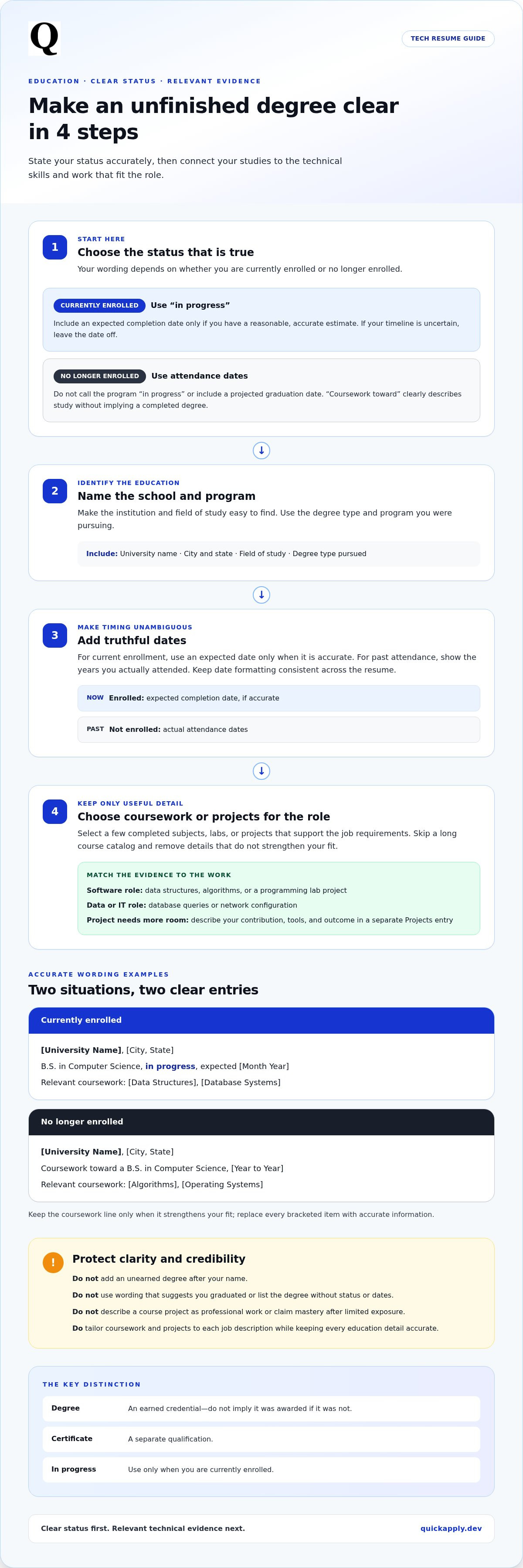
Use a simple sequence: choose the accurate status, name your program and institution, add truthful dates, then include only relevant detail. That structure makes your education easy to scan without letting it compete with stronger evidence, such as technical experience or projects.
- Choose the status: currently enrolled or no longer enrolled.
- Name the program: use the field and degree type you were pursuing.
- Add dates: show your expected completion date if enrolled, or attendance dates if you left.
- Select relevant detail: add coursework or a project only if it supports the role.
Resume wording for a degree still in progress
Use “in progress” only while you’re enrolled. Add an expected date only when you have a reasonable, accurate estimate. If your timeline is uncertain, leave the expected date off rather than guessing. List coursework selectively, based on the technical requirements in the job description. For instance, prioritize data structures for a software role if the posting emphasizes algorithms or problem-solving.
Example, currently enrolled:
- [University Name], [City, State]
- B.S. in Computer Science, in progress, expected [Month Year]
- Relevant coursework: [Data Structures], [Database Systems]
Remove the coursework line if it doesn’t strengthen your fit. Keep the entry compact so the reader can quickly move to your projects, skills, and experience.
Resume wording for a degree program you left
If you’re no longer enrolled, don’t describe the degree as in progress or include a projected graduation date. Name the school, program, and dates you actually attended. Phrases such as “Coursework toward” make the distinction clear. Add completed subjects or projects only if you can accurately explain what you did.
Example, no longer enrolled:
- [University Name], [City, State]
- Coursework toward a B.S. in Computer Science, [Year to Year]
- Relevant coursework: [Algorithms], [Operating Systems]
For a project, use a separate Projects entry if it needs more room to show your contribution, tools, or outcome. Don’t imply that a course project was professional work or that you mastered a technology after limited exposure.
Use the same date style throughout your resume, and make sure the dates reflect your actual attendance. Consistent formatting also keeps the page readable when you adapt it for different roles. With resume tailoring for tech roles, emphasize the courses and projects that best match each job description while keeping every education detail accurate.
Tech Resume Examples for Different Unfinished-Degree Situations
The right entry depends on your enrollment status and how much relevant evidence your resume already contains. Use these templates as starting points, replacing every bracketed item with accurate details. Keep education concise, then give more space to projects or experience when they better demonstrate your technical ability.
A resume entry should describe the study you completed, not imply that you earned a credential.
| Situation | Resume entry template | What to include |
|---|---|---|
| Currently enrolled | [University Name], [City, State] B.S. in [Field], in progress, expected [Month Year] |
Add the expected date only if it’s accurate. Include relevant coursework, such as [Course Name], when it supports the target role. |
| Studies paused | [University Name], [City, State] Coursework toward a B.S. in [Field], attended [Year to Year] |
Leave out an expected graduation date unless you have a genuine, current plan to return and the date is realistic. |
| Left before graduation | [University Name], [City, State] Coursework toward a B.S. in [Field], [Year to Year] |
List relevant completed subjects. Add a project separately if it needs room for tools, your contribution, or results. |
Pair the entry with evidence that fits the role
For an enrolled student applying to software roles, a relevant algorithms course may support the education entry, while a class project can show how you used a language or framework. For paused studies, avoid suggesting that you’ll graduate on a schedule that isn’t settled. If a project or technical skill is more useful than the school name, give that evidence its own resume section.
For applicants who left before graduating, include the education entry only if it strengthens the match. A few completed database or networking courses may add context for a related role. If you have relevant professional experience and the coursework adds nothing, omit the education entry and use the space for results, tools, or projects.
That’s the practical answer to how to list unfinished degree on resume for tech job applications: match the wording to your real status, then adjust the supporting detail to the role. Use good resume examples for 2026 for broader layout ideas, but keep your education labels precise and your evidence accurate.
How to Make Incomplete Education Relevant to a Tech Job
Shift the focus from how long you attended school to what you can demonstrate. Match completed coursework, labs, capstone work, personal projects, and repositories to the requirements in the job description. Education provides context. Your technical evidence shows how you apply what you learned.
Turn coursework into evidence, not a substitute degree
List only completed courses that connect directly to the role. A database course may support a data-focused application; an operating systems course may be relevant to systems work. Describe labs and assignments as coursework projects, not professional experience, and be precise about your contribution.
Keep skill claims proportional to your experience. Completing an introductory Python course supports saying you studied Python or used it in coursework. It doesn’t automatically support claiming advanced proficiency. Show the work behind each skill so a recruiter can understand where and how you applied it.
Use projects and technical skills to strengthen the story
Choose capstone work, personal projects, and public repositories that demonstrate skills relevant to the target job. For each project, make the problem, tools, and verifiable outcome clear. Use a structure like this:
- [Project name]: Built [feature or solution] to address [problem] using [language, framework, or tools]; [verifiable result or completed functionality].
Keep the result factual. If you can verify that an app supports a particular workflow, describe that functionality. Don’t claim user growth, performance gains, or production use unless you can substantiate them. Link to a repository only if it’s accessible and reflects the work you’re describing. Prioritize technologies you’ve used in a project, job, or completed coursework over tools you’ve only encountered briefly.
Consistency matters. Your education section, skills list, project descriptions, and application answers should agree about what you studied, built, and can do. Tailor the order and emphasis to each posting without changing the underlying facts. For a practical approach to choosing what to emphasize, see tailoring a resume to a job description.
Use QuickApply to tailor your resume to a specific tech job description and highlight relevant coursework, projects, and technical skills: tailor your tech resume.
Tailor and Check Your Tech Resume Before Applying
A strong resume is accurate, relevant, and easy to scan. Before you submit, check the education details, match your evidence to the role, review the formatting, and record the application. This final pass catches unclear degree status and keeps relevant technical strengths in focus.
A final accuracy and relevance check
Start with the facts. Verify the institution, program or field of study, attendance dates, and enrollment status. Make sure nothing suggests you earned a degree that wasn’t awarded. If you’re currently enrolled, confirm any expected graduation date is still accurate. If you’ve left the program, don’t leave an old “in progress” label in place.
Next, compare your resume with the job description. Keep courses, skills, and projects that support its requirements. Don’t add keywords just to increase their frequency. A skill should appear because you can back it up with coursework, a project, or work experience, not simply because it appears repeatedly in the posting.
- Accuracy: Do your education status and dates reflect what actually happened?
- Relevance: Does each course, project, or skill support this role?
- Consistency: Do dates, headings, links, and formatting follow the same style?
- Readability: Can someone scan the page and find your strongest evidence quickly?
Check that project links work and that their descriptions match what’s in the repository. Keep education, skills, and application answers consistent. The final step in how to list unfinished degree on resume for tech job applications is to state your status clearly and prove your fit without overstating your credentials.
Build a repeatable application workflow
Keep a master resume with your complete, accurate history. For each application, create a focused version that brings forward the most relevant coursework, projects, and technical skills. Tailor the emphasis, not the facts. This keeps each resume targeted without turning the process into a full rewrite.
QuickApply can help tailor resume versions to specific job descriptions and provide a match score to help you review role fit. Treat the score as a workflow signal, not a prediction of hiring results. After submitting, log the role and any follow-up task in the application tracker so your search stays organized.
For a more organized application workflow, tailor a resume and organize applications with QuickApply.
Make Your Education Clear, Then Lead With Your Skills
An unfinished degree can add useful context to a tech resume when you label it accurately and connect it to relevant work. State whether you’re currently enrolled, use truthful dates, and never imply you earned a credential you didn’t. Then shift the focus to completed coursework, projects, tools, and outcomes that show what you can do.
That’s the core of how to list unfinished degree on resume for tech job applications: be direct about your education, then tailor the evidence to each role. Keep a master resume with accurate details, and adapt the most relevant courses and projects for each job description without stretching your skills or stuffing keywords.
QuickApply helps you tailor resume versions to specific job descriptions, review a match score as one way to assess role fit, and track your applications. Tailor your resume to the role and keep your applications organized with QuickApply. Your degree status is one part of your story. Lead with honesty, back it up with technical evidence, and move forward with confidence.
Frequently Asked Questions
Should I put an unfinished degree on my resume?
Yes, include it if it adds relevant evidence for the role, such as completed technical coursework, labs, or projects. State your program and attendance dates clearly, and distinguish current enrollment from a program you’ve left. If your professional experience and projects already make a stronger case and the education adds no useful context, you can leave it off. Keep the focus on skills you can demonstrate.
How do I list a degree I did not finish on a resume?
List the institution, field of study, and dates attended, then label the education accurately. For example: “[University Name], coursework toward a B.S. in Computer Science, [Year to Year].” Add relevant completed courses only if they support the job. This is the core of how to list unfinished degree on resume for tech job applications: show the study you completed without suggesting that a degree was awarded.
Can I list a degree as in progress if I am not currently enrolled?
No. “In progress” signals that you’re currently working toward the degree, so don’t use it if you’re no longer enrolled. Instead, list the program or relevant coursework with the institution and truthful attendance dates. Leave out an expected graduation date unless you’re enrolled and have a reliable estimate. Accurate status prevents recruiters from mistaking past study for an active program or completed credential.
Should I include an unfinished degree on an entry-level tech resume?
Often, yes, if it helps demonstrate relevant foundations and you have limited professional experience. Select completed courses, labs, or projects that connect directly to the target role, such as database coursework for a data-focused position. Keep the entry brief and use project descriptions to show how you applied what you learned. If your projects already provide stronger evidence, prioritize those instead of listing unrelated coursework.
Will an unfinished degree hurt my chances of getting a tech job?
An unfinished degree doesn’t automatically determine your prospects. Its impact depends on the role, the employer’s requirements, and how clearly your resume demonstrates relevant skills. Avoid ambiguity: state your education status accurately, then support your fit with projects, work experience, and tools you’ve used. Never imply you graduated. A focused, truthful resume gives employers a clearer view of your technical capability.
Do I need to explain why I did not finish my degree on my resume?
No. Your resume usually needs to show what you studied, when you attended, and what relevant knowledge or work you gained, not the personal reason you left. Use the space for technical evidence that supports the role. If an interviewer asks about your education, answer briefly and honestly, then bring the conversation back to your current skills, projects, and readiness for the position.


