

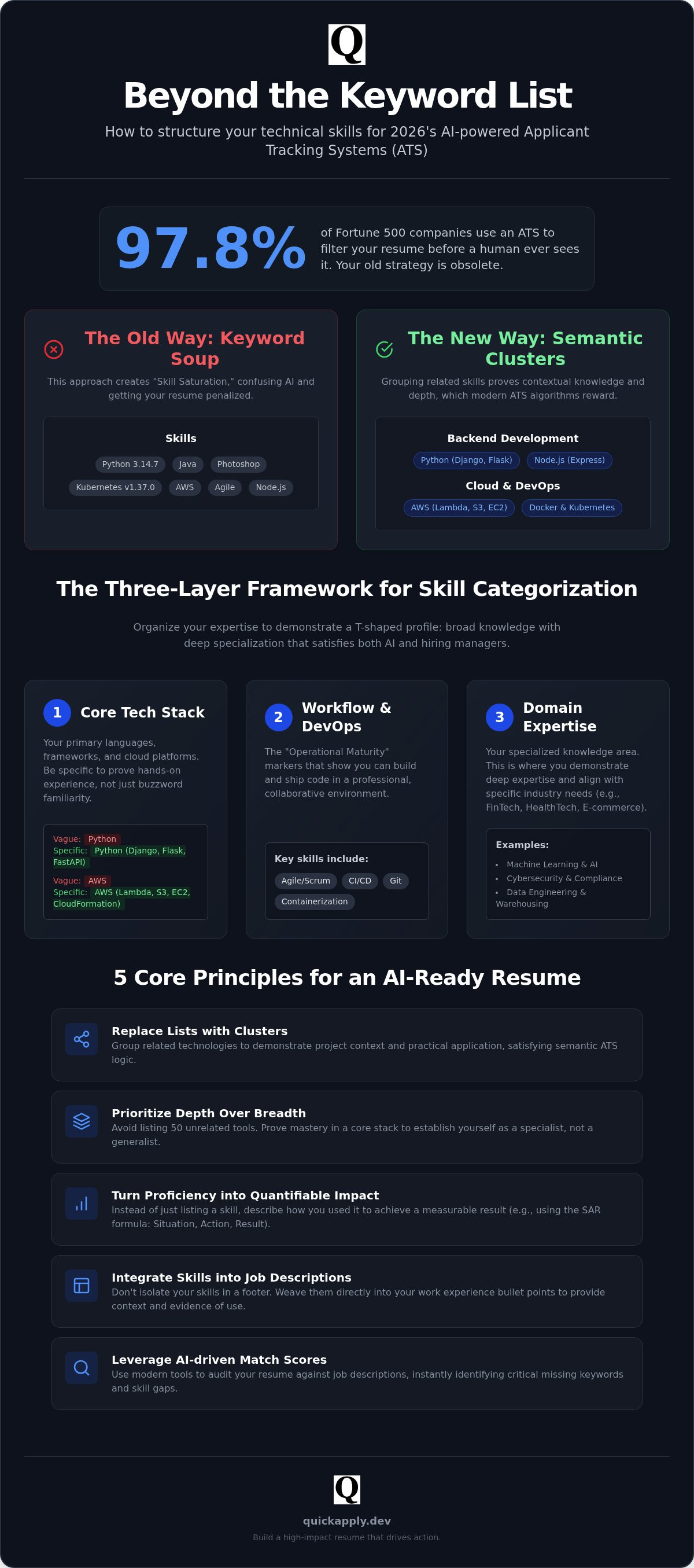
97.8% of Fortune 500 companies use a detectable ATS to filter your application before a human ever sees it. If your technical section looks like a keyword soup from 2019, you're already losing the game. You know the frustration of being ghosted despite mastering Python 3.14.7 or Kubernetes v1.37.0. It's time to stop guessing which skills to prioritize and start optimizing for the algorithm. This guide teaches you exactly how to list technical skills on resume by moving beyond generic lists.
We understand that quantifying proficiency across multiple languages feels like a losing battle in a crowded market. That's why you'll learn to use AI-backed strategies that prove your proficiency through quantifiable systems and outcomes. We're breaking down the exact framework to achieve a high Match Score and accelerate your application cycles through automated tailoring. By the end of this systemic guide, your resume won't just list tools; it'll prove you've mastered the modern tech stack with evidence that filters can't ignore. Stop wasting time on manual edits and start building a high-impact document that drives immediate action from hiring managers.
Key Takeaways
- Replace static keyword lists with semantic clustering to satisfy 2026 ATS logic and prove technical relationships.
- Implement the Three-Layer Framework to organize core technologies, workflow tools, and DevOps systems for maximum clarity.
- Master how to list technical skills on resume using the SAR formula to turn generic proficiencies into quantifiable impact.
- Integrate technical expertise directly into job descriptions and hybrid summaries rather than isolating them in a footer.
- Leverage AI-driven Match Scores to audit your resume against job descriptions and identify critical missing keywords instantly.
The Death of the Keyword List: Why Static Skill Sections Fail in 2026
The static keyword list is dead. In 2026, dumping fifty unrelated technologies into a footer doesn't just look desperate; it actively tanks your ranking. Modern Applicant Tracking Systems (ATS) have moved beyond simple string matching. They now utilize semantic clustering to analyze the relationships between the tools you claim to know. If you list Python 3.14.7 but fail to mention related libraries like TensorFlow 2.21.0 or PyTorch 2.14.0, the algorithm flags a lack of depth. Understanding how to list technical skills on resume requires a shift from "what I know" to "how I build."
The traditional definition of a skill has evolved. It is no longer about domain-general knowledge. It is about domain-specific application. Listing 50 different languages creates "Skill Saturation." This confuses the AI, making it impossible to determine your actual specialty. You aren't a jack-of-all-trades; you're a master of none in the eyes of a machine. High-performance resumes prioritize depth over breadth, proving you can handle complex systems rather than just knowing where the buttons are.
How 2026 ATS Algorithms Rank Your Skills
Algorithms now penalize context-switching. If your skills section jumps from Java to Photoshop to Kubernetes v1.37.0 without logical grouping, the AI struggles to build a coherent profile of your expertise. It looks for "Skill Recency." A tool you haven't used since 2023 carries less weight than one integrated into your current stack. Systemic proficiency is the ability to integrate tools into a production workflow. This transition from tool knowledge to AI-ready formatting ensures your resume speaks the language of modern recruitment engines. Focus on clusters that tell a story of efficiency.
Recruiter Psychology: The 6-Second Technical Scan
Hiring managers have even less time than they did five years ago. They scan for immediate authority. They don't want a list of buzzwords; they want to see core competencies that align with their specific pain points. If they see "Backend Efficiency" as a heading followed by a cluster of Node.js and AWS, you've established authority in two seconds. Establishing this immediate credibility is the core of how to list technical skills on resume effectively. Check out these Good Resume Examples for 2026 to see how high-performers structure these sections. Focus on proof, not just claims.
The Three-Layer Framework for Technical Skill Categorization
Stop categorizing skills as "hard" or "soft." That binary is obsolete. In 2026, recruiters and AI filters demand a T-shaped professional profile. This means you possess broad knowledge across multiple areas and deep expertise in a specific niche. To achieve this, you need a systemic approach to how to list technical skills on resume. We use the Three-Layer Framework to ensure your profile is both broad enough for discovery and deep enough for selection. This structure satisfies the algorithm's need for keywords while proving your actual utility to a hiring manager.
Layer 1: Defining Your Tech Stack
Layer 1 covers your core tools: languages, frameworks, and cloud platforms. Don't just list "Python." That's too vague for modern semantic engines. Instead, group your frameworks to show depth. Write "Python (Django, Flask, FastAPI)" to signal you understand the ecosystem, not just the syntax. Prioritize your primary languages first. Secondary tools follow to show versatility. This grouping helps the ATS map your skills to specific project requirements. For a look at how this appears on paper, Yale University's technical resume guide provides excellent visual templates for structuring these clusters.
Specificity is your competitive advantage. When listing cloud platforms, break them down into specific services. "AWS" is a buzzword; "AWS (Lambda, S3, EC2, CloudFormation)" is evidence of infrastructure knowledge. This level of detail satisfies both the machine and the technical lead. It proves you've actually deployed code rather than just reading a tutorial.
Layer 2 & 3: Proving Operational Maturity
Layer 2 focuses on workflow and DevOps. Skills like Agile, CI/CD, Git, and containerization prove you can ship code in a professional environment. These are the "Operational Maturity" markers that separate senior engineers from juniors. If you can't manage your code or work in a sprint, your technical knowledge is theoretical. Layer 3 is your domain expertise. Whether it's Fintech Architecture, Cybersecurity, or Machine Learning, this layer proves you understand the business context. It transforms you from a "code monkey" into a strategic asset.
Balancing these three layers creates a resume that passes high-level filters. You're showing the "how" and the "why" alongside the "what." If you're unsure if your layers are balanced, use a Match Score to audit your skill density against current market demands. This ensures your operational maturity is visible to the algorithm immediately, giving you a distinct edge in a crowded application pool.
Adjectives vs. Evidence: Quantifying Technical Impact
Stop describing yourself as "proficient" or an "expert." These are subjective adjectives that carry zero weight in a data-driven hiring environment. In 2026, systemic outcomes are the only currency that matters. To win, you must prove your technical mastery through the Skill-Action-Result (SAR) formula. This approach transforms a passive list of tools into a narrative of high-impact performance. It is the most effective way to understand how to list technical skills on resume while satisfying both AI screeners and human technical leads.
Hiring managers no longer care that you "used" a tool. They want to know the delta you created. Turning a generic claim like "Used React" into "Architected a React-based dashboard that reduced load time by 40%" signals that you understand the relationship between code and user experience. You aren't just a technician; you're a system optimizer. This shift from task completion to systemic proficiency is what triggers a higher ranking in modern recruitment platforms.
The Quantifiable Tech Framework
To move beyond surface-level descriptions, you must adopt a framework of evidence. Use industry benchmarks to estimate the time you saved or the costs you reduced. If you don't have exact numbers, use conservative estimates based on project scope. The table below illustrates the difference between a resume that gets ghosted and one that gets an interview.
| Weak Skill Listing | Strong Technical Evidence |
|---|---|
| Knowledge of SQL | Optimized complex SQL queries, reducing database latency by 25% through strategic indexing. |
| Experience with AWS | Migrated legacy infrastructure to AWS Lambda; reduced monthly hosting costs by $12,000. |
| Familiar with CI/CD | Implemented automated CI/CD pipelines that decreased deployment errors by 50%. |
Mapping Skills to Technical Outcomes
Every technical skill on your resume must map to a business-critical outcome. If you list "Clean Code," you must prove it led to a 30% reduction in technical debt or accelerated feature delivery. If your expertise is "Security," highlight that you maintained zero critical vulnerabilities across 12 consecutive months of production. This level of specificity proves your operational maturity. To ensure these outcomes align perfectly with the specific needs of a role, learn How to Tailor Your Resume to a Job Description using automated strategies. This alignment turns your how to list technical skills on resume strategy into a tool for immediate professional leverage.
Strategic Placement: Where to Feature Your Tech Skills
Location is visibility. If your skills are buried in a footer, they don't exist for the recruiter. In 2026, the most effective strategy for how to list technical skills on resume is the "Hybrid Summary" approach. This involves weaving your core tech stack into the very first paragraph of your document. It establishes your technical identity immediately, ensuring that both the human eye and the AI scanner see your most relevant tools within the first two seconds. Don't make the hiring manager hunt for your value; place it front and center.
Experience-First Integration is mandatory for senior roles. Skills must live within your job descriptions. If you mention Kubernetes v1.37.0 in your skills list but it never appears in your experience section, the ATS flags it as a low-confidence match. Use horizontal blocks for your layout rather than sidebars. While sidebars look modern, they often break in legacy ATS parsers, causing your data to become a jumbled mess. A horizontal block below the summary or within each role ensures the AI reads every character correctly. Validate your expertise by including GitHub links or portfolio URLs directly in your contact header to provide instant proof of your claims.
The Power of the Professional Summary
Your summary is your table of contents. It should highlight your technological identity with surgical precision. Instead of using vague phrases like "Experienced developer," use "Full-stack Engineer specializing in Python 3.14.7 and React-based performance optimization." This tells the AI exactly what to look for in the rest of the document. Keep the layout clean and parseable. Avoid complex graphics or multi-column tables that AI tools struggle to decode. You want your summary to act as a roadmap that guides the recruiter toward your most impressive technical wins.
Beating the 2026 ATS Filters
Remove legacy skills that no longer add value. If you're still listing jQuery or SVN from ten years ago, you're wasting valuable real estate. Move these to a bottom section or delete them entirely to keep your profile focused on modern systems. Use project lifecycle keywords like "architected," "deployed," and "scaled" to prove end-to-end technical ownership. This differentiates your input from mere participation. For more on modern pitfalls, read our guide on ChatGPT Resume Myth-Busting. High-tech roles require human-verified strategies, not just AI prompts. Ready to optimize your placement? Audit your resume with QuickApply to see if your skills are positioned for maximum impact.
Automate the Mapping: Using QuickApply to Align Your Skills
Manual keyword mapping is a relic of the past. In 2026, you don't have the luxury of time to guess which skills a recruiter prioritizes. QuickApply's AI scans every Job Description (JD) to uncover "hidden" technical requirements that human eyes often miss. If a JD mentions Python 3.14.7, the AI knows to audit your profile for related dependencies like TensorFlow 2.21.0 or specific cloud services. This automation is the ultimate solution for how to list technical skills on resume without the manual grind. It eliminates the friction between your talent and the recruiter's filters.
Use the Match Score as your final system auditor. This feature identifies exactly which technical keywords are missing from your current document before you hit submit. It provides a statistical advantage by ensuring your resume hits the required density for specific clusters. The One-Click Tailoring advantage allows you to pivot from a generic developer profile to a targeted systems engineer in seconds. You stop being a broad applicant and start being a specific solution. This targeted approach is what drives faster application cycles and higher response rates.
Instant Technical Keyword Mapping
The process starts by uploading your base resume and the target JD. The platform immediately categorizes skills into high-priority and low-priority clusters based on semantic importance. Our AI then suggests rephrasing your bullet points using your actual tech history to mirror the company's specific dialect. Utilize our Resume Tailoring service to ensure your semantic clustering aligns with the unique ATS logic of the hiring firm. This ensures your technical identity is perfectly mapped to the role's requirements every single time.
From Resume to Technical Interview
Your resume gets you through the door, but your explanation keeps you in the room. Carry the documented technical proof you built in previous sections into the coding interview with total confidence. QuickApply provides Interview Practice tools to help you rehearse technical explanations for the very skills you've highlighted. You'll move from simply knowing a tool to explaining how you utilized it to solve systemic problems. Manage every tailored version of your resume with our Application Tracker. This ensures you're always reviewing the correct technical narrative before the call. Start tailoring your technical skills with QuickApply today.
Master Your Technical Narrative for 2026
The era of the generic keyword dump is over. You've learned that 2026 ATS filters demand semantic clustering and the Three-Layer Framework to rank your profile. By shifting from "tool knowledge" to "systemic proficiency," you prove you're an architect of outcomes rather than just a user. Mastering how to list technical skills on resume means aligning your evidence with the specific needs of the market. Quantify your impact using the SAR formula and place your most valuable tech front and center in a hybrid summary to capture attention in seconds.
Stop letting manual edits slow your career velocity. You can optimize your technical skills with QuickApply AI to tailor your profile in seconds. Audit your document with our Match Score to ensure you never miss a critical keyword again. Our platform is already used by high-performing engineers at FAANG and top startups to bypass filters and secure interviews. You have the tools and the strategy to beat the algorithm. Now, go build the career you deserve.
Frequently Asked Questions
Should I list every programming language I've ever used?
No, you should only list languages relevant to the specific role. Listing every language you've touched since university creates "Skill Saturation," which confuses 2026 ATS algorithms. Focus on your primary and secondary stack. If a language is obsolete or unrelated to the job description, remove it. This ensures the AI sees a clear Technological Identity rather than a fragmented list of tools you haven't used in years.
How do I show proficiency levels for technical skills?
Avoid subjective progress bars or star ratings. AI screeners can't parse them, and they mean nothing to human recruiters. Instead, use the Skill-Action-Result (SAR) formula within your experience section. Prove your proficiency by describing how you used a tool to solve a specific problem. For example, "Optimized SQL queries to reduce latency by 25%" is a much stronger indicator of mastery than a generic "Advanced" label.
Is it better to list skills in a sidebar or a separate section?
Use a separate horizontal section or a Hybrid Summary at the top. Sidebars often fail during the ATS parsing process, leading to scrambled data or missing keywords. A horizontal block ensures every character is read correctly by 2026 algorithms. This is the most reliable way to handle how to list technical skills on resume while maintaining a clean, professional layout that appeals to both machines and human hiring managers.
Can AI help me find the technical keywords in a job description?
Yes, AI is the most efficient way to map keywords. QuickApply's platform automatically scans job descriptions to identify "hidden" technical requirements. It provides a Match Score that reveals which keywords are missing from your current version. This allows you to perform how to list technical skills on resume with surgical precision. You'll stop guessing and start applying with a document that is mathematically optimized for the specific role you want.
How do I list technical skills if I'm a career changer?
Highlight transferable technical skills and personal projects. If you're moving into software engineering from another field, prioritize the tools you've used in bootcamps or open-source contributions. Group these under a "Technical Projects" section to provide context. Use Layer 2 skills like Git and Agile to prove you understand professional workflows. This demonstrates operational maturity even if your professional history is in a different industry or non-technical field.
Should I include soft skills in my technical skills list?
No, keep your technical skills section strictly technical. Mixing "Python" with "Communication" dilutes your technical authority and confuses semantic clustering algorithms. If you want to highlight soft skills, weave them into your experience bullet points as evidence of teamwork or leadership. For the skills section, stick to languages, frameworks, and cloud platforms. This maintains a high-density technical profile that satisfies senior-level engineering filters and machine-learning screeners.
What are the most in-demand technical skills for 2026?
Demand is highest for AI-integrated development and cloud-native infrastructure. Proficiency in Python 3.14.7, Kubernetes v1.37.0, and TensorFlow 2.21.0 is currently essential for high-level roles. Beyond specific languages, recruiters prioritize "Systemic Proficiency," which is the ability to integrate disparate tools into a functional CI/CD pipeline. Mastery of these tools signals you can handle the complexity of modern, automated production environments without active supervision or constant hand-holding.
How many technical skills is too many for a one-page resume?
Quality beats quantity. Aim for 15 to 20 highly relevant skills grouped into logical clusters. Going beyond this risks "Skill Saturation," where the AI can't determine your core specialty. Focus on the T-shaped professional profile: broad knowledge of workflow tools and deep expertise in your primary stack. If a skill doesn't appear in the job description or your recent experience, it's likely taking up space that could be used for evidence.


