

What if the 300 generic coding puzzles you just solved are the reason you'll fail your next interview? In 2026, the manual grind is a legacy tactic. It leaves you exhausted and underprepared for the specific demands of modern software engineering. Learning how to prepare for a technical interview now requires a pivot from volume to precision. You're likely facing information overload and struggling to simulate real-time pressure. Stop wasting hours on topics that won't appear on your screen.
You need a strategy that mirrors the speed of the current market. This guide provides a clear roadmap to build confidence in coding and behavioral rounds by shifting to a high-efficiency, AI-powered preparation model. You'll learn to leverage targeted simulation and optimized interview practice. We're moving past the noise to focus on what actually converts. From mastering Python 3.14.5 nuances to applying ES2025 updates, this is your blueprint for a higher offer rate. Secure your competitive advantage and turn technical hurdles into signed contracts.
Key Takeaways
- Pivot from broad knowledge to job-specific mastery by aligning your technical and behavioral skills with exact role requirements.
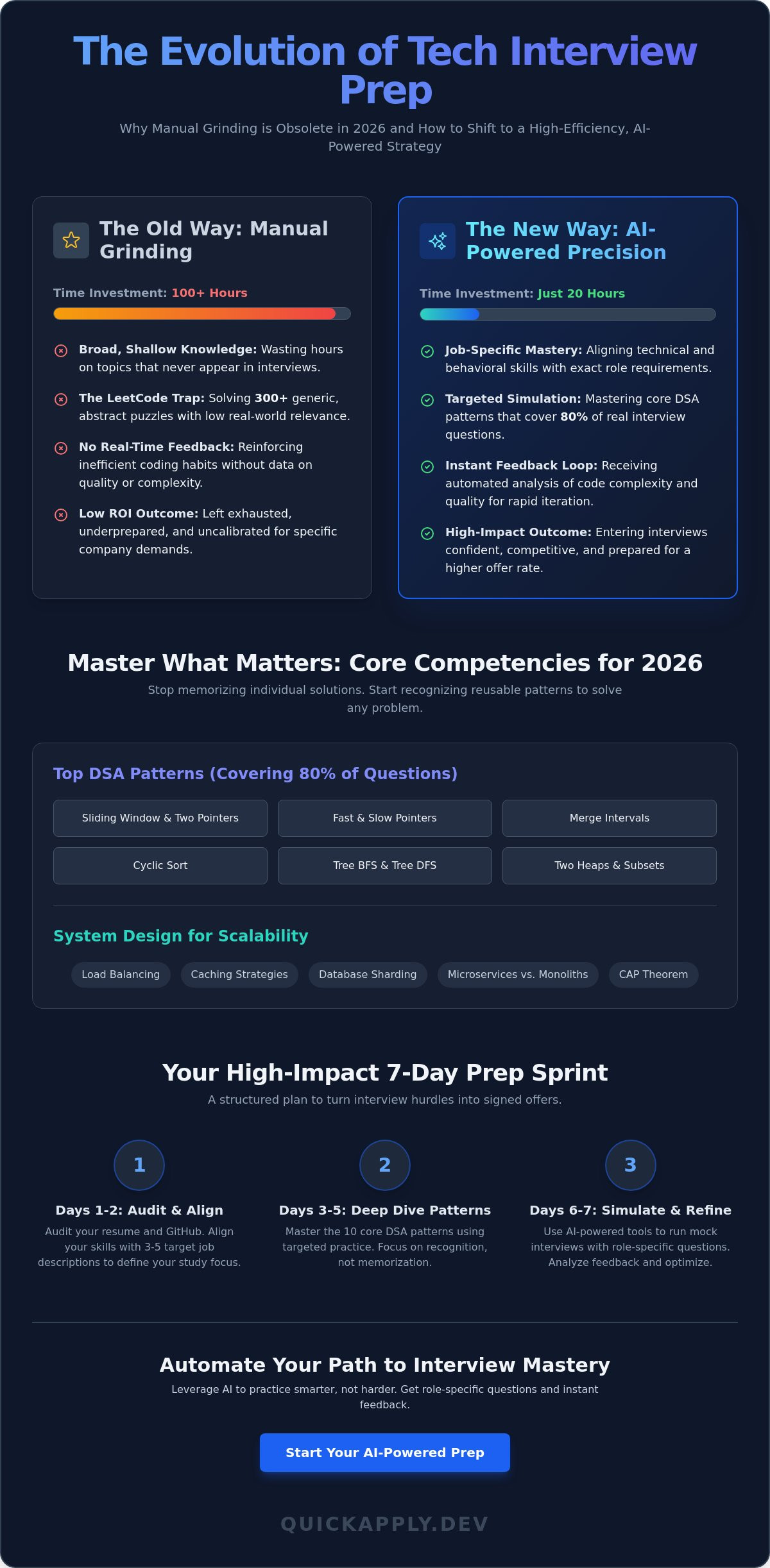
- Learn how to prepare for a technical interview in just 20 hours using AI-driven simulation instead of 100+ hours of manual grinding.
- Optimize your study focus by prioritizing Data Structures and System Design patterns based on your specific engineering track.
- Execute a high-impact 7-day sprint plan that audits your resume and masters the 10 core DSA patterns.
- Utilize automated Interview Practice tools to generate role-specific questions and receive instant feedback on code complexity.
What is Technical Interview Preparation in 2026?
Technical preparation is the strategic alignment of your coding, architectural, and behavioral skills with specific job requirements. It isn't a generic study session. In 2026, the market rewards job-specific mastery over broad, shallow knowledge. If you're still treating every interview like a standardized test, you're losing. Winning requires a high-tech approach that mirrors the speed of modern software development. Manual grinding is now a statistical disadvantage; it consumes too much time for too little ROI. Understanding what is a technical interview? is the first step, but the second is building a Preparation Stack: Research, Simulation, and Refinement.
The Three Pillars of Modern Tech Prep
- Coding & Algorithms: Stop memorizing solutions. Focus on mastering Data Structures and Algorithms (DSA) through pattern recognition. If you recognize the pattern, the specific problem doesn't matter.
- System Design: Move beyond back of the envelope sketches. You must demonstrate deep knowledge of scalable architecture, including load balancing, caching, and database sharding.
- Behavioral Mastery: Use the STAR method to prove cultural and professional fit. Every story should highlight how your technical decisions saved time or optimized systems.
Why Your Current Prep Strategy is Failing
The LeetCode Trap is the most common reason candidates stall. You spend weeks solving abstract puzzles that never appear in real-world scenarios. Learning how to prepare for a technical interview effectively means prioritizing relevance over volume. General prep fails because it doesn't address the specific tech stack or engineering culture of the hiring company. If you're applying for a role using Python 3.14.5 and React 19.2.6, practicing legacy syntax is a waste of energy.
The lack of real-time feedback is the ultimate blocker. Without it, you're reinforcing inefficient coding habits. Modern preparation uses simulation to provide instant data on code quality and complexity. This allows for rapid iteration. You need to identify your specific weaknesses before the interviewer does. Shift your focus from finishing problems to optimizing your execution speed and accuracy. Mastering how to prepare for a technical interview requires you to treat your prep like a software deployment: test, refine, and optimize for performance.
The Core Technical Competencies You Must Master
Efficiency is your only metric. Don't waste time on Red-Black trees if you're a Frontend engineer. You need to know how to prepare for a technical interview by filtering out the noise and focusing on role-specific requirements. High-performing candidates don't study everything; they study what matters. Leverage authoritative Technical Interview Preparation Resources to identify the specific tools and methodologies favored by top-tier firms in 2026.
Data Structures and Algorithms (DSA) Patterns
Stop memorizing individual solutions. It's a losing game. Instead, master the top 10 patterns that cover 80% of interview questions. These include:
- Sliding Window and Two Pointers
- Fast and Slow Pointers
- Merge Intervals and Cyclic Sort
- Tree BFS and Tree DFS
- Two Heaps and Subsets
Pattern recognition beats memorization because it provides a reusable framework for solving unseen problems on the fly. When you're coding, explain your thought process out loud. Interviewers aren't just looking for a "Pass" on the test cases; they're evaluating your logic and communication speed. If you want to refine these skills under pressure, use Interview Practice tools to simulate the real environment.
System Design for Scalability
Architecture is where senior roles are won or lost. You must move beyond basic "back of the envelope" calculations. Focus on load balancing, caching strategies, and database sharding. Understand the trade-offs between Microservices and Monoliths. You should be able to navigate the CAP theorem and explain why you'd prioritize consistency over availability in a specific context. Practice drawing diagrams that clearly communicate complex data flows. If you can't visualize the system, you can't build it.
Master the language-specific nuances of your primary stack. If you're working with React 19.2.6, you must be an expert in Hooks and the latest concurrent rendering features. For Go developers, concurrency isn't optional. For take-home assignments, don't start from scratch. Build a reusable boilerplate library to handle authentication, API routing, and styling. This ensures you deliver high-quality code in half the time. This is how to prepare for a technical interview without wasting a single hour.
Manual Grinding vs. AI-Driven Simulation
Solving puzzles in a vacuum is a waste of your engineering talent. Traditional platforms encourage a high-effort, low-efficiency path that often leads to burnout rather than offers. When you're learning how to prepare for a technical interview, you must treat your time as a finite resource. AI-driven systems allow you to compress 100+ hours of manual study into just 20 hours of hyper-focused simulation. This isn't just a time-saver. It's a strategic upgrade that targets your specific performance gaps.
The Limitations of Static Prep Platforms
Relying on "Green Checks" from legacy coding sites is a dangerous gamble. Passing a test case doesn't equate to being hired. These platforms focus on the "what" but ignore the "how." They don't evaluate your code's readability or its adherence to modern best practices. They certainly don't assess your ability to communicate complex ideas under pressure. Static lists of "Top Questions" are obsolete almost as soon as they're published. In 2026, recruiters look for candidates who can navigate shifting requirements, not those who can recite a solution from a fixed database.
Leveraging AI for Real-Time Interview Coaching
AI-driven coaching provides the real-time feedback loop that static sites lack. It analyzes your code as you write it, flagging suboptimal time complexity and suggesting Big O improvements instantly. This immediate correction prevents you from reinforcing bad habits. Beyond the code, AI simulates a live interviewer’s follow-up questions, forcing you to defend your architectural choices. It also evaluates your verbal delivery, checking your tone, pace, and the clarity of your technical explanations. For those seeking advanced support, explore Final Round AI: Mastering the 2026 Interview for a real-time copilot experience.
The psychological advantage is undeniable. Practicing in a simulated, high-pressure environment desensitizes you to interview anxiety. You'll learn to maintain your logic even when the clock is ticking. AI also generates role-specific behavioral questions by scanning your target job description. This ensures your STAR-method responses are perfectly aligned with what the hiring manager actually wants to hear. For those seeking to further bridge the gap between technical ability and professional poise, the Achieve With Nate Movement offers personalized digital confidence coaching to help you master these high-stakes interactions. This targeted approach is how to prepare for a technical interview in a high-volume, competitive market. Efficiency isn't just about working faster. It's about working smarter.
The 7-Day Technical Prep Sprint Plan
Seven days is all you need to move from overwhelmed to offer-ready. This isn't a suggestion; it's a high-intensity protocol. Most candidates fail because they lack a schedule. They wander through documentation without a target. If you want to know how to prepare for a technical interview with maximum efficiency, follow this sprint plan. It replaces aimless study with tactical execution. No fluff. No wasted hours. Just results.
Days 1-2: Foundation and Alignment
Start with your professional foundation. You must align your narrative with the company's specific pain points. Use an AI resume tailor to identify your strongest talking points instantly. This tool scans the job description and highlights the exact skills you need to feature. Map your past projects to these requirements. Don't just list technologies; explain the impact. Audit your GitHub and portfolio to ensure they mirror the expertise claimed in your tailored resume. Consistency builds trust. Discrepancies kill offers.
Days 3 and 4 are for the technical core. Deep dive into the 10 DSA patterns identified in earlier sections. Solve three problems per pattern to lock in the logic. On Day 5, pivot to System Design. Conduct architectural walkthroughs of common systems like URL shorteners or global chat apps. Focus on the trade-offs. Why choose NoSQL over SQL? How does database sharding impact your latency? Your goal is to speak the language of scale fluently. This is how to prepare for a technical interview when time is your most valuable asset.
Days 6-7: The Final Polish
The final phase is about delivery. Technical genius is useless if you can't communicate it. Record yourself answering common prompts like "Tell me about a time you failed." Analyze the playback. Watch your tone and pace. Ensure your STAR-method responses are punchy and results-oriented. Verify your technical setup. Check your camera, mic, and internet stability for remote rounds. Finally, write a single sentence summarizing your unique value proposition. This is your mission statement for the interview room. You aren't just a coder. You're the specific solution to their problem.
Ready to execute? Access the QuickApply Interview Practice tool to start your 7-day sprint today.
QuickApply: Automating Your Path to Interview Mastery
Success in the 2026 market requires more than just knowledge. It requires a system that eliminates friction. QuickApply acts as the ultimate efficiency layer for the modern job seeker. It bridges the gap between your initial application and the final handshake. While competitors suggest manual research on company blogs, QuickApply automates the discovery process. It transforms the way you approach how to prepare for a technical interview by integrating your resume data directly into your practice sessions. This is systemic optimization at its best.
The Interview Practice tool doesn't provide generic prompts. It generates questions tailored specifically to your target role and the tech stack mentioned in the job description. If the role demands React 19.2.6 and Node.js 26.2.0, your practice environment will reflect those exact requirements. This targeted simulation ensures you aren't caught off guard by domain-specific nuances. It's the difference between practicing for a test and seeing the actual questions beforehand. You'll enter the room with a validated strategy, not a guess.
Tailoring your resume does more than get you past the ATS. It creates a built-in cheat sheet for your behavioral rounds. When you use QuickApply to align your experience with a job post, you're simultaneously mapping out your strongest talking points. These become the foundation for your STAR-method responses. Managing multiple high-stakes pipelines is equally streamlined. Use the Application Tracker to monitor every stage of your journey without the stress of manual spreadsheets. Stay organized. Stay fast.
Beyond the Interview: Salary and Promotion
Mastering how to prepare for a technical interview is only half the battle. Once you pass the technical round, you must secure the value you deserve. Use the Salary Negotiation Guide to maximize your offer based on current 2026 market data. Your growth shouldn't stop at the hiring phase. Prepare for your first 90 days with an AI-generated Promotion Roadmap. QuickApply supports your entire career lifecycle, ensuring you don't just get the job, but dominate the role. We provide the tools for continuous productivity without the active effort.
Ready to Stop Grinding and Start Winning?
The manual grind is a legacy tactic. In a crowded market, your competitive edge comes from the tools you use. Don't wait for the next rejection to optimize your process. Tailor your first resume and start a mock interview today. Shift your energy from low-impact study to high-velocity execution. Optimize your interview prep with QuickApply and secure your next offer with precision.
Master the Future of Technical Hiring
The manual grind is a legacy tactic that no longer delivers results in a high-speed market. Success in 2026 requires a pivot toward systemic automation and role-specific precision. You've learned how to prepare for a technical interview by focusing on pattern recognition, high-level system design, and AI-driven simulation. By replacing 100 hours of generic study with 20 hours of targeted practice, you maximize your ROI and enter the interview room with unshakeable confidence.
QuickApply provides the ultimate toolkit to streamline this transition. Generate AI-powered resume tailoring in seconds to ensure your experience matches every requirement. Utilize our automated interview practice tools to simulate real-world pressure and refine your technical explanations. Keep your entire job search organized with our comprehensive application tracking system. Stop fighting the system and start leveraging it to your advantage.
Start your AI-powered interview prep with QuickApply today. Your next offer is waiting for a candidate who values efficiency as much as expertise. Build your roadmap, own your narrative, and win the role you deserve.
Frequently Asked Questions
How long does it take to prepare for a technical interview?
It takes approximately 20 hours of AI-targeted simulation to master how to prepare for a technical interview, compared to the traditional 100+ hours of manual grinding. This compressed timeline relies on identifying role-specific patterns rather than solving every puzzle in existence. Focused execution on high-impact topics like system design and core DSA patterns ensures you stay ahead of the curve. This efficiency allows you to focus on the final polish.
Is LeetCode still relevant for technical interviews in 2026?
LeetCode remains a relevant baseline for syntax and basic logic, but the volume-based approach is obsolete in 2026. Recruiters now prioritize candidates who can apply patterns to real-world architectural challenges. Solving hundreds of problems is a statistical disadvantage if you can't explain the Big O complexity or trade-offs. Use these platforms for quick syntax drills, then pivot to AI-driven simulation for higher-level interview practice.
What is the STAR method and how do I use it in tech interviews?
The STAR method stands for Situation, Task, Action, and Result. Use it to structure your behavioral responses by describing a specific technical challenge and the measurable impact of your solution. In tech interviews, focus on the Action by explaining the specific tools or algorithms you used. End with a Result that highlights optimized latency, reduced costs, or saved engineering hours to prove your professional value.
How do I prepare for a system design interview if I have no experience?
Start by mastering foundational trade-offs like Latency vs. Throughput and Consistency vs. Availability (CAP Theorem). You don't need years of experience to understand how load balancing or database sharding works in theory. Practice drawing data flow diagrams for common services like URL shorteners. Focus on why certain architectural choices are made rather than memorizing a specific implementation. This builds the necessary high-level architectural intuition.
Can AI tools help me during a live technical interview?
AI coaches are designed to optimize your preparation through mock sessions and real-time feedback on your verbal delivery. These tools help you refine how to prepare for a technical interview by identifying performance gaps before the real event. While some copilot tools claim to assist during live rounds, they carry significant ethical risks. They're often detected by modern proctoring software, making them a major liability for your candidacy.
What are the most common coding patterns I should know?
You should prioritize the top 10 patterns that cover 80% of coding questions. These include Sliding Window, Two Pointers, Fast and Slow Pointers, and Two Heaps. Mastering these patterns allows you to solve unseen problems by recognizing the underlying structure. This approach is far more efficient than memorizing individual solutions for every possible data structure scenario. It ensures you can handle unexpected variations during the live round.
How do I handle a technical question I don’t know the answer to?
Be transparent about your thought process and explain the logic you do understand. Start by verbalizing the brute-force solution to show you can at least solve the problem inefficiently. Ask clarifying questions to narrow down the constraints. Most interviewers value your ability to navigate ambiguity and collaborate on a solution more than a perfect answer delivered in silence. It shows you can function within a real engineering team.
Should I use a real-time AI copilot during my interview?
Using a real-time AI copilot during a live interview is high-risk and generally discouraged. Most top-tier tech firms use advanced detection systems to identify external assistance. Relying on these tools during the round undermines your credibility and prevents you from demonstrating genuine problem-solving skills. Stick to AI-powered Interview Practice tools during your preparation phase to build legitimate, unshakeable confidence that doesn't rely on external scripts.


