

What if the silence following your job application isn't a rejection, but a system failure you're supposed to debug? You've optimized your resume, hit send, and then nothing. The black hole of modern ATS systems makes it feel like your credentials vanished into a server farm. It's frustrating to track dozens of leads only to be met with total radio silence while the U.S. unemployment rate sits at a steady 4.3 percent. You're doing the work, but the system isn't responding.
You don't have to wait for a miracle or an automated rejection letter. We'll show you how to master the follow up email after job application no response to re-establish a human connection and bypass the algorithmic gatekeepers. This strategy is about high-signal, low-friction communication that treats silence as a data point rather than a defeat. You'll learn the exact 2026 timeline for checking in, how to add value without being a pest, and the specific workflow needed to turn a stalled application into a live interview.
Key Takeaways
- Bypass the ATS black hole by timing your outreach during the "Golden Window" for maximum recruiter visibility.
- Master the strategic structure of a follow up email after job application no response to transition from a digital ghost to a high-priority candidate.
- Deploy high-signal templates that re-highlight your technical skills directly to hiring managers, cutting through HR layers.
- Replace manual spreadsheets with an automated Application Tracker to manage your follow-up loop with surgical precision.
- Leverage AI-driven Match Scores to identify which silent applications deserve a strategic nudge and which to archive.
Why You Haven’t Heard Back: Decoding the Recruiter Silence
Silence isn't a "no." It's a latency issue. In a tech-heavy market, your application for employment enters a high-velocity pipeline where human eyes are the final, rarest stage. Most candidates interpret a week of quiet as a definitive rejection. They're wrong. Recruiters are drowning in data, not ignoring your talent. They're managing a system that prioritizes volume over velocity, leading to significant delays in communication.
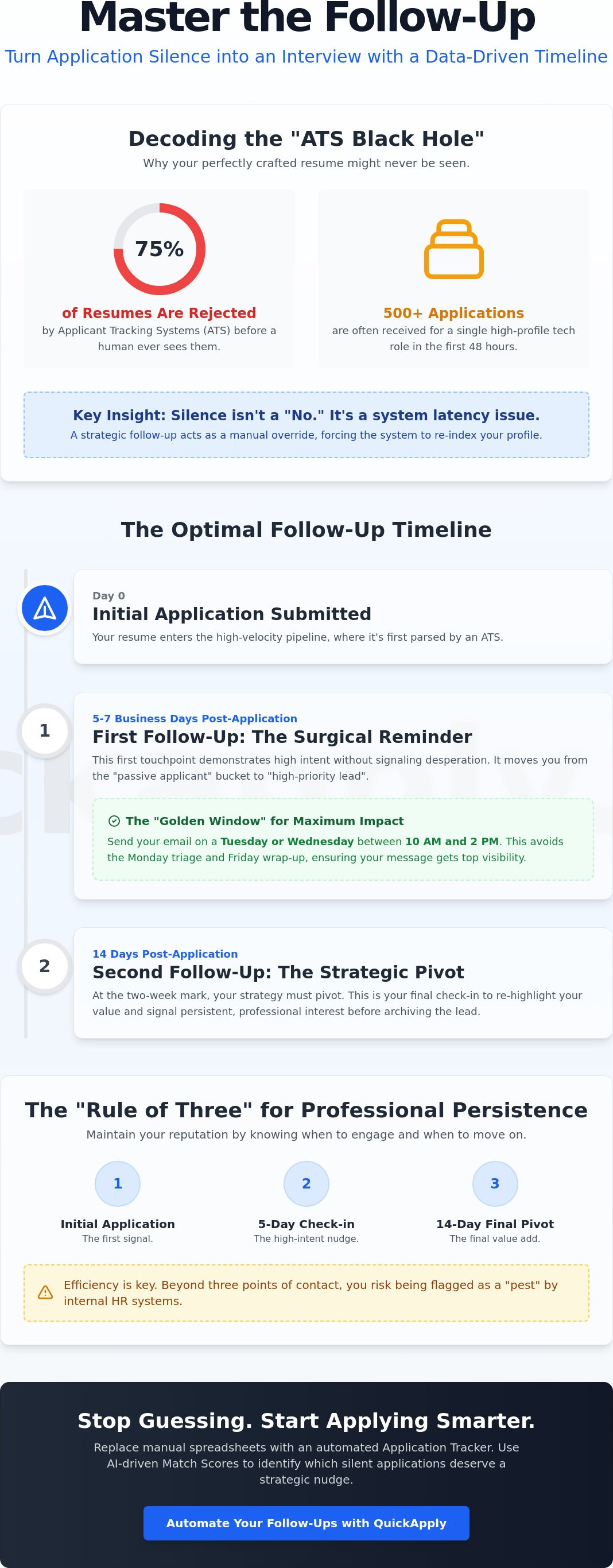
Statistically, 75 percent of resumes never reach a human recruiter. They're intercepted by Applicant Tracking Systems (ATS) designed to filter out noise. When a high-profile tech role opens, the system often ingests over 500 applications within the first 48 hours. This volume creates a massive bottleneck. A professional follow up email after job application no response acts as a manual override. It forces the system to re-index your profile. It signals that you're a high-intent candidate, not just another bot in a mass-apply script.
Internal shifts also play a major role in the silence. Project budgets can fluctuate or team priorities might pivot mid-week. These shifts cause hiring stalls that look like permanent rejection to the applicant. Your follow-up serves as a signal of persistence. It separates serious professionals from the automated noise of the modern job market.
The "ATS Black Hole" Explained
Modern ATS platforms don't just store documents; they parse them for specific keyword density and structural logic. Even a good resume example can fail if it doesn't align with the specific scoring parameters of the software. If your document isn't optimized for these digital gatekeepers, the recruiter never receives a notification to review your profile. Silence often means your data is stuck in a queue, waiting for a trigger that never fired.
Recruiter Workflows in 2026
Recruiting has shifted to a "low-hire, low-fire" model where every headcount is scrutinized. The typical screening cycle for software engineering roles now spans a full 14 days. During this window, recruiters prioritize "active" candidates who engage beyond the initial click. Sending a follow up email after job application no response demonstrates a level of professional interest that automated systems cannot simulate. It moves you from the "passive applicant" bucket into the "high-priority lead" category. In this environment, a "no response" state is rarely a rejection. It is usually a "not yet" state that requires a strategic nudge to resolve.
The Optimal Follow-Up Timeline: When to Break the Silence
Timing is your primary competitive advantage. Most applicants fail because they either spam the recruiter or wait until the lead is stone cold. Sending a follow up email after job application no response requires a data-driven approach to human psychology and corporate workflows. You must hit the inbox when the recruiter is active but not overwhelmed. In the "low-hire, low-fire" market of 2026, where every open role is scrutinized, your timing signals your professional maturity.
Target the "Golden Window" for maximum impact. This occurs on Tuesdays and Wednesdays between 10 AM and 2 PM. Mondays are high-stress periods dedicated to triage and "inbox purges" where recruiters archive weekend backlogs without deep review. Fridays are for closing out weekly cycles and administrative wrap-ups. Mid-week midday ensures your message sits at the top of the stack while the hiring team is in peak execution mode. It increases the probability of a human response by aligning with their natural workflow rhythm.
Respect the "Rule of Three" to maintain your reputation. Your outreach loop should consist of the initial application, a 5-day check-in, and a 14-day final pivot. Beyond three points of contact, you risk being flagged as a "pest" by internal HR systems. Efficiency means knowing when to double down and when to move to the next node in your pipeline. If you're struggling to keep track of these critical windows across multiple companies, using an automated application tracker ensures you never miss a high-signal opportunity or over-message a single contact.
The First Follow-Up (5-7 Days Post-Application)
Five business days is the industry sweet spot. It demonstrates high intent without signaling desperation. This first touchpoint should be a surgical reminder of your specific value proposition. Avoid the Monday morning rush at all costs. If you submitted your application on a Friday, your first follow-up should land the following Thursday. This allows the recruiter a full week to clear the initial 500+ application surge that typically follows a new tech posting.
The Second Follow-Up (14 Days Post-Application)
At the two-week mark, your strategy must pivot. If your email remains unread, change the medium. Move from email to a professional LinkedIn DM directed at the hiring manager or a technical recruiter. Maintain a results-driven tone. Re-state your core match score or highlight a specific project relevance that aligns with their current stack. This is your final check-in. If silence persists after this second attempt, your data has likely been archived. Shift your focus and re-allocate your energy to fresh opportunities in your queue.
High-Signal Follow-Up Templates for Tech Professionals
Your subject line is the metadata of your outreach. Avoid generic phrases like "Checking in" or "Follow up." These are low-signal and often ignored. Use high-open rate formats such as "[Job Title] Application Update - [Your Name]." This provides instant context. It respects the recruiter's limited bandwidth. A precise subject line increases open rates by removing cognitive friction. It signals that you understand professional efficiency.
Templates must be lean. High-volume hiring environments in 2026 don't allow for long-winded introductions. Your follow up email after job application no response should focus on data points and technical alignment. Use these structures to bypass the noise and get a status update. Every word must serve a purpose. If it doesn't add value, delete it.
The Professional Recruiter Check-In
Keep this outreach to three sentences or less. Your goal is to trigger a status update, not to tell your life story. Re-attach your resume as a PDF. This saves the recruiter from searching through the ATS database. Mention your specific "Match Score" or key tech stack alignment to prove relevance immediately. For example: "I’m following up on my Senior Dev application. My profile shows a 94 percent match for your current React/Node stack. I've re-attached my resume for your convenience." This is direct. It’s effective. It gets results.
The Hiring Manager Direct Outreach
Cut through the HR layer by finding the engineering lead or department head. Use LinkedIn or company directories to identify the specific person managing the team. Focus on the problem they need to solve. If they are scaling a specialized team, mention your specific contributions to similar high-growth projects. Link directly to your tailored resume to showcase an immediate technical fit. This approach shows initiative. It bypasses the standard queue by addressing the decision-maker directly. It positions you as a solution rather than just another applicant.
The LinkedIn Connection Strategy
Relationships outperform cold applications. Use a LinkedIn connection request to build a bridge rather than just asking for a job status. Comment on a technical post they shared. Mention a shared interest in a specific framework or architecture. This transforms you from a data point into a person. It creates a human connection in a digital-first market. When you eventually send a follow up email after job application no response, they will already recognize your name. This recognition is a powerful competitive advantage in a crowded field.
Managing the Follow-Up Loop with AI Efficiency
Manual spreadsheets are legacy tech. If you're managing dozens of applications in the 2026 "low-hire, low-fire" market, a Google Sheet is a significant bottleneck. It's prone to human error; it lacks the logic to trigger a follow up email after job application no response at the precise five-day mark. You need a system that functions like a high-performance CRM for your career. Automation isn't just a luxury. It's a necessity for maintaining a high-volume search without losing your competitive edge. Stop wasting cycles on manual data entry and start optimizing your pipeline for speed.
Data-driven searching relies on prioritization. Not every application deserves the same level of persistence. Use "Match Scores" to identify which roles have the highest probability of conversion. These scores calculate the technical delta between your profile and the job requirements. Focus your manual energy on the 90 percent matches while letting automated systems handle the routine check-ins for lower-priority leads. This allows you to scale your output without sacrificing the quality of your professional connections.
Automated Job Application Tracking
Centralized dashboards provide a bird's-eye view of your entire pipeline in real-time. Modern job application trackers eliminate the mental load of remembering who to nudge and when. They sync with your outreach to monitor "sent" status, which prevents the embarrassment of duplicate follow-ups that annoy recruiters. By offloading the scheduling to a dedicated system, you ensure that no high-signal opportunity falls through the cracks. This systematic approach transforms a chaotic search into a repeatable, high-efficiency workflow.
AI-Powered Personalization
Scaling your search shouldn't mean sacrificing the human touch. Use AI to generate follow-up drafts that reference the specific technical requirements of the original job description. This ensures your outreach feels personal rather than like a generic script. Maintain a "Human in the Loop" for the final tone check to ensure the message aligns with your professional brand. Utilizing a high-performance cover letter builder ensures your initial application and subsequent follow-up share a consistent, authoritative voice. This consistency builds trust with hiring managers who are looking for clear, concise communication.
Stop managing your job search with 20th-century tools that slow you down. Efficiency comes from leveraging systems that work while you're focused on interview prep. A strategic follow up email after job application no response is only effective if it's sent on time, every time, with the right data points. Optimize your entire search workflow and regain control of your schedule by using the QuickApply Application Tracker today.
Scale Your Success with QuickApply
Efficiency isn't just about working harder. It's about deploying technology that removes systemic friction. QuickApply automates the tedious manual processes that drain your energy and stall your progress. Instead of guessing why you're being ghosted, you use data to force a response. Our platform transforms the job search from a game of chance into a calculated engineering problem. You gain a competitive advantage by operating at a speed that manual applicants cannot match.
The "Match Score" is your primary filter for outreach. It analyzes your technical profile against the live job description to determine your probability of success. High scores indicate where a follow up email after job application no response will yield the highest return on investment. Don't waste time on low-probability leads. Focus your tactical efforts on the roles where your technical alignment is undeniable. This data-driven prioritization ensures your energy is always directed toward the most lucrative opportunities.
Our integrated Application Tracker moves your status from "Applied" to "Interviewing" with surgical precision. It centralizes your entire pipeline, providing a real-time dashboard of every active lead. You can manage your follow up email after job application no response loop without ever opening a spreadsheet. This level of organization is essential in a 2026 market where recruiters expect immediate, professional engagement. By automating the tracking, you free up cognitive bandwidth for high-value tasks like technical preparation.
From Application to Interview
Success starts with the initial document. Our AI resume tailor optimizes your profile to bypass ATS filters before you even hit send. Once you're in the system, the tracker manages your follow-up cadence effortlessly. When the silence breaks and the recruiter responds, you can immediately pivot to interview practice. This seamless transition ensures you're always ready for the next phase of the hiring cycle without missing a beat.
Take Control of Your Career Path
Stop guessing and start optimizing your workflow. The modern job market rewards speed and precision. Join thousands of tech professionals who are using QuickApply to overcome statistical hurdles and secure high-impact roles. Beyond the initial hire, our tools provide a salary negotiation guide and a promotion roadmap to ensure your long-term growth. Empower your career with a system built for the digital-first era. Start tailoring your path to success with QuickApply today.
Take Control of Your Outreach Pipeline
Silence is a data point that your application needs a manual override. You now have the technical blueprint to navigate the 2026 job market with surgical precision. Success requires more than just waiting. It demands a strategic follow up email after job application no response that re-establishes your technical value. By adhering to the five-day rule and deploying high-signal templates, you bypass algorithmic noise and force a human notification. This isn't just persistence; it's optimization.
Stop letting manual spreadsheets and mental checklists slow your momentum. Top-tier professionals at FAANG and high-growth startups use automated systems to maintain their competitive edge. You need a dedicated infrastructure that handles the heavy lifting while you focus on high-value technical execution. With an AI-powered Match Score and unlimited resume tailoring, you ensure every outreach is optimized for maximum conversion. Efficiency is your only path to a faster hire.
It's time to stop guessing and start executing. Automate your job search and tracking with QuickApply to regain control of your schedule and land more interviews. Your next career milestone is waiting for you to trigger the right response. Build your future today.
Frequently Asked Questions
How long should I wait to follow up on a job application if I hear nothing?
Wait exactly five business days before sending your first check-in. This timeframe allows recruiters to process the initial 48-hour application surge while demonstrating your continued interest. In the 2026 market, where tech roles receive hundreds of applications in the first few days, jumping the gun looks desperate. A mid-week follow up email after job application no response ensures you land in the inbox during peak productivity hours when recruiters are actively screening.
Is it annoying to follow up on a job application?
Professional follow-ups are recognized as a signal of high intent and professional maturity rather than an annoyance. Recruiters manage massive data pipelines and often miss qualified candidates due to system latency or high volume. A concise, value-driven nudge helps them do their jobs more effectively. It separates serious applicants from automated mass-apply bots that never engage beyond the initial click. Just stick to the rule of three to avoid over-communication.
Should I follow up with the recruiter or the hiring manager?
Direct your first follow-up to the recruiter managing the screening process. They own the administrative flow and can provide immediate status updates on your file. If silence persists after seven days, pivot to the hiring manager via a professional medium. The hiring manager is the decision-maker who feels the pain of the unfilled role. Addressing them directly with a technical value proposition can bypass HR bottlenecks and move you into the interview phase.
What should the subject line of my follow-up email be?
Use a high-signal subject line that provides instant context for the reader. The most effective format is "[Job Title] Application Update - [Your Name]." This structure respects the recruiter's limited bandwidth by identifying exactly what the email contains before they open it. Avoid vague subjects like "Checking in" or "Quick question." Those are low-priority markers that often lead to your email being archived without a review or response.
Can I follow up on a job application via LinkedIn?
LinkedIn is a powerful tool for your second follow-up attempt at the two-week mark. Use it after your initial email has gone unanswered for at least seven days. Send a brief connection request or a direct message to the hiring manager or technical recruiter. Focus on a specific technical project or a shared industry interest. This transforms your profile from a cold data point into a human connection and builds rapport outside the saturated email inbox.
What if I still get no response after two follow-up emails?
Stop outreach after two unanswered follow-up attempts. If you've sent a follow up email after job application no response and a secondary LinkedIn nudge without success, the lead is likely dead. Re-allocate your energy to higher-probability opportunities in your application tracker. Continuing to message at this stage damages your professional brand and yields diminishing returns. Use your match score to find fresh roles that align better with your current technical stack.
How do I mention that I have another offer in my follow-up?
Mention a competing offer only if you genuinely prefer the current role. State that you have received another offer but would prefer to move forward with their team due to specific technical alignment. This creates immediate urgency and can force a stagnant application through the final screening stages. Be direct and concise. Provide a clear deadline for when you need a status update to make your final decision without sounding aggressive.
Does a follow-up email actually help you get hired?
Strategic follow-ups significantly increase your visibility in crowded tech pipelines by triggering a manual review. While it doesn't guarantee a hire, it ensures your resume is actually reviewed by a human rather than being buried by the ATS. Many hiring managers value the persistence and communication skills demonstrated by a well-timed check-in. It moves you from the passive applicant pool into the active candidate list where the actual hiring decisions are made.


