

Two hundred applications without a clear response can make the job search feel like a verdict on your value. It isn’t. If you’re wondering how to stay motivated when you’ve sent 200 applications, start by changing the scorecard: measure what you can learn and improve, not just who replies.
It makes sense if repeated silence or rejection has drained your energy. A high-volume search can also become a blur of deadlines, versions, and unanswered questions. More applications won’t automatically fix a process that’s hard to track or wearing you down.
This guide will help you build a repeatable job-search system with practical limits and clear next steps. You’ll learn how to separate outcomes from self-worth, spot patterns in your applications, and shape a sustainable weekly routine. The goal isn’t to force constant positivity or keep applying on autopilot. It’s to make each step more intentional, protect your time, and give yourself useful signals to act on, whether you track applications in a spreadsheet or use an application tracker.
Key Takeaways
- Learn how to stay motivated when you've sent 200 applications by treating the search as a process to adjust, not a judgment of your worth.
- Review a manageable sample of applications to spot patterns in role fit, tailoring, response, and interview progression.
- Build a weekly routine that balances finding roles, applying thoughtfully, following up, and taking recovery time.
- Set a realistic application workload based on your available time and the effort each opportunity deserves.
- Use automation to reduce repetitive tasks while keeping your decisions and application details accurate and personal.
How to Stay Motivated After 200 Job Applications Without Blaming Yourself
Two hundred applications can represent weeks or months of searching, tailoring, and waiting. If most have disappeared into silence, feeling worn down is understandable. You don’t have to treat motivation as an endless supply of willpower. Support it with a repeatable routine, time to recover, and visible signs of progress, such as improving a resume draft or identifying roles that fit your skills.
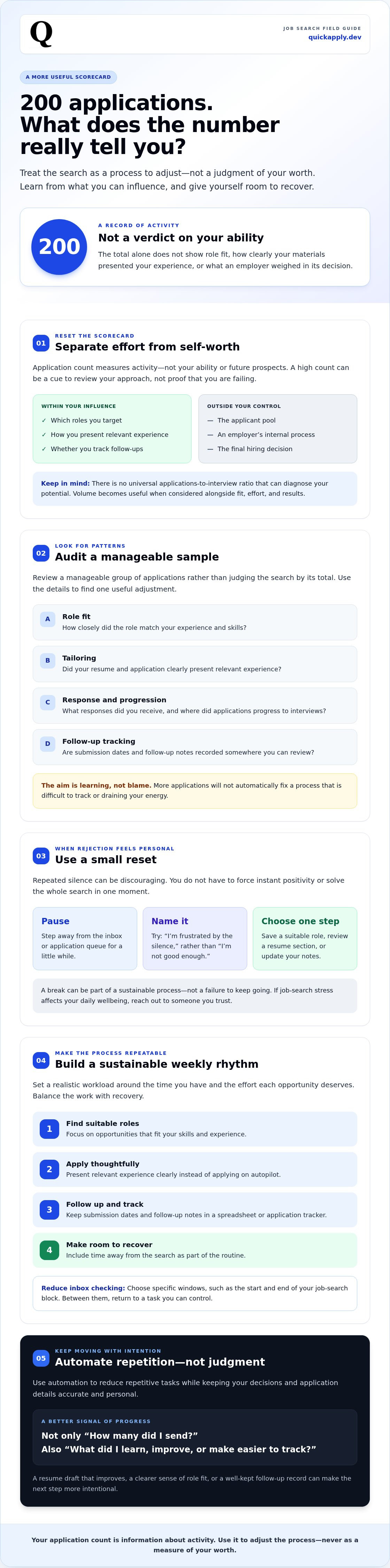
If you’re wondering how to stay motivated when you’ve sent 200 applications, begin with this distinction: Your application count measures activity, not your ability or your future prospects. Two hundred applications alone can’t diagnose your potential. They don’t reveal how closely each role matched your experience, how clearly your materials presented it, or what employers weighed in their decisions.
What does sending 200 applications actually tell you?
The total is a record of volume. It doesn’t tell you whether each application was tailored, whether the role was a strong fit, or whether a hiring team changed its priorities. Avoid using an assumed universal applications-to-interview ratio as a verdict on your search. The useful question is what the activity can teach you.
Separate your inputs from outcomes. You can influence which roles you target, how you present relevant experience, and whether you track follow-ups. You can’t control the applicant pool, an employer’s internal process, or its final decision. That’s why a high count may be a cue to review your approach, not proof that you’re failing.
How to respond when rejection starts feeling personal
Repeated silence can make taking another step feel pointless. Wikipedia describes the psychological drain of a long job search through the concept of learned helplessness, where repeated experiences perceived as failures can contribute to passivity. That idea can offer context, but it isn’t a diagnosis of you or your situation.
Use a short reset instead of demanding instant positivity:
- Pause: Step away from the inbox or application queue for a little while.
- Name the feeling: Say, “I’m frustrated by the silence,” rather than “I’m not good enough.”
- Choose one manageable next action: Save one suitable role, review one resume section, or update your application notes.
That next action doesn’t need to solve the whole search. It only needs to make the next step clear. If job-search stress is affecting your daily wellbeing, reach out to someone you trust. You don’t need to carry the pressure alone, and taking a break can be part of a sustainable process, not a failure to keep going.
Why 200 Applications Can Drain Motivation, and What the Number Does Not Prove
Repeated applications ask you to do similar work again and again: locate a role, adapt your materials, submit, then wait. The effort is immediate, but the result is uncertain. If you also refresh your inbox throughout the day, attention can stay locked on decisions you can’t control. That mismatch between effort and feedback can make the search feel heavier over time.
Application volume only becomes useful when you pair it with context about fit, effort, and results. Sending more applications doesn’t automatically mean you’ll get better results. If the roles aren’t aligned with your experience, or each submission uses generic materials, increasing volume may simply multiply the same process. A lower, more intentional pace can give you room to assess your approach instead of treating every application as another unit of output.
Why silence from employers can disrupt momentum
Hiring processes vary. Some employers provide updates; others may not communicate at every stage. That uncertainty can make it tempting to check for news repeatedly, even though refreshing your inbox won’t change the decision timeline. Advice on handling job search rejection can help put a response, or lack of one, in perspective without turning it into a judgment of your ability.
Set specific windows to check messages, such as at the start and end of your job-search block. Between those times, return to a task you can control. An application tracker can also help you record submission dates and follow-up notes, so you don’t have to rely on memory or keep checking the same status.
When to pause, recover, or change the process
Discouragement after a difficult week doesn’t automatically mean your strategy is broken. Look for a pattern. Is the pace leaving you depleted? Are you applying to roles that don’t match your skills? Are repetitive materials taking too long, or is uncertainty making it hard to focus? The answer points to a more useful adjustment than simply adding applications.
If you’re asking how to stay motivated when you've sent 200 applications, give yourself permission to pause deliberately. Step away for a set period, then return with one clear change, such as narrowing your role criteria or setting a limit on application tasks. Rest is a reset, not a failure. If distress persists or interferes with everyday life, consider reaching out to a qualified health professional or someone you trust.
When scattered updates are adding friction, an application tracker for organizing your search may help keep status and next steps visible. Use it to support your process, not to measure your worth.
How to Audit Your Job Search and Find the Next Useful Adjustment
Don’t audit all 200 applications at once. Start with a manageable sample of recent submissions, such as the last 10 you can review clearly. The goal isn’t to grade yourself or find a single explanation for every outcome. It’s to spot a signal worth testing.
For each application, note the role, source, relevant skills, resume version, response, screening calls, interviews, and follow-ups. Compare the work itself with your experience, not just the job title. Two roles with the same title may ask for different skills. Check whether your resume makes the most relevant evidence easy to find and connects it to the job description.
Which job-search signals are worth reviewing?
Keep each stage distinct. Count applications sent, employer responses, screening calls, interviews, and follow-ups separately. This creates a simple view of where activity is progressing and where it appears to stall. If you use an application tracker, record the same details there; a spreadsheet works too.
A pattern is a clue, not proof. A quiet response rate may reflect role fit, how your materials present your experience, the application source, or factors you can’t observe about the employer’s process. Use the pattern to form a test, then gather more information.
| Observed signal | Possible interpretation | Next experiment |
|---|---|---|
| Relevant roles receive few responses | Your fit may not be clear in the resume, or other factors may be affecting results. | Tailor the resume to highlight the skills and evidence that match the role. |
| Applications rarely match your strongest skills | Titles may be steering your search more than requirements. | Compare role requirements with your experience before applying. |
| Screenings happen, but interviews don’t progress | Your examples or answers may need sharper alignment with the role. | Practice explaining relevant projects and skills for upcoming interviews. |
| Applications are hard to track | Follow-ups or status updates may be getting lost. | Record submission dates, sources, and next steps in one place. |
How to choose one change instead of rebuilding everything
Pick the experiment that matches the signal. If roles are relevant but responses are limited, test clearer resume alignment. If you’re getting screenings but stalling later, focus on interview preparation for that transition. Change one process variable at a time and record what happens next. If you revise your resume, adjust your target roles, and change application sources together, you won’t know which change mattered.
This is a practical answer to how to stay motivated when you've sent 200 applications: turn a vague verdict into a specific question. Test one adjustment, review the next set of applications, and keep what helps your process. The result may not explain every employer decision, but it gives you a clearer next move.
How to Build a Sustainable Weekly Job-Search Routine
A repeatable week reduces the need to decide from scratch each day. Set a sequence that fits your schedule, then adjust the time you spend based on your responsibilities and the effort each role deserves. The target isn’t a fixed application quota. It’s a manageable process you can maintain without letting the search take over every day.
What should a repeatable job-search week include?
Batch similar tasks so you can focus. For example, use one session to find roles and shortlist those that meet your criteria, then set aside separate blocks to tailor and submit applications. Reserve a short review session for follow-ups, status updates, and one improvement to test next week.
- Find and prioritize: Search for roles, then shortlist opportunities based on relevant skills, requirements, and your interests.
- Tailor and submit: Use focused sessions to adapt your resume and cover letter to the strongest matches. Leave room for careful review.
- Follow up and review: Check due follow-ups, update your records, and note what you learned from the process.
Set your workload from the time you actually have. If a role needs substantial tailoring, plan for fewer submissions that week. If your schedule is already full, reduce the job-search block instead of trying to compensate by applying continuously. Add breaks between focused sessions, and protect job-search-free time. A routine needs an off switch.
How can you keep progress visible without obsessing over outcomes?
Track the parts of the search that are easy to lose in a busy week: role, application date, current stage, next action, and useful notes. Record completed actions and lessons alongside employer responses. For instance, completing a tailored resume or identifying a better-fit role is visible progress, even while a hiring decision is pending.
QuickApply’s application tracker is one option for organizing application stages. A spreadsheet or another simple system can work too. Pick one place to record updates, and check it during your planned review rather than monitoring it throughout the day.
If you’re working out how to stay motivated when you've sent 200 applications, let the routine carry the structure. Keep the schedule flexible, measure actions you control, and revise it when it stops fitting your life. Use QuickApply to organize your applications with an application tracker and keep next steps visible.
How to Keep Moving Forward With a More Focused Application System
A reset doesn’t require rebuilding your entire job search. Review the patterns you’ve noticed, choose one adjustment, then restart at a pace that leaves room for careful applications and recovery. For your next search cycle, shortlist a small set of roles that match your skills and priorities. Focus on clear fit, not a bigger application count.
What should you automate, and what should stay personal?
Use tools to reduce repetitive work, not to make career decisions for you. Resume tailoring and cover letter generation can help create role-specific drafts. A match score can offer another signal as you assess role fit, while application tracking can keep stages and next actions organized.
Review every draft before submitting. Confirm that each detail is accurate, relevant, and genuinely reflects your experience. Keep the final say on which roles to pursue, how to describe your work, and whether an application represents you well. Automation should speed up preparation, not replace your judgment or truthful self-presentation.
What is the next step after a 200-application reset?
Set up one focused cycle: identify well-matched roles, tailor your materials, submit applications you’ve checked, and record each next action. Choose a scheduled time to review progress rather than checking every application for updates. At that review, look at the signals you can act on and decide whether to continue the current approach or test one adjustment.
If you’re considering how to stay motivated when you've sent 200 applications, make the next step small enough to start and structured enough to repeat. You don’t need to solve the whole search today. You need a clear process for the next few suitable opportunities.
QuickApply brings together resume tailoring, cover letter generation, a match score, and application tracking to support that workflow. Explore QuickApply if those tools would help you organize and prepare your applications. They can make parts of the process more manageable, but your choices remain yours, and no tool can promise a hiring outcome.
Make Your Next Job-Search Move More Intentional
Two hundred applications are a record of effort, not a verdict on your ability. The next step isn’t to push harder by default. Review a sample of your search, choose one adjustment to test, and set a weekly pace that leaves room for focused applications and time away from the process.
If you’re still asking how to stay motivated when you've sent 200 applications, keep your attention on useful signals: role fit, the clarity of your materials, and the progress you can control. A steady system won’t determine an employer’s decision, but it can make your next move easier to see.
QuickApply offers AI-powered resume and cover letter tailoring based on job descriptions, plus match scores and application tracking to support a more organized search. Explore QuickApply’s job-search tools if they fit the workflow you’re building.
You don’t need to solve the whole search today. Choose one good next step, then keep moving at a pace you can sustain.
Frequently Asked Questions
Is it normal to feel discouraged after sending 200 job applications?
Yes, feeling discouraged after a long stretch of applications and limited feedback is understandable. Repeating tasks while waiting on decisions can wear down your energy, but the number alone doesn’t measure your ability or predict what happens next. If you’re wondering how to stay motivated when you've sent 200 applications, start by treating the count as a record of activity, then review what you can adjust and set a pace you can sustain.
Should I keep applying after 200 rejections or no responses?
You can keep searching, but don’t assume the best next move is simply sending more applications. First, distinguish explicit rejections from applications with no update, since silence doesn’t tell you why an employer hasn’t responded. Review a manageable sample of recent roles for fit, resume alignment, and application source. If the pattern suggests a change, test one adjustment before deciding whether to increase your workload.
How do I stay motivated when employers do not respond?
Set specific times to check your inbox and application updates instead of refreshing throughout the day. Use the time between checks for tasks you control, such as identifying suitable roles or preparing a tailored application. Record actions and useful observations, not just employer replies. That makes progress easier to see while decisions are pending. If the silence is affecting your daily wellbeing, consider talking with someone you trust or seeking qualified support.
Should I send more applications or focus on quality?
Choose quality when more volume would mean applying to roles that don’t fit or submitting materials without careful review. Choose a workload that matches your available time and lets you explain why each role suits your skills. Tailor your resume to make relevant experience clear, and check that every detail is accurate. More applications aren’t automatically better; a focused process helps you learn from each submission.
How can I tell if my resume is the reason I am not getting interviews?
You can’t confirm the resume is the sole reason from silence alone. Look for a pattern across roles that genuinely match your skills. Check whether the resume clearly reflects each job description and makes relevant experience easy to find. Compare versions and note where you applied and what response followed. If you’re also getting screenings, the issue may lie later in the process, so review interview preparation too.
How do I take a break from job searching without falling behind?
Make the break intentional: decide when you’ll pause and when you’ll return, then leave yourself a clear next step. For example, save a shortlist of relevant roles and note which resume draft needs review before stepping away. You don’t need to monitor messages constantly during your break. When you resume, check updates at a planned time and continue with the task you already identified.
Can an application tracker help me stay motivated?
An application tracker can reduce the mental load of remembering where you applied and what needs attention next. Record each role, application date, stage, next action, and a brief note. Review it on a schedule, and track completed steps as well as employer responses. QuickApply offers an application tracker to organize job-search progress, but a spreadsheet or another simple system can work too. Tracking supports organization, not guaranteed outcomes.


