

Job search fatigue isn't an emotional flaw; it's an operational bottleneck. You spend hours tailoring resumes and drafting cover letters into the void, only to get ghosted by automated screening algorithms. The unstructured days trigger constant guilt, and opening another job board sparks instant dread. If you want to know how to overcome job search fatigue, the answer isn't working harder. It's auditing a broken, low-yield workflow that burns through your cognitive bandwidth.
You don't need to tolerate administrative exhaustion to secure your next role. Discover how to diagnose application burnout, eliminate repetitive manual inputs, and increase your interview conversion rates using modern efficiency systems. Here are five strategic steps to streamline your pipeline, enforce strict daily boundaries, and rebuild your competitive momentum in 2026.
Key Takeaways
- Reframe application exhaustion as an operational drag rather than a personal deficit to stop the drain on your mental bandwidth.
- Discover how to overcome job search fatigue by replacing manual resume tweaking with structured, rules-based automation.
- Deploy algorithmic match scoring to filter out dead-end listings before you invest time into applying.
- Ditch chaotic spreadsheets for a centralized application tracker to eliminate context-switching and mental clutter.
- Implement a strict five-step operational framework that enforces firm daily boundaries while maximizing your pipeline yield.
What Is Job Search Fatigue and Why Traditional Advice Fails
Job search fatigue is not a character flaw. It is clinical cognitive depletion caused by relentless administrative friction. Generic career advice tells you to practice mindfulness, take long walks, or overhaul your mindset. That advice fails because it treats an operational failure as an emotional weakness. Taking a weekend off does nothing to resolve the dread of facing hundreds of high-friction application portals on Monday morning. Willpower alone cannot compensate for fundamentally inefficient processes.
Modern recruitment relies heavily on algorithmic screening filters and automated systems. Candidates pour hours into tailoring applications, only to hit silent corporate firewalls or waste energy on ghost jobs that companies leave online without any intention of hiring. This creates severe uncertainty and rejection shock. Learning how to overcome job search fatigue requires engineering out the repetitive friction points rather than trying to out-meditate systemic burnout.
Recognizing the Warning Signs: From Mental Drain to Cynicism
Burnout compounds quietly through repetitive, low-yield manual inputs. Watch for these operational warning signs:
- Portal Dread: A distinct aversion to opening job boards or navigating cumbersome corporate portals.
- Process Paralysis: Chronic procrastination triggered by copy-pasting work history between identical web forms.
- Emotional Cynicism: A sense of numbness caused by receiving cold, automated rejection emails weeks after applying.
The Psychology of Rejection in the Automated ATS Era
The modern job search introduces an extreme asymmetry of effort. You spend forty-five minutes reformatting bullet points, writing customized cover letters, and parsing your resume into rigid applicant tracking fields. The hiring platform evaluates, scores, and rejects that labor within milliseconds using automated filters.
Your brain is wired to process feedback through human social exchange. Instant, mechanical rejections strip away that context, leaving you with zero actionable data on why an application failed. Over hundreds of iterations, this persistent input-output mismatch triggers learned helplessness. You aren't broken; your operational setup is. Understanding how to overcome job search fatigue means replacing manual drudgery with high-leverage workflows that protect your mental clarity and restore your competitive edge.
The True Culprit: How Manual Search Drudgery Drains Momentum
Every job application requires complex context-switching. You jump between raw job descriptions, open document editors, GitHub repositories, and multi-step web forms. Each jump forces your brain to reload context, burning finite executive function before you submit a single application. Applying for modern technical positions isn't just time-consuming; it creates severe cognitive overhead that bleeds into the rest of your week.
Treat your job hunt like an engineering problem. You have a finite daily energy budget. If you burn 80% of that budget manually formatting documents and managing rows in clunky spreadsheets, you leave zero reserve bandwidth for high-stakes screening calls and technical assessments. Figuring out how to overcome job search fatigue starts with identifying where your operational energy leaks into routine clerical tasks.
The Cost of Manual Resume and Cover Letter Customization
Spending forty-five minutes tweaking bullet points for individual applicant tracking systems guarantees rapid burnout. You manually rephrase achievements, match keywords line by line, and draft cover letters that may never be read by human eyes. This high-friction input generates an outsized emotional stake in every submission. When you invest an hour into a single application, an automated rejection hurts. When you use modern job application processes to automate repetitive tailoring, you decouple your emotional state from routine screening outcomes.
Application Chaos: The Cognitive Toll of Poor Tracking
Decentralized tracking compounds application stress. When your submission history is scattered across saved browser tabs, email folders, and ad-hoc spreadsheets, you operate under constant mental friction:
- Missing Context: Forgetting the exact version of the resume submitted when a recruiter reaches out for an unscheduled phone screen.
- Dead-End Follow-ups: Losing submission dates, making it impossible to audit response rates or follow up effectively.
- Cognitive Leakage: Re-reading past postings repeatedly just to remember basic role requirements and tech stacks.
A disorganized search multiplies daily anxiety. Deploying a structured workspace like QuickApply removes that chaotic administrative load by centralizing application data and tailoring resumes automatically. Transforming a messy pipeline into an organized workflow is essential if you want to eliminate friction and discover how to overcome job search fatigue over the long haul.
High-Volume Spraying vs. Strategic Systems: The Efficiency Audit
Job seekers frequently split into two losing extremes. Some blast out hundreds of generic resumes using one-click boards, hoping brute volume wins. Others spend entire days crafting a single, bespoke submission. Both approaches wreck your stamina. Mass-applying produces sub-one-percent response rates and compounding silence. Extreme manual tailoring caps your pipeline at five applications a week, making every rejection sting. High-performance job hunting sits right between these models: high volume powered by deep, algorithmic relevance.
Intelligent automation bridges that gap. It gives you the throughput of a high-volume pipeline alongside the precise keyword alignment of a targeted application. If you want to understand how to overcome job search fatigue, you must replace emotional effort with automated precision. You don't need fewer applications; you need higher conversion per unit of effort.
The Myth of the 100-Application-a-Day Routine
Clicking easy-apply buttons creates an illusion of progress. You feel productive, but your pipeline yield stays near zero. Modern recruiting software automatically filters out unaligned submissions within seconds of receipt. Blasting hundreds of identical resumes floods your inbox with automated rejections, tanking your morale while burning valuable daylight. The math simply does not support untargeted spraying.
Targeted Alignment: Maximizing Yield While Conserving Mental Bandwidth
A strategic system screens opportunities before you invest a single second into applying. Using automated match scoring lets you audit how well your background aligns with a role before submission:
- Target Fit: Identify positions where your core technical skills hit an 80% or greater match threshold.
- Drop Low-Yield Roles: Eliminate postings that demand niche requirements you don't possess, dodging certain automated rejection.
- Instant Customization: Learn how to tailor your resume with AI precision to reflect relevant keywords without manual drafting.
Filtering roles through match scoring shrinks your daily operational load while dramatically increasing interview invitations. Instead of sending fifty misaligned resumes into a corporate void, you dispatch ten targeted applications tuned to pass screening parameters. Mastering how to overcome job search fatigue comes down to this core leverage: maximize ATS match rates while minimizing manual keystrokes.
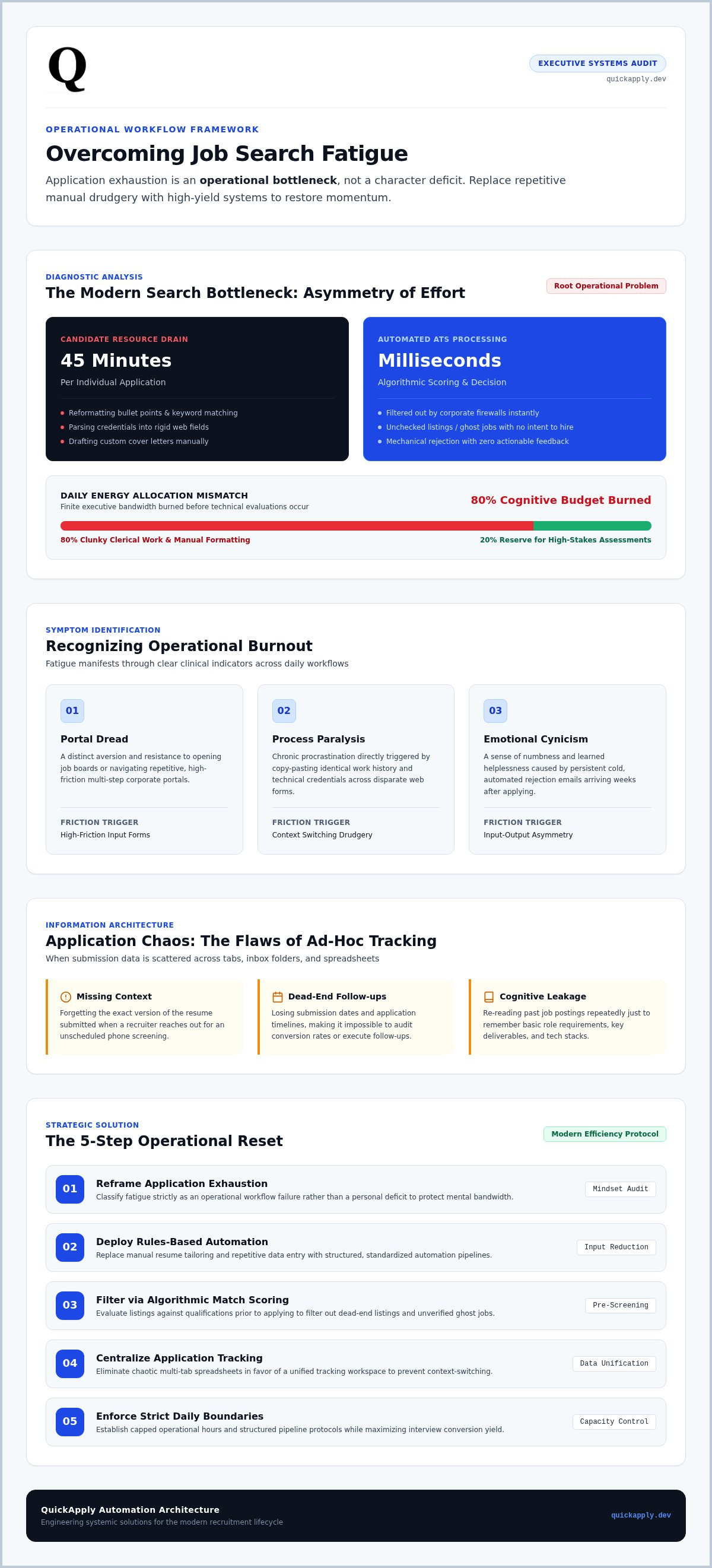
How to Overcome Job Search Fatigue: The 5-Step Systemic Reset
Ending search exhaustion requires restructuring your daily operating environment. When you replace open-ended, chaotic browsing with rigid parameters, mental depletion disappears. This five-step framework treats your career search like an optimized delivery pipeline. Follow these operational steps to build momentum without sacrificing your personal sanity.
Steps 1 & 2: Audit Your Search Metrics and Enforce Timeboxing
Diagnose where your pipeline stalls before changing your routine. Track your conversion rates from initial submission to recruiter screen. If your response rate dips below 5%, your targeting is misaligned; if you convert initial screens but fail technical rounds, document customization is no longer your bottleneck.
Next, place strict constraints on active application generation. Cap daily submission windows at ninety focused minutes. When the timer expires, close every job portal completely. Establish a non-negotiable shutdown time every evening. Setting hard boundaries stops ambient guilt from bleeding into your personal hours, providing an immediate answer for how to overcome job search fatigue.
Steps 3 & 4: Automate Asset Customization and Centralize Pipeline Tracking
Clerical production tasks drain your cognitive reserves. Remove manual drafting from your daily schedule by deploying an automated cover letter generator to assemble tailored documents instantly. Pair this with algorithmic resume tuning to align your technical keywords directly against posted hiring criteria.
Centralize your submission pipeline in one dedicated workspace. Stop updating fragmented local spreadsheets or digging through cluttered email threads. Organizing your target companies, communication stages, and active interview rounds in a unified tracking system eliminates low-value context switching. Ready to streamline your search architecture? Start optimizing your pipeline with QuickApply to manage tailored submissions and stage tracking from a single dashboard.
Step 5: Pivot Focus Toward Interview Execution and Skill Growth
Compressing application overhead frees up critical working memory. Reinvest that recovered bandwidth where human presence actually matters:
- Live Interview Practice: Run technical scenarios, system architecture breakdowns, and behavioral STAR stories until your delivery is effortless.
- Skill Sharpness: Spend application-free afternoons contributing to open-source code, refining your portfolio, or learning adjacent frameworks.
- High-Value Networking: Reach out directly to engineering managers and peers without the exhaustion of filing cold portal applications.
Shifting your attention from document formatting to live presentation execution changes your entire trajectory. This structured leverage protects your stamina and shows you how to overcome job search fatigue permanently.
Rebuilding Career Momentum with QuickApply Automation
Clerical friction kills your momentum. Spending your productive morning hours copy-pasting work histories and reformatting margins is an operational mistake. QuickApply automates that administrative overhead, letting you channel your energy into interview execution and high-level career positioning. Replacing manual labor with targeted automation transforms an overwhelming process into a scalable, low-stress system.
True career leverage comes from speed combined with precision. You don't need expensive consulting programs or endless passive alerts to get hired. You need a streamlined toolkit that handles repetitive logistics in seconds. That efficiency is the ultimate solution for how to overcome job search fatigue while scaling your application output.
Instantaneous Document Tailoring Without Cognitive Burnout
Every role requires a distinct angle, but manually adjusting resumes for every posting burns finite mental reserves. QuickApply dynamically adapts your experience to meet specific employer criteria:
- Targeted ATS Optimization: Extract keywords from target job descriptions to produce tailored, parsing-ready resumes instantly.
- Rapid Cover Letter Generation: Create compelling, position-aligned narratives in seconds without facing creative friction.
- Authentic Positioning: Preserve your authentic professional voice while eliminating tedious manual phrasing.
A Unified Command Center for Every Stage of Your Search
Scattered tracking tools drain cognitive stamina. QuickApply consolidates your search operations into a centralized, single-pane command center. Automated match scoring screens prospective postings upfront, flagging high-probability matches and filtering out poor fits before you commit effort to applying.
Once you submit, the built-in application tracker logs every role, timeline, and company update without clunky external spreadsheets. As interviews convert, you can transition directly into interactive interview practice modules to sharpen technical delivery. The platform also offers long-term resources, including a salary negotiation guide and a promotion roadmap to guide your trajectory after you sign an offer. Stop burning out on repetitive clerical tasks. Take back control, preserve your focus, and automate your job applications with QuickApply to see how to overcome job search fatigue with intelligent systems.
Upgrade Your Search Architecture to Take Back Control
Job search exhaustion doesn't mean your skills are obsolete. It means your manual process is broken. When you stop copy-pasting documents and start running your search through structured systems, the administrative dread disappears. Setting strict daily timeboxes, filtering listings with automated match scores, and replacing manual tailoring with algorithmic speed are the proven tactical steps for how to overcome job search fatigue.
You don't have to navigate broken hiring portals alone. Tailor resumes to any job description in seconds, filter out poor-fit roles before you apply, and replace chaotic spreadsheets with centralized tracking. Ready to stop burning out on clerical busywork? Eliminate search burnout and automate your applications with QuickApply today. Take command of your workflow, protect your mental energy, and let modern tooling drive your next career breakthrough.
Frequently Asked Questions
How do I know if I am suffering from job search fatigue or clinical depression?
Job search fatigue lifts when you step away from application portals, whereas clinical depression persists across all areas of your daily life. If your exhaustion, brain fog, and cynicism occur solely when managing resumes, cover letters, or rejection emails, you are dealing with operational burnout. If low mood, sleep disruption, and anhedonia follow you everywhere, consult a licensed healthcare professional for a medical evaluation.
How many jobs should I apply for per day to avoid burnout?
Aim for three to five highly aligned applications per day rather than submitting dozens of unfocused forms. Quality screening outperforms mass distribution every time. When you use automated match scoring to pre-screen openings, this tight target ensures high qualification overlap without draining your cognitive bandwidth. Cap your active submission workflow at ninety focused minutes, then log off completely to protect your daily stamina.
Is it bad to take a complete break from searching for a job?
Taking a deliberate, structured break of three to seven days prevents chronic mental depletion and restores executive function. Stepping away lets you reset your nervous system after prolonged exposure to rejection shock. An effective pause has a scheduled start and end date. Use this time to recharge your mental battery before deploying streamlined systems that show you how to overcome job search fatigue sustainably.
Does using AI to tailor resumes and cover letters hurt my chances with ATS?
No, because modern ATS filters evaluate document structure, relevant hard skills, and contextual keyword density rather than who typed the words. Problems only arise when candidates submit hallucinated claims or unformatted text blocks. Leveraging intelligent resume tailoring ensures your authentic accomplishments align precisely with role requirements, helping your profile clear automated screening rules while saving you hours of repetitive drafting.
How can I handle the emotional toll of being ghosted by employers?
Reframe employer silence as an automated systemic failure rather than a reflection of your professional capability. High application volumes cause many corporate recruitment pipelines to drop communication entirely. Log your submissions inside a centralized application tracker and set a firm fourteen-day follow-up rule. Once that window closes without a response, mark the status as closed and reallocate your focus toward active opportunities.
What should I do when every rejection feels like a personal failure?
Decouple your self-worth from non-human corporate screening algorithms. Algorithmic filters eliminate candidates based on rigid keyword thresholds, shifting headcount priorities, or unposted internal candidates, none of which reflect your engineering competence. Tracking your pipeline conversion metrics helps you view rejections objectively. When you treat the search as an optimization process, understanding how to overcome job search fatigue becomes a matter of refining workflows instead of absorbing emotional hits.
How can I stay motivated during a tech job search that takes months?
Shift your daily metrics from external hiring outcomes to internally controlled actions. You cannot control recruiter turnaround times, but you can control your timeboxed daily routine, interview practice reps, and technical skill development. Build tangible momentum by mastering simulated interview prompts and refining code portfolios during hours previously lost to manual data entry. Automating repetitive clerical tasks keeps your pipeline moving forward without draining your energy.


