

Meticulously editing every resume bullet point feels like diligence. In reality, the hidden cost of spending too much time on each application is a starved interview pipeline and rapid burnout. With the average corporate job posting attracting roughly 250 applicants and high-demand roles closing within 48 hours, hyper-focusing on one submission leaves you behind the curve. You pour hours into manual tweaks, hit submit, and meet absolute silence.
You already feel the exhaustion of grinding through applications with zero momentum to show for it. It's time to fix the math. In this guide, you'll discover the quantifiable financial, psychological, and pipeline costs of over-tailoring, along with the proven framework to balance high submission velocity with precision personalization. We will unpack why manual perfectionism throttles your search and how to deploy automated workflows that produce tailored resumes in seconds.
Key Takeaways
- Calculate how prolonged search timelines directly eat into your annual earning potential through delayed compensation costs.
- Uncover the real cost of spending too much time on each application when modern recruitment systems filter manual submissions algorithmically.
- Protect your career trajectory by maintaining top-of-funnel pipeline velocity rather than betting everything on just two active leads.
- Build a structured master career repository that slashes your application submission time to under five minutes per role.
- Implement automated Resume Tailoring workflows to hit high-velocity output with precision keyword alignment in seconds.
The Hidden Math: Calculating the Real Cost of Application Over-Optimization
Application over-optimization occurs when candidates spend excessive manual hours micro-tuning single submissions for marginal, often nonexistent gains. Job seekers frequently assume that agonizing over every phrase guarantees recruiter attention. The actual financial data tells a completely different story. The true cost of spending too much time on each application directly compounds as lost earning power, prolonged unemployment, and severe cognitive drain.
When manual adjustments extend beyond 45 minutes per role, candidate return on investment craters. Modern corporate pipelines process hundreds of incoming resumes within days. If you manually tweak one document across three hours, you trade high-probability market exposure for cosmetic changes that automated screening algorithms largely ignore. Understanding the opportunity cost of your time reveals why this manual approach actively hurts your career trajectory.
The Compound Salary Penalty of Extended Searches
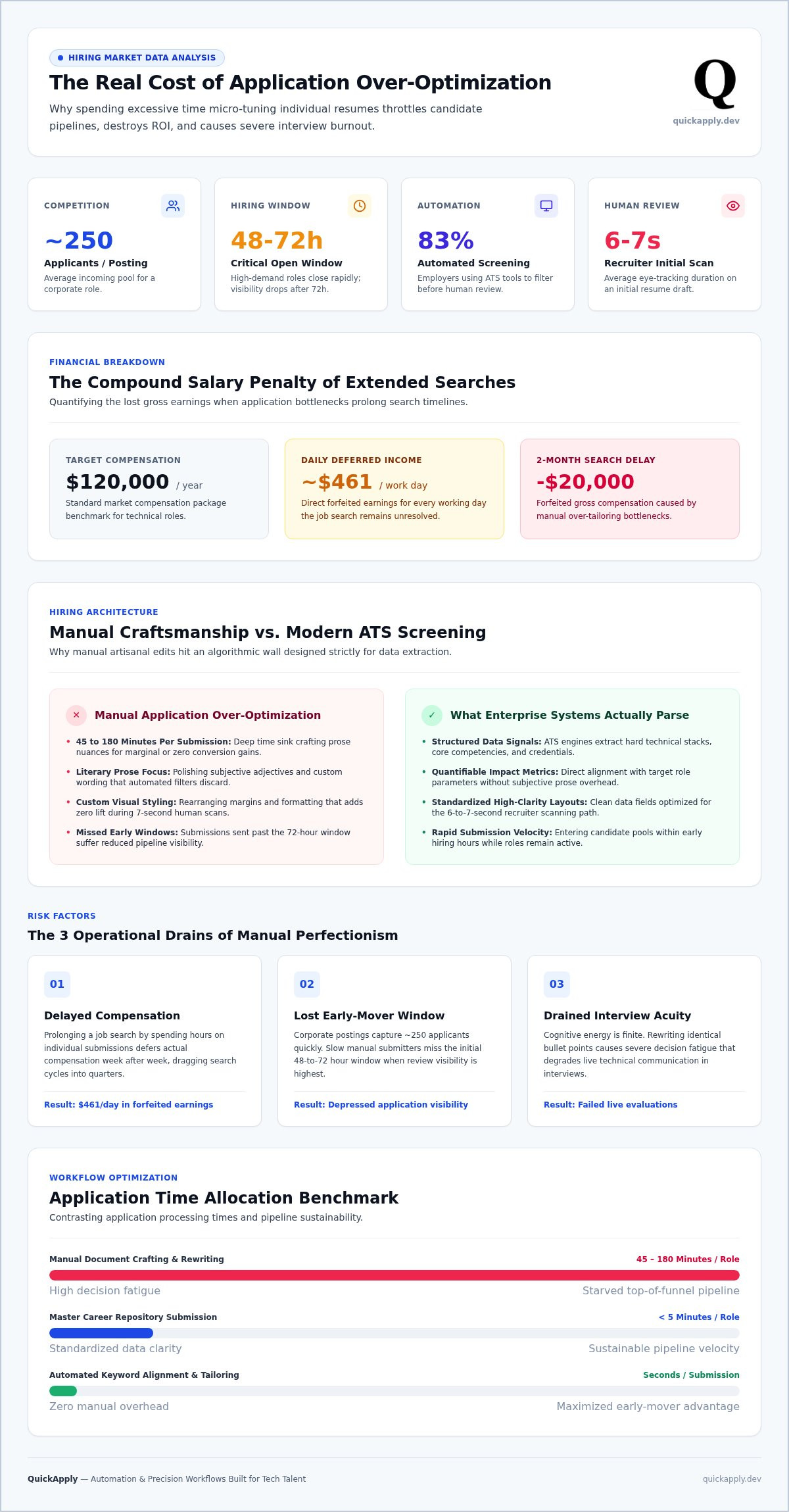
Every delayed week carries a fixed financial loss. Consider a tech professional targeting a $120,000 annual compensation package. That role pays approximately $461 per working day. Burning two additional months personalizing a handful of resumes forfeits nearly $20,000 in gross earnings. Because high-demand listings routinely close within 72 hours, slow manual submitters miss open hiring windows entirely, dragging their search timelines out for quarters instead of weeks.
Decision Fatigue and the Law of Diminishing Returns
Cognitive energy is finite. Rewriting identical bullet points four times a day causes steep mental depletion. A resume polished across three manual hours performs almost identically to one structured cleanly in three minutes; applicant tracking systems parse data fields, not subjective prose nuances. Worse, that exhaustion carries over. Candidates who burn out during manual document editing show up sluggish and unfocused in technical interviews, failing the exact evaluations that secure job offers.
To quantify the financial drain, consider this operational breakdown:
- Daily Forfeited Compensation: Prolonged searches defer actual income day after day.
- Missed Early-Mover Advantage: Applications sent after the first 72 hours drop in visibility.
- Drained Interview Acuity: Manual document fatigue degrades live technical communication.
Spending excessive hours on individual submissions isn't meticulous; it's an inefficient bottleneck that depresses your pipeline.
The Diminishing Returns of Manual Craftsmanship in 2026 Hiring
Manual effort yields diminishing returns when algorithmic filters gatekeep the initial hiring stages. Candidates often spend an hour polishing unique adjectives, assuming human recruiters read every line with deep literary appreciation. In practice, modern corporate hiring runs on rapid data parsing. The cost of spending too much time on each application escalates quickly when manual craftsmanship hits an algorithmic wall designed strictly for pattern recognition.
How Modern Applicant Tracking Systems Actually Screen
Contemporary enterprise ATS platforms don't evaluate prose styling or creative phrasing. They extract raw data points: technical stacks, hard skills, certifications, and measurable outcomes. Approximately 83% of employers utilize automated screening tools to rank and sort applicants before a recruiter opens a single file. Submitting an artisanal, painstakingly crafted cover letter won't bypass an algorithm looking for specific competency signals. Candidates who understand how to tailor resume to job description with AI align their experience directly with these data criteria without manual overhead.
The 7-Second Recruiter Scan vs. Your Two-Hour Draft
Once your resume clears automated screening, recruiter eye-tracking heatmaps reveal an unsettling truth. Most human screeners spend roughly six to seven seconds evaluating an initial application. Their eyes scan a predictable path: current title, previous company names, employment dates, and quantifiable impact metrics. Forty minutes spent finessing margins or rearranging custom visual elements produces zero conversion lift. Standardized, high-clarity structures win every time because they allow immediate data digestion.
Relying on manual labor in an automated ecosystem guarantees friction. Practicing strategic time management requires focusing energy where human judgment actually moves the needle, like live technical challenges and compensation discussions.
Consider where manual over-crafting breaks down:
- Algorithmic Mismatch: Subjective human phrasing often misses specific machine-indexed requirements.
- Recruiter Dwell Time: Brief seven-second scans render long-form bespoke paragraphs invisible.
- Opportunity Loss: Hours spent crafting a single submission prevent you from competing for dozens of concurrent roles.
Automating document structuring preserves clean formatting while ensuring precise keyword coverage. You can streamline this workflow and eliminate repetitive editing entirely using QuickApply to generate targeted, ATS-ready documents in seconds.
Opportunity Cost vs. Pipeline Velocity: Why Volume Protects Your Career
Treating a tech job search like an artisan craft is a mathematical trap. Modern hiring behaves like a probabilistic sales funnel, not an art competition. The hidden cost of spending too much time on each application is acute structural fragility. When you bet your entire career transition on two or three manually pampered submissions, you surrender all leverage to corporate variables you cannot control.
The Math of Tech Hiring Conversion Rates
Engineering funnels run on predictable conversion drops. Cold submission-to-screening rates typically hover between 5% and 8%, even for qualified talent with aligned technical backgrounds. Submitting five bespoke applications a week generates roughly one exploratory conversation every month. If that team hits a sudden budget freeze, executes an internal transfer, or closes the req without notice, your entire pipeline drops to zero. Maintaining continuous top-of-funnel submission velocity buffers your search against inevitable requisition cancellations.
Leverage and Competing Offers in Negotiation
Velocity doesn't just insulate you from ghosting; it creates actual market power. When you hold four active interview loops simultaneously, recruiter dynamics shift in your favor. You dictate scheduling cadences, field competitive counteroffers, and deploy proven compensation strategies from a position of absolute security. In contrast, candidates who spend three weeks babying a single application arrive at final rounds completely vulnerable. Walking away from a lowball offer isn't an option when an empty pipeline leaves you with zero alternatives.
Maintaining high-velocity output delivers direct strategic dividends:
- Systemic Redundancy: Ghost jobs and unannounced budget cuts no longer wipe out your forward momentum.
- Compounding Technical Sharpness: Frequent screening loops build live conversational fluency far faster than isolated interviews.
- Genuine Negotiation Leverage: Overlapping final rounds force hiring committees to present their best possible compensation bands.
Treat your career search like a production pipeline. You cannot control corporate hiring whims, but you can control pipeline volume. When you eliminate manual application bottlenecks, predictable math replaces blind hope.
The Modern Application Playbook: Balancing Tailored Quality with High Output
Most career advice forces a false choice: blast hundreds of generic resumes into the void, or spend two agonizing hours handcrafting a single application. Both models fail. The first gets blocked by semantic ATS filters, while the second starves your candidate pipeline. Eliminating the cost of spending too much time on each application means replacing slow manual labor with a streamlined, repeatable system. By following a structured five-step framework, you can produce targeted, high-relevance submissions in under five minutes.
Step 1 & 2: Establishing Master Profiles and Keyword Mapping
Stop writing resumes from scratch. Start by compiling a comprehensive master experience repository containing every engineering project, tech stack, leadership initiative, and quantified metric from your career. When a target role appears, run the job description through automated semantic parsers to extract mandatory technologies, domain requirements, and core competencies. Reviewing how to tailor your resume to a job description shows you how matching your master record to these extracted parameters provides complete keyword coverage without manual guesswork.
Step 3, 4 & 5: Rapid Generation, Quality Audits, and Tracking
Once you map the core keywords, execute the final three stages of the pipeline in rapid succession:
- Step 3: Algorithmic Document Generation. Deploy automated tools to align your bullet points to the target role and generate a tailored cover letter in seconds.
- Step 4: The 60-Second Quality Audit. Perform a rapid visual scan. Verify technical metrics, confirm accurate date parsing, and check that the target company name is correct.
- Step 5: Centralized Pipeline Logging. Ditch chaotic, manually maintained spreadsheets. Instantly record the job title, company, salary band, and submission date into a dedicated dashboard.
Executing these stages systematically creates continuous top-of-funnel momentum. For a deeper breakdown of tracking mechanics and interview conversion loops, consult our guide on mastering the job application process.
You don't need to spend nights trapped in document editors to stand out. Take control of your search velocity and automate your application workflow with QuickApply today.
Scaling Your Applications with QuickApply: Automation Built for Tech Talent
Manual customization simply does not scale in a compressed hiring market. High-performing engineers don't write repetitive scripts by hand; they deploy automated pipelines. Your career search demands that exact same technical discipline. The real cost of spending too much time on each application is lost momentum, pipeline starvation, and severe burnout. QuickApply functions as a dedicated career operating system built specifically to eliminate manual friction, turning hours of tedious document preparation into a streamlined, high-speed workflow.
Automated Resume Tailoring and Match Scoring
Job descriptions pack complex technical stacks and competencies into dense paragraphs. QuickApply extracts these core parameters instantly. Through automated Resume Tailoring, the system aligns your verified achievements directly to target job descriptions without rewriting your background from scratch. Job-specific algorithms generate customized resumes and drive automated Cover Letter Generation in seconds. The platform calculates a real-time match score against target postings, pinpointing missing technical keywords and syntax gaps before you hit submit. This pre-submission validation ensures your materials pass automated screening while maintaining rapid output velocity.
Centralized Search Management and Interview Readiness
High application velocity creates organizational chaos without the right infrastructure. QuickApply solves this with a centralized Application Tracker that manages active leads, submission dates, and candidate statuses without messy spreadsheets. The platform doesn't stop at document submission; it supports your entire hiring lifecycle from initial screening to long-term growth:
- Interview Practice: Transition smoothly from application submissions into technical interview preparation.
- Salary Negotiation Guide: Secure optimal compensation packages once competing offers materialize.
- Promotion Roadmap: Plan your long-term internal trajectory once you land the role.
Stop paying the continuous cost of spending too much time on each application with wasted hours and stalled searches. Reclaim your focus, build deep pipeline redundancy, and secure more interviews. Get started today with QuickApply to scale your search efficiently.
Turn Pipeline Velocity Into Your Unfair Advantage
Manual job searching is broken. Pouring hours into cosmetic edits won't beat automated filters, and betting on a handful of slow submissions leaves your pipeline vulnerable. The quantifiable cost of spending too much time on each application isn't just lost hours; it's delayed compensation, mental exhaustion, and surrendered negotiating power. Winning in today's market demands operational efficiency and consistent volume.
You have the engineering skills. Now give yourself the technical infrastructure to showcase them at scale. Generate targeted resumes and cover letters in seconds, validate keyword alignment with real-time match scores, and organize your pipeline using an automated Application Tracker. Once the interviews start rolling in, leverage dedicated Interview Practice and compensation tools to secure the offer you deserve. Stop wasting precious working days on repetitive manual formatting. Accelerate your search and tailor resumes in seconds with QuickApply. Your next breakthrough is just a streamlined workflow away.
Frequently Asked Questions
How much time should I realistically spend on each job application?
Target three to five minutes per submission when using an optimized workflow. Spending 45 to 90 minutes per role ruins your search velocity. When you maintain a verified master repository and automate semantic keyword alignment, you can evaluate role criteria, audit technical metrics, and submit high-impact materials rapidly. Capping active effort per listing ensures you hit early 72-hour application windows while preserving cognitive bandwidth for technical interviews.
Will recruiters know if I use AI tools to tailor my resume?
Recruiters cannot distinguish between an authentically tailored resume produced by software and one edited manually, provided the underlying facts reflect your actual career history. Modern recruiting systems check for relevant technical keywords, matching competencies, and clear achievements. As long as you run a quick audit to verify factual accuracy and avoid generic fluff, automated tools simply format your genuine experience to meet specific ATS requirements efficiently.
Is sending more job applications better than sending fewer tailored ones?
You need a hybrid strategy: high submission velocity paired with targeted keyword relevance. Blasting generic resumes rarely clears initial screening algorithms, while handcrafting only two submissions per week starves your candidate pipeline. The compounding cost of spending too much time on each application is an empty calendar when unexpected hiring freezes occur. Modern automated workflows give you both advantages by delivering custom-fit documents at scale.
What is the biggest mistake job seekers make when tailoring resumes manually?
The single biggest mistake is rewriting resume phrasing subjectively instead of targeting objective ATS criteria. Candidates often spend hours tweaking adjectives or layout margins that automated parsers ignore. Modern screening engines look for hard technical proficiencies, specific frameworks, and quantified metrics. Focusing on creative narrative rather than verified keyword alignment wastes cognitive energy and fails to improve conversion during initial automated reviews.
Can automated resume tailoring help pass Applicant Tracking Systems?
Automated tailoring directly improves ATS pass rates by parsing job descriptions for critical keywords and mapping them to your real achievements. Recruitment algorithms evaluate raw data fields, not your emotional writing effort. Automated tools calculate match scores, ensuring required skills, libraries, and certifications appear in standardized formats that ATS parsers extract effortlessly, dramatically reducing screening rejections.
How does spending too much time per application lead to job search burnout?
Prolonged manual tailoring builds intense emotional investment in single job listings. When you spend three hours perfecting a bespoke cover letter and resume, an automated rejection or silence feels devastating. That psychological drain is a massive cost of spending too much time on each application. High submission velocity buffers your mental health by spreading expectations across an active pipeline rather than one fragile requisition.
What tools should I use to track high-volume job applications effectively?
Ditch manual spreadsheets and use dedicated platforms with integrated tracking dashboards. A centralized Application Tracker logs submission dates, company targets, and stage progression automatically. Software platforms like QuickApply combine this pipeline tracking with instant document customization and interview practice modules, giving you an end-to-end command center that keeps your active search organized without spreadsheet maintenance.


