

What if a long job search isn’t a verdict on your value, but a signal that one part of your process needs a reset? If repeated applications aren’t turning into interviews, it’s frustrating to keep pushing without knowing whether your resume, role targeting, or application approach is the problem.
Knowing what to do when your job search is taking forever starts with finding the stall point, not adding more busywork. You’ll learn how to spot patterns in your applications, make a few focused changes, and track whether they’re helping. The goal isn’t to apply endlessly. It’s to build a steady search that protects your time and confidence while creating better opportunities.
We’ll break down the job-search funnel, from choosing roles to getting interviews, and show you what to adjust at each stage. You’ll also see how tailored application materials and a simple tracker can help turn scattered effort into a clearer next step.
Key Takeaways
- To figure out what to do when your job search is taking forever, review a manageable sample of applications and look for the stage where progress stalls.
- Compare each role’s requirements with the skills and experience you can clearly demonstrate before sending another application.
- Use a simple role-fit table to separate strong matches from meaningful gaps, and focus effort where you can make a credible case.
- Build a sustainable weekly routine around reviewing results, testing one adjustment, and balancing applications with networking and interview preparation.
- Job-specific resume and cover letter drafts can reduce repetitive work, leaving more time for thoughtful targeting and follow-up.
Job Search Taking Too Long? Start With the Facts
A long job search can wear down your energy and confidence, especially when applications disappear into silence. That frustration doesn’t mean you’ve failed. Hiring timelines vary by role, employer, and interview process, so search duration alone can’t tell you what’s wrong. A stalled job search is a signal to investigate, not a verdict on your ability.
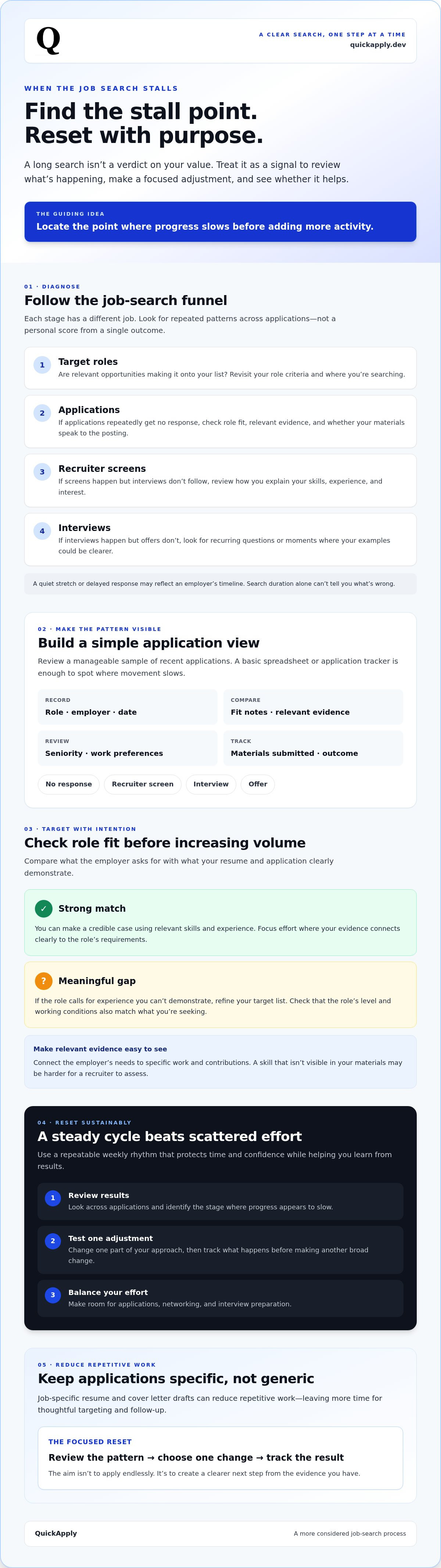
Get specific before you change your whole strategy. Think of the search as a funnel: target roles, applications, recruiter screens, interviews, and offers. Each stage has a different job. Targeting determines which opportunities you pursue; your application makes the case for fit; screens and interviews test that case in more depth. The broader job seeking process includes multiple ways to find and pursue work, not just submitting applications online.
Is a long job search automatically a sign that something is wrong?
No. A quiet stretch after applying, or a delay between interviews, may reflect an employer’s timeline rather than a problem with your candidacy. Processes differ, and waiting by itself isn’t enough evidence to judge your prospects.
Look instead for a repeated pattern. One unanswered application offers little to diagnose. If applications for roles that appear to fit consistently lead nowhere, that’s a reason to review your targeting or materials. If you’re getting screens but not advancing, the questions to test may be different. Treat each pattern as information, not a personal score.
Which part of the job-search funnel is stalling?
Create one simple view of recent applications. Record the role, employer, date, fit notes, and current outcome: no response, recruiter screen, interview, or offer. Include applications at different stages so you can see where movement slows. A basic spreadsheet or application tracker is enough.
- Few relevant roles make it onto your list: Revisit your role criteria and where you’re searching.
- Applications repeatedly get no response: Check whether your resume clearly connects your experience to each role’s requirements.
- Screens happen, but interviews don’t follow: Review how you explain your skills, experience, and interest.
- Interviews happen, but offers don’t: Look for recurring questions or moments where your examples could be clearer.
These are starting points for testing, not automatic diagnoses. Compare several applications before changing your approach, then adjust one part and track what happens. For a broader walkthrough of each stage, see the job application process guide. This is the practical answer to what to do when your job search is taking forever: locate the stall before adding more activity.
Diagnose Why Your Job Applications Are Not Moving Forward
Once you’ve identified where progress slows, look for patterns before you rewrite everything. Review a manageable sample of recent applications, not just the most disappointing result. For each role, note the requirements, your relevant evidence, seniority level, work preferences, materials submitted, and outcome. This makes it easier to separate a fit issue from an application issue.
Compare what the employer asks for with what your resume and application actually show. If a posting calls for experience improving software reliability, for example, does your resume name the relevant work and describe your contribution? A skill you have but haven’t made visible may not help a recruiter assess your fit. Also check whether the role’s level and working conditions match what you’re seeking.
What does it mean if applications get no responses?
Repeated silence is a prompt to review the whole application, not proof that one system or factor is responsible. Check whether you meet the core qualifications, whether your materials are relevant to the specific posting, and whether every requested field or document was included. Look for a clear connection between the employer’s needs and your demonstrated skills, rather than relying on a generic list of duties.
Keep the review focused. If your role choices look appropriate but your resume uses broad language, test a more specific version that reflects the posting’s priorities. If the roles require experience beyond what you can demonstrate, refine your target list before increasing volume. The stage where responses stop helps narrow what to review next.
What if you get interviews but no offers?
Interviews show that your application is prompting further consideration, but they don’t guarantee an offer. Review your notes after each conversation. Do you repeatedly struggle to explain a project, describe your impact, or connect your experience to the role? Notice whether momentum drops at the same interview stage, and consider any feedback you’ve received. Then practice targeted examples that address the pattern instead of rehearsing answers at random.
For structured preparation, explore this AI interview practice guide. The aim is to sharpen your explanations and learn from each conversation, not to memorize a script.
Change one variable at a time. You might revise how you present relevant experience while keeping your role criteria consistent, then track outcomes for the next set of applications. If you change your resume, target roles, and application method all at once, it’s harder to tell which adjustment made a difference. That’s a practical way to approach what to do when your job search is taking forever: use the evidence you have to choose a focused next test.
A simple application tracker can help you compare roles, materials, and outcomes in one place. If you want support organizing applications and tailoring materials to job descriptions, explore QuickApply’s job-search tools.
Choose Better-Fit Roles Before Increasing Application Volume
More applications create more activity, but not necessarily more useful opportunities. A high-volume approach can help you explore the market, yet rushing often leaves little time to check fit or tailor your materials. A targeted approach takes more preparation per role, but gives you a clearer way to show why your experience matches the work. It also creates better feedback: if a well-matched application gets no response, you can review the materials instead of wondering whether the role was suitable in the first place.
Before applying, make a quick role-fit map. Pull out the main responsibilities and requirements, then connect them to evidence you can support with a project, result, or relevant skill. For example:
- Role requirement: Improve reliability of a software system.
- Evidence you can show: A project where you identified recurring failures and helped reduce them.
- Meaningful gap: The posting asks for experience with a tool you haven’t used. Decide whether it’s essential or something you can learn.
This simple comparison helps you avoid two traps: applying indiscriminately to roles with major mismatches, and self-rejecting because you don’t meet every preferred qualification. Read the posting closely. “Required” and “preferred” signal different expectations, though the full context matters. Focus on essential qualifications and actual responsibilities, then assess honestly whether your transferable skills and experience make a credible case.
How can you tell whether a role is a realistic match?
Look for evidence, not just familiar keywords. If a role asks for cross-functional communication, identify a project where you worked across teams and explain your contribution. If you have a genuine gap, flag it for learning or clarification rather than disguising it. A match score, when available, can help prioritize roles, but it can’t measure every employer preference or predict hiring outcomes. Use it as one input, not a decision-maker.
Should you send more applications or tailor fewer?
Don’t prescribe a fixed application count. Run a small experiment instead: choose a set of roles that meet your core criteria, tailor your resume to each posting, and track the effort, completeness, and responses. Compare that with your recent results. Keep the approach that gives you better information and makes your experience easier to assess.
Volume is useful only if applications remain relevant and complete. A carefully targeted application should connect the role’s priorities to concrete evidence, not just repeat phrases from the posting. For a practical walkthrough, read this AI resume tailoring strategy. If you’re deciding what to do when your job search is taking forever, test role fit before simply increasing output.
Reset Your Job Search With a Focused, Sustainable Weekly Plan
A useful job-search routine gives each action a purpose and a stopping point. You don’t need to fill every open hour with applications. Set a few realistic priorities for the week, then reserve focused blocks for the work that supports them. For example, you might spend one block researching suitable roles, another tailoring application materials, and separate time on outreach, follow-ups, skill-building, or interview practice. Adjust the mix to fit your current bottleneck.
What should a practical job-search routine include?
Start each week with a short reset. Review your activity, identify where progress is slowing, choose one experiment, and record what happens. If your applications aren’t getting responses, you might test clearer evidence of relevant experience in your resume. If interviews are underway, you might prioritize practice instead of adding more applications. Keep other priorities moving, but avoid changing several parts of your process at once.
Put boundaries around the work. Choose a start and finish time for each search block, and decide what “done” means before you begin. That could be researching a small set of roles, preparing one complete application, or sending planned follow-ups. A clear endpoint helps keep the search from taking over the day while still making consistent progress.
How do you track progress without creating more admin?
Use one searchable system, such as a spreadsheet or application tracker. Capture only details that help you make a decision or take the next step:
- Role and employer, plus the application date.
- Materials used, such as the resume version or cover letter.
- Contact and stage, including recruiter, screen, interview, or closed.
- Next action, with a reminder date if you need to follow up or prepare.
Update the record when something changes, not after every small search activity. Close out roles that are no longer active so your view stays useful. During the weekly reset, scan for patterns and select one next move. Tracking supports better decisions; it can’t control an employer’s timeline or guarantee faster hiring.
If repetitive application work is crowding out thoughtful targeting and preparation, QuickApply’s application tracker and job-specific resume and cover letter tools can help organize parts of the workflow. Explore QuickApply’s job-search tools and decide whether they fit your routine. The goal is a sustainable system that answers what to do when your job search is taking forever without making the search your full-time job.
Use QuickApply to Make the Next Job-Search Cycle More Efficient
Once you’ve pinpointed what needs attention, make the next application cycle easier to manage. Tools can handle some repetitive drafting and record-keeping, but you stay in control of which roles to pursue, what your materials say, and what happens next. The aim isn’t to automate judgment. It’s to free up time for decisions that need your attention.
Which job-search tasks can QuickApply help streamline?
QuickApply can tailor resumes and generate cover letters for specific job descriptions, helping you start with materials relevant to each opportunity rather than a one-size-fits-all draft. Its match score can offer another signal when you’re comparing roles. Use it to support prioritization, not as a prediction of recruiter interest or an assessment of your full potential.
An application tracker can help you keep role details and progress organized, while interview practice tools can support preparation once conversations begin. These tools cover different parts of the process. They don’t replace your own review or guarantee an interview, offer, or job.
How do you turn a reset into your next application cycle?
Start with a focused group of roles that fit your experience and preferences. Read each posting before preparing materials, and identify the responsibilities you can credibly address. Then review every AI-assisted resume and cover letter before using it:
- Check accuracy: Confirm that all skills, dates, and accomplishments are true.
- Check relevance: Make sure the content speaks to the specific role, not just the general field.
- Check your voice: Edit wording that sounds generic or unlike how you’d explain your work.
- Check the evidence: Make your contribution and results clear without overstating them.
That final human pass matters. A polished draft is only useful if it represents you accurately and gives an employer a clear reason to consider your experience. Keep your target list selective, review each application yourself, and use the tracker to note what you sent and what response follows. Then carry those observations into your next search reset.
If you’re deciding what to do when your job search is taking forever, a more organized workflow can make the next steps clearer without taking decisions out of your hands. Explore QuickApply’s job-search tools as one option for tailoring materials, organizing applications, and preparing for interviews.
Make Your Next Search More Intentional
A long search can feel like one big problem. Break it into signals you can act on: where applications stop moving, whether the roles fit your demonstrated strengths, and which adjustment is worth testing next. That’s the practical answer to what to do when your job search is taking forever. Use what you learn to guide the next cycle, not to judge your ability.
Keep the process focused and sustainable. Prioritize opportunities where you can make a clear case for your fit, track outcomes so patterns don’t get lost, and protect time for preparation and outreach. Consistent, informed steps are more useful than adding activity without a reason.
QuickApply can support that workflow with job-specific resume and cover letter tailoring, a match score for assessing opportunities, application tracking, and interview practice tools. Review AI-assisted materials yourself and choose how to use each tool. Streamline your next job-search cycle with QuickApply.
You don’t need to solve the entire search today. Start with one clear next step, learn from the result, and keep moving forward.
Frequently Asked Questions
What should I do when my job search is taking forever?
Start by checking where progress stops: before a response, after a recruiter screen, or after interviews. Look across recent applications for patterns instead of drawing conclusions from one result. Then choose one change to test, such as tightening your role criteria or making relevant experience easier to spot. Record the adjustment and what happens next. A slow search is frustrating, but its duration alone can’t explain the cause or predict the outcome.
How long is too long to look for a job?
There’s no single duration that proves a search is taking too long. Hiring timelines vary by employer, role, seniority, and market conditions. Rather than measure your progress against a universal deadline, check whether applications are getting responses or moving through stages. If they aren’t, review your role fit, materials, and outreach patterns. Current labor-market data can offer broad context, but it can’t predict how long your individual search will take.
Why am I not getting responses to my job applications?
Several factors could be involved, including competition, role fit, timing, an incomplete application, or materials that don’t show relevant experience clearly. Silence alone doesn’t prove an automated screening system rejected you, and no single explanation fits every employer. Review several applications together. Confirm that your qualifications align with each role and that your resume makes the connection visible. Then test one evidence-based adjustment before assessing the next results.
Should I apply to more jobs or spend more time tailoring my resume?
More applications aren’t automatically better if the roles are poor fits or your materials don’t make your relevant experience clear. Compare role suitability, preparation effort, and response patterns. Try a focused approach with a manageable group of suitable roles, tailoring your materials truthfully and tracking what happens. Use the results to learn which choices improve relevance. There’s no universal application quota, and changing your approach can’t guarantee a particular outcome.
Can using AI help when a job search is taking forever?
AI can help reduce repetitive work, such as drafting job-specific resume and cover letter versions, organizing applications, or practicing interview responses. It can’t guarantee an employer will respond or determine whether a role truly fits your goals. Review generated content for accurate details, relevant evidence, and a voice that sounds like you. Treat AI as workflow support, then use the time it saves for thoughtful targeting, networking, and preparation.
What should I do if I get interviews but no job offers?
Review where interviews tend to stall and note recurring questions, feedback, or skills you’re asked to demonstrate. Prepare concise examples that show relevant work, explain your decisions, and make your impact clear. Consider feedback across multiple conversations rather than treating one comment as a complete diagnosis. Continue pursuing suitable roles while refining your preparation. Each employer has different needs and processes, so interview progress can’t guarantee an offer.
How can I stay motivated during a long job search?
Set a sustainable routine with defined search blocks, a short list of weekly priorities, and time away from applications. Track actions you control, such as relevant applications, outreach, and preparation, alongside employer responses. Review your plan regularly and make specific adjustments instead of measuring your worth by each outcome. If the search is affecting your wellbeing, reach out to trusted people or appropriate professional support. Rest is part of a workable plan, not a failure to keep trying.


