

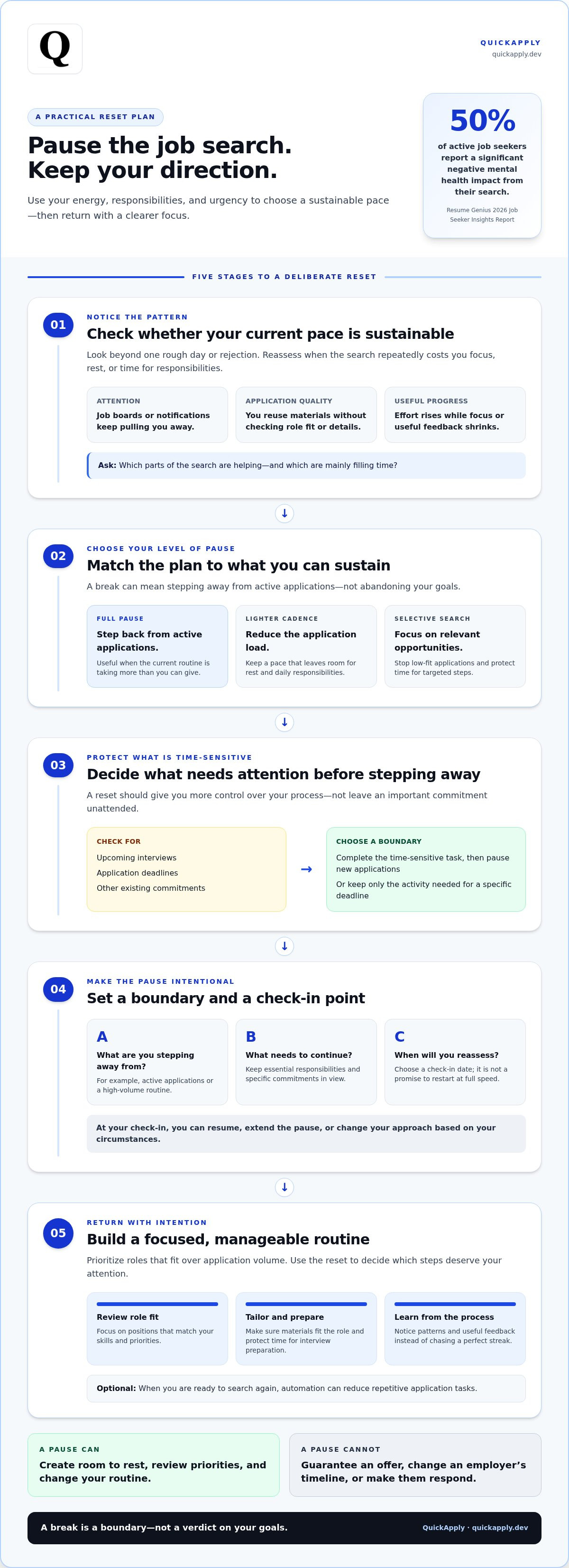
A nonstop job search can drain the energy you need to make your next move. If repeated applications and silence have left you wondering, “is it okay to take a break from job searching,” the answer is yes. Resume Genius’s 2026 Job Seeker Insights Report found that 50% of active job seekers report a significant negative mental health impact from their search. Feeling worn down isn’t a personal failure; it’s a signal to reassess your pace.
Pausing doesn’t have to mean abandoning your goals or losing all momentum. A short reset, a lighter application schedule, or a temporary focus on daily responsibilities can help you return with more clarity. The right choice depends on your finances, deadlines, wellbeing, and time.
This guide will help you recognize when a break may help, protect your priorities while you pause, and restart with a focused, manageable routine. You’ll also learn how to reduce repetitive application work when you’re ready, without turning your search into a full-time grind.
Key Takeaways
- If you’re asking “is it okay to take a break from job searching,” use your energy, responsibilities, and urgency to guide the decision.
- Choose between a full pause, a lighter cadence, or selective applications based on what you can realistically sustain.
- Set a check-in date for your break so you can reassess without locking yourself into a fixed timeline.
- Restart with a focused routine that prioritizes relevant opportunities over application volume.
- When you’re ready to search again, automation can reduce repetitive application tasks. Using a tool during your break is optional.
Is It Okay to Take a Break from Job Searching? Signs You Need a Reset
Yes. If you’re asking, “is it okay to take a break from job searching,” consider what the search is costing you and whether your current routine is still useful. A pause isn’t proof that you’re lazy, uncommitted, or failing. It can be a practical response when application tasks consume time and attention without helping you make better decisions.
A rough day or a rejected application can cause temporary frustration. Look for a pattern instead. Are you struggling to focus, skipping routines that matter to you, or finding it difficult to switch off? These are reasons to reassess your workload, not evidence that you need to label or diagnose yourself. The general Burnout overview offers context on the concept, but your immediate decision can stay practical: is this search cadence sustainable?
A job-search break is an intentional, time-bounded pause from active applications, with a clear point to reassess what comes next. It doesn’t have to mean deleting your resume or giving up on your goals. Setting a boundary makes the pause purposeful rather than an open-ended decision made in a moment of frustration.
Signs the search is taking more than it gives
Notice how the search fits into your day. Do you keep checking job boards during meals, conversations, or time set aside to rest? Do application notifications pull your attention away even after you’ve decided to stop for the day? If you’re repeatedly applying to roles that don’t fit just to keep your activity up, your routine may be running on autopilot.
Another signal is diminishing attention. You might reuse the same materials without checking whether they fit the role, overlook basic details in postings, or struggle to explain why a position interests you. One rushed application isn’t a verdict. But if the pattern continues, ask whether your pace leaves enough focus for thoughtful applications and ordinary life.
Try a quick sustainability check: Which parts of your search are producing useful progress, and which are mainly filling time? If you can’t maintain the routine without sacrificing rest, responsibilities, or concentration, reduce the load or pause to reset.
When repeated effort is not producing useful progress
More applications don’t automatically create more insight. A high-volume routine can crowd out time to review which roles match your skills, tailor your resume to a target position, or prepare for an interview. It can also make every rejection feel like a reason to send the next application faster instead of checking whether your approach needs adjustment.
Look for learning, not just outcomes. Are you getting interviews for certain roles but not others? Are you receiving feedback you can use, or repeating the same process without reviewing it? A lack of offers doesn’t prove you’re doing something wrong. Employers make decisions for reasons you may never see, and silence alone rarely gives you enough information to draw a conclusion.
If effort is rising while focus and useful feedback are shrinking, treat that as a cue to reassess. You could pause, or stop low-fit applications and protect time for more targeted steps. The goal isn’t to keep a perfect streak. It’s to choose a search routine you can sustain and learn from.
What a Job-Search Break Can, and Cannot, Do for Your Momentum
A pause changes your pace, not the hiring process. If you’re deciding whether is it okay to take a break from job searching, separate what you can control from what you can’t. Time away may give you room to review your priorities and application habits. It can’t make an employer respond, change a hiring timeline, or guarantee that your next application will lead to an offer.
A pause can reset your routine, but it can’t guarantee an offer. Treat a break as a chance to make a considered choice, not a tactic that promises a specific outcome. Its value lies in what you decide to do with the space, whether that means returning with a different focus or choosing a lighter pace.
Rest, reflection, and changing the search approach
Time away can create distance from the daily loop of searching and applying. Once you’ve stepped back, review the process with fresh attention. Which roles genuinely fit your skills and priorities? Do your application materials address each role, or are you sending the same version everywhere? How much time does each step take, and which tasks are helping you move forward?
You don’t need to turn the pause into a full audit. Jot down a few observations when you’re ready. You may notice that a particular role type takes more preparation than you can sustain, or that searching broadly makes it harder to focus on positions you’d seriously consider. Those insights can guide a new routine. They don’t predict how employers will respond, and rest doesn’t need to be a way to improve your odds.
Keep urgent responsibilities in view, too. If you have an upcoming interview, application deadline, or other commitment, decide how to handle it before stepping away. A break should give you more control over your process, not leave an important obligation unattended. You might complete the time-sensitive task and pause new applications, or keep only the activity needed to meet a specific deadline.
A break is not the same as giving up
Make the pause deliberate. Define what you’re stepping away from, what needs to continue, and when you’ll check in with yourself. That return point is for reassessment, not a promise to restart at full speed. You might resume, extend the pause, or change your approach based on your circumstances.
Stopping all activity isn’t the only option. If a complete pause feels impractical, reduce your search cadence or focus only on roles that meet your key criteria. That leaves room for responsibilities and rest without requiring you to maintain an exhausting application routine. Choose a level of activity that fits your real constraints, not an idealized schedule.
When you choose to return, QuickApply’s application tools can help reduce repetitive admin. There’s no need to use a job-search tool during your break.
Will Taking a Break Hurt Your Job Search? Choose the Right Level of Pause
A pause doesn’t erase your experience, undo applications you’ve already submitted, or cancel the work you’ve done. It can mean fewer chances to apply while you’re paused, but you don’t have to keep applying at maximum speed. If you’re weighing whether is it okay to take a break from job searching, choose a level of pause that fits your energy and real-world constraints.
There are three practical options: stop new search activity for a while, reduce your overall cadence, or apply only to roles that meet your priorities. Compare them with your current situation:
| Option | Energy | Urgency | Ongoing commitments | Practical trade-off |
|---|---|---|---|---|
| Full pause | Best fit when searching is taking more focus than you can sustain. | More workable when you can step back from new applications. | Plan for interviews, deadlines, or follow-ups already in progress. | Creates clear space, but you may miss roles posted during the pause. |
| Reduced cadence | Useful when you need to lower the workload, not stop completely. | Can keep a small amount of activity going. | Set aside time for existing commitments and selected new tasks. | Preserves some momentum but still requires regular attention. |
| Selective applications | Fits when you can focus on a few strong matches. | May suit a search with specific target roles or deadlines. | Keep track of relevant applications and follow-ups. | Less volume, with more attention reserved for roles you genuinely want. |
These are options, not a ranking. A formal requirement, financial pressure, or deadline can narrow what’s realistic. If benefits, an employment program, or another arrangement sets conditions for your search, understand those conditions before pausing. If income is urgent, a complete stop may not feel workable; reducing low-fit applications could be a more practical middle ground.
When a full pause may fit better
A full pause may suit you if the routine feels unsustainable and your obligations allow you to step away from new applications. Decide what you want the time to make possible: catching up on responsibilities, resting from search tasks, or thinking through which roles fit. Choose a date to reassess based on your circumstances. There’s no single break length that works for everyone.
When a lighter search cadence may be more realistic
If stopping completely feels impractical, narrow your search. Check listings at planned times instead of monitoring every new post, and prioritize roles that match your skills, needs, and preferences. You can separate existing commitments, such as an upcoming interview, from the decision to submit new applications. Urgent income needs or formal obligations may call for a different balance.
The goal is not to maintain activity for its own sake. Pick the option that respects your constraints while keeping the search at a manageable level.
How to Take a Job-Search Break and Restart Without Losing Your Bearings
A useful break has a start, a boundary, and a way back in. You don’t need to predict exactly how long you’ll want away. Choose a check-in date, then use it to decide what fits your energy and obligations at that point. This turns “I’ll get back to it someday” into a flexible plan you control.
A practical pause plan sets a boundary, names a check-in date, and defines one next action. Use this sequence as a starting point, then adapt it to your situation:
- Check your commitments. List upcoming interviews, application deadlines, follow-ups, and any financial, contractual, or program-related requirements that affect your search. Decide what must stay active before stepping away from new applications.
- Set the boundary. Choose which tasks are paused and which, if any, remain on your list. For example, you might stop browsing job boards but keep checking email for an interview response. Adjust job alerts or notifications to match your boundary.
- Pick a check-in date. Put a date on your calendar to review how the pause is working. It’s a moment to reassess, not a deadline to restart at full pace. If your circumstances change before then, you can revisit the plan.
- Choose a small re-entry task. Make the first step specific, such as reviewing saved roles or updating one section of your resume. A clear task makes restarting less daunting than trying to catch up on every listing you missed.
Set boundaries before stepping away
Make the pause visible in your routine. If checking listings has become automatic, log out or remove shortcuts for the period you’ve chosen. If you’re keeping certain responsibilities active, decide exactly when you’ll handle them instead of leaving email open all day. Before pausing, review relevant program rules and any financial or contractual commitments. If those limits affect your options, factor them into your plan rather than assuming you can switch off every task.
For an overview of the steps involved in applying, use this job application process guide to identify which parts you may want to resume first.
Restart with a small, focused first week
At your check-in, begin with a review, not a backlog sprint. Revisit your target roles, saved opportunities, and current priorities. Remove listings that no longer fit, note deadlines, and choose a manageable number of search blocks for the week. Leave room for other responsibilities. The aim is to restart deliberately, not compensate for every day you paused.
When you’re ready to apply, tailor your resume to the role’s requirements instead of sending the same version everywhere. This job-description tailoring strategy can help focus your work. QuickApply can reduce repetitive application admin when you resume; you don’t need a tool during your break. Explore QuickApply for your next applications.
Make Your Next Job Search More Manageable with QuickApply
You’ve decided whether to pause and how you want to restart. Now you can shape the process around a pace that works for you. If you’ve been asking, “is it okay to take a break from job searching,” remember that using a tool isn’t part of the decision. You don’t need to log in, apply, or maintain a search workflow during your break. Consider automation only when you choose to resume or want support with a lighter cadence.
The goal isn’t to replace a selective search with faster, higher-volume applications. It’s to spend less time repeating administrative steps and keep your attention on roles that fit. Decide your priorities first, then use tools to support your plan rather than set your pace.
Use automation when you are ready to apply again
QuickApply tailors resumes to specific job descriptions in about 30 seconds per job. Total application time is about 90 seconds. These time estimates can help reduce repetitive preparation, but they don’t change the need to decide whether a role is right for you or review your materials before applying.
QuickApply also generates personalized cover letters and includes an application tracker to organize your search in one place. A tracker keeps application details together instead of scattered across notes or left to memory. Use it to support the level of activity you’ve chosen, whether that means a few selected applications or a lighter ongoing routine.
The platform provides 30 tailored resumes and 30 personalized cover letters per month. You don’t have to use every available resource. Start with roles that align with your experience and priorities, then decide whether the workflow makes your process easier to manage.
Keep the workflow selective and sustainable
Automation is most useful when it supports a clear filter. Before applying, check whether the role matches what you’re looking for and whether your materials show relevant skills. A faster workflow shouldn’t become a reason to apply indiscriminately. Focus on suitable opportunities and set a weekly pace that leaves room for other responsibilities.
QuickApply reports a 94% ATS match score after tailoring. Treat that as a platform metric, not a promise of an interview, callback, or job offer. An ATS match score doesn’t control employer decisions or establish whether a position is right for you. Your judgment still matters.
QuickApply offers a free 3-day trial with no credit card required. There’s no need to start before you’re ready. When you decide to resume your search, try QuickApply free for 3 days to support a focused workflow at your own pace.
Choose Your Next Step at Your Own Pace
There’s no need to turn a pause into another test of productivity. The question “is it okay to take a break from job searching” isn’t about proving how committed you are. It’s about choosing a pace that fits your circumstances and adjusting when those circumstances change.
Give yourself permission to make the next step small. You might check in with your priorities, revisit one promising role, or decide you need more time before restarting. Progress doesn’t have to mean filling every available hour with applications. A more deliberate search can leave room for the rest of your life, too.
When you’re ready to apply again, let technology handle some repetitive admin while you stay in control of which roles deserve your attention. QuickApply can support that workflow, but the pace is yours.
Your search can move at a sustainable pace. Take the next step when you’re ready.
Frequently Asked Questions
Can I keep networking while taking a break from applications?
Yes, you can pause applications while keeping a small number of networking conversations if they feel manageable. For example, you might reply to a former colleague or attend one planned industry event rather than adding daily outreach. Set a boundary, such as no cold messages or networking tasks outside a chosen time. If rest is the goal, keep networking from becoming another full-time search.
Should I tell recruiters that I am taking a break from my job search?
You don’t have to announce a pause to every recruiter. If one contacts you, a concise, honest update about your current availability is usually clearer than a long explanation. For example, you can say you’re not pursuing new roles right now, if that’s accurate. If you’re already interviewing or agreed to a timeline, contact the recruiter directly so they know what to expect.
Will employers ask why I have a gap in my resume after a job-search break?
A job-search break doesn’t necessarily create a resume gap, because a resume should accurately show your work history, not every period spent applying. If you were also away from work and an interviewer asks about that time, answer briefly and truthfully, then bring the conversation back to relevant skills or projects. Employers vary, so no particular explanation can guarantee how someone will respond.
Can I take a break from job searching if I was recently laid off?
Yes, you can consider a pause after a layoff while weighing emotional strain against immediate practical needs. Before stepping away, review your income situation, benefits, upcoming deadlines, and responsibilities at home. If you receive benefits or take part in a program with job-search conditions, consult the relevant official information for rules that apply to your situation. Don’t assume you have the same flexibility as someone else.
Is it okay to pause my job search after receiving no responses?
Yes, it is okay to take a break from job searching after receiving no responses. Silence can be discouraging, but it doesn’t prove you lack the skills employers need. You could take a short pause, review whether your applications match the roles, or change how often you apply. More applications aren’t guaranteed to produce callbacks, and neither is a break, so choose the next step based on your needs.
How do I keep my confidence up while taking a job-search break?
Separate your sense of worth from application outcomes, which depend on decisions you can’t fully see or control. Choose restorative activities that don’t quietly turn into career tasks, and keep a private note of accomplishments or strengths to revisit when you return. If distress persists or significantly disrupts daily life, consider reaching out to a qualified professional or someone you trust. You don’t have to manage it alone.


