

Your spreadsheet isn't a tool; it's job search debt. In a 2026 market where the U.S. hiring rate has plummeted to 3.1 percent, clinging to manual data entry is a recipe for professional invisibility. You're likely exhausted from copy-pasting job descriptions and losing track of which resume version went to which recruiter. We agree that the old ways are officially broken. You need a high-velocity system that moves as fast as the AI-driven HR departments you're trying to impress.
This article promises to transform your fragmented search into a centralized command center. By leveraging a modern job application tracker app, you'll learn to eliminate manual entry and automate your entire pipeline from first click to final offer. We'll explore how to integrate automatic status updates, tailor resumes at scale, and drastically cut down that 44-day average time-to-fill. It's time to stop playing catch-up and start dominating the modern tech market with a system built for speed and precision. Prepare to replace your manual fatigue with a high-velocity tracking system designed for the competitive edge you deserve.
Key Takeaways
- Eliminate the hidden costs of manual spreadsheets by automating data capture and status updates for every role.
- Deploy browser extensions to scrape job data instantly from major boards, turning your morning scroll into a high-velocity pipeline.
- Centralize your target company list within a dedicated job application tracker app to maintain a unified command center for all opportunities.
- Connect your tracking system with integrated resume tailoring and interview prep tools to maximize your interview conversion rates.
- Optimize your search workflow to meet the high-volume demands of the 2026 tech market without sacrificing precision or quality.
Why Manual Tracking is Your Job Search's Single Point of Failure
The tech market in 2026 is a numbers game. With the U.S. hiring rate hitting a low of 3.1 percent, the traditional quality over quantity mantra is a trap. You need both. Applying to ten roles a week is a strategy for stagnation. High-velocity hunting requires a centralized system that handles the heavy lifting of data management. Every minute you spend updating a cell in a spreadsheet is a minute stolen from networking or refining your skills. This is the hidden cost of manual labor; it's an efficiency leak that kills your momentum.
Data fragmentation is your biggest enemy. When a job listing expires on LinkedIn or Lever, your manual entry often becomes a ghost. You lose the original job description, the specific contact info, and the context required for a successful interview. A professional job application tracker app acts as a permanent repository for this data. It ensures you never walk into a call blind. It's not just a list; it's a strategic optimization engine designed to keep your pipeline moving while your competitors are still stuck in data entry hell.
The Death of the Job Search Spreadsheet
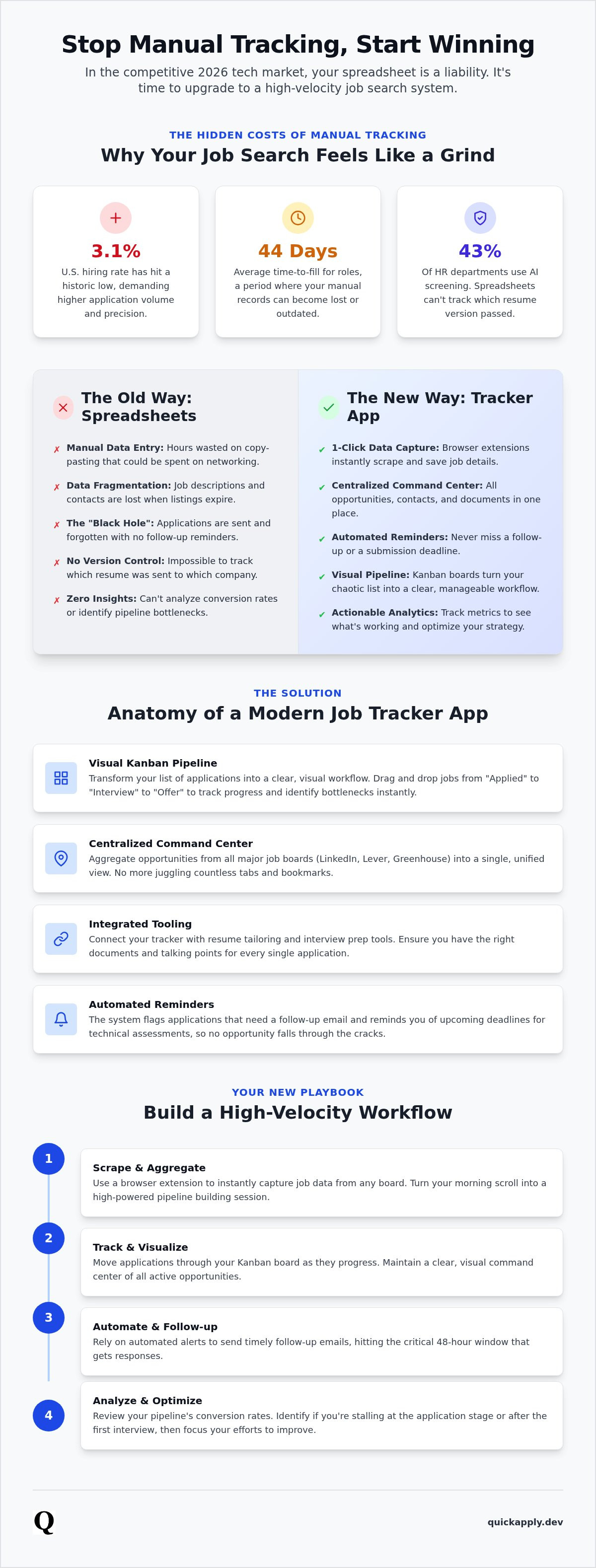
Version control is a constant nightmare for the manual tracker. You might send a backend-focused resume to one firm and a full-stack version to another. Spreadsheets can't track these file versions or automate follow-ups. This creates the "Black Hole" effect. You apply, you wait, and you eventually forget the opportunity ever existed. Without automated alerts, you'll likely miss the critical 48-hour window for follow-up emails. Static files also lack actionable insights. They can't tell you that your conversion rate is dropping because you aren't passing the AI screenings used by 43 percent of HR departments. It's a dead file in a live, high-speed market.
High-Velocity Hunting vs. Passive Applying
Modern the job hunting process requires a command center approach. Passive applying is reactive; high-velocity hunting is proactive. By utilizing a job application tracker app, you transform a chaotic list into a visual pipeline. This shift significantly reduces search fatigue. Burnout happens when you feel out of control of your own progress. Seeing a clear board with specific stages provides a psychological win. It turns a grueling marathon into a manageable, automated workflow. This system handles the logistics so you can focus entirely on your performance during the interview stages.
The Anatomy of a Modern Job Application Tracker App
A job application tracker app isn't just a digital notebook. It's a high-performance CRM for your career. It automates data capture and provides real-time status updates. This eliminates the friction of manual logging. You need a system that works while you're offline. It should be a centralized hub where every application, contact, and document lives in a single, searchable database. This is the foundation of an optimized search strategy.
Efficiency starts at the source. Use browser extensions to scrape data from LinkedIn, Lever, and Greenhouse instantly. One click saves the role, the salary range, and the hiring manager's details. No more tabbing back and forth between your browser and a spreadsheet. This scraping technology ensures your data is accurate and formatted correctly from the start. It's about reducing the time-to-entry so you can focus on the time-to-interview.
Visualization is the key to pipeline management. Kanban boards provide the visual clarity you need to see exactly where you stand. Move roles from "Applied" to "Interview" with simple drag-and-drop actions. It maps your progress across the entire funnel. This layout helps you identify bottlenecks in your process. If roles are stalling at the "Applied" stage, you know your resume needs work. If they stall after the "First Interview," you know where to focus your practice.
Automated reminders within a job application tracker app ensure you hit every technical assessment deadline. If a recruiter hasn't responded in five days, the system flags it. You stay ahead of the curve. These alerts prevent opportunities from slipping through the cracks during a high-volume search. You don't have to remember to follow up; the software remembers for you.
Cross-Platform Synchronization
Aggregation is essential. Pull roles from niche tech boards and major aggregators into a single, unified view. Modern tools offer auto-fill features that slash your time-to-apply. Most importantly, it centralizes job descriptions before they disappear. Employers often pull listings down once they hit an applicant cap. Your tracker keeps that data locked down for future interview prep. You'll always have the original requirements at your fingertips.
Integrated AI Tailoring
The best systems link specific resume versions to each entry. You must know exactly which keywords you used for every individual submission. Use Match Scores within the tracker to prioritize high-probability roles. This allows you to tailor resume to job description directly from the tracking card. It turns your tracker into an execution engine. If you want to see this in practice, explore the QuickApply command center for yourself. It connects your tracking data with AI-driven optimization in one seamless workflow.
Spreadsheets vs. Dedicated Tracker Apps: The 2026 Comparison
Stop treating your career search like a high school accounting project. Spreadsheets are static. Your job search is dynamic. In 2026, the "Total Cost of Ownership" for a free spreadsheet is actually higher than a paid professional tool. You pay for it with your time. Every minute spent formatting cells is a minute you aren't networking. A dedicated job application tracker app eliminates this administrative drag, allowing you to focus on high-impact activities that actually lead to offers.
Data security is another critical differentiator. Storing recruiter phone numbers, personal contact details, and salary negotiations in a local .xlsx file is a liability. Cloud-native tracking apps utilize enterprise-grade encryption to protect your professional data. They also solve the mobile accessibility problem. Managing a complex search on a clunky mobile spreadsheet is impossible. Dedicated apps provide a responsive interface that lets you track status updates or prep for an interview during your commute. They offer a level of workflow synergy that static files can't match, connecting directly to your calendar and email to turn notifications into actionable tasks.
Feature Breakdown: Automation vs. Manual Entry
The math is simple. Manual data entry takes approximately five minutes per application. Automation via a job application tracker app takes 30 seconds. If you're managing a high-velocity search with 200 applications, you're looking at a difference of nearly 15 hours of manual labor. Modern apps auto-sync status updates by scanning your inbox for keywords like "interview" or "offer." This level of scalability is essential for the modern tech market. You can manage a massive pipeline effortlessly without ever losing track of a single role.
The ROI of Career Management Software
Organized candidates win more roles. It's a fact. Organising your follow-ups and tracking your metrics can lead to a 10 percent increase in your interview conversion rate. This improvement easily justifies the cost of professional software. By integrating good resume examples directly into your tracking workflow, you ensure every submission is optimized for 2026 AI-driven screenings. This structured approach reduces your total "Time to Hire" by keeping you ahead of deadlines and ensuring no recruiter email goes unanswered. Efficiency is your most valuable asset; don't waste it on a spreadsheet.
How to Build a High-Velocity Job Search Workflow
Speed is your primary competitive advantage in the 2026 tech market. A high-velocity search isn't about working more hours. It's about building a repeatable, automated pipeline that functions without your constant supervision. Most candidates fail because they treat every application as a manual, isolated event. You need to move from a reactive mindset to a command center approach. By implementing a systematic workflow, you can handle the volume required to overcome the current 3.1 percent hiring rate while maintaining surgical precision.
- Step 1: Centralize. Don't wait for a job post to appear. Build a 'Target Company' list within your job application tracker app. This allows you to track hiring trends and internal shifts before roles are even publicized.
- Step 2: Quick Save. Use a browser extension to scrape data during your morning scroll. One click should populate your tracker with the role, salary range, and company metadata.
- Step 3: Tailor. For 'Must-Have' roles, leverage integrated AI to align your resume and cover letter with the specific job description instantly.
- Step 4: Trigger. Set automated follow-up reminders for exactly five days post-application. Precision timing ensures you stay on the recruiter's radar without being a nuisance.
- Step 5: Refine. Review your 'Match Score' analytics weekly. If you aren't hitting 80 percent or higher, pivot your targeting strategy based on the data.
Optimizing the 'Applied' Stage
Every application you submit needs a unique, tracked resume version. Standardized resumes are dead. They fail the AI screenings now used by 43 percent of HR departments. Part of mastering the job application process involves knowing exactly which keywords you sent to which company. Don't leave recruiter contact info buried in your inbox. Move it to your tracker immediately. This organization allows you to respond to interview requests in minutes, not hours. Automate your search with QuickApply today to ensure your pipeline never stalls.
Managing the Interview Pipeline
When a role moves to the 'Interview' column, your job application tracker app should become your prep station. Attach your technical notes and research directly to the job card. Use integrated practice tools that pull from the specific job description to simulate likely questions. After the call, log your feedback immediately. This creates a data loop that helps you improve for the next round. Don't forget to track your thank you notes. Organization at this stage is what separates an applicant from a new hire.
QuickApply: The AI-Powered Command Center for Tech Professionals
In 2026, a standard job application tracker app isn't enough to secure a role at a top-tier tech firm. You need an integrated ecosystem that bridges the gap between finding an opening and signing an offer. QuickApply is that ecosystem. It's an AI-powered command center built specifically for the high-velocity demands of the modern web. Instead of just logging your progress, QuickApply optimizes every step. It's a tool designed by experts who understand that your time is your most valuable asset. The software mirrors the speed of the tech industry itself, providing a competitive edge that manual methods simply cannot match.
The QuickApply Advantage: Speed + Precision
Our platform eliminates the lag between discovery and submission. From within the dashboard, you can deploy our ai cover letter generator to produce high-impact, tailored documents in seconds. This isn't generic output. It's a precise alignment of your skills with the employer's specific pain points. The 'Match Score' algorithm provides a data-driven reality check, showing your odds of success before you even hit submit. If your score is low, the system suggests specific tweaks to your profile. Automated status syncing for major tech boards ensures your board is always current without any manual input. This level of automation allows you to maintain a massive pipeline with minimal effort, ensuring you stay ahead of the curve.
Your 2026 Career Roadmap
QuickApply doesn't stop when you land the interview. It's built for the entire lifecycle of your career. When a card in your job application tracker app moves to the 'Offer' stage, you gain immediate access to our salary negotiation guides. These aren't generic tips; they're tactical playbooks designed for the 2026 economic landscape. They help you navigate the complexities of total compensation packages, including equity and performance bonuses. Once you're in the door, the platform transitions into a promotion-tracking hub. You can map out your path to senior or lead roles using our promotion roadmaps. These roadmaps track your achievements and align them with the requirements for your next move. This long-term focus turns a temporary job search into a permanent career advantage. Join the thousands of tech professionals who have already abandoned manual systems for the power of an automated command center. It's time to stop searching and start managing your future with a system that works as hard as you do.
Dominate the 2026 Tech Market with Systemic Efficiency
The era of the manual spreadsheet is over. In a market where hiring rates have dropped to 3.1 percent, you can't afford the administrative drag of manual data entry. You've seen how a professional job application tracker app transforms a chaotic search into a high-velocity pipeline. By centralizing your data and automating follow-ups, you gain the bandwidth to focus on what actually moves the needle: your interview performance. Efficiency isn't just a buzzword; it's your primary competitive advantage in a crowded field.
It's time to move from being a passive applicant to a strategic career manager. Leverage an AI Match Score for every role and deploy auto-tailoring that takes less than 30 seconds. This level of precision ensures your profile stands out to the 43 percent of HR departments now using AI screening. Scale your job search and track every win with QuickApply. Our command center provides integrated interview practice and salary negotiation guides to help you secure the compensation you've earned. Your next breakthrough is waiting for the right system. Start building your future today.
Frequently Asked Questions
What is the best free job application tracker app?
Teal and Prentus offer unlimited tracking on their free tiers, providing a functional foundation for basic organization. These tools are useful for entry-level seekers, but free versions often restrict the deep AI integration required for high-velocity tech searches in 2026. If you're serious about professional optimization, look for a job application tracker app that prioritizes automated scraping and status updates rather than just providing a static, manual list of your applications.
How do I track job applications in Notion vs. a dedicated app?
Notion requires manual data entry and custom template builds, which creates massive administrative drag. A dedicated app automates the entire capture process via browser extensions and scrapes metadata instantly from job boards. While Notion is a flexible workspace, it isn't a purpose-built optimization engine. Dedicated software provides the specific workflow synergy and automated status syncing that general-purpose productivity tools simply can't deliver in the current high-speed tech market.
Is it worth paying for a job search tracker?
It's absolutely worth the investment if you value your time. The ROI is calculated through increased interview rates and a significantly shorter "Time to Hire." Organizing your follow-ups and leveraging AI match scores can boost your conversion by 10 percent. Paying for a professional system turns a chaotic search into a repeatable, high-output process. It's a small cost for a tool that helps you secure a six-figure tech salary faster.
Can a job tracker app help me beat the ATS?
A tracker helps you beat the ATS by integrating directly with resume tailoring tools. Tracking which version of your resume was sent to which company allows you to analyze which keywords are actually getting you past the filters. Since nearly half of tech HR departments now use AI for screening, having a job application tracker app that stores and analyzes job descriptions is essential for strategic keyword alignment and successful bypass of automated gates.
How many job applications should I be tracking at once in tech?
You should track every single application, often reaching 100 or more in a competitive tech market. High-volume hunting is the only way to ensure a consistent interview pipeline. Tracking 50 to 200 active roles allows you to identify bottlenecks in your funnel. A centralized command center makes this volume manageable, ensuring you never miss a deadline or a recruiter's follow-up request while maintaining a clear view of your progress.
Does a job tracker app automatically update when I get an email from a recruiter?
Yes, professional trackers utilize inbox scanning to update your board automatically. When you receive a confirmation, interview invite, or rejection email, the system identifies the company and moves the corresponding card to the correct stage. This feature eliminates manual logging and ensures your pipeline is accurate in real-time. It's a critical component for maintaining a high-velocity search without the burnout associated with constant, repetitive data entry and manual status checks.
How do I organize my job search when applying to different roles like SWE and Product Manager?
Organize multi-role searches using tags or separate Kanban boards within your tracker. If you're applying for both Software Engineer and Product Manager positions, you need distinct resume versions and interview prep notes for each. A robust app allows you to filter your view by role type, ensuring you don't send technical SWE notes to a PM recruiter. This segmentation keeps your strategy focused and your messaging consistent across different professional career paths.
Can I export my data from a job application tracker app to Excel?
Most professional tracking platforms allow you to export your data as a CSV or Excel file. This is useful for personal backups or custom data analysis beyond the app's built-in metrics. While the app provides the automation and visualization you need for day-to-day operations, having an export option ensures you own your professional data. It's a standard feature for any tool designed for tech-literate users who value data portability and long-term storage.


