

99% of Fortune 500 companies now use sophisticated AI to filter your application before a human ever sees it. If you're sending generic PDFs, you're fighting a losing battle with a dismal 4.2% callback rate. You're likely exhausted from spending hours manually auditing every bullet point. It feels like shouting into a digital void while you wonder exactly how to check if resume matches job description requirements that seem to change every week. You deserve a system that works as hard as you do.
This guide changes the math. You'll master the science of semantic AI matching to hit a 90% plus match score in seconds, bypassing ATS filters with zero manual effort. We're moving beyond simple keyword stuffing to align with the intent-based algorithms of 2026. We will explore the latest global AI hiring regulations, the shift toward semantic parsing, and the exact steps to automate your resume tailoring for maximum impact. Stop guessing and start dominating the recruitment stack with a data-driven strategy that puts you back in control of your career trajectory.
Key Takeaways
- Learn why 2026 hiring systems prioritize semantic intent over simple keyword stuffing. This shift makes manual editing a liability for high-velocity tech roles.
- Discover how to check if resume matches job description requirements using AI to achieve a 90% plus match score instantly. Automated tools ensure you capture every critical competency.
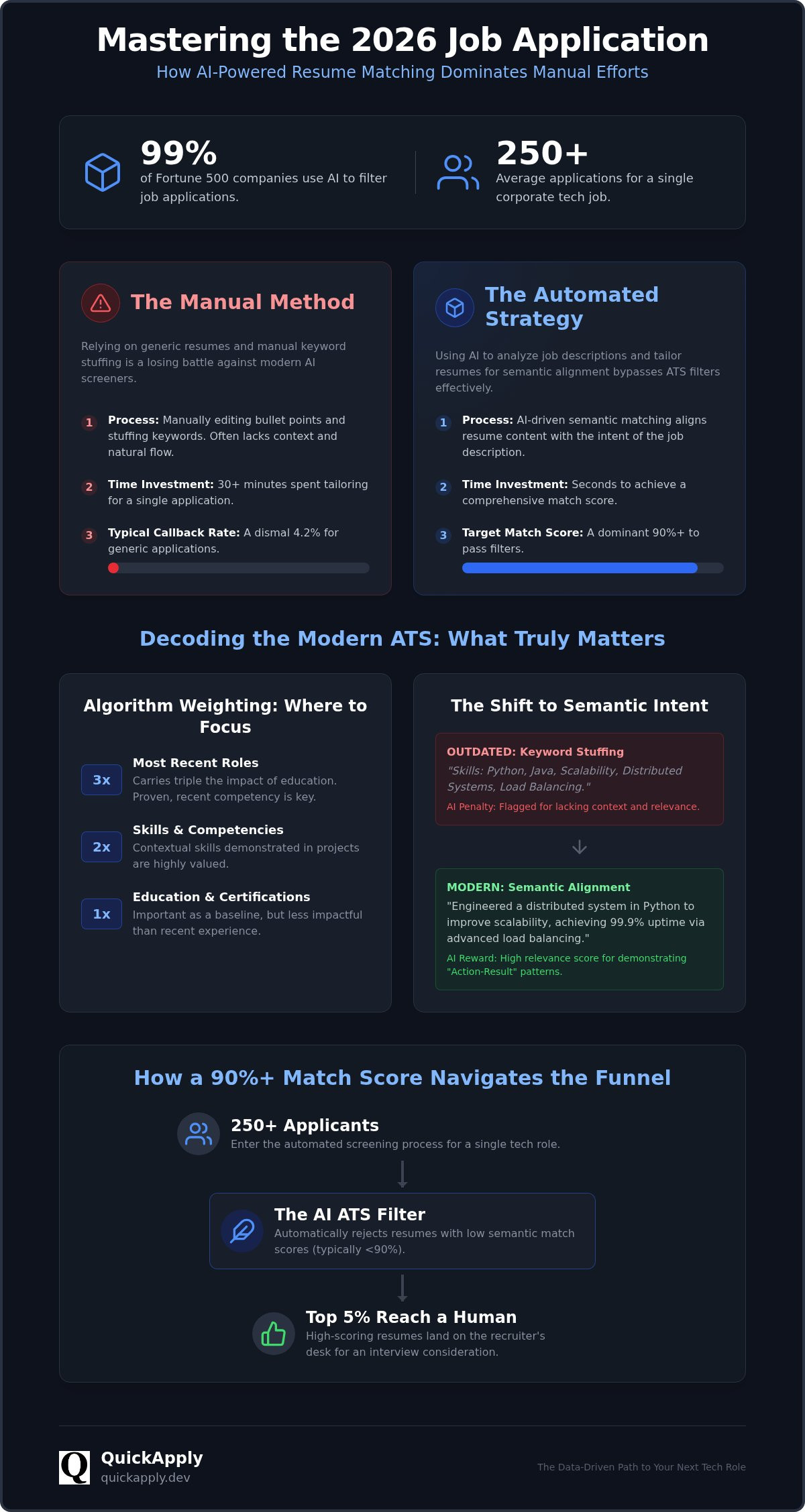
- Understand the hidden weighting of ATS algorithms where your most recent roles carry triple the impact of your education. Focus your optimization on the sections that recruiters actually value.
- Balance technical optimization with human readability to ensure your profile resonates with both robots and hiring managers. High match scores must lead to meaningful interview conversations.
- Transition to a high-velocity career strategy by using an application tracker to manage your pipeline. Gain full control over your professional data without the manual overhead.
The Mechanics of the Resume and Job Description Match in 2026
In 2026, the "match" is a technical calculation of semantic alignment between your experience and an employer's requirements. It's no longer just about finding the exact phrase "Python" five times. Modern Applicant Tracking Systems (ATS) use Large Language Models (LLMs) to understand the intent and context of your professional history. If you're wondering how to check if resume matches job description standards today, you have to look beyond the surface level. A high match score is the only way to survive the automated culling process and earn the six seconds of human attention required to land an interview.
Modern systems don't just scan; they interpret. They look for "Action-Result" patterns that prove competency. If the job description emphasizes "scalability," the AI searches your resume for synonyms and related outcomes like "load balancing" or "distributed systems." Understanding how to check if resume matches job description requirements means recognizing these semantic clusters. Without a high match score, your resume is effectively invisible. The system acts as a high-pass filter, ensuring only the most technically aligned profiles reach a human recruiter's desk.
From Keyword Stuffing to Semantic Alignment
Older systems were easily tricked. You could hide keywords in white text or list dozens of libraries without context. Those hacks are dead. 2026 hiring tech understands that a "Java Developer" is semantically identical to a "Software Engineer with Java expertise." These systems analyze the surrounding text to verify your proficiency. If you list skills that don't align with your described projects, the AI flags the discrepancy. Context-aware systems now penalize irrelevant keyword lists, rewarding candidates who demonstrate deep alignment through their actual work history.
The 2026 ATS Landscape for Tech Jobs
The competition is brutal. A single corporate job posting in the tech sector now attracts an average of 250 applications. Since nearly 99% of Fortune 500 companies use automated screening, the sheer volume of data makes manual human review impossible for every candidate. Recruiters rely on the AI to rank the top 5% of applicants automatically. If your resume doesn't hit that elite threshold, it stays at the bottom of the stack indefinitely. Manual tailoring is a losing statistical game in this environment. It takes too long and lacks the precision of the algorithms you're trying to impress. Efficiency is your only path to the interview stage.
Why Manual Keyword Matching is Obsolete for Tech Roles
Spending 30 minutes manually tweaking bullet points for a single application is a tactical error. In the 2026 tech market, where velocity is everything, this manual approach creates a massive efficiency gap. You can't compete with candidates using automation to apply for ten roles in the time it takes you to finish one. Every minute spent on manual editing is an opportunity cost that prevents you from reaching more recruiters. Outsmarting The ATS requires a level of precision that manual human effort simply can't sustain without introducing errors.
The risk of over-optimization is equally dangerous. When you manually force keywords into your text, you often end up sounding like a bot during the human interview phase. Recruiters notice when a resume feels disjointed or lacks a natural narrative flow. Even worse, manual errors in keyword placement or typos in technical terms can trigger immediate ATS rejection flags. If you're struggling with how to check if resume matches job description requirements without losing your professional voice, you're fighting an uphill battle against sophisticated algorithms designed to detect authenticity.
The Mathematical Impossibility of Manual Tailoring
Success in tech hiring is a volume game backed by high precision. If your manual tailoring results in two applications per hour, your weekly reach is severely limited. Data shows that tailored resumes have an 11.7% callback rate, but you need the scale to make those numbers work. You're caught in the Tailoring Paradox: the more time you spend on quality, the more you sacrifice quantity. Automation is the only way to resolve this conflict, allowing you to hit 90% plus match scores across dozens of applications daily.
Contextual Nuance in Software Engineering Resumes
Modern tech stacks require more than just a list of acronyms. You need to demonstrate how you used the MERN stack, AWS, or Kubernetes to drive architectural impact. Simply listing these terms isn't enough for 2026 systems. You must tailor resume to job description with AI to ensure your technical skills are framed within the specific pain points of the employer. This maintains your unique voice while satisfying the algorithm's need for context. Utilizing smart Resume Tailoring ensures your architectural contributions aren't buried under a pile of generic keywords, giving you a distinct competitive advantage in a crowded market.
Decoding the Match Score: What ATS Actually Looks For
A 90% plus match score isn't a vanity metric. It's a technical validation of your suitability for a specific role. When you analyze how to check if resume matches job description criteria, you must understand that the algorithm weights your data unevenly. Your most recent job title and bullet points carry 3x the match weight of your education or older roles. If your current title doesn't align with the target role, your score will crater regardless of your technical skills. The system assumes your most recent experience is the best predictor of future performance.
The hierarchy of tech keywords also dictates your ranking. Core languages like Java, Python, or Go are weighted more heavily than specific frameworks or ephemeral cloud tools. The system first validates your foundational stack; then it looks for the surrounding ecosystem. You must distinguish between "Critical" skills, typically found in the first five bullets of a job description, and "Desired" skills that appear toward the end. Focusing your optimization on these high-impact requirements is the only way to move the needle effectively. Efficiency requires prioritizing the skills that recruiters actually use to filter their pipeline.
The Three Pillars of a High Match Score
- Structural Integrity: Your resume must be easily parsable. Avoid tables, columns, and non-standard headers that confuse 2026 AI systems. Simple, clean layouts ensure every word is indexed correctly.
- Keyword Density: Aim for the sweet spot between 2% and 5%. Higher density triggers spam filters and looks like keyword stuffing; lower density looks like a mismatch.
- Semantic Relevance: Match the company's tech culture. Startups value "rapid prototyping" and "building from zero," while enterprise firms look for "scalability," "governance," and "high availability."
Why Your 'Perfect' Resume is Getting a 40% Score
Common pitfalls often sabotage highly qualified candidates. Using the title "Developer" when the employer specifically searches for an "Engineer" creates a semantic gap that lowers your score. Technical debt in your resume, such as using images, columns, or non-standard fonts, breaks the parsing logic entirely. If the AI can't read your data, it can't rank you. You can verify your current score and fix these issues using the best ai resume builder 2025 frameworks to ensure your profile is technically sound. Knowing how to check if resume matches job description standards before you hit submit is the difference between an interview invite and a silent rejection. This proactive check ensures your architectural contributions aren't buried under a pile of generic keywords.
How to Achieve a 90%+ Match Score Without Manual Editing
Most tools identify gaps but leave the heavy lifting to you. If you're tired of staring at a 40% score and wondering how to check if resume matches job description criteria effectively, you need an automated pipeline. Achieving a 90% plus match score shouldn't take hours of manual labor. It requires a systematic approach that leverages AI to bridge the semantic gap between your history and the employer's needs. This process ensures your resume isn't just readable, but irresistible to the algorithm.
- Step 1: Scrape for Competencies. Use AI to extract the core architectural requirements and technical pain points from the job posting.
- Step 2: Map Experience. Align your existing bullet points to those specific needs, ensuring your most relevant achievements are front and center.
- Step 3: Regenerate Impact. Transform generic responsibilities into impact-driven results that mirror the job's success metrics.
- Step 4: Audit and Validate. Run a final check for ATS readability and confirm your match score hits the elite threshold.
- Step 5: Execute and Track. Submit your application and use a dedicated tool to manage your interview pipeline.
Leveraging AI for Instant Tailoring
Our Resume Tailoring technology generates custom versions of your profile in seconds. This isn't about lying; it's about translation. AI tailoring preserves your core career narrative while optimizing your history for specific tech stacks and architectural styles. You maintain your professional identity while giving the ATS exactly what it's programmed to find. This disruptive approach allows you to scale your job search without sacrificing the precision that high-tier tech roles demand. Start using Resume Tailoring now to dominate the applicant stack and secure more interviews.
Moving Beyond the 'Keyword' Mindset
A high match score on your resume is the foundation, but the 2026 strategy requires a holistic approach. You should use AI to generate cover letter examples that reinforce your tailored resume claims. This creates a consistent narrative across all touchpoints, including your LinkedIn profile. The modern reality is simple: you have one core resume that acts as your data source, and you produce 100 tailored variants to match the specific needs of 100 different companies. This high-velocity strategy ensures you're always the top-ranked candidate, regardless of the competition's volume.
Beyond the Match: Automating Your Tech Career Growth
Landing a 90% plus match score is a massive technical win. It solves the immediate problem of how to check if resume matches job description requirements, but it is only the first step in a high-velocity job search. A high match score triggers the interview. Your system must then handle the volume of responses that follows. Successful tech pros don't just optimize their resumes; they automate their entire career trajectory to ensure they never miss a high-value opportunity.
Use an application tracker to maintain total visibility across your active leads. Managing multiple interview stages manually is a recipe for missed opportunities and scheduling conflicts. Your dashboard should provide a clear view of every application's status. This organization allows you to focus on high-value activities like AI-simulated technical rounds and behavioral practice. Efficiency doesn't stop at the application; it carries through to the moment you sign the offer and beyond.
The QuickApply Ecosystem for Tech Pros
We built a comprehensive suite designed to eliminate the friction of professional growth. Our system moves you from a match score to a submission in seconds, effectively automating the "Apply" button. When the offers start rolling in, our Salary Negotiation Guide provides the data-driven leverage you need to maximize your total compensation. We even help you plan your next move with a Promotion Roadmap. This AI-powered tool uses career insights to ensure you aren't just getting a job, but building a long-term path to seniority and influence.
Winning the 2026 Tech Job Market
The most successful engineers in 2026 are those who treat their job search like a software deployment. They automate the repetitive, low-value tasks to focus on the high-level architecture of their careers. If you have mastered how to check if resume matches job description criteria, you're already ahead of 90% of the market. Now, shift your mindset: you are the high-value product, and QuickApply is your marketing engine. Stop wasting hours on manual data entry and keyword hunting. Optimize your career with QuickApply now and take full control of your professional future.
Take Control of Your Career Pipeline
The 2026 job market demands a shift from manual effort to systemic efficiency. You've learned that semantic intent now trumps simple keyword counting. You've seen why manual tailoring is a statistical dead end for high-velocity tech applicants. Most importantly, you now understand exactly how to check if your resume matches a job description's specific requirements by leveraging AI to achieve elite match scores. This technical alignment is your only path through the automated filters of the Fortune 500.
Stop fighting the algorithms with outdated methods. Use our AI-powered Match Scores to validate your alignment instantly. Our platform allows you to tailor resumes in less than 10 seconds, giving you a massive competitive advantage over those stuck in manual workflows. With an integrated Application Tracker, you can manage your entire pipeline without losing momentum or missing high-value leads.
Stop building, start tailoring with QuickApply
Your technical expertise belongs in an interview, not in a spreadsheet. Start automating the tedious parts of your search today. You have the tools to dominate the stack. Now, execute your strategy and secure the role you deserve.
Frequently Asked Questions
Is it ethical to use AI for resume and job description matching?
Yes, using AI for matching is a standard optimization strategy in 2026. Since the vast majority of major employers use AI to filter candidates, you must use similar technology to ensure your experience is accurately parsed. It's not about fabrication; it's about semantic translation. You're simply ensuring that your real-world achievements are presented in a technical format that the employer's system is programmed to reward.
How do I know if my resume is actually ATS-friendly?
Your resume is ATS-friendly if it uses a simple, single-column layout without complex graphics or tables. You can test this by copying the text from your PDF into a plain text editor. If the formatting breaks or words merge, your structure is flawed. Using a specialized tool to how to check if resume matches job description requirements will confirm your document's parsability and ensure your data reaches the recruiter's screen.
What is a 'good' match score for a tech role in 2026?
A score between 75% and 85% is the industry standard for a 'good' match, but tech roles often require 90% or higher to guarantee visibility. Because a single job posting can receive hundreds of applications, recruiters only focus on the top-ranked profiles. Aiming for the 90th percentile ensures you bypass the automated culling process. High scores are especially critical for roles in competitive sectors like cloud architecture and cybersecurity.
Can I use ChatGPT for resume matching, or do I need a specialized tool?
Specialized tools are far superior to ChatGPT because they're specifically engineered to simulate ATS parsing logic. While ChatGPT can suggest keywords, it often ignores the structural constraints required for a resume to remain readable by a machine. Dedicated software provides real-time match scores based on current recruitment algorithms. This level of precision is necessary for tech pros who need to apply to multiple roles quickly without sacrificing technical accuracy.
Does the match score account for soft skills or just technical keywords?
Semantic matching in 2026 goes beyond technical keywords to analyze the soft skills documented in your history. The AI scans your bullet points for evidence of cross-functional collaboration, leadership, and architectural ownership. It looks for context rather than just vocabulary. A high match score reflects how well your demonstrated behaviors align with the company's culture and the specific soft skill requirements listed in the job description.
How often should I update my core resume before tailoring it?
Update your core master resume every quarter or immediately after finishing a significant project. This document serves as the data repository for your tailoring tool. By maintaining a high-quality source of truth, you can use automation to how to check if resume matches job description criteria for hundreds of roles with minimal effort. This strategy ensures your most recent technical wins are always mapped against new job descriptions, keeping your interview pipeline full.
Will recruiters know if I used AI to match my resume to the job description?
Recruiters are primarily concerned with whether your skills match their needs, not the tools you used to format your application. In a tech-driven market, using optimization software is seen as a sign of digital literacy. As long as your resume accurately reflects your experience and you can speak to every bullet point during the interview, using AI is a non-issue. The focus remains on the quality of the candidate, not the manual labor of the edit.
What happens if I have a 100% match but don’t have the required years of experience?
A 100% match score will likely trigger an interview invite, but you must be prepared to defend your experience level. Years of experience are often weighted heavily in the final human review. If you lack the exact tenure but possess the technical mastery, your high match score serves as a bridge to prove your capability. However, consistently applying for roles far beyond your seniority level will eventually lead to rejection during the human screening phase.


