

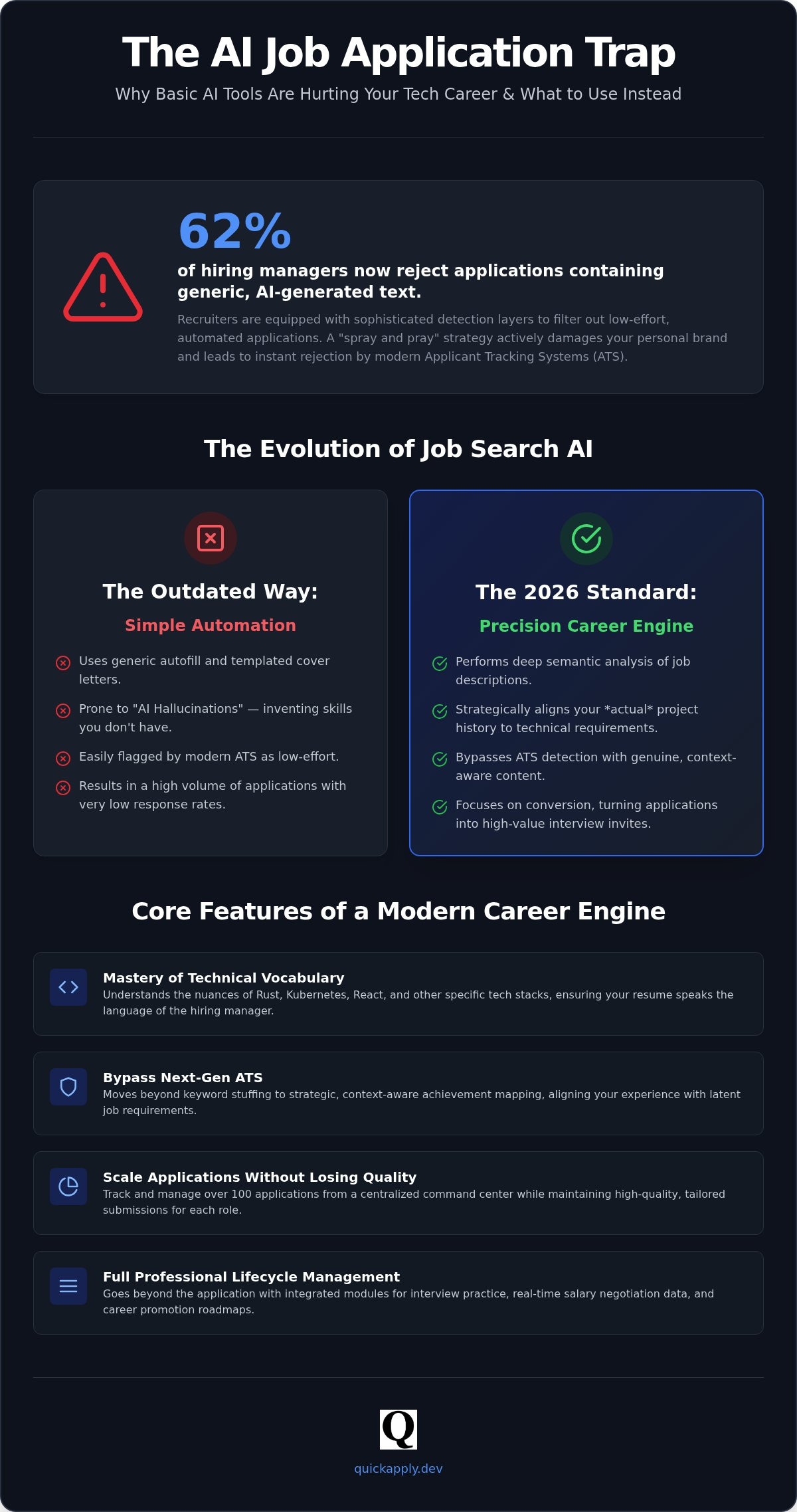
62% of hiring managers now report rejecting applications for containing generic, AI-generated text. If you're still relying on basic copilots that just autofill forms, you're likely part of that statistic. The market has shifted beyond simple automation. Finding a high-precision jobright ai alternative isn't just about speed anymore; it's about avoiding the "bot" label while maintaining a massive application volume. High rejection rates from ATS and generic cover letters are the hallmarks of outdated tools that fail to understand technical nuances.
You've probably spent hours tweaking a resume only to get an automated rejection three minutes later. It's frustrating to watch your career goals stall because of a low-match score or a lack of follow-through. We're moving past the era of "spray and pray" job hunting. You need a system that doesn't just find jobs, but actually masters the technical requirements of high-level engineering and product roles. This article reveals why top-tier tech professionals are ditching basic tools for comprehensive career automation engines that manage the full lifecycle.
We'll break down how to automate the tracking of over 100 applications without losing quality. You'll see how precision tailoring and automated follow-through can finally turn those "thank you for your interest" emails into high-value interview invites.
Key Takeaways
- Replace basic copilots with high-precision engines to eliminate AI hallucinations and generic application flags.
- Evaluate any jobright ai alternative based on its mastery of technical vocabulary, including Rust, Kubernetes, and React.
- Scale your search capacity by tracking 100+ applications through a centralized command center without sacrificing quality.
- Master the full professional lifecycle using integrated modules for interview practice, salary negotiation, and promotion roadmaps.
- Bypass sophisticated 2026 ATS detection with automated resume tailoring built for high-level engineering and product roles.
Why Job Seekers are Moving Beyond Jobright AI in 2026
Basic job matching is no longer a competitive advantage. In the high-stakes tech market of 2026, simple automation has become a commodity that recruiters easily filter out. Tech professionals are realizing that a standard copilot isn't enough to secure a role at a top-tier firm. They need a high-precision jobright ai alternative that treats the job search as a technical pipeline to be optimized, not just a numbers game to be played. The shift from basic matching to high-fidelity career management is driven by a need for accuracy and depth that entry-level tools simply cannot provide.
One of the most significant frustrations with legacy AI tools is the tendency to "hallucinate" skills. When a basic builder invents proficiency in Rust or Kubernetes just to hit a keyword density target, it destroys your credibility during the technical screen. This "one-size-fits-all" approach fails because it ignores the nuance of your actual experience. High-level roles require a tool that understands the AI in the hiring process and counters it with genuine, tailored data. You don't just need a tool that handles the search; you need a system that manages the post-apply phase, including interview prep and salary negotiation.
The 'Bot-Like' Application Trap
Recruiters in 2026 are equipped with sophisticated detection layers. They identify low-effort, automated applications in seconds. Generic cover letters that lack specific technical context are immediate grounds for rejection. If your application looks like a template, you're signaling that you don't value the role. This high-volume, low-quality strategy actively damages your personal brand. You aren't just a profile in a database. You're a specialist. Your applications must reflect that level of technical sophistication to survive the initial ATS cull.
Moving from Search Copilots to Career Engines
A copilot watches you work; an engine drives the process forward. The best jobright ai alternative functions as a full-stack career engine. It doesn't just "find" jobs. It wins them by integrating every phase of the professional lifecycle into a single workflow. QuickApply bridges the gap between the initial application and the final onboarding. By combining automated resume tailoring with interview practice and real-time salary data, it transforms a fragmented search into a streamlined path to a new role. Stop searching and start executing. Your career deserves a precision engine, not a basic assistant.
- Eliminate Hallucinations: Ensure every skill listed is backed by your actual project history.
- Full-Stack Management: Track 100+ applications while preparing for the interviews they generate.
- Technical Depth: Use tools that understand the difference between library versions and architectural patterns.
The 2026 Standard: Precision Tailoring vs. Simple Automation
Precision Tailoring is the 2026 evolution of the AI resume. It moves beyond simple word-swapping. Instead, it uses deep semantic analysis to align your career history with specific job requirements. This is why a high-fidelity jobright ai alternative is essential for tech pros. While basic tools focus on volume, precision engines focus on conversion. Jobright often takes a broader, less technical approach. It's designed for the general masses, not the specialized software engineer who needs to highlight specific stack expertise.
The mechanism is sophisticated. Modern AI analyzes job descriptions for latent requirements. These are the skills and experiences recruiters expect but don't always list explicitly. For example, a Senior DevOps role might imply specific security compliance knowledge or experience with legacy migrations. A precision tool identifies these gaps and maps your existing achievements to them instantly. It ensures your profile speaks the same language as the hiring manager. This strategic alignment is what separates an interview invite from a 404 rejection.
How Modern ATS Detects Low-Effort AI
Recruiters now use semantic analysis to spot bot-generated fluff. Keyword stuffing is dead. In 2026, context-aware achievement-mapping is king. ATS software looks for logical flow and technical depth that basic automation misses. AI resume tailoring is the strategic alignment of career history to specific job requirements. If your resume lacks this depth, it won't pass the initial screening. You need a tool that understands the nuance of software development and avoids generic phrasing. High-quality output requires a tool that can:
- Analyze the underlying intent of a job description.
- Map specific achievements to technical requirements.
- Maintain a natural, professional voice that bypasses bot filters.
The Role of Technical Match Scores
Recent data highlights the massive scale of AI's impact on the job market. With more applications than ever, you can't afford to apply manually to every listing. Match scores serve as your primary filter for your time investment. QuickApply identifies the best-fitting opportunities for software engineers by calculating technical compatibility across 100+ data points. This allows you to prioritize high-value roles that actually fit your stack. Using a jobright ai alternative that provides these granular scores ensures you aren't shouting into the void.
Stop wasting energy on low-match postings. Use a How to Tailor Resume to Job Description with AI: The 2026 Efficiency Guide to refine your approach. A high match score means a higher interview response rate. It's about working smarter, not harder. If you're ready to optimize your search, it's time to switch to a precision engine that understands the technical landscape. This is the new standard for the modern job seeker who values their time and career trajectory.
QuickApply vs. Jobright AI: A Technical Comparison
While Jobright functions as a high-speed search tool, QuickApply operates as a precision-engineered career engine. The core difference lies in technical depth. Jobright excels at finding listings, but it often leaves the heavy lifting of technical alignment to the user. AI has fundamentally altered the job hunt, creating a scenario where only the most technically accurate applications survive. Choosing a jobright ai alternative in 2026 requires looking past the user interface and evaluating the underlying logic of the technical output. Speed is a vanity metric if the resulting resume fails a human review.
Resume Tailoring vs. Simple Job Matching
QuickApply goes beyond basic matching. It doesn't just highlight keywords; it rewrites your bullet points to reflect specific tech stack requirements. If a role demands experience with distributed systems using Go, the engine reframes your background to emphasize concurrency and microservices architecture. It doesn't hallucinate; it optimizes. Active job seekers need The 6 Best AI Resume Builders of 2026: Stop Building, Start Tailoring to understand why unlimited resume versions are a non-negotiable requirement. You can't use the same document for a DevOps role and a Backend Engineering role. QuickApply generates these versions in seconds, ensuring every submission is a 1:1 match for the job description.
Beyond the Application: Interview Practice and Growth
The transition from "applicant" to "candidate" is where most tools fail. Jobright focuses almost exclusively on the search phase. QuickApply provides a full-stack career roadmap. Once the Application Tracker logs your submission, the system pivots to the next phase of the lifecycle. You get access to Interview Practice modules that simulate technical screens based on the specific company's hiring patterns. This isn't generic advice. It's targeted preparation designed to convert interviews into offers.
Comparing Jobright's feature set to QuickApply reveals a significant gap in long-term value. Tech professionals in 2026 require more than a job search tool. They need a Promotion Roadmap to navigate their new roles and a Salary Negotiation Guide to ensure they're paid their market value. QuickApply handles the full career arc. It's a comprehensive jobright ai alternative that moves as fast as the software development world it serves. Don't settle for a tool that stops at the "Apply" button. Use an engine that powers your entire professional trajectory.
- Application Tracker: A centralized command center for syncing 100+ applications across platforms.
- Technical Output: High-fidelity resume tailoring that understands React, Rust, and Kubernetes nuances.
- Career Lifecycle: Integrated tools for salary negotiation and long-term promotion planning.
Selection Criteria for Your 2026 AI Career Stack
Your search stack is only as strong as its weakest integration. Finding a high-performance jobright ai alternative requires a rigorous evaluation of technical capabilities. It's not enough to generate text. You need a precision engine that understands the architectural nuances of modern software development. If your tool can't distinguish between a React hook and a Rust lifetime, your resume will fail the human review phase. Technical depth is the first and most critical requirement for any serious professional in 2026.
Security is the second pillar. Your professional history is sensitive data. Ensure any platform you use prioritizes encryption and data privacy. Finally, look for versatility. Efficiency dies when you have to manage five different subscriptions for resume tailoring, cover letter generation, and interview practice. A centralized command center saves time and ensures your brand remains consistent across every touchpoint of the hiring process. If a tool doesn't offer an integrated approach, it's just another piece of fragmented software slowing you down.
Overcoming the 'Login Wall' Challenge
Many basic automation tools fail the moment they hit a company-specific career portal. These 'login walls' are designed to block low-fidelity bots. A sophisticated jobright ai alternative must navigate these complex systems without triggering security flags. QuickApply manages the application tracker to keep your search organized while ensuring your data reaches the recruiter directly. This level of coordination is essential for Mastering the Job Application Process: A Comprehensive How-To Guide. Don't let a technical barrier stop your momentum.
Data-Driven Re-strategizing
Efficiency requires constant iteration. Use your application tracking data to see which resume versions perform best in real-time. If your response rate stalls, pivot your search strategy every 15 days. A centralized 'Career Growth Hub' allows you to analyze these trends instantly. You can see which tech stacks are getting the most traction and adjust your tailoring accordingly. This data-driven approach eliminates guesswork. It turns a chaotic job search into a predictable pipeline of interview opportunities. Stop guessing and start optimizing your career trajectory with a professional-grade automation engine.
- Technical Vocabulary: Deep understanding of React, Rust, and Kubernetes nuances.
- Portal Integration: Seamlessly handles complex 'login walls' and company career sites.
- Unified Workflow: Resume tailoring, interview prep, and salary data in one secure location.
Why QuickApply is the Definitive Alternative for Tech Pros
QuickApply transforms your job search from a manual grind into a high-precision pipeline. You've seen why general tools fail. They lack the technical vocabulary and depth required for senior engineering roles. This is the definitive jobright ai alternative for those who refuse to waste time on low-match postings. We've optimized every stage of the funnel. You move from hours of manual resume tweaking to seconds of AI-driven precision. It's about execution, not just effort. Your time is your most valuable asset. Spend it on coding, not on filling out forms.
The ROI of your search isn't just the job offer. It's the total compensation package. Our Salary Negotiation Guide acts as a direct revenue booster. It provides the data you need to secure your market value during the final stages of the hiring process. Landing a role at a top-tier firm is the first step. Ensuring you're paid like a specialist is the second. Stop applying blindly and hoping for the best. Start executing a career strategy that values your technical expertise and professional trajectory.
Setting Up Your Automated Career Hub
Setup is instantaneous. Import your profile and start tailoring for complex roles in minutes. The Application Tracker serves as your command center. It monitors your submissions across various portals, ensuring no opportunity stalls due to lack of follow-through. Combine this with our AI Cover Letter Generator: Automate Your Path to More Interviews in 2026 to ensure every document is technically sound. You'll maintain a high-volume search without sacrificing the quality recruiters demand. This isn't just automation; it's professional-grade optimization.
Executing the Promotion Roadmap
Your career trajectory doesn't end at the offer letter. QuickApply supports continuous growth once you're inside the organization. The Promotion Roadmap helps you navigate the internal structures of modern tech companies. It identifies the specific milestones you need to hit for your next level. This long-term focus ensures you aren't just finding a job; you're building a legacy. Join the ranks of tech professionals who value their time and expect their tools to do the same. Switch to a system designed for specialists who want to win. Move fast. Optimize everything.
- Immediate ROI: Use the Salary Negotiation Guide to maximize your total compensation.
- Full Lifecycle: Manage everything from the first application to the first promotion.
- Technical Edge: Leverage an engine built specifically for software development professionals.
Optimize Your Career Pipeline Now
The era of basic job search copilots is over. Relying on tools that hallucinate skills or output generic templates is a fast track to recruiter rejection in 2026. A high-performance jobright ai alternative must offer technical depth that mirrors your own expertise. You need a precision engine that understands the difference between complex architectural patterns and simple keyword strings. Efficiency isn't just about applying faster; it's about applying better with data-backed accuracy.
QuickApply delivers the full-stack optimization required to dominate the tech market. By leveraging AI-powered Match Scores and automated Resume and Cover Letter Tailoring, you ensure every submission bypasses modern ATS filters. The platform doesn't stop at the application. It powers your entire transition with integrated Interview Practice and Salary Negotiation Guides designed to maximize your total compensation. Stop settling for manual processes that drain your time. Start automating your professional trajectory and focus on what you do best. Build great software while we handle the rest.
Start Tailoring Your Tech Career with QuickApply Today
Your next high-impact role is waiting for a candidate who masters these complex systems. Take the lead and optimize your path to onboarding now.
Frequently Asked Questions
Is QuickApply better than Jobright for software engineers?
QuickApply is specifically built for technical depth. While Jobright focuses on broad matching, QuickApply serves as a precision-engineered jobright ai alternative that understands the nuances of software development. It maps your actual experience to specific tech stacks like Rust or Kubernetes. This ensures your resume reflects genuine expertise rather than generic keywords. It's the difference between a search assistant and a full-stack career engine designed for specialists.
Does QuickApply help with ATS detection in 2026?
QuickApply uses context-aware achievement mapping to bypass modern filters. ATS software in 2026 identifies generic, low-effort automation. Our system aligns your professional history with specific job requirements using semantic analysis. This approach ensures your application reads naturally to both algorithms and human recruiters. By focusing on high-fidelity tailoring, you eliminate the risk of being flagged as bot-generated fluff during the initial screening phase.
Can QuickApply tailor resumes for FAANG companies?
Absolutely. QuickApply identifies the latent requirements common in FAANG-level job descriptions. It reframes your background to emphasize architectural patterns, system design, and scalability. These companies look for specific indicators of high-level engineering maturity. Our precision engine ensures those indicators are front and center. You get unlimited resume versions, allowing you to optimize every submission for the unique technical culture of each Tier-1 firm.
How does the application tracker differ from a standard spreadsheet?
A spreadsheet is static; our Application Tracker is a dynamic command center. It syncs over 100 applications across company portals and login walls in real-time. You don't have to manually update status changes or follow-up dates. The tracker organizes your search pipeline, allowing you to re-strategize every 15 days based on actual response rates. It's a high-speed tool built for those who value their time and search efficiency.
Does QuickApply provide interview practice for technical rounds?
Yes, QuickApply includes dedicated Interview Practice modules. These tools simulate technical screens and behavioral rounds based on the specific patterns of the company you're targeting. You don't just get generic advice. You get targeted preparation designed to convert your interview invites into signed offers. This integrated approach ensures your performance in the room matches the high-quality technical profile established by your tailored resume.
Is there a free trial for the Jobright alternative, QuickApply?
QuickApply offers a free plan that covers your first 5 applications. This allows you to experience the precision engine's tailoring capabilities without an upfront commitment. It's the most effective way to test why tech pros prefer this jobright ai alternative for high-stakes searches. Once you see the match scores and tailoring depth, you can scale your search with our expanded tiers designed for high-volume application cycles.
How does QuickApply handle salary negotiation?
QuickApply provides a Salary Negotiation Guide to boost your ROI. This guide uses data-driven strategies to help you navigate the final stages of the hiring process. We help you secure your true market value by providing the technical language and negotiation frameworks recruiters respect. Landing the job is only the first half of the process. Our system ensures you maximize your total compensation and benefits package.
Will recruiters know I used an AI job application tool?
Recruiters won't detect AI if the output is high-fidelity. QuickApply avoids the generic, bot-like templates that plague basic copilots. By mapping your genuine achievements to job specifications, it creates a document that looks and feels like a manually crafted masterpiece. It's about strategic alignment, not just automation. When your resume speaks the recruiter's technical language with precision, they see a qualified expert, not a piece of software.


