

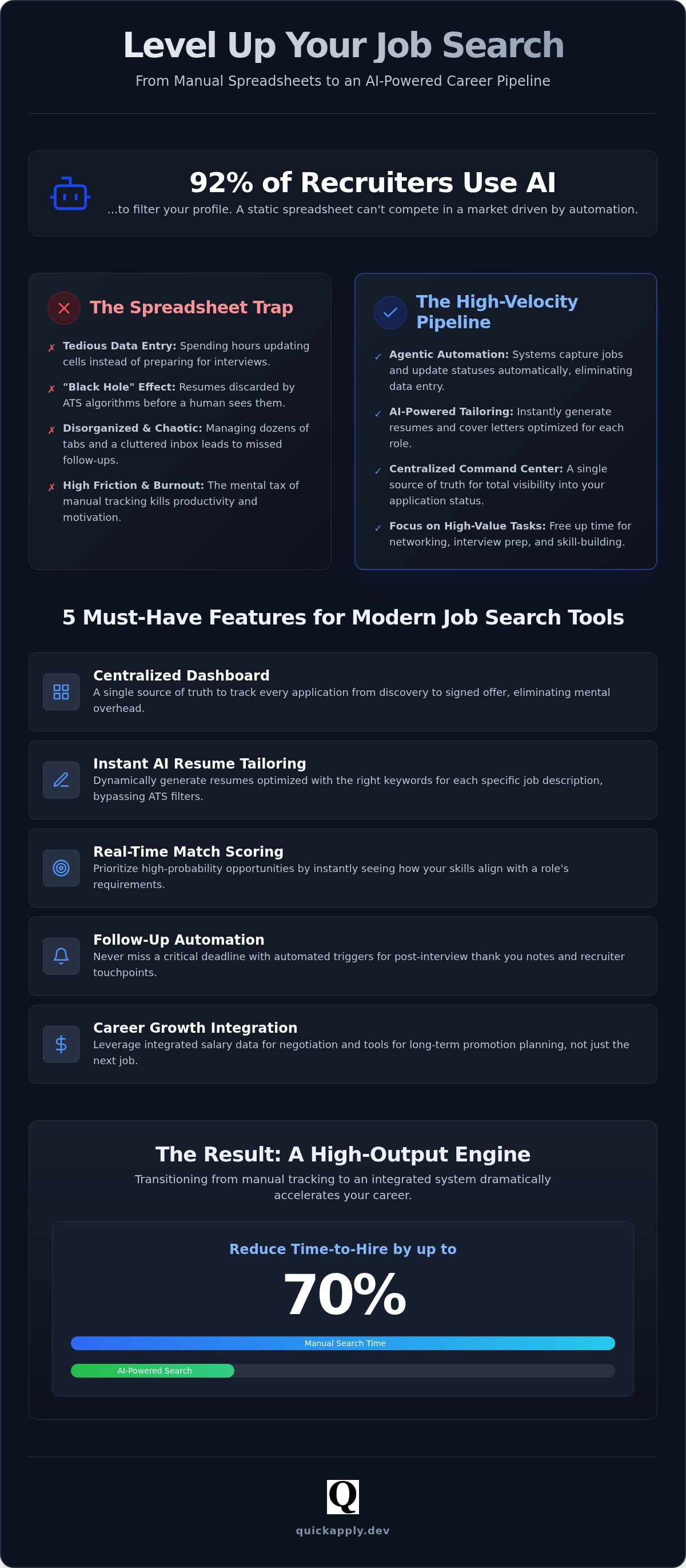
Approximately 92% of recruiters now use AI to filter your profile, yet most tech professionals still manage their careers using static, manual spreadsheets. Your current job search organization tools are likely slowing you down. If you're spending more time updating cells than preparing for interviews, you've already lost your competitive edge. Stop treating your career like a tedious data entry project. It's time to start treating it like a high-velocity pipeline.
We understand the frustration of spreadsheet fatigue and the sinking feeling of losing track of a critical follow-up deadline. You're putting in the volume, but your interview conversion rates aren't reflecting that effort. This guide promises a better way. You'll learn how to replace chaotic tracking methods with high-velocity AI systems that organize your search and automate your success. We're moving past simple storage and into the era of agentic automation.
We'll preview the best centralized command centers of 2026 that provide automatic resume tailoring and total visibility into your application status. Discover how to leverage tools that can reduce your time-to-hire by up to 70%, ensuring you stay ahead of the curve in a crowded market.
Key Takeaways
- Replace static spreadsheets with integrated systems that link application tracking directly to automated resume tailoring for maximum velocity.
- Evaluate modern job search organization tools based on their ability to provide a centralized command center and instant AI generation for every role.
- Avoid the efficiency drain of "Frankenstein" software stacks by utilizing a single platform that maintains a unified source of truth for your entire career.
- Streamline your daily output by batching job discovery through automated match scores and executing high-velocity tailoring sprints.
- Transition from manual data entry to a high-output pipeline that identifies your best-fitting opportunities instantly without active, repetitive effort.
Why Manual Job Search Spreadsheets are Obsolete in 2026
Spreadsheets are where applications go to die. In 2026, the job market moves at a velocity that manual entry cannot sustain. If you're still copy-pasting job titles into a Google Sheet, you're already losing. Modern job search organization tools aren't just digital ledgers; they're integrated systems that link tracking data directly to active application tailoring. Speed is the only currency that matters when a single posting can attract hundreds of AI-generated applications within minutes.
Most candidates fail because they ignore how a modern Applicant Tracking System (ATS) actually works. Without real-time match scoring, you're flying blind. You apply to dozens of roles, but your resume lacks the specific keyword density required for that specific tech stack. This creates the "black hole" effect. You wait for weeks, but the algorithm has already discarded your profile before a human ever saw it. Disorganization also carries a heavy mental tax. Managing thirty open browser tabs and a cluttered inbox is a productivity killer. It creates friction. Friction leads to burnout. You need a centralized command center that clears the noise and focuses your energy on high-probability targets.
The Rise of the Automated Job Application Tracker
Stop building lists and start building pipelines. A modern Application Tracker captures job details instantly from any board. It eliminates the tedious data entry phase entirely. You don't need to manually update a status from "Applied" to "Interviewing." The system handles the logistics through automated updates. This shift allows you to focus on high-value tasks like networking and interview prep. Automation ensures your data is always current, providing a real-time view of your progress. It turns a passive search into an active, high-output engine that runs in the background.
Why Tech Professionals Need Specialized Systems
Tech hiring is uniquely complex. You aren't just tracking one resume; you're managing variations for different tech stacks and roles. Specialized systems handle these nuances effortlessly. They allow you to swap between a React-focused profile and a backend-heavy version in seconds. These tools also track technical interview stages and coding challenge deadlines that generic trackers miss. By integrating salary data directly into your dashboard, you gain immediate negotiation leverage. You'll know the market rate for a Senior DevOps role before you even start the first screening call. This level of organization transforms your search from a chaotic chore into a streamlined, professional operation.
5 Must-Have Features for Job Search Organization Tools
Modern job search organization tools are built to handle complexity at scale. You don't just need a list; you need an engine. A centralized dashboard provides a single source of truth for every role. It tracks your progress from initial discovery through the final signed offer. This visibility eliminates the mental overhead of remembering which recruiter messaged you on which platform. It turns a scattered search into a professional operation.
You also need the capability to tailor resume to job description instantly. Manual editing is a bottleneck you can't afford. Match scoring allows you to prioritize roles based on skill alignment rather than just the post date. This ensures you spend your energy on high-probability opportunities. Follow-up automation is equally critical. Never miss a post-interview thank you or a recruiter touchpoint again. These tools set triggers to keep your pipeline moving without active effort. Finally, look for career growth integration. The best platforms include resources for salary negotiation and promotion planning. They don't just help you get a job; they help you manage your entire career trajectory. If you're ready to upgrade your process, explore the features available at QuickApply.
The Power of Integrated Resume Tailoring
An AI resume builder must be a core component of your tracker. It's no longer enough to have a "good" resume. You need a resume that is perfect for this specific role. By using advanced job search techniques to identify high-value targets, you can then generate tailored documents in seconds. This approach bypasses modern ATS filters by ensuring every keyword matches the specific tech stack the employer requires. You move from "one-size-fits-all" to "one-size-fits-this-role" instantly.
Intelligent Match Scoring and Prioritization
Fit is determined by data, not gut feelings. Match scoring algorithms analyze your profile against job descriptions before you even hit apply. This allows you to focus your energy where it actually counts. You'll stop chasing dead ends and start receiving more high-quality interview invites. Over time, these systems use your application history to refine your search criteria. It's a feedback loop that makes you more efficient with every submission. You're not just applying; you're optimizing.
Integrated vs. Standalone Tools: Choosing Your Career Stack
Many tech professionals inadvertently build a "Frankenstein" stack. They use one tool for tracking, another for writing, and a third for searching. This creates data silos. Every time you switch tabs, you lose momentum. Integrated job search organization tools eliminate this friction by maintaining a single source of truth for your entire career. Your professional data stays in one secure SaaS environment. This isn't just about convenience; it's about security. Keeping your career history and salary expectations in one place reduces your digital footprint and protects your privacy. You don't want your sensitive professional data scattered across five different browser extensions.
A job search is rarely a sprint. It's a multi-month project that requires scalability. Standalone tools often break down as your application volume grows. Integrated platforms keep your history organized, allowing you to track progress over months without losing critical context. While Indeed provides a comprehensive guide to job search tools across the broader market, the real advantage for a tech pro lies in how these systems communicate. When your tracker, tailor, and practice tools are synced, you spend less time managing software and more time landing offers.
Why Standalone AI Writers Fail Tech Pros
Generic AI prompts produce generic results. If you use ChatGPT for a cover letter, it doesn't know your specific project history or the nuances of the job description. Your cover letter builder must have access to your full application history to be effective. It needs to know which resume version you used and which skills you highlighted. This ensures a consistent professional voice across every document you submit. Standalone writers can't provide this level of synchronization. They force you to manually feed them data, which defeats the purpose of automation.
The Benefits of a Unified Command Center
A unified center allows for a seamless transition from your application for job to the interview prep phase. When you get a hit, your tracker should trigger interview practice modules immediately. You also gain consolidated analytics. You can see exactly which resume versions are generating the most interviews. A unified notification system ensures you never miss a deadline across fifty different applications. It's about total control. You need one screen that tells you exactly where you stand and what to do next. That's the difference between a chaotic search and a high-velocity career move.
Optimizing Your Daily Workflow for Maximum Application Velocity
Speed is your primary advantage. In a market where nearly all recruiters use automated filters, your manual processes are a liability. High-velocity job search organization tools transform your search from a reactive chore into a proactive pipeline. You need a workflow that prioritizes output without sacrificing document quality. This isn't about working harder; it's about building a system that moves as fast as the market does.
Your daily routine should follow a strict, high-efficiency protocol:
- Step 1: Batch your job discovery. Use automated match scores to filter roles that align with your specific tech stack.
- Step 2: Tailor your documents. Execute 30-second sprints to generate resumes and cover letters that hit every required keyword.
- Step 3: Sync everything. Use browser extensions to push application data directly to your tracker instantly.
- Step 4: Automate follow-ups. Set triggers for recruiter touchpoints exactly 48 hours after submission.
- Step 5: Review analytics. Analyze your weekly performance to pivot away from low-conversion strategies.
Stop wasting hours on manual tracking and start using a system designed for speed. You can automate your application workflow with QuickApply today.
The 30-Minute Application Sprint
High velocity doesn't mean low quality. You can apply to five high-tier roles in the time it used to take for one. Leverage automation for repetitive form-filling tasks that drain your energy. Use AI to handle the heavy lifting of tailoring, but keep a human-in-the-loop check. Spend sixty seconds reviewing the generated content to ensure it captures your specific professional nuance. This balance maintains high output while ensuring your applications stand out in a crowded ATS. Consistency wins the volume game.
Managing the Interview Pipeline
Interviews are where the complexity spikes. You must organize technical rounds, live coding sessions, and take-home assignments simultaneously. Use your command center to track specific role requirements and deadlines. Integrate interview practice tools to prep for the exact stack mentioned in the job description. After each round, log the feedback immediately. This data allows you to refine your performance for subsequent stages. A well-organized pipeline ensures you never walk into a technical screening unprepared or overwhelmed by conflicting schedules.
QuickApply: The AI-Powered Command Center for Tech Careers
QuickApply is the final evolution of job search organization tools. It doesn't just track your data; it drives your entire career lifecycle. While other platforms leave you to manage the transition from applying to interviewing, QuickApply automates every step. The core of this system is the Match Score engine. It identifies your best-fitting opportunities instantly by analyzing your profile against live job descriptions. You stop guessing and start targeting roles where you have a statistical advantage. This precision is why tech professionals and students choose QuickApply to gain a competitive edge in a crowded 2026 market.
Your career stack should be as advanced as the software you build. QuickApply functions as a centralized hub, pulling in job data and pushing out tailored applications at high velocity. It eliminates the friction of manual entry and replaces it with systemic automation. This isn't a passive tracker. It's an active agent that works to reduce your time-to-hire by focusing your energy on high-probability leads. By integrating every phase of the search into one dashboard, you maintain a single source of truth that evolves as you do.
Resume and Cover Letter Automation
Document creation is often the biggest bottleneck in any job search. QuickApply solves this with instant tailoring that maintains your unique professional brand. You get unlimited resume versions to target every specific niche in the tech market. Whether you're pivoting from frontend to full-stack or targeting a specific DevOps role, the system adjusts your keywords in seconds. The platform also generates high-impact cover letters designed to be read by recruiters. These aren't generic templates. They're data-driven documents that highlight your specific value proposition for every individual role.
Career Growth and Negotiation Tools
Getting the interview is only half the battle. QuickApply prepares you for the offer with data-backed salary negotiation guides. You'll enter the final round with the confidence of knowing exactly what the market pays for your specific skill set. Once you land the role, the platform continues to work for you. The Promotion Roadmap feature helps you plan your next move from day one. It identifies the skills and milestones needed for your next level up. This allows for continuous career management even when you aren't actively searching. You stay ahead of the curve, ensuring your professional trajectory never stalls.
Master Your Career Pipeline Today
The 2026 job market doesn't reward manual effort; it rewards systemic efficiency. You've seen why spreadsheets are obsolete and how integrated job search organization tools provide the visibility needed to land high-tier roles. By centralizing your command center, you eliminate the mental tax of disorganization and focus entirely on high-probability opportunities. Discard the friction of manual entry and embrace a high-velocity workflow.
Don't let a "Frankenstein" stack of standalone tools slow your momentum. Use a unified platform that evolves with you from the first application to your next promotion. Leverage AI-powered Match Scores and unlimited resume tailoring to bypass ATS filters in seconds. This isn't just about finding a job; it's about building a sustainable career engine that operates with zero friction. It's time to stop tracking and start winning.
Start organizing your tech career with QuickApply for free today and access comprehensive Promotion Roadmaps to secure your long-term growth. Your next offer is waiting. Build your future with the speed it deserves.
Frequently Asked Questions
What are the best job search organization tools for software engineers?
Integrated platforms like QuickApply are the top choice for software engineers because they manage complex technical stacks and multiple resume versions. Engineers require systems that link tracking directly to active tailoring. Avoid manual spreadsheets that create data silos. Use tools that offer match scoring and automated follow-ups to reduce administrative overhead. These systems allow you to focus on technical interviews rather than tedious data entry. Efficiency wins the volume game.
How do I organize my job search without using a spreadsheet?
Transition to an automated application tracker that captures job data instantly via browser extensions. Modern job search organization tools replace static spreadsheet cells with dynamic pipelines. These platforms sync your status updates in real-time and provide a centralized dashboard for every role. You gain a single source of truth for every application you submit. This setup eliminates manual entry and prevents critical follow-up deadlines from slipping through the cracks. Automation is the standard.
Can AI tools really help me get more interviews in tech?
AI tools increase interview conversion rates by ensuring your profile passes automated recruiter filters. Research shows that approximately 92% of recruiters now use AI in their hiring process. By using match scores and instant tailoring, you align your resume with the specific technical requirements of every role. This precision ensures your application reaches a human recruiter rather than being discarded by an algorithm before the first screening. It's a statistical advantage you can't ignore.
Is it safe to use AI resume tailoring for ATS systems?
Using AI resume tailoring is both safe and necessary to remain competitive in the current market. Applicant Tracking Systems look for specific keyword density and skill alignment. AI tailoring ensures your resume contains the exact terminology found in the job description without manual guesswork. This isn't about cheating; it's about translating your real-world experience into the language the software understands. It's a standard professional practice for tech experts who value their own time.
How many jobs should I track at once during a career transition?
Maintain a pipeline of 15 to 25 active applications at various stages of the hiring process. High-velocity tools allow you to manage this volume without burnout or data loss. Tracking too few roles limits your negotiation leverage, while tracking too many can degrade the quality of your interview prep. Focus on high-probability opportunities identified by match scores. This balanced approach ensures a consistent flow of interviews while maintaining high standards. Quality and quantity can coexist.
What features should I look for in a job application tracker?
Prioritize a centralized dashboard, automated match scoring, and integrated resume tailoring. A high-quality tracker must offer browser extensions for instant data capture from any job board. Look for automated follow-up reminders and interview practice modules that sync with your applications. These features turn a passive list into an active career engine. The best job search organization tools eliminate repetitive tasks and provide visibility into your next professional steps. Seek tools that move as fast as you.
How does QuickApply differ from basic job boards or LinkedIn?
QuickApply functions as an end-to-end command center, whereas LinkedIn is primarily a discovery and networking platform. Basic job boards stop at the application submission button. QuickApply takes over by automating the tailoring process, tracking every stage of the interview, and providing practice tools. It bridges the gap between finding a role and securing a signed offer. It is a specialized stack designed for high-output professionals who expect their software to do the heavy lifting.
Are there tools that help with salary negotiation and promotions?
QuickApply offers specialized salary negotiation guides and promotion roadmaps that support your career beyond the initial search. You can prepare for offers with data-backed compensation benchmarks and plan your next internal move immediately. Managing your professional trajectory requires tools that handle both the hunt for a new role and the strategy for advancing within your organization. These resources ensure your growth remains consistent and your earnings stay optimized. Plan your success with precision data.


