

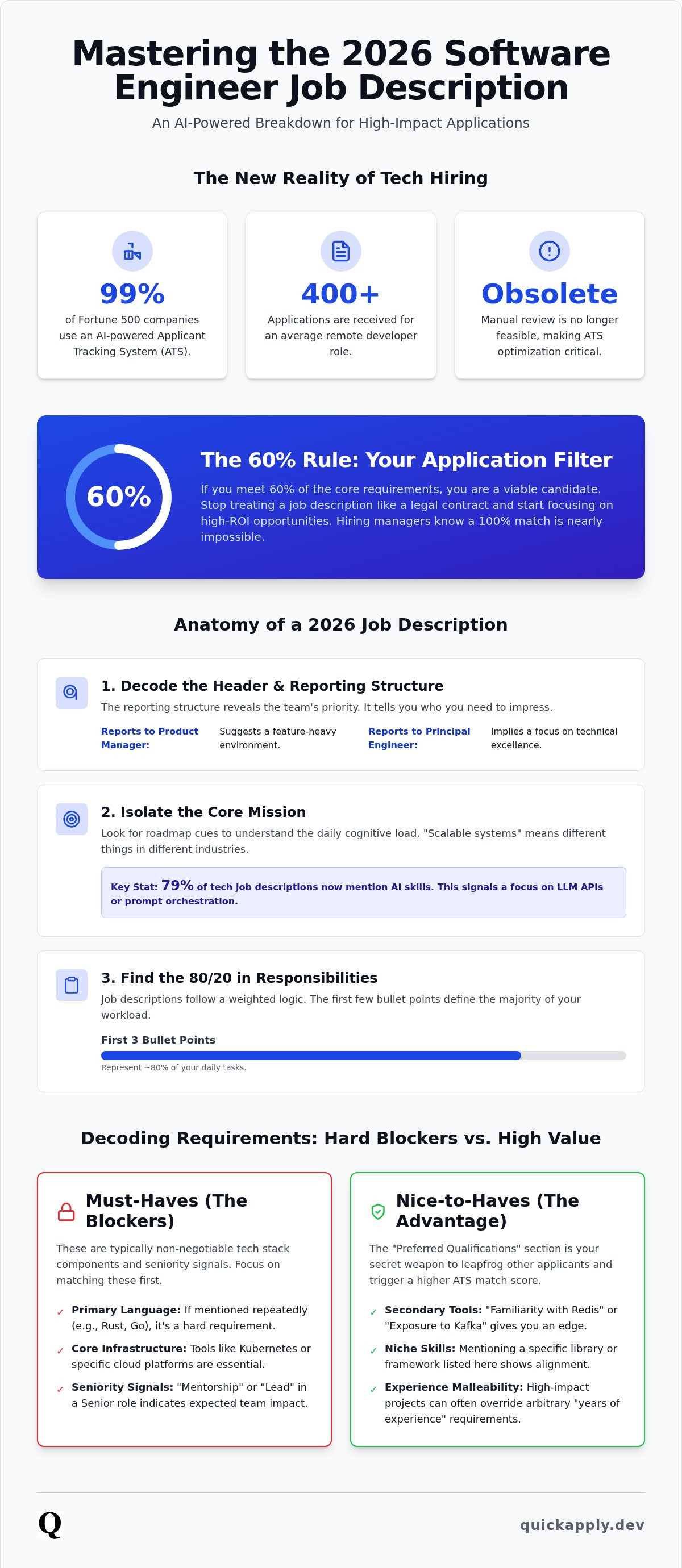
99% of Fortune 500 companies use an AI-driven Applicant Tracking System to filter your profile before a human recruiter ever sees it. In 2026, the average remote developer role receives up to 400 applications, which means manual review is officially obsolete. If you're still performing a manual software engineer job description breakdown for every single opening, you're burning your most valuable resource: time.
It's exhausting to scan a list of 20 niche requirements and feel unqualified because you haven't touched a specific Python 3.14.7 library. You're tired of tailoring resumes for roles that were never a fit in the first place. You need a process that's as optimized as your production code. This guide teaches you how to strip away corporate fluff, isolate high-impact keywords, and use smart technology to match your profile to any role in seconds. We'll provide a clear framework for querying JDs like a data set and using a Match Score to identify high-ROI opportunities without the manual grind.
Key Takeaways
- Apply the 60% rule to filter out "nice-to-have" skills and focus on the non-negotiable tech stack that actually triggers an interview.
- Execute a precise software engineer job description breakdown to extract high-impact keywords that satisfy modern AI-powered Applicant Tracking Systems.
- Stop wasting time on manual JD analysis and leverage automated Match Scores to prioritize roles where you have the highest probability of success.
- Identify mission-critical product goals hidden in job headers to align your technical experience with a company's specific 2026 growth trajectory.
- Use real-time data to bridge skill gaps and tailor your profile in seconds, allowing you to dominate high-volume application cycles without losing quality.
The Anatomy of a 2026 Software Engineer Job Description
Think of a job description as a technical specification. You wouldn't start a sprint without a clear ticket; you shouldn't start an application without a software engineer job description breakdown. Most candidates scan the title and skip to the salary. You're different. You look at the header to identify the reporting structure. A role reporting to a Product Manager suggests a feature-heavy environment, while reporting to a Principal Engineer implies a focus on technical excellence and software engineering fundamentals. Understanding this hierarchy tells you exactly who you need to impress during the interview process.
Identifying the Core Mission
The mission statement isn't just marketing fluff. It defines your daily cognitive load. In 2026, building "scalable systems" in Fintech means managing high-frequency transactions with zero latency. In Gaming, it might mean managing concurrent state for millions of users. Look for 2026 roadmap cues. If the JD mentions AI integration, expect to work with LLM APIs or prompt orchestration, as AI skills now appear in 79% of tech postings. Spotting whether the role is infrastructure-heavy or feature-focused helps you decide if your current tech stack, like Python 3.14.7 or C++26, aligns with their immediate needs.
The Hidden Hierarchy of Responsibilities
Job descriptions follow a weighted logic. The first three bullet points usually represent 80% of your actual daily workload. If "cross-functional collaboration" is at the top, you'll spend more time in Figma and Jira than in your IDE. If "independent contributor" is the focus, they want a code machine. Job responsibilities translate into resume bullet points by matching the company's stated problems with your proven solutions.
Distinguishing between hard blockers and flexible preferences is the ultimate efficiency hack. Requirements like a specific degree are often legacy text, but a requirement for Rust or Kubernetes in a 2026 cloud-native role is usually a non-negotiable hard skill. Don't let a list of 20 niche skills trigger your anxiety. Use this software engineer job description breakdown to isolate the non-negotiables. Once you identify the core 60%, you're ready to optimize your profile and move toward that FAANG offer.
Decoding Requirements: Must-Haves vs. Nice-to-Haves
Stop treating a job description like a legal contract. It's a wishlist, not a mandate. Many engineers suffer from imposter syndrome because they don't check every box. In 2026, the 60% rule is the standard. If you meet 60% of the requirements, you're a viable candidate. Hiring managers know finding a 100% match is statistically impossible. Your goal during a software engineer job description breakdown is to isolate the non-negotiables from the fluff.
Hard skills are your primary blockers. If a company requires Rust, Go, or Kubernetes, these are usually non-negotiable tech stack components. They represent the architecture you'll touch on day one. Soft skills like mentorship or leadership aren't just buzzwords; they signal the expected seniority level. A Senior title with mentorship requirements means they expect you to scale the team's output, not just your own. Aligning your core responsibilities and skills with these signals ensures you don't apply for roles where you're fundamentally over or under-qualified.
Spotting the Non-Negotiables
Identify the primary language by frequency. If Python appears in the header and the first three bullet points, it's the anchor. Secondary tools like "familiarity with Redis" are often flexible. Years of experience are equally malleable. If a JD asks for five years but you've spent three years delivering high-impact features in a similar stack, apply anyway. Reviewing good resume examples helps you see how to frame project impact to override arbitrary experience caps.
The 'Nice-to-Have' Advantage
The Preferred Qualifications section is your secret weapon. Most candidates ignore these. If you possess even one niche skill mentioned here, you immediately leapfrog the applicant pool. These skills are high-value keywords for the ATS. Including them doesn't require expert status; simple "exposure to" or "familiarity with" is enough to trigger a higher Match Score. You can quickly see how you stack up by checking your profile against a JD at quickapply.dev. Leveraging these niche certifications or tools allows you to bypass candidates who might have more years of experience but less specific technical alignment. This is the most efficient way to turn a software engineer job description breakdown into a competitive advantage.
Extracting High-Impact Keywords for the ATS
The first "developer" to review your code isn't a human; it's an algorithm. In 2026, 99% of Fortune 500 companies rely on an Applicant Tracking System (ATS) to filter talent. These systems act as gatekeepers, scoring your resume based on how well your data matches the job's requirements. If your software engineer job description breakdown fails to identify the right tokens, your application dies in a database before a recruiter ever sees your name. To win, you must treat your resume like a query optimized for the company's specific index.
Effective extraction requires distinguishing between Skill Keywords and Contextual Keywords. Skill Keywords are the hard tools: Java, AWS, or React. Contextual Keywords describe the environment, such as "low-latency," "distributed systems," or "CI/CD pipelines." While the U.S. Bureau of Labor Statistics Occupational Outlook provides a baseline for standard developer duties, every company has a unique dialect. You must mirror that dialect. You can learn how to tailor your resume to a job description using AI to ensure you hit these markers without sounding like a bot. Avoid keyword stuffing; modern ATS parsers are sophisticated enough to penalize resumes that lack logical flow.
Technical Keyword Extraction
Focus on the specific frameworks and methodologies mentioned in the JD. If a posting emphasizes "Test-Driven Development (TDD)" or "Agile Scrum," these are high-weight tokens. Look for "hidden" keywords that imply a specific tech stack. A mention of "event-driven architecture" is a signal to include Kafka or RabbitMQ if you have the experience. In 2026 ATS environments, exact phrasing often outweighs synonyms because the system looks for direct semantic matches found in the original job description. Using "Full-Stack Engineer" when the JD asks for a "Full Stack Developer" can actually lower your relevance score in older systems.
Action Verbs and Impact Metrics
Your software engineer job description breakdown should also identify the company's preferred tone. A scrappy startup wants to see "deployed," "built," and "iterated." An enterprise legacy firm looks for "architected," "optimized," and "standardized." Replace passive phrases like "worked on" with active verbs that signal ownership. Quantify your results to match the JD's expected outcomes. If the JD mentions "improving system reliability," your resume should highlight how you "increased uptime by 14%." This strategy proves you don't just have the skills; you understand the mission-critical metrics that drive the business forward.
Why Manual Breakdown is Obsolete in 2026
The math of the modern job search is brutal. In 2026, the average remote developer position receives between 200 and 400 applications, which is a massive jump from the 50 to 100 applications seen just a few years ago. If you spend two hours performing a manual software engineer job description breakdown for every role, you'll apply to maybe four jobs a week. That volume is insufficient for a competitive market. You're competing against candidates using automated systems to apply to dozens of high-quality roles in the same timeframe. Efficiency isn't just a preference; it's your primary competitive advantage.
Manual analysis is a low-ROI activity. It's prone to human error, fatigue, and bias. You might miss that a company specifically wants experience with "Python 3.14.7" or "C++26" hidden in a wall of text. AI analysis identifies these specific tokens instantly. Beyond speed, the rise of the "Match Score" allows you to know your odds before you even click 'Apply.' This data-driven approach prevents burnout. You stop chasing "ghost" roles where your profile has a low match and start focusing on the 90% plus opportunities. You can optimize your search now and stop guessing which JDs are worth your time.
The Efficiency Gap
Comparing the time spent on manual versus AI-assisted analysis reveals a massive productivity chasm. A human takes 15 to 20 minutes to deeply read a 1,000-word JD. An AI does it in seconds. More importantly, AI catches the "hidden" requirements that human eyes miss during a quick scan, such as specific architectural patterns or subtle mentions of legacy system migration. There is a massive psychological benefit to this. Starting your application with a high Match Score provides the confidence needed to perform well in later interview stages.
Scale Without Sacrificing Quality
Applying to more roles shouldn't mean sending generic resumes. High-volume output with low-effort input is the goal for the modern engineer. By automating the software engineer job description breakdown, you maintain high-quality tailoring while increasing your application volume by 10x. This workflow allows you to integrate ai cover letter generation directly into your process. You aren't just spraying and praying; you're executing a targeted strike on the most relevant positions.
Managing this increased volume requires a systematic approach. An automated job application tracker is non-negotiable in 2026. It ensures you never lose track of which version of your resume went to which FAANG offer. Stop wasting your cognitive cycles on administrative tasks. Let the technology handle the heavy lifting so you can focus on passing the technical interview.
Optimizing Your Strategy with QuickApply
Your manual software engineer job description breakdown is a relic of a slower era. In 2026, efficiency is the only metric that matters. QuickApply transforms the JD from a wall of text into an actionable data set. The process is streamlined into five high-velocity steps designed to maximize your output with minimal manual input. You stop guessing and start executing based on hard data.
- Step 1: Upload the JD to QuickApply to generate an instant Match Score.
- Step 2: Identify missing keywords and technical skill gaps in real-time.
- Step 3: Automatically tailor your resume to hit 90% plus relevance for that specific role.
- Step 4: Generate a targeted cover letter that references specific JD requirements and company goals.
- Step 5: Log the application in the tracker to ensure follow-up precision and pipeline management.
Leveraging the Match Score
Data-driven prioritization is the core of a successful search. A Match Score of 80% or higher indicates a high probability of an interview. Focus your energy there. If the score is lower, use the breakdown to identify specific skill gaps. You might discover that highlighting a single methodology like "TDD" or a specific library version boosts your relevance significantly. This isn't about inventing experience. It's about surfacing the transferable skills you already possess but haven't properly indexed for the ATS.
Automated Tailoring in Seconds
Preserving your technical truth is vital. QuickApply's AI doesn't invent experience; it optimizes your existing history to speak the language of the JD. This ensures you hit the relevance threshold without sounding like a generic bot. The workflow integrates Resume Tailoring and Cover Letter Generation into a single, cohesive motion. Managing 50 or more applications becomes effortless with a "set and forget" tracker that replaces messy spreadsheets.
Finalizing your application is no longer a multi-hour project. You can tailor resume to job description with AI to ensure your profile is always at the top of the stack. This systemic automation bridges the gap between your talent and the FAANG offer you're chasing. By automating the software engineer job description breakdown, you reclaim your time and focus on what actually gets you hired: passing the technical interview and negotiating your 2026 salary.
Dominate the Technical Application Pipeline
The landscape of 2026 demands a shift from manual scanning to algorithmic precision. You've learned that a software engineer job description breakdown isn't about checking every box; it's about identifying the high-impact tokens that trigger an ATS interview invitation. By distinguishing between hard blockers and preferred skills, you can focus your energy on roles where your technical stack actually moves the needle. Manual effort is a bottleneck in your career growth that you can no longer afford.
You need to move faster than the 400 other applicants vying for that same remote role. Efficiency is your only path to a FAANG offer in a crowded market. Stop wasting hours on manual tailoring and start using systems built for the modern web. You have the talent; now use the right tools to prove it to the recruiters and the algorithms alike.
Stop breaking down JDs manually; Get your Match Score with QuickApply for free. Leverage AI Match Score analysis to find your best fit instantly. Tailor your resumes in less than 10 seconds with tech-first keyword optimization. Your next offer is just a data-driven application away. Success belongs to those who optimize.
Frequently Asked Questions
How do I know if a software engineer job description is 'ghosting' or real?
Check the posting date and company activity immediately. Roles older than 30 days without a "recently updated" tag are often talent pipelines rather than active hires. Real JDs usually include specific project context or team-level details. If the description is generic and lacks a clear reporting structure, it might be a ghost listing used for data collection.
What are the most important keywords for a Senior Software Engineer JD in 2026?
Focus on architectural and leadership tokens. Keywords like "distributed systems," "system design," "mentorship," and "AI orchestration" are critical for senior roles. In 2026, AI-related skills appear in 79% of tech postings, making them vital for high-level positions. Ensure your software engineer job description breakdown identifies these high-weight tokens to satisfy sophisticated ATS algorithms.
Can I apply for a role if I don't know the specific programming language listed?
You can apply if you meet the 60% rule and the language isn't the primary anchor. If you're an expert in Java but the JD asks for C#, your architectural knowledge is often transferable. Highlight your ability to ramp up quickly on new stacks. Mentioning your experience with Python 3.14.7 or C++26 proves you stay current with modern language evolutions.
How much of the job description should I include in my resume?
Aim for a 90% semantic match without copying text verbatim. Focus on the first three bullet points of the responsibilities section, as these represent 80% of the actual workload. Mirror the specific frameworks and methodologies mentioned to satisfy the ATS. Don't include every minor tool; only focus on the tokens that drive the core mission of the role.
Why do some software engineer JDs list so many unrelated technologies?
This is "JD bloat" caused by HR teams combining requirements from multiple departments. Your task is to identify the core tech stack. Look for the technologies mentioned most frequently in the header and first few bullet points. Those are the real requirements. Ignore the "nice-to-have" list if you possess the primary languages like Python, C, or C++.
What is a good Match Score for a software engineering role?
A score of 80% or higher is a strong match for a technical role. Anything above 90% suggests high relevance and a high probability of an interview. Use these scores to prioritize your application pipeline. If your score is below 70%, perform a deeper software engineer job description breakdown to see if you've missed transferable skills or niche keywords.
How do I break down a JD for a remote software engineering position?
Prioritize keywords related to asynchronous communication and independent delivery. Remote roles often emphasize "self-starter" traits and specific collaboration tools like Slack or Jira. With 82% of companies using remote work as their default hiring model in 2026, demonstrating remote proficiency is vital. Highlight your experience with distributed version control and cloud-native environments to prove you can deliver without direct supervision.
Does the ATS penalize resumes that are too perfectly matched to the JD?
Resumes aren't penalized for matching, but they are flagged for keyword stuffing. A perfect match triggers the ATS, but you must back up every keyword with "technical truth" during the interview. Avoid lists of words without context. Instead, integrate keywords naturally into your impact metrics. Recruiters look for logical flow and evidence of project success, not just a list of tokens.


