

Don’t rewrite everything yet. To figure out how to revamp your resume when getting no interviews, first make sure you’re targeting roles that fit your skills. Then tailor your resume to each job and use your cover letter to reinforce the same case. A stronger document won’t fix an application strategy aimed at the wrong roles.
If you’ve been applying consistently and hearing nothing back, it’s frustrating to wonder whether your experience is the problem. Often, the issue is how clearly your application connects your experience to the job, not simply how much you’ve changed your resume.
This guide helps you decide what to fix first: your target roles and application approach, your resume’s relevance to a specific job, or the alignment between your resume and cover letter. You’ll get practical steps to diagnose the problem, highlight relevant results, and adapt your materials without misrepresenting your skills or starting from scratch for every application.
Key Takeaways
- Clarify your target roles before revising your resume so you’re solving the right application problem.
- Connect your most relevant experience to the employer’s needs, not just the keywords in the posting.
- Make your resume and cover letter reinforce the same case for why you fit the role.
- Tailor each application by prioritizing relevant skills and achievements while keeping every claim accurate.
1. Tailoring to an employer’s business problem
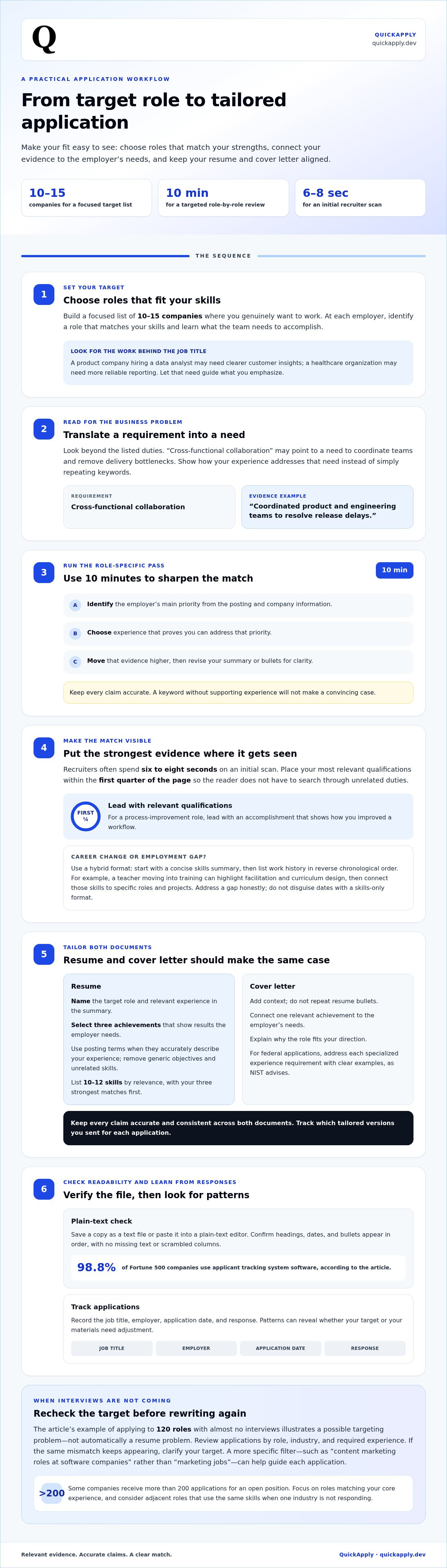
Start with a focused list of 10-15 companies where you genuinely want to work. For each employer, select a role that matches your skills and investigate what the team needs to accomplish. A product company hiring a data analyst may need clearer customer insights, while a healthcare organization may need more reliable reporting. Those needs should shape what your resume emphasizes.
Look beyond the listed responsibilities to understand what problem the job description is asking you to solve. A request for “cross-functional collaboration” may signal a need to coordinate teams and remove delivery bottlenecks. Match that need with a specific example, such as: “Coordinated product and engineering teams to resolve release delays.” Tailoring means making this connection, not simply copying keywords into a skills section.
Use a 10-minute pass for each target role. First, identify the employer’s main priority from the posting and company information. Next, choose experience that proves you can address it. Then move that evidence higher on the page and revise the summary or bullets for clarity. Keep the claims accurate. A keyword without supporting experience won’t make a convincing case.
Make your strongest evidence easy to find. Recruiters often spend six to eight seconds on an initial scan, so place your most relevant qualifications within the first quarter of the page. If the role calls for process improvement, lead with an accomplishment that shows how you improved a workflow. Don’t make the reader search through unrelated duties to understand your fit.
For a career change or employment gap, use a hybrid format: lead with a concise skills summary, then list your work history in reverse chronological order. This keeps transferable strengths visible while preserving a clear timeline. For example, a teacher moving into training can highlight facilitation and curriculum design, then connect those skills to specific roles and projects. Address a gap honestly; don’t disguise dates with a skills-only format.
2. Customizing resumes and cover letters
Start with the job posting, then make targeted edits to your resume. Name the target role and relevant experience in your summary. Choose three achievements that demonstrate results the employer needs. For a project manager role, highlight a delivery improvement instead of listing routine meeting duties. Remove generic objectives and unrelated skills that distract from your fit.
For applicant tracking system screening, use relevant skills and terms from the posting. Include exact wording when it accurately describes your experience. A posting that asks for “SQL” and “data visualization” gives you clear terms to include, if you have those skills. Keep the skills section focused: list 10-12 skills by relevance, with the three strongest matches first.
How many pages should a U.S. resume be? Use enough space to show relevant experience clearly, without padding. The right length depends on your career history and target role. Keep the most important qualifications easy to find, and cut older or unrelated details before shrinking the text.
Consider a professional resume review if repeated, targeted applications still fail to communicate your fit or you need an objective edit. The cost depends on the reviewer’s experience and the scope of work, such as a resume-only review or revisions to multiple documents. Compare the specific deliverables and feedback included.
Customize your cover letter to add context, not repeat resume bullets. Connect one relevant achievement to the employer’s needs, then explain why that role fits your direction. For federal applications, address each specialized experience requirement with clear examples, as the National Institute of Standards and Technology (NIST) advises. Keep every claim accurate and consistent across both documents.
Use a tailored resume and cover letter for each application, then track which versions you sent. If you want to streamline those edits, tailor your resume and cover letter to the role while keeping the employer’s requirements in view.
3. Diagnosing application strategy before rewriting
To decide how to revamp your resume when getting no interviews, pause before editing another bullet. A job seeker who applies to 120 roles with almost no interviews may have a targeting problem, not just a resume problem. Review recent applications by role, industry, and required experience. If the same mismatch appears repeatedly, clarify your target before revising the document.
Check whether your target is specific enough to guide each application. “Marketing jobs” is broad; “content marketing roles at software companies” gives you a clearer filter. Compare the roles you’re applying for with your strongest skills and evidence. If one industry isn’t responding, consider adjacent roles that use the same skills, such as moving from customer support into customer success.
Competition also affects response rates. Some companies receive more than 200 applications for an open position, so sending the same resume everywhere can weaken your signal. Choose roles where your experience matches the core requirements, then track each job title, employer, application date, and response. Patterns across those records can reveal whether your target or materials need adjustment.
To check whether an applicant tracking system can read your resume, save a copy as a text file or paste it into a plain-text editor. Confirm that headings, dates, and bullets appear in order, without missing text or scrambled columns. Since 98.8% of Fortune 500 companies use applicant tracking system software, a clean, readable layout matters for those applications.
Common mistakes that can block interviews include applying to roles that don’t match your experience, using one generic resume, and listing duties without relevant results. Unsupported claims can also undermine credibility. For example, “expert in analytics” is weak without a tool, project, or outcome to support it. Compare each application with the job posting and remove claims you can’t substantiate.
Use this process to decide how to revamp your resume when getting no interviews: test one change at a time. Narrow the role type, revise the opening for a specific position, or target an adjacent industry. Track each version and response. That record helps distinguish a resume issue from a targeting issue, giving your next revision a clear purpose.
4. How should I tailor a resume to each job description?
Use the job description as a prioritization map, not a script to copy. The U.S. Bureau of Labor Statistics advises tailoring your résumé for each occupation or job of interest. Start by identifying the role’s core responsibilities, required skills, and repeated terms. Then compare those requirements with evidence already present in your experience.
Update your summary to name the target role and include two or three relevant skills from the posting. For a project coordinator position that emphasizes schedules and stakeholder updates, foreground your planning and communication experience. Keep the wording truthful: don’t claim a tool or capability you haven’t used. Relevant language should make your real experience easier to recognize.
Next, reorder your experience bullets so the strongest matches appear first. If a posting prioritizes customer retention, move a verified retention achievement above general administrative duties. Add relevant keywords naturally within descriptions of your work instead of creating a block of disconnected terms. A hiring team should see how each skill connects to a real task or outcome.
Review the skills section after updating your summary and experience. List 10-12 skills in order of relevance, with the first three aligned closely to the target role. For a data analyst job, that might mean placing SQL, data visualization, and reporting ahead of less relevant tools. Remove skills that don’t support this application.
Finish with a consistency check. Review the job title, dates, formatting, and terminology, then compare your revised document with the posting again. Save each version with a clear role or employer label to avoid sending the wrong file. This repeatable workflow keeps each application focused without changing your underlying career history.
Ready to adapt your next application? Tailor your resume to the job description and make the most relevant experience easier to spot.
QuickApply: Resume Tailoring
QuickApply turns your target role into application materials tailored to its job description. Use Resume Tailoring and Cover Letter Generation once you’ve identified suitable openings and want to align your experience with each employer’s requirements. The match score can help identify opportunities that fit your background, while the Application Tracker keeps your search organized. Interview Practice helps you prepare when an application leads to a conversation.
This can be a practical next step when manual edits slow your application workflow. Keep your experience accurate, review each tailored draft, and make sure the final documents reflect your real skills and results. QuickApply supports the application process, but choosing roles that fit your goals is still essential.
Visit quickapply.dev to explore QuickApply.
Make Your Next Application More Intentional
The next step in how to revamp your resume when getting no interviews is to stop making changes blindly. Treat each application as a focused test: choose a suitable role, make a clear adjustment, and record which version you submitted. That gives you a signal to guide your next decision instead of another round of guesswork.
Keep your claims grounded in real experience, and judge each draft by whether a hiring team can quickly understand the value you bring. If tailoring every application manually is slowing you down, QuickApply’s Resume Tailoring and Cover Letter Generation can help you prepare role-specific materials. Interview Practice can help you prepare when an application moves forward.
Explore QuickApply for resume support, then put your next application into motion with a clearer plan. You can make a more deliberate move today.
Frequently Asked Questions
What Should You Fix First?
Fix the part of your process that creates the clearest mismatch. If you can’t explain why a role fits your background, narrow your target before editing documents. If the role fits but your experience is hard to spot, revise the resume’s opening and strongest evidence. This diagnostic approach keeps you from changing several things at once and losing track of what improved your application.
How can I tell why my resume is not getting interviews?
Review a sample of recent applications and look for repeated friction. Are you pursuing roles with different core requirements, or do your applications consistently miss a required qualification? Ask someone unfamiliar with your work to read one job posting and your resume, then identify the role and your strongest relevant evidence. If they can’t connect them, make that connection clearer before applying again.
How do I write an effective resume summary and experience bullets?
Make the summary a quick positioning statement: identify your professional focus, strongest relevant capabilities, and the kind of work you can take on. For each experience bullet, lead with an action, then add the project or responsibility and its outcome. A sample achievement might say a new ticketing system reduced response time by 20% and raised customer satisfaction scores by 15%. Use your own verified results.
How should I quantify achievements on a resume?
Choose a measure that shows the scale, speed, quality, or business impact of your work. Consider how many reports you produced, how much time a process saved, or whether a project improved a measurable result. If you don’t have an exact figure, use a concrete scope or outcome you can substantiate. Never estimate a metric just to make a bullet sound more impressive.


