

A polished careers page can’t show whether engineers get to do their best work. To learn how to find companies with the best engineering culture, look at how teams make decisions, share code ownership, respond to failures, and deliver useful work to customers. Everyday practices reveal more than slogans or perks.
It’s reasonable to want a workplace that values strong engineering and sustainable work. Engineering culture shapes collaboration, professional growth, and technical decisions, affecting your experience well beyond accepting an offer. This guide explains what engineering culture means, how a healthy culture benefits teams, and what to look for at companies such as Netflix, Meta, Apple, and Spotify. Use these signals to assess whether a team supports thoughtful engineering, clear ownership, and room to grow.
Key Takeaways
- Look beyond company slogans: assess how engineers make decisions, share code ownership, and respond when systems fail.
- Notice whether teams recognize technical mastery and support the people who help others grow.
- Weigh the practical benefits of a strong engineering culture, including collaboration, development, and sustainable work.
- Use your job search to identify teams whose daily practices match the environment where you do your best work.
1. Engineering cultures at Netflix, Facebook, Apple, and Spotify
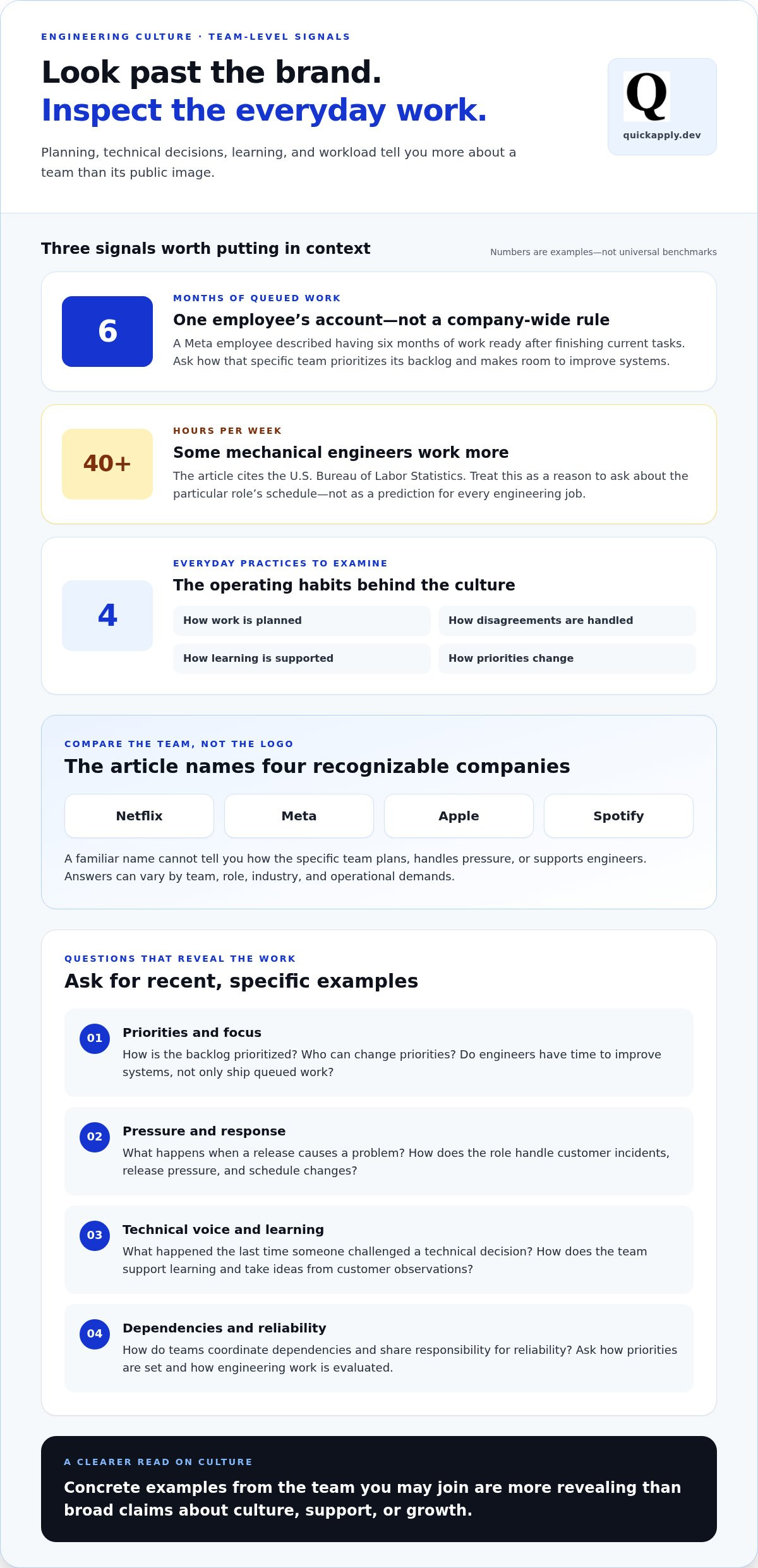
Netflix, Facebook, Apple, and Spotify are recognizable names, but a brand alone can’t show how an engineering team operates. Assess the specific team behind each role: how it plans work, handles technical disagreements, supports learning, and responds to changing priorities. This is a practical way to find companies with the best engineering culture without mistaking reputation for day-to-day experience.
A Meta employee described having six months of work ready after completing current tasks. Treat this as one account of a team’s workload pipeline, not proof that every Facebook or Meta group works the same way. Ask how the team prioritizes its backlog, who can change priorities, and whether engineers have time to improve systems instead of only shipping queued work. Ask the same questions at Netflix, Apple, and Spotify, and compare answers from the specific team you’d join.
Engineering culture and work-life balance vary with company size, industry, team responsibilities, and operational demands. Some mechanical engineers work more than 40 hours weekly, a workload candidates can ask about when assessing work-life balance, according to the U.S. Bureau of Labor Statistics. Ask how the particular role handles release pressure, customer incidents, and schedule changes.
Make your interview questions specific. Ask engineers, “How does the team respond when a release causes a problem?” and “What happened the last time someone challenged a technical decision?” Ask hiring managers how they set priorities, protect focus time, and evaluate engineering work. Concrete examples reveal more than general claims about a supportive culture or fast career growth.
Find out how closely engineers work with users. Ask whether they observe customer environments directly, including through on-site visits, and how those observations inform product decisions. For roles connected to Google or another large platform, ask how teams coordinate dependencies and share responsibility for reliability. Compare answers to understand the work you’d actually do, not just the company’s public image.
2. Recognition and development of engineering craft
Recognition should reward more than visible launches. Look for teams that value both engineers who master difficult technical work and those who help colleagues build that mastery. Both strengthen a team: one raises the quality bar, while the other spreads knowledge. Ask how managers recognize code quality, thoughtful design, documentation, and peer support. Specific examples reveal what the team truly values.
Addepar hosts developer competitions to engage engineers and showcase its engineering team. This points to a useful signal: companies can create structured opportunities for engineers to demonstrate skills, collaborate, and share technical work. Ask whether the team uses demos, internal projects, or engineering discussions to make its craft visible. For a mobile engineer, a showcase might explain a design trade-off, testing approach, or accessibility improvement, not just a feature launch.
Professional development needs a path, not just praise. Ask an engineer how they learned a new tool or took on a harder problem. Then ask a manager how the team supports growth through code review, mentorship, project ownership, or time to explore a technical approach. Listen for examples of feedback leading to new responsibilities or skills. Clear answers show whether learning is part of the work.
Use the interview to find out how recognition works in practice. Ask, “Who gets credit when a shared project succeeds?” and “How does the team support someone who unblocks others?” Strong answers include examples of collaboration, not just individual output. Ask whether promotion and performance decisions recognize technical depth alongside mentoring and reliable delivery. These details help you judge whether advancement rewards the contributions you want to make.
As you prepare for interviews, connect your examples to the role’s technical needs. A focused cover letter for an engineering role can help you explain a craft achievement and the impact of your contribution.
3. Benefits of engineering culture
A strong engineering culture gives a team a clearer path from problem to usable product. Shared expectations help engineers coordinate technical choices, surface risks early, and avoid preventable misunderstandings. For example, setting aside time for focused code review can catch design issues before they spread across a feature. The practical result is more attention for building and improving software.
Culture also shapes whether a career feels sustainable. A former Meta employee working at Spotify reported taking a 15% pay cut in exchange for remote work, work-life balance, and better mental well-being. That account shows why candidates weigh more than compensation alone. Flexibility, workload expectations, and day-to-day support can all affect whether a role fits the life they want.
Engineering can thrive when people can raise concerns and learn from mistakes. If an engineer can explain a risky change without fearing blame, the team can focus on the cause and improve its process. A production issue, for instance, might lead to clearer tests or better documentation. The team can then use what happened to improve its work.
Development is another concrete benefit. When engineers share knowledge through reviews, technical discussions, and mentoring, useful context doesn’t stay with one person. A teammate learning a service’s architecture can contribute more effectively as they take on new work. Ask how engineers exchange knowledge and what happens when someone needs help with unfamiliar code.
Assess these benefits through examples, not culture slogans. Ask an engineer how the team handled its last demanding release, how priorities changed, and what support followed. Ask a hiring manager how flexibility works across the team and how engineers raise workload concerns. Compare their answers: consistent examples of support, learning, and clear expectations give you a better sense of whether the culture fits your goals.
4. Characteristics of a successful engineering culture
Look for processes that make ownership and technical decisions visible. In an engineering-driven company, the team owns its code, and technical authority follows expertise rather than job title. Metrics and models inform choices, and teams explain their reasoning. This helps engineers understand priorities and contribute their knowledge.
Healthy software development processes move work toward real users. Teams release products or features, observe how they perform, and iterate from what they learn. Google’s 20% time gives engineers space for projects beyond their primary responsibilities. Google’s examples of efficient processes and blameless culture are presented as scalable to companies with 15 to 15,000 employees. Ask how a team tests ideas and learns from outcomes.
Healthy technical decision-making includes debate before a choice, followed by commitment to the agreed direction. The people closest to the work often make the decision, and teams replace manual processes with software where practical. Google publicly explained the causes, resolution, and prevention measures for its 2016 Google Compute Engine incident, an example of sharing what went wrong and how it was addressed.
Warning signs include opaque decisions, authority based only on title, and work repeatedly stuck in reviews or ticket queues. Ask how the team handles an unexpected issue. A healthy response fixes the immediate problem, then invests comparable effort in preventing a repeat.
Leadership matters, too. The CEO and engineering leaders need to support an engineering-driven culture, while other functions contribute and use data to inform decisions. Ask who sets technical direction, how other teams provide input, and whether engineers help shape and communicate the company’s vision. Clear examples make these practices easier to assess.
Use these signals to compare teams, not just company slogans. If you’re ready to present your experience clearly, prepare your engineering application materials.
QuickApply: Resume Tailoring
QuickApply helps you tailor application materials to specific engineering roles. Use Resume Tailoring to align your resume with a job description, then use Cover Letter Generation to explain why the team’s engineering practices fit your goals. Role-specific examples can show how you approach technical decisions, collaboration, and development.
As you apply, Interview Practice helps you prepare to discuss the questions that reveal team culture, while the Application Tracker keeps your search organized. These tools support your application; conversations with engineers and hiring managers help you assess whether a company is the right fit.
Visit QuickApply to streamline your next application.
Make your next move with a clear plan
Turn your impressions into a decision you can explain. After each interview, record what you learned about the team’s day-to-day work and compare it with the conditions that matter most to you. This keeps an employer’s persuasive brand from outweighing evidence about the role. To find companies with the best engineering culture, define your priorities before the next conversation and use them consistently.
When you’re ready to apply, QuickApply can help you tailor your resume, generate a cover letter, and practice for interviews. Use these tools to present relevant experience clearly and prepare focused questions about the team. They support your application, while your judgment remains central to choosing the right environment.
Contact QuickApply to discuss your next move, and take the next step with a sharper plan.
Frequently Asked Questions
What is engineering culture?
Engineering culture is the set of shared habits that shape how an engineering group plans work, learns, and handles trade-offs. It shows up in everyday choices, such as whether a developer can explain a design constraint before implementation or whether onboarding includes time to understand a working system. There’s no single template: a startup shipping a new product may work differently from a mature platform team. Judge the routines that affect your role, not the culture labels.
How Do You Know if a Company is Engineering-Driven?
A company is engineering-driven when engineering expertise meaningfully shapes product priorities and execution. Look at job descriptions, product updates, and technical talks to see whether teams explain why they chose an approach, not just what they launched. During interviews, ask how an engineering concern changed a roadmap or prevented rework. Specific examples reveal how engineering input works across the organization.
So how do you get there?
Start by targeting roles where the problems match your strengths, then make a clear case for that fit. Choose a project that demonstrates relevant skills, document the trade-offs you made, and explain what you learned. In interviews, connect that example to the team’s product and ask what the role would own. This makes your next step deliberate instead of relying on the company’s reputation alone.
What defines a strong engineering culture at a company?
A strong culture makes expectations practical in daily work. A new engineer, for example, should be able to find system documentation, understand how code reaches production, and know where to raise a concern. Teams should also make time to maintain existing systems, not just launch features. Ask how onboarding works and how engineers balance new development with upkeep to see whether those practices are real.
What metrics or signals can help evaluate engineering culture?
Look for trends that reveal what work is like, rather than relying on a single score. Teams can discuss review delays, recurring production issues, unfinished work, and how often planned priorities change. Ask what the team learned from those patterns and what it changed afterward. Metrics are useful when engineers can explain their context and use them to improve decisions, rather than blindly optimizing for a target.
How can job seekers assess a company's engineering culture before applying?
To find companies with the best engineering culture, gather clues before applying. Read technical posts and release notes to see what the company explains about its products and engineering choices. Compare those details with the role description, then prepare questions about the team’s current challenges. If you can speak with an employee, ask what surprised them after joining and what they wish they’d known earlier.


