
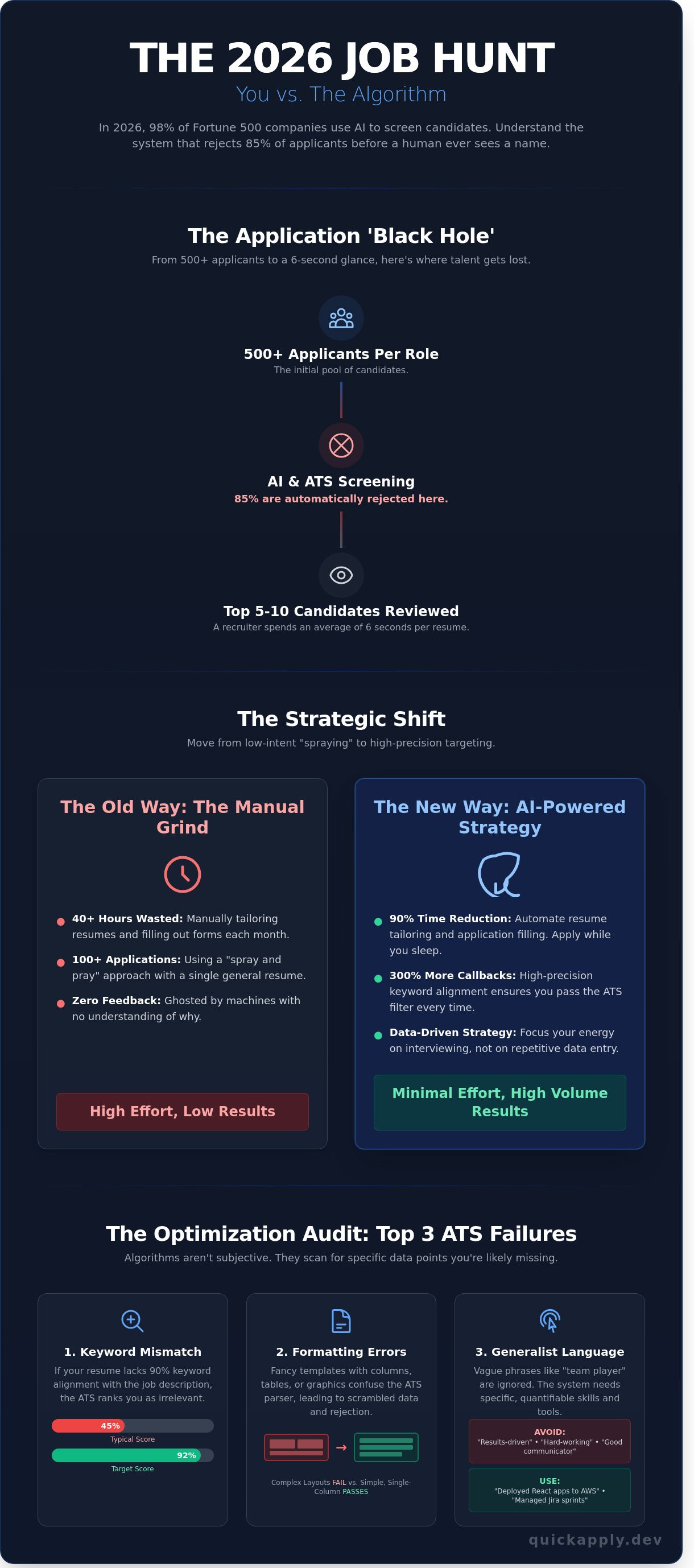
In 2026, 98% of Fortune 500 companies use AI-driven screening that rejects 85% of applicants before a human recruiter even sees a name. If you're constantly asking why am i not getting interviews, the answer is rarely your experience. It's the algorithm. You've likely spent over 40 hours this month tailoring resumes only to receive zero feedback. It's exhausting to send 100+ applications and hit an ATS wall that feels impossible to climb. You don't deserve to be ghosted by a machine.
We agree that the traditional job hunt is a legacy system that no longer works for modern professionals. This article will show you exactly how to identify the technical flaws in your strategy. Learn to use AI to flip the script and beat the numbers game. We promise to help you increase your interview callback rates by 300% while slashing your application time by 90%. Move from manual labor to high-speed optimization. Here's the data-driven reality of the 2026 market and the blueprint for how you can start applying while you sleep.
Key Takeaways
- Stop guessing why applications vanish and master the ATS "parse-ability" factor to bypass the 75% automated rejection rate.
- Transition from a low-intent "spray and pray" approach to high-precision target-hunting to finally answer the question, "why am i not getting interviews?"
- Audit your resume using quantifiable impact statements and strict keyword alignment to force algorithms to rank you higher.
- Leverage AI-powered automation to handle the heavy lifting of tailoring applications so you can apply while you sleep.
- Adopt a developer mindset to scale your job search, achieving high-volume results with minimal manual effort.
The 2026 Job Market: Why Your Applications Disappear into the 'Black Hole'
Stop checking your inbox every ten minutes. The silence isn't a reflection of your talent; it's a symptom of a broken, automated system. In the 2026 tech climate, the "no-response" cycle has become a psychological grind for even the most skilled developers. You’re likely asking yourself, "why am i not getting interviews" after hitting 'apply' on dozens of roles. The reality is stark. Industry data confirms that 75% of resumes are discarded by an Applicant Tracking System (ATS) before a human recruiter ever sees them. This is the "Black Hole," a digital graveyard where high-quality talent goes to die because it didn't meet a specific algorithmic threshold.
Hiring in 2026 revolves around the Volume vs. Precision paradox. In 2020, career coaches told you to "spray and pray" by sending out as many resumes as possible. That advice is now obsolete. Today, high-volume, low-quality applications trigger spam filters and damage your candidate reputation. If your resume lacks 90% keyword alignment with the job description, you're effectively invisible. Efficiency isn't just about speed anymore; it's about surgical optimization. You need to beat the machine at its own game.
The Rise of Algorithmic Gatekeeping
Companies now face 500+ applicants for every single open role. They don't hire more recruiters to handle the load; they deploy more AI. These bots don't look for "potential" or "culture fit." They look for data matches. "Good enough" resumes are binned instantly to save human time. This shift from human intuition to data-driven candidate ranking means your resume is a data packet, not a life story. If your data isn't structured for the bot, you're out before the game even starts.
- AI Filtering: Modern systems use Natural Language Processing to rank candidates by relevance scores.
- Ranking Systems: If you aren't in the top 5% of the algorithmic stack, a human will never read your name.
- Data Over Intuition: Recruiters now spend 6 seconds reviewing the top 10 candidates the AI selected, ignoring the rest.
The Myth of the Perfect General Resume
Using one master resume for every application is your biggest strategic liability. Generalist language is a massive red flag for 2026 filters. When you try to appeal to everyone, the algorithm decides you're a fit for no one. This lack of specificity is a primary reason why am i not getting interviews in a market that demands specialists. In a hyper-specialized economy, a broad skillset suggests you are a master of none rather than a solution for one. You must automate the customization process to remain competitive without burning out.
The Invisible Barrier: How ATS Algorithms Scan You Out
Stop asking "why am i not getting interviews" and start looking at the software standing in your way. An Applicant Tracking System (ATS) is a database that ranks your resume before a human ever sees it. In 2024, over 98% of Fortune 500 companies use tech stacks like Greenhouse, Lever, or Workday to filter thousands of applications. These systems aren't reading your story; they're calculating a "Match Score" based on keyword density and formatting.
Recruiters set specific filters to handle the volume. If the algorithm detects a match percentage below 80%, your application is buried in the digital basement. This isn't a reflection of your talent. It's a lack of data compatibility. To reach a human recruiter, you have to beat the resume robots by speaking their language. High-volume hiring relies on these gatekeepers to reduce 250+ applications down to a shortlist of 10 candidates in seconds.
Keyword Optimization: Beyond Just Buzzwords
Hard skills are your currency. If a job description mentions Docker, Jira, or AWS three times, the ATS expects to see those exact strings in your file. Missing one required tool can trigger an immediate "auto-reject" status. You must identify "hidden" keywords by looking at the specific verbs and environment requirements in the listing. Don't just list skills; provide context. The system values "deployed React apps to AWS" more than a static list of technologies. If you're tired of manual tweaking, you can automate your application strategy to ensure your profile always hits the mark.
Formatting Fails That Break the System
Fancy Canva templates are your biggest enemy. These multi-column layouts and non-standard fonts often break the "Parse-ability" factor. When an ATS scans a two-column resume, it often reads across the entire page. This merges your experience with your contact info into a garbled mess. Key details hidden in headers, footers, or images are invisible to the parser. If the AI can't read it, you don't exist.
To verify your resume, use the "Plain Text" test. Copy your entire resume and paste it into a basic Notepad file. If the text is scrambled or missing data, the AI has already discarded you. Stick to standard layouts and professional fonts. This ensures every word is indexed correctly. Your goal is a seamless data transfer, not a design award. Clear headers and standard bullet points are the only way to ensure the machine understands your career trajectory.
Strategy Check: Are You Spraying and Praying or Target-Hunting?
Stop treating your job search like a lottery. If you send 50 identical resumes daily and hope for a callback, you are "Spraying and Praying." This high-volume, low-intent strategy is the primary reason you are asking yourself, "why am i not getting interviews" in a competitive market. Recruiters can spot a generic application in less than six seconds. It signals a lack of effort and a lack of fit.
Contrast this with "Target-Hunting." This approach focuses on high-precision applications built for specific roles. Data from 2024 hiring trends shows that five deeply tailored applications generate more interviews than 50 generic ones. However, manual tailoring is slow. The modern solution is "Precision Scalability." This means using AI to automate the customization process, allowing you to maintain the quality of a hunter with the volume of a machine. You don't have to choose between quality and quantity anymore.
The Danger of Low Match Scores
Applicant Tracking Systems (ATS) are the gatekeepers. Most recruiters set their software to filter out anyone with less than a 90% match score. If your resume only hits a 70% match, you stay invisible. In high-volume roles that receive over 250 applications, a 70% score is a guaranteed rejection. Use data to decide where to spend your energy. If you cannot reach that 90% threshold through honest optimization, that job is not worth your time. Focus your resources on roles where your background aligns with at least 85% of the core requirements to ensure you actually land on a human's desk.
The Time-to-Apply Metric
Speed is a competitive advantage. Statistics from LinkedIn indicate that being among the first 25 applicants increases your interview chances by 40%. The traditional trade-off was speed versus depth. You could apply fast with a bad resume, or apply late with a great one. That trade-off is now obsolete. You must learn how to tailor your resume to a job description in seconds using AI-powered tools.
- Monitor new postings: Set alerts for roles posted in the last 24 hours.
- Automate the bridge: Use software to map your skills to the JD instantly.
- Submit immediately: Aim to apply within the first 2 hours of a listing going live.
When you combine high match scores with rapid submission, you stop wondering "why am i not getting interviews" and start managing a calendar full of them. Efficiency isn't just about doing things faster; it's about using the right leverage to beat the numbers game.
The Optimization Audit: 5 Reasons Your Resume is Failing the Test
If you keep asking yourself, "why am i not getting interviews," the answer is likely hiding in your data. Your resume isn't a biography. It's a technical specification document designed to clear an automated gatekeeper. If your document hasn't been audited for 2026 standards, it's getting filtered out before a human even sees it. Stop guessing and start auditing.
- Step 1: Check Keyword Alignment. Compare your resume directly to the job description. If you don't share an 85% overlap in core competencies, the ATS will score you as a low-match candidate.
- Step 2: Audit Impact Statements. Replace every passive verb with a hard metric. Numbers prove competence. Adjectives are just noise.
- Step 3: Verify Tech Stack Formatting. Parsers struggle with complex graphics, columns, or tables. List your tech stack in a clean, comma-separated format to ensure 100% readability for the machine.
- Step 4: Kill the Generic Cover Letter. A template is a signal that you don't care. Tailor your intent to the company's 12-month roadmap or recent funding round.
- Step 5: Use AI Match-Scoring. Run your resume through a simulator to see exactly how a machine ranks your profile against the role.
Quantifying Your Impact
Phrases like "responsible for" or "familiar with" are weak signals. They describe a task, not a result. In a market where 92% of applicants meet the basic requirements, results are your only differentiator. Shift your focus from what you did to what happened because you were there. Use the X-Y-Z formula: Accomplished [X] as measured by [Y], by doing [Z].
Impact Transformation:
- Before: Responsible for managing the company's cloud infrastructure and fixing bugs.
- After: Optimized AWS cloud architecture to reduce monthly spend by 14%, while maintaining 99.99% uptime during peak traffic periods in Q3.
The Cover Letter Problem
Think cover letters are dead? They aren't. In 2026, recruiters use AI to scan these documents for culture fit and long-term intent. A generic "Dear Hiring Manager" letter tells a recruiter you're mass-applying without a strategy. This is a primary reason for the "why am i not getting interviews" frustration. You need a letter that speaks to the specific pain points of the engineering lead. Use the best AI cover letter builders to generate high-intent, tailored letters in seconds. Efficiency is the only way to win this volume game.
Stop wasting time on manual fixes that don't move the needle. You need a system that handles the heavy lifting of optimization so you can focus on the interview itself. Automate your application strategy with QuickApply and start seeing the data-driven results your career deserves.
Automate the Grind: How to Apply While You Sleep
Stop treating your job search like a manual labor gig. If you are asking yourself, "why am i not getting interviews," the answer often lies in your output volume and precision. The modern market moves at a relentless pace. You cannot keep up using manual Word documents and copy-pasted cover letters. QuickApply flips the script. We treat job seeking as an optimization problem rather than a test of endurance. Automation is the ultimate career hack. It lets you focus on high-value tasks like networking and interview prep while the software handles the repetitive data entry. You deserve to spend your energy on the conversation, not the paperwork.
Applying to 10 tailored roles in the time it takes your competition to finish one gives you a 900% mathematical advantage. This isn't just about speed; it's about technical accuracy. AI doesn't get tired at 11 PM. It doesn't miss critical keywords. It ensures every application is a perfect strike. By the time you wake up, you could have a dozen high-quality applications already sitting in recruiter inboxes. This shift moves you from a desperate job seeker to a sophisticated career optimizer.
QuickApply: Your AI Secret Weapon
Our AI Resume Tailor analyzes job descriptions in milliseconds. It identifies the exact skills recruiters want and adjusts your profile to match. Most applicants are ignored because they don't hit the 80% match threshold required by modern ATS filters. Our Match Score feature shows you exactly where you stand before you hit submit. You will never have to guess "why am i not getting interviews" when you can see your compatibility score in real time. Once you're in the pipeline, the Application Tracker eliminates ghosting anxiety. You see every status update in one centralized dashboard. When the recruiter calls, use our Interview Practice tool to run AI-driven simulations. We provide the data and the training you need to close the deal instantly.
Taking Immediate Action
The 1-Hour Challenge starts now. Optimize your top 3 applications today using our platform. Waiting for the "right time" is a losing strategy in a fast-moving market. When 250 people apply for a single role within the first 48 hours, speed is your greatest asset. Professionals who use automation see a 3x increase in interview requests within the first 14 days of switching. Stop being a passive participant in your own career. Become a career optimizer who uses technology to win. The system is rigged toward the efficient. Be the person who masters the system rather than the one who gets crushed by it.
Stop Fighting the 2026 Algorithm and Start Winning
The 2026 job market doesn't reward manual effort; it rewards optimization. If you're still wondering why am i not getting interviews, the data provides a cold reality check. Recent hiring reports show that 98% of tech firms now use neural-net ATS filters to screen candidates. Without a 90% match score, your resume hits the digital black hole instantly. You can't out-hustle an algorithm by hand, and you shouldn't have to. You need a system that works as fast as the recruiters do.
Stop wasting 40 hours a week on manual entries. High-performance candidates are already using AI-powered match scoring to ensure their profiles hit the top of the pile every time. Real-time data proves that automated application tracking increases your reach by 5x while maintaining surgical precision. It's time to flip the script and let technology handle the grind while you focus on the actual work.
Optimize your job search and start getting interviews with QuickApply. Our platform offers instant resume tailoring for tech roles to make sure you're never invisible again. The system is rigged, so it's time you used the right tools to beat it. You've got the talent; now go get the visibility you deserve.
Frequently Asked Questions
Why am I getting rejected immediately after applying?
Immediate rejection usually means you failed the initial ATS screen within 3 seconds of submission. Over 75% of resumes are filtered out by automated systems before a human recruiter ever sees them. Your document likely lacks the specific hard skills or job titles required by the algorithm. Use an AI-powered scanner to ensure your keywords match the job description exactly. This ensures your profile survives the first 10 seconds of digital scrutiny.
How many jobs should I apply for each day in 2026?
Target 15 to 20 applications daily to maintain a competitive edge in the 2026 job market. Data shows that candidates who submit 100 applications per week are 3 times more likely to land an interview within 30 days. Automation is the only way to hit these numbers without burning out. Stop manual entry and start using tools that optimize your output for speed and high-volume success.
Does the ATS actually read my cover letter?
Yes, roughly 63% of modern ATS platforms scan cover letters to calculate your overall relevance score. These systems look for specific industry terminology and technical skills that mirror the job posting. Don't skip this step; an unoptimized cover letter can lower your total match percentage. Treat every document as a data point that needs optimization for the algorithm to ensure you aren't hidden from recruiters.
Is it okay to use AI to write my resume and cover letters?
It's more than okay; it's a necessity for professionals who want to win the numbers game. Recent 2025 surveys indicate 45% of recruiters prefer AI-assisted resumes because they're often clearer and better structured. If you're wondering why am i not getting interviews, it might be because your manual writing isn't hitting the 85% keyword density threshold required by modern software. Use technology to gain an advantage.
Why do I have the right skills but still get no interviews?
You're likely facing a formatting wall where 43% of qualified candidates are rejected due to non-standard layouts. If the ATS can't parse your data, your skills don't exist in the system. Stop using complex graphics or multi-column designs that break the software. This technical gap is a primary reason why am i not getting interviews despite having 5 or more years of relevant experience in your field.
What is a good match score for a job application?
Aim for a match score of 80% or higher to ensure you move to the top of the recruiter's pile. Most enterprise-level ATS platforms automatically archive any candidate with a score below 70%. You can increase this number by mapping your bullet points to the specific requirements listed in the first 5 lines of the job description. High scores lead to human eyes and faster interview invites.
How do I know if my resume is ATS-friendly?
Test your resume by copying all the text into a plain .txt file to see if the information remains organized. If the dates, titles, and company names become a jumbled mess, the ATS won't be able to read it either. Stick to standard fonts and clear H1 headings. Remember that 98% of Fortune 500 companies use these systems to filter their massive applicant pools every single day.
Should I follow up with a recruiter if I haven’t heard back?
Send a polite follow-up message exactly 5 business days after you submit your application. Statistics show that 31% of recruiters view a single follow-up as a sign of high intent and professional persistence. Keep the message under 50 words and focus on a specific value you bring to the team. Don't wait longer than 7 days, as the hiring cycle for modern roles moves incredibly fast.


