
Your ten-page CV is a liability, not an asset. In the high-speed tech market of 2026, a deep list of publications is just noise to an automated recruiter system. You've spent years mastering a niche, yet you likely feel overqualified for entry-level roles and under-experienced for the positions you actually want. It's a common trap where academic jargon blocks your path to a tech interview. You shouldn't have to spend hours manually rewriting every bullet point just to get a rejection email from a bot.
We're here to fix that. This guide teaches you to master the resume for academic transitioning to industry by treating your career pivot like a data optimization problem. You'll learn how to compress a decade of research into a high-impact, two-page document that triggers a high Match Score on every job description. We're moving past the translation phase and into the optimization phase. This guide previews the technical shift from CV to resume, the strategy for beating modern ATS filters, and the scalable system you need to land interviews without the manual grind.
Key Takeaways
- Ditch the exhaustive CV for a curated, high-impact resume designed to survive the 6-second recruiter scan.
- Master the resume for academic transitioning to industry by converting research jargon into measurable business outcomes using the Outcome-Action-Context formula.
- Bypass ATS gatekeepers by focusing on keyword density and technical Match Scores rather than academic prestige.
- Automate your job search with high-volume AI tailoring that replaces hours of manual editing with seconds of optimization.
- Deploy a 30-day roadmap to audit your background, identify industry archetypes, and scale your applications through an automated tracker.
CV vs. Resume: Decoding the Structural Shift
Your academic CV is a record of your past. An industry resume is a forecast of your future value. Transitioning means moving from an exhaustive list of every achievement to a curated highlight reel of relevant results. If you hand a recruiter a five-page document, they won't find your talent; they'll find the exit. In the corporate world, your history is only useful if it proves you can solve tomorrow's problems.
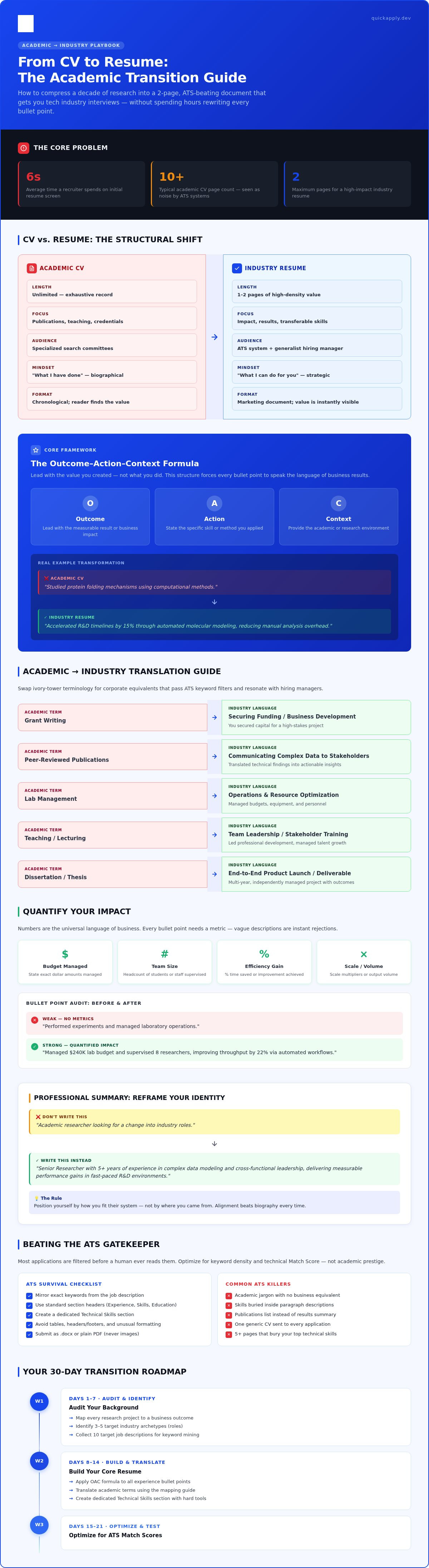
Recruiters spend an average of six seconds on an initial screen. They aren't looking for your publications or grant history. They're looking for proof of impact. When building a resume for academic transitioning to industry, length is a direct threat to your success. Every extra page dilutes your core message. You must shift your focus from "what I have done" to "what I can do for you."
The Core Differences
- Length: Academic CVs are unlimited and exhaustive. Industry resumes are strictly 1-2 pages of high-density value.
- Content Focus: CVs prioritize publications, teaching, and credentials. Resumes prioritize impact, results, and transferable skills.
- Target Audience: CVs speak to specialized search committees. Resumes must pass through an ATS and impress a generalist hiring manager.
Why Your Academic CV Fails the Industry Test
The "Curriculum Vitae" mindset is biographical. It's a chronological list of professional events that expects the reader to do the work of finding the value. Industry hiring managers don't have that time. The industry resume is a strategic marketing document rather than a comprehensive professional biography. When you include every minor presentation or teaching assistant role from a decade ago, you obscure your most marketable technical skills. You're effectively burying the lead.
Excessive detail creates friction. If a hiring manager has to hunt for your Python proficiency or project management experience amidst a sea of citations, they'll move to the next candidate. You need to frame your academic work as professional experience. Your lab research was a project. Your dissertation was a product launch. Your funding was a successful capital raise.
The professional summary is where you frame this pivot. Don't describe yourself as an "Academic looking for a change." Position yourself as a "Senior Researcher with 5+ years of experience in complex data modeling and cross-functional leadership." This immediately tells the recruiter how you fit into their system. It's about alignment, not just history.
Translating Academic Speak into Industry Results
Stop describing your work in syllables and start describing it in dollars. Your academic background is a goldmine of data analysis and cross-functional collaboration. The problem is your vocabulary. A resume for academic transitioning to industry fails when it reads like a syllabus. Industry recruiters don't care about your methodology; they care about your results. You need to stop being a researcher and start being a problem solver.
The most effective way to bridge this gap is the Outcome-Action-Context formula. This structure forces you to lead with the value you created. Instead of saying you "studied protein folding," you "accelerated R&D timelines by 15% through automated molecular modeling." This shift reframes your academic history as a series of successful business projects. It moves the needle from "what I did" to "how I won."
The Academic-to-Industry Translation Guide
Translation is about mapping your skills to the language of your target market. If you want to survive the initial screen, you must swap ivory tower terms for corporate equivalents. Use this mapping to overhaul your experience section:
- Grant Writing: Securing Funding or Business Development. You didn't just write a proposal; you secured capital for a high-stakes project.
- Peer-Reviewed Publications: Communicating Complex Data to Stakeholders. You translated technical findings into actionable insights for expert audiences.
- Lab Management: Operations and Resource Optimization. You managed budgets, equipment, and personnel to ensure peak efficiency.
- Teaching: Team Leadership or Stakeholder Training. You didn't just lecture; you led professional development and managed talent growth.
Quantifying Your Impact
Numbers are the universal language of business. In academia, precision lives in the footnotes. In industry, precision lives in the bullet point. Vague descriptions like "performed experiments" are useless. You need metrics. If you managed a budget, state the dollar amount. If you supervised students, state the headcount. If you optimized a process, state the percentage of time saved.
Your technical skills section must also evolve. Don't hide your tools inside a paragraph about your dissertation. Create a dedicated section for hard skills like Python, SQL, or AWS. Recruiters and ATS bots scan for these specific strings first. If you're struggling to find the right industry keywords, using an automated tool for resume tailoring can identify the exact technical gaps in your current draft. Focus on the tools that deliver the work, not just the theories behind them.
Technical Optimization: Beating the ATS
Most academics assume their credentials speak for themselves. They don't. To an Applicant Tracking System (ATS), your resume is just a text file to be parsed. If the bot cannot extract your data, you don't exist. Mastering the resume for academic transitioning to industry requires you to stop designing for human eyes and start designing for algorithms. Prestige doesn't trigger a match; data does.
Keyword density is the primary ranking factor. Having a "PhD" on your resume is often a baseline requirement, not a differentiator. ATS algorithms look for specific technical strings that mirror the job description. If a role requires "Agile Project Management" and you wrote "coordinated research cycles," you will fail the screen. You must integrate the exact terminology used by the target industry to signal your relevance to the system.
The hybrid resume format is the superior choice for this pivot. It combines a functional skills section with a reverse-chronological work history. This structure allows you to lead with your technical value while providing the necessary context of your academic career. It bridges the gap between your deep research background and the immediate needs of a corporate team.
The ATS-Ready Checklist
Clean data is the goal. Complex LaTeX templates or multi-column layouts often break parsers, resulting in a garbled profile that recruiters will ignore. Follow these technical rules:
- Standard Fonts: Use Arial, Calibri, or Helvetica. Avoid decorative fonts that confuse OCR software.
- Simple Layout: Stick to a single-column format. Avoid using headers, footers, or tables to store critical contact info or skills.
- Standard Headings: Use "Experience" instead of "Professional History" or "Chronology." Systems are programmed to recognize specific labels.
- Natural Integration: Don't just stuff keywords in a hidden list. Use them within your bullet points to provide context and proof of application.
Handling Publications and Presentations
A ten-page publication list is an instant rejection in the tech world. It signals that you don't understand industry norms. Use a "Selected Publications" section and only list the three most relevant papers that demonstrate your industry-specific expertise. For the rest of your work, include a single link to your Google Scholar profile or a digital portfolio. This saves valuable real estate and keeps the focus on your impact. You can optimize your resume with AI precision to ensure your selected highlights align perfectly with the technical requirements of the role.
Scaling the Search: Why Manual Tailoring is Obsolete
Manual tailoring is a legacy process that belongs in the library, not the tech market. In 2026, the volume of high-quality applicants is staggering. If you spend three hours perfecting a single resume for academic transitioning to industry, you've already lost. Your competitors are applying to 50 roles in the same timeframe using automated systems. You aren't just fighting for attention; you're fighting against a statistical disadvantage that manual work cannot overcome.
Modern efficiency relies on the "Match Score." This is a data-driven percentage that tells you exactly how well your profile aligns with a specific job description. AI tools analyze the semantic overlap between your academic history and industry requirements. This eliminates the guesswork. Instead of wondering if your "computational modeling" translates to "predictive analytics," the system identifies the connection and adjusts your phrasing instantly. Using a generic resume is a tactical failure. It signals a lack of specialization and ensures your file stays at the bottom of the stack.
From Lab Speed to Tech Speed
Research moves at lab speed. Your job search must move at tech speed. Staring at a blank document trying to reword your dissertation summary is a waste of your intellectual capital. AI can generate targeted bullet points that highlight your technical impact in seconds. This allows you to scale your search without sacrificing quality. Check out the 6 best AI resume builders of 2026 to see how automation is replacing the traditional writing process.
Maintaining Authenticity While Automating
Automation is your engine, but you are the pilot. You must fact-check AI-generated content to ensure it accurately reflects your actual research and technical capabilities. The system provides the structure and the keywords, but you provide the truth. Focus your energy on customizing the final 10% of your resume for high-value roles where you have a genuine interest. This hybrid approach ensures you remain authentic while maintaining a high output. For a deeper dive into these technical mechanics, read our guide on beating the ATS.
Stop fighting the system and start using it to your advantage. You can automate your resume tailoring now to secure your competitive edge in the 2026 market.
Executing the Transition: Your 30-Day Roadmap
A career pivot is a project. Like any technical project, it requires a timeline, a stack, and a deployment strategy. You don't need months of soul-searching; you need 30 days of high-intensity execution. By following a structured roadmap, you turn the daunting task of building a resume for academic transitioning to industry into a series of manageable sprints. Stop waiting for the perfect moment and start building your pipeline. Speed is your competitive advantage.
Week 1: The Audit. Stop viewing your career as a list of papers. Identify five industry archetypes where your skills provide immediate value. Common pivots include Data Scientist, Product Manager, or R&D Lead. Map your technical competencies to these specific roles to define your target market. This clarity prevents you from wasting time on misaligned opportunities.
Week 2: Infrastructure Setup. Create your master resume. This document contains every possible bullet point and metric you've ever achieved. Simultaneously, configure your Application Tracker. You need a centralized dashboard to monitor your progress and maintain momentum. Efficiency starts with organization. A spreadsheet is a manual burden; an automated tracker is a force multiplier.
Week 3: Deployment. This is the high-volume phase. Use AI-driven Resume Tailoring to generate versions for multiple roles each week. Don't overthink every application. Let the software handle the keyword alignment while you focus on identifying the highest-value opportunities. Volume creates data, and data leads to interviews.
Week 4: The Narrative. Shift your focus to the final stage of the funnel. Refine your "Academic-to-Industry" story. When asked why you're leaving the lab, focus on your desire for faster feedback loops and commercial impact. Practice delivering this narrative with the same precision you used for your dissertation defense. You aren't escaping academia; you're graduating into a new system.
Managing the Pipeline
Success in a competitive market is a function of volume and tracking. Use an Application Tracker to monitor status, deadlines, and follow-up dates. Set daily application targets to ensure you don't stall. Momentum is your greatest asset during a pivot. For a deeper look at optimizing your workflow, see our guide on mastering the job application process.
The Next Level: Interview Readiness
The resume gets you the meeting; the narrative gets you the offer. You must be able to translate your research into a business case. Address the "Why are you leaving academia?" question by highlighting the transferability of your expertise to the company's specific challenges. Use our Interview Practice tool to simulate industry-specific questions and refine your delivery. You've mastered complex systems before. The corporate world is just another system to optimize.
Deploy Your Industry Value Now
Transitioning to a corporate role is a technical upgrade for your career. You've learned that a resume for academic transitioning to industry must function as a high-impact marketing document, not a biography. By mapping your research to R&D outcomes and optimizing for ATS algorithms, you remove the friction between your expertise and a recruiter's needs. Manual tailoring is a legacy method that wastes your intellectual capital. You now have the roadmap to execute this pivot in 30 days with precision and speed.
Stop translating and start tailoring. Use QuickApply to turn your CV into an industry-ready resume in seconds. Our AI Match Scores ensure your resume hits 90%+ of required keywords, allowing you to tailor unlimited versions for different industry roles. Track every application in one centralized dashboard to maintain peak efficiency and stay ahead of the curve.
The tech market moves fast, but your strategy can move faster. Your academic depth is a massive asset once it's formatted for industry speed. Take control of your transition and start landing the interviews you deserve.
Frequently Asked Questions
How long should a resume be for an academic transitioning to industry?
Your resume should be strictly one to two pages. Industry recruiters spend an average of six seconds on an initial scan, so brevity is essential for a resume for academic transitioning to industry. Unlike an academic CV that grows with every achievement, an industry document is a curated highlight reel. If you cannot fit your value on two pages, you're including irrelevant data that dilutes your core impact.
Should I include my full list of publications on an industry resume?
Do not include your full publication list. Instead, create a "Selected Publications" section featuring two or three papers that demonstrate technical skills relevant to the job description. For everything else, provide a single link to your Google Scholar profile or a digital portfolio. This approach satisfies the need for proof of expertise without cluttering the document or distracting the reader from your marketable results and impact.
How do I explain a gap in my employment if I was only doing research?
Research is professional experience, not a gap in employment. Frame your time in the lab as a job by using titles like "Senior Researcher" or "Project Lead." Describe your dissertation or postdoc work as a series of projects with specific deliverables, budgets, and stakeholders. If you lead with the technical outcomes you produced, the recruiter will see a continuous career of high-level problem solving rather than isolation.
Is a PhD a disadvantage for entry-level industry roles?
A PhD is only a disadvantage if you fail to translate its value into business terms. For entry-level roles, some hiring managers worry about "overqualification" or a lack of practical speed. You must counter this by emphasizing your ability to deliver results quickly and work within team structures. Position your advanced degree as proof of your ability to master complex systems and solve high-stakes technical problems others cannot.
What is the best resume format for a postdoc moving to tech?
The hybrid resume format is the most effective choice for a postdoc moving to tech. This structure leads with a robust technical skills section and a professional summary, followed by a reverse-chronological experience section. It allows you to showcase your specific tools like Python or SQL immediately while providing the necessary context of your research career. This balance ensures you pass through ATS filters while still telling a coherent professional story.
How do I handle the 'lack of industry experience' objection in an interview?
Address the "lack of industry experience" by reframing your academic work as project management and product development. When building a resume for academic transitioning to industry, highlight your experience managing budgets, leading cross-functional teams, and meeting strict deadlines. Explain that while the environment was academic, the skills required to execute high-level research are identical to those needed to drive innovation in a corporate setting. Focus on your capabilities.
Can I use AI to help rewrite my academic CV into a resume?
Using AI is the most efficient method for converting an academic CV into an industry resume. Automation tools can identify the semantic overlap between your research and a specific job description in seconds. This eliminates the manual grind of guessing which keywords will trigger a match. By leveraging AI-driven tailoring, you ensure your document is optimized for modern ATS rankings while maintaining the technical accuracy of your professional background.
Do I need a cover letter if I am transitioning from academia?
You should always include a cover letter when transitioning from academia. Use this space to connect the dots between your research expertise and the company's specific business challenges. While your resume provides the data, the cover letter provides the narrative. It's your opportunity to explain why your unique perspective as a researcher makes you a high-value asset who can solve problems that traditional industry candidates might miss.


