

Hiring a professional human writer in 2026 is a legacy move that costs you more than just money. It costs you the speed required to survive this hyper-competitive market. The traditional debate of an ai resume builder vs human writer is officially obsolete. You're likely exhausted from spending hours on a single application just to receive an automated rejection. It's frustrating to watch your interview conversion rates stall while manual services demand massive fees for a document that's static by the time you hit send.
You don't need a human to tell your story anymore. You need a system that outpaces the competition. Discover why dynamic tailoring is the only way to win the 2026 tech job market and how to apply to more roles in less time without sacrificing quality. We'll analyze the latest callback statistics, debunk the "master resume" myth, and show you how to leverage Resume Tailoring and Cover Letter Generation to hit a 97% ATS pass rate. The era of manual effort is over. Efficiency is the only competitive advantage that matters.
Key Takeaways
- Stop using static documents and learn why 2026 recruiters instantly reject generic "master resumes" that lack precise job alignment.
- Discover why the ai resume builder vs human writer debate is dead, as manual 7-day turnarounds fail to meet the speed requirements of the modern tech market.
- Leverage real-time Match Scores to predict your success and prioritize applications that offer the highest probability of an interview.
- Scale your output with automated Resume Tailoring and Cover Letter Generation to apply to more roles in less time.
- Gain a competitive edge by bridging the gap between machine-speed execution and human-level strategy to land interviews at top-tier firms.
The 2026 Job Market: Why Your "Master Resume" is Obsolete
The "Master Resume" is dead. It's a legacy artifact from an era when you could blast one document to fifty companies and expect a callback. In 2026, that strategy is professional suicide. Recruiters don't read your resume first; their AI does. If your document hasn't been specifically engineered for the prompt, it gets purged before a human ever sees it. The fundamental choice between an ai resume builder vs human writer often comes down to how quickly you can achieve this precision.
Modern hiring systems have moved beyond simple keyword matching. They now prioritize "contextual relevance." This means the system analyzes the relationship between your skills and the specific challenges mentioned in the job description. Understanding The Purpose of a Resume requires a total shift in mindset. It's no longer a career summary. It's a high-precision data packet designed to trigger a specific algorithmic response. If your resume doesn't pivot for every single application, you aren't competing. You're just noise.
The Saturation Crisis in Tech Hiring
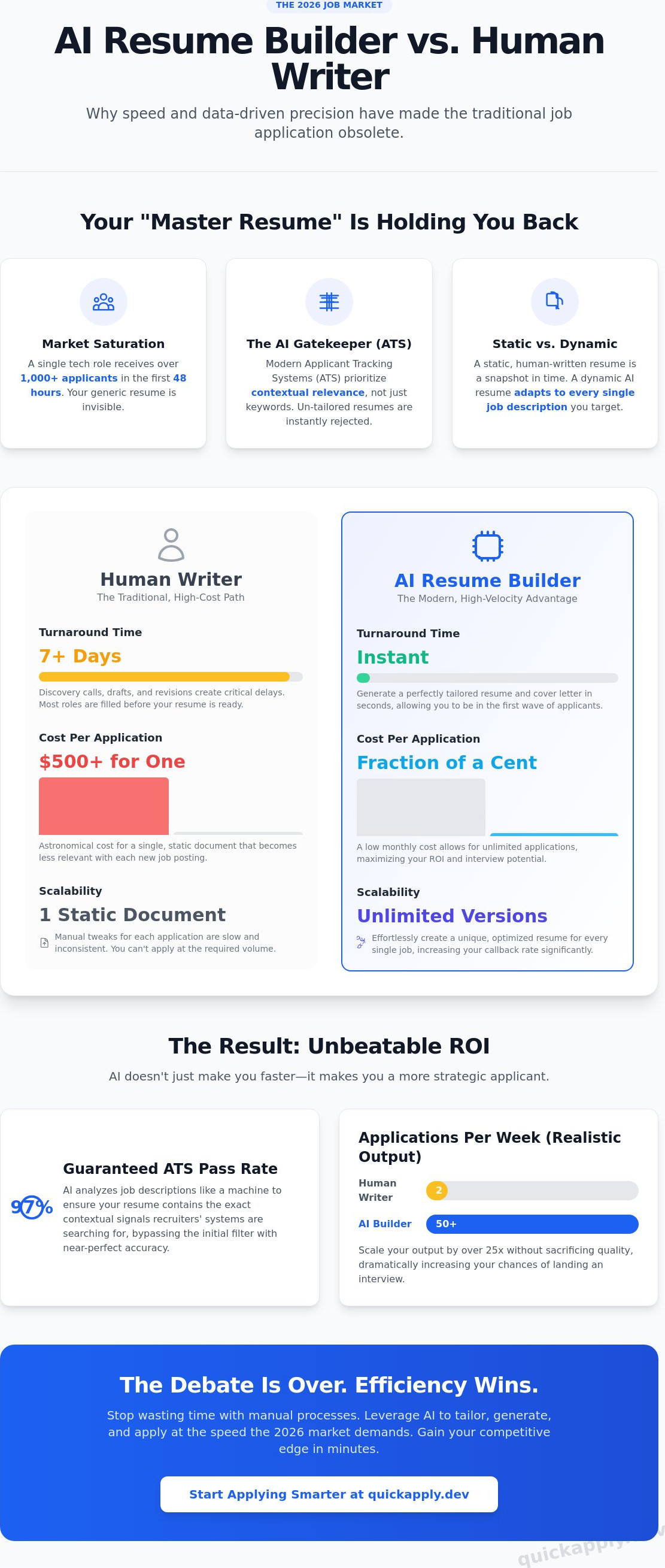
Mass-application tools have flooded the market. A single "Software Engineer" posting at a top-tier firm now attracts over 1,000 applicants in 48 hours. Recruiter bandwidth is non-existent. "Good enough" resumes are now invisible in this sea of data. To land an interview, you must overcome statistical challenges through high-volume output with low-effort input. You need 100% precision across 50 applications, not 80% precision on one. High-speed tailoring is the only way to bypass the initial filter and reach a human decision-maker.
Static vs. Dynamic Resume Strategy
Static resumes are human-made museum pieces. They're often well-written, but they're completely rigid. They fail to adapt to the nuanced requirements of modern job descriptions. By the time a human writer finishes your "perfect" draft, the job posting has already received 400 applications. You've already lost the lead.
Dynamic resumes are living documents. They evolve in real-time based on specific JD prompts. Learning how to tailor your resume to a job description is the new industry standard for high-performers. When comparing an ai resume builder vs human writer, the winner is determined by adaptability. AI builders analyze job descriptions to identify hidden requirements and reframe your experience instantly. This ensures your resume is always the "best fit" for the specific role, every single time you hit apply.
Human Resume Writers: The High-Cost, Low-Volume Luxury
Paying a professional human writer is like buying a tailored suit for a marathon. It looks impressive, but it restricts your movement. The traditional workflow is a bottleneck. You start with a discovery call. You wait three days for a first draft. You spend another two days on revisions. By the time you have a final product, the job market has moved on. The ai resume builder vs human writer debate often ignores this critical latency. In the 2026 tech sector, a 7-day turnaround is a death sentence for your candidacy. Most high-growth roles receive their target applicant pool within 96 hours. If you aren't in that first wave, you don't exist.
Consider the math. If you pay $500 for a single human-written resume, your cost-per-application is astronomical. This legacy model assumes you only need one version. But as we established, the "Master Resume" is obsolete. If you need to apply to 20 roles, you can't afford $500 for each. Even if the writer offers minor tweaks, they can't match the speed of a live job board. When weighing the merits of an ai resume builder vs human writer, you must factor in the cost of missed opportunities. Human writers excel at one thing: navigating complex, non-linear career pivots. If you're moving from professional opera singing to cloud architecture, you might need that manual touch. For everyone else, it's a strategic drain. You can get better guidance from career experts on how to automate this process instead.
The Storytelling Myth
Traditionalists argue that only humans can craft a compelling narrative. They're wrong. Modern Large Language Models (LLMs) analyze your career history against specific company values with surgical precision. They don't just write; they optimize for proof of impact. In technical screenings, a flowery story matters less than quantifiable results and tech stack alignment. Recruiters want to see how you solved a specific problem, not a poetic description of your passion for coding. If you want to see how machine logic outperforms manual drafting, you should scale your application volume with automated tools.
The Scalability Wall
Humans have a hard scalability limit. Editing a resume for 10 different roles takes a human writer hours of focused labor. Fatigue is inevitable. By the fifth version, the quality of bullet points drops. The phrasing becomes repetitive. AI doesn't get tired. It maintains 100% accuracy and optimization for the fiftieth application just as it did for the first. Human writers are a "one-and-done" solution. They give you a static document that fails the moment you need to pivot to a slightly different job description. In a multi-application world, relying on manual labor is a strategic error.
AI Resume Builders: Precision Tailoring at Machine Speed
The choice between an ai resume builder vs human writer is no longer about who writes better. It's about who has the best data. Human writers rely on intuition and past experience. AI builders rely on algorithms trained on millions of successful hiring outcomes. This shift empowers you to see what the ATS sees before the recruiter ever opens your file. You're no longer guessing if your experience aligns with the role. You're auditing your candidacy against the machine logic that governs modern hiring.
Specialized builders don't just scan for keywords; they decode the underlying intent of the job description. They surface the "hidden" requirements, those unspoken technical nuances that human recruiters expect but often fail to list explicitly. This level of insight is how you outclass the good resume examples currently circulating in the tech market. You aren't just following a template. You're deploying a targeted solution. Real-time Match Scores provide a pre-submission audit, giving you a statistical edge. A recent university study confirms that AI hiring tools favor AI-written resumes because they align more effectively with structured recruitment logic. When you use an ai resume builder vs human writer, you're choosing a tool designed to pass the very filters that reject manual efforts.
Beyond ChatGPT: Purpose-Built Career AI
Generic LLMs are for brainstorming. They aren't for high-stakes career moves. Serious candidates know why prompting isn’t a strategy in a market this tight. You need proprietary algorithms that speak fluent "DevOps," "Microservices," and "Full-Stack Deployment." Specialized builders understand tech context. They don't just hallucinate bullet points. They map your actual impact to the specific needs of the role. This is the difference between a generic summary and a high-conversion career asset. You gain the ability to pivot your messaging for 100+ versions without losing a shred of quality.
Real-Time Application Management
Efficiency requires more than a single document. High-volume success depends on an integrated Application Tracker. You need to manage 50+ versions without losing your mind. Purpose-built tools handle Resume Tailoring and Cover Letter Generation simultaneously. This ensures your narrative remains consistent across every touchpoint. You maintain a rock-solid personal brand while deploying machine-level speed. It's about dominating the funnel through automation. By linking your tracker to your tailoring tools, you create a seamless pipeline that moves as fast as the 2026 job market demands.
The ROI Showdown: Speed, Quality, and Conversion
Return on investment in a job search isn't just about the initial cost. It's about your "Time to Interview" metric. When you evaluate an ai resume builder vs human writer, you're choosing between a static asset and a scalable engine. A human-written document is a single shot in the dark. A subscription to a specialized AI tool is an endless supply of high-precision ammunition. You get the ability to pivot, test, and refine your approach in real-time based on the feedback you receive from the market.
The "Correction Loop" is where AI truly dominates. If a specific version of your resume isn't getting hits, you can tweak the parameters and regenerate it in seconds. With a human writer, every correction requires a new email thread and a long wait. Recruiters in 2026 don't care if you used a tool. They care about results. The "AI Detection" myth is a distraction. If your document solves their problem and passes the context-aware filters, you get the call. Efficiency is the only signal that matters in a high-volume environment.
Interviews per Hour: The Only Metric That Matters
Let's look at the output. A professional human writer might deliver one tailored resume per week. In that same timeframe, the best AI resume builders allow you to deploy 50 tailored versions. This isn't just about quantity; it's about maximizing your top-of-funnel opportunities. During a hiring surge, the speed of your response determines your place in the queue. Applying to more roles with high precision creates a compound interest effect. More applications lead to more data, which leads to better tailoring and more interviews.
The Quality Gap: Is AI "Good Enough"?
Critics claim AI lacks "soul." In 2026, soul doesn't get you past a context-aware ATS. Match Rate is the only definition of quality that impacts your bank account. A 95% match score resume generated by a machine will beat a "beautifully written" 60% match resume from a human writer every single time. The machine doesn't care about prose elegance; it cares about alignment. AI quality is the alignment between candidate data and employer pain points. If you're ready to stop guessing and start converting, it's time to automate your career growth with high-precision tools.
The QuickApply Strategy: AI Speed with Human Strategy
The 2026 showdown between an ai resume builder vs human writer is finally settled. It isn't about choosing one over the other. It's about using machine speed to power human strategy. You are the architect of your career. The AI is your high-speed execution engine. By utilizing a "Match Score," you can instantly decide which jobs deserve your attention. Don't waste hours on a low-probability application. Use the data to focus on high-yield opportunities where your skills align perfectly with employer pain points. This approach turns your job search into a data-driven operation rather than a game of chance.
This human-in-the-loop model ensures your final document remains authentic while meeting the statistical requirements of the ATS. You verify the output. The AI does the heavy lifting. This shift in workflow allows you to move from the tedious "Applying" phase to the high-stakes "Interviewing" phase in record time. Once you land the callback, switch to Interview Practice tools to refine your delivery and handle tough technical questions. You're no longer just a candidate. You're a high-efficiency professional managing a sophisticated talent pipeline with total precision.
Your Career Growth Tech Stack
A job search is just the first step in a long-term optimization plan. Your career growth tech stack should manage your entire professional trajectory. Beyond automated Resume Tailoring, you need tools that handle the nuances of the corporate ladder. Use a Promotion Roadmap to plan your next vertical move. Leverage a Salary Negotiation Guide to ensure your compensation reflects your true market value. By keeping your history in a centralized Application Tracker, you maintain a permanent record of your impact. This data-driven approach turns your career into a manageable system rather than a series of random events. You stay ahead of the curve by treating your professional life like a product that requires constant updates.
Getting Started: The 60-Second Tailoring Workflow
Winning the 2026 tech market requires a streamlined process. The 60-second tailoring workflow eliminates the friction of manual drafting. Upload your base profile. Paste the target job description. Tailor the content. Apply. To secure a 360-degree match, integrate an ai cover letter generator into your routine. This ensures your narrative is consistent across all documents, signaling high intent to recruiters. Stop wasting time on manual "museum pieces" that can't adapt to the market. It's time to stop building and start tailoring. Optimize your search with QuickApply today and claim your competitive advantage.
Dominate the 2026 Tech Market with Machine Precision
The verdict for the 2026 job market is clear. Speed and precision aren't optional; they're the baseline for survival. Relying on a manual process in a high-volume ecosystem is a strategic failure. The debate over an ai resume builder vs human writer ends when you realize that human speed can't compete with algorithmic optimization. You've learned that static documents fail context-aware filters and that your ROI depends on the number of high-quality applications you can deploy per week. Success requires a system that outpaces the competition at every stage of the funnel.
It's time to stop fighting the machine and start using it to win. You need a solution that offers 90%+ Match Scores for top tech firms and handles the logistics while you focus on the interview. By leveraging automated application tracking and 1-click tailored cover letters, you can scale your search without burning out. Efficiency is your only real competitive advantage in a crowded field. Apply to more tech roles in seconds with QuickApply. Your next career move is a data problem. Solve it with the right tools. Success is waiting at the top of the funnel.
Frequently Asked Questions
Can recruiters tell if I used an AI resume builder in 2026?
Recruiters prioritize results and technical alignment over the specific tool you used to draft your document. In a high-speed market, they look for proof of impact and a clear match for the role. If your resume accurately reflects your skills and is tailored to the job description, the method of production is irrelevant. Most top-tier candidates now use automation to stay ahead of the curve.
Will an AI-written resume get rejected by the ATS?
No, an AI-written resume is actually more likely to pass than a manual one. Modern Applicant Tracking Systems favor structured data and contextual relevance. When comparing an ai resume builder vs human writer, the AI has a distinct advantage. It uses clean formatting and precise terminology that machines can parse instantly, ensuring you hit the high match scores required for a callback.
How much does a professional human resume writer cost vs. an AI builder?
Human writers typically charge hundreds or even thousands of dollars for a single static draft. AI builders operate on a subscription model that costs a small fraction of that price. You get unlimited versions and real-time updates for a predictable monthly fee. This makes automation the more scalable and cost-effective investment for a high-volume job search in the tech sector.
Is it better to have one perfect resume or many tailored versions?
Tailoring is the only way to win in 2026. A "perfect" resume that isn't aligned with the specific job description will fail context-aware filters. You need to pivot your messaging for every application to maintain a competitive edge. Automation makes this high-volume customization possible without the fatigue and errors associated with manual editing.
Do AI resume builders work for senior-level tech roles?
Yes, they excel at mapping complex leadership metrics to specific JD requirements. Senior roles require a focus on strategic impact and tech stack mastery. Specialized builders analyze these high-level prompts to ensure your executive summary and bullet points reflect the seniority recruiters expect. It’s an efficient way to manage a sophisticated career history without losing the technical nuances.
Can I use an AI builder for career transitions into tech?
AI tools are highly effective at identifying and highlighting transferable skills. They scan your professional history and reframe your achievements to resonate with technical hiring managers. This allows you to bridge the gap between your previous industry and your new target role with machine-level precision. It’s the fastest way to translate non-tech experience into a tech-ready format.
How does QuickApply ensure my resume doesn’t sound robotic?
QuickApply focuses on quantifiable impact and technical context rather than generic adjectives. By prioritizing Resume Tailoring based on actual job descriptions, the output sounds like a professional who understands the specific role. You maintain final control by reviewing the draft to ensure it reflects your unique career milestones and professional voice. Efficiency doesn't have to mean a lack of personality.
Is it ethical to use AI to tailor my resume for every job?
It is completely ethical to optimize your professional presentation for the current market. Employers already use AI to screen and filter thousands of applicants. Using an ai resume builder vs human writer is simply a way to level the playing field. You’re ensuring your actual qualifications are visible to the systems designed to find the best fit for the role.


