

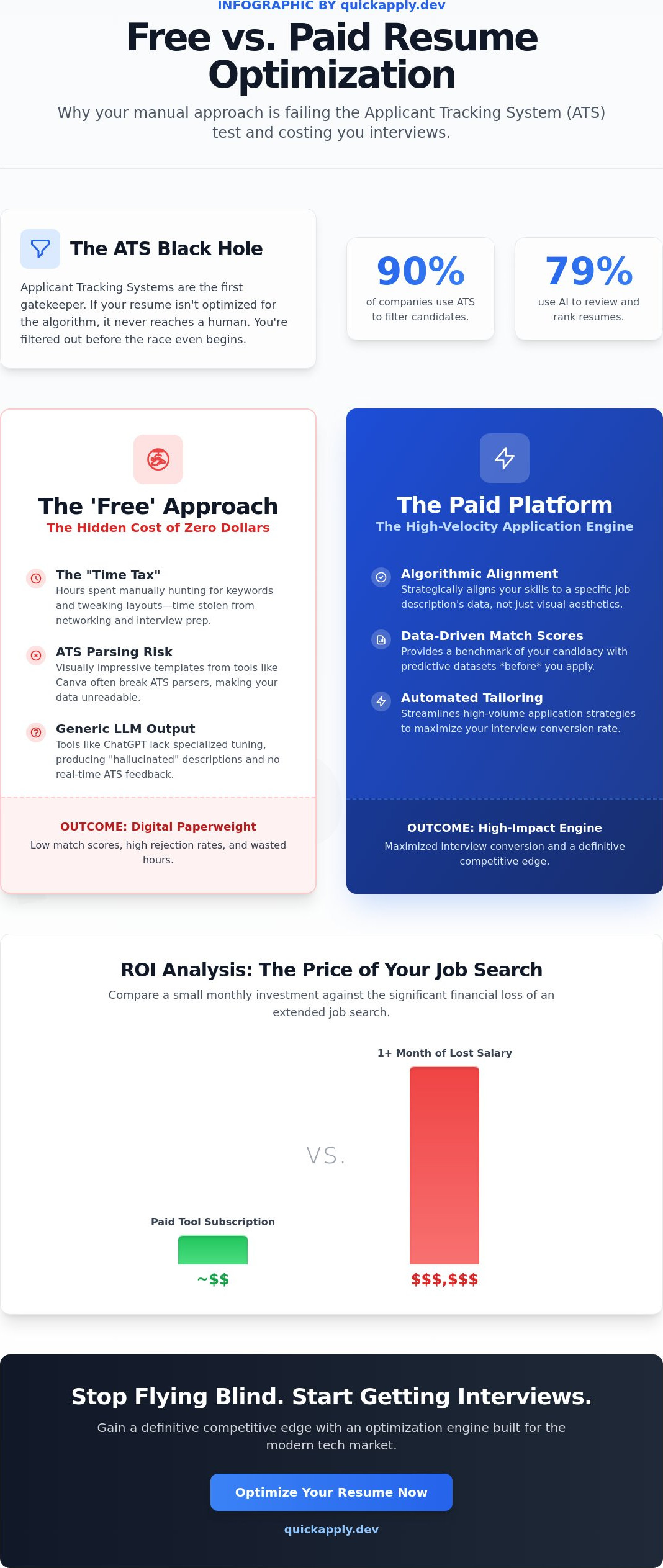
Your manual resume tailoring is a legacy process that is killing your conversion rate. In a market where up to 90 percent of companies use Applicant Tracking Systems to filter talent, sending a standard document is essentially opting for an automatic rejection. You are likely spending hours tweaking bullet points only to disappear into the ATS black hole. The debate over free vs paid resume optimization tools isn't just about saving a few dollars. It is about whether you want a digital paperweight or a high-velocity application engine that drives results.
We understand the frustration of a low interview-to-application ratio despite having the right stack. It is a systemic failure, not a skill gap. This guide promises to show you if a paid optimization engine is the missing link to your next high-paying tech role. We will break down the 2026 ROI of premium platforms, compare them against limited free tiers, and reveal how to gain a definitive competitive edge in a crowded market. Stop wasting time on manual edits and start optimizing for the algorithms that actually control the gate.
Key Takeaways
- Prioritize algorithmic alignment over visual aesthetics to ensure your data actually registers with modern ATS filters.
- Quantify the "time tax" of manual tailoring to evaluate the true ROI of free vs paid resume optimization tools.
- Use match scores and predictive datasets to benchmark your resume against specific job descriptions before you apply.
- Compare subscription costs against the significant financial loss of career stagnation or extended search timelines.
- Streamline your high-volume application strategy with automated tailoring to maximize your interview conversion rate.
The 2026 Job Search Paradox: Why Formatting Isn't Optimization
Most tech professionals think a clean layout is the finish line. It isn't. In 2026, true optimization is the strategic alignment of your technical stack to a specific job description. A "perfect" template is a liability if the underlying data doesn't trigger the right algorithmic responses. You are competing in an environment where 79 percent of companies use AI to review resumes. Sending a generic, static document into this ecosystem is a recipe for silence. The choice between free vs paid resume optimization tools determines whether you are submitting a digital flyer or a precision-engineered data packet.
Optimization is not about aesthetics. It is about mapping your skills to the specific semantic requirements of a role. While free tools often focus on visual templates, they frequently ignore the data structures that recruiters actually value. You need a dynamic strategy that evolves with every application. High-volume hiring now requires a level of tailoring that manual editing cannot achieve without significant error rates. You must move beyond the "one-size-fits-all" mindset to survive the initial automated sweep.
The Role of ATS in Modern Tech Hiring
Recruiter screens are no longer the first hurdle. Software does the heavy lifting long before a human enters the loop. An Applicant Tracking System (ATS) functions as a ranking engine that parses tech-specific keywords and experience hierarchies. It assigns a relevance score based on how well your profile matches the employer's ideal candidate profile. An ATS is a database management tool for high-volume recruitment. If your resume lacks the specific markers the system expects, you won't even appear in the search results. Paid platforms often provide the edge here by simulating these ranking algorithms to ensure your document sits at the top of the pile.
Why 'Good Enough' is the Enemy of 'Hired'
Settling for "good enough" is a career-ending move in a crowded market. Tech job boards are flooded with hundreds of applicants for every open role. Manual tailoring is slow and leads to "resume fatigue," where your quality drops as your frustration rises. This is a primary differentiator when evaluating free vs paid resume optimization tools. Premium tools introduce "Match Scores" as the primary metric for success. These scores give you a data-driven benchmark of your candidacy before you hit submit. A 2025 survey found that 66 percent of companies use AI for candidate assessments. If you aren't using similar technology to audit your own materials, you are essentially flying blind into a high-stakes dogfight.
Free Resume Optimization Tools: The Hidden Cost of 'Zero Dollars'
Don't mistake a zero dollar price tag for a bargain. In the high-stakes tech market, "free" is often a high-interest loan on your time. When you use baseline tools, you aren't saving money; you're paying a massive "Time Tax." Every hour spent manually hunting for keywords and dragging text boxes in a visual editor is an hour stolen from networking or interview prep. The choice between free vs paid resume optimization tools often comes down to how much you value your own hourly rate. If your target salary is six figures, spending ten hours a week on manual tailoring is an expensive hobby you can't afford.
Visual-heavy builders like Canva create a specific parsing risk. While they look impressive to the human eye, their multi-column layouts and graphic elements frequently break legacy ATS parsers. If the system can't read your data, you don't exist. You risk being rejected not because you lack the skills, but because your "free" template was a technical failure. Relying on these tools forces you into a cycle of manual labor that rarely yields the match scores required for top-tier roles.
The Limitations of Generic LLMs (ChatGPT/Claude)
Standard LLMs are generalists, not career experts. Without specialized tuning, generic prompts often produce "hallucinated" descriptions or overly flowery language that triggers recruiter red flags. These interfaces lack real-time ATS feedback, leaving you to guess if your prompt actually improved your ranking. For a deeper dive into why simple prompting fails, check out this ChatGPT resume myth-busting article. Generic AI doesn't understand the specific 2026 scoring logic that separates a lead engineer from a junior developer.
Platform-Locked Builders (Indeed/LinkedIn)
Builders hosted on major job boards prioritize the platform's database over your individual career goals. These tools are designed to make candidates easily searchable for the platform's paying clients, which often results in a "genericism trap." You end up looking identical to every other applicant in the recruiter's dashboard. These resumes also lack portability. Exporting them for external applications often results in broken formatting or stripped metadata. To break out of this cycle, you need a solution that prioritizes your visibility across the entire web. You can automate your resume tailoring to ensure you stand out without the platform-locked limitations. Professional results require professional infrastructure, not a generic template that treats you like a row in a spreadsheet.
Paid Optimization Platforms: Comparing Features that Actually Matter
Building a document is a solved problem. Optimizing it for a ranking algorithm is where the battle is won. When you evaluate free vs paid resume optimization tools, the divide isn't about font choices or layout templates; it's about backend logic. Premium platforms leverage proprietary datasets to reverse-engineer how modern ranking systems behave. They don't just check for keywords. They analyze the semantic weight of your experience against the job description. This ensures your profile doesn't just contain the right words, but projects the right level of seniority and technical depth.
Efficiency requires a unified stack. A high-performing job search needs more than just a tailored PDF. Paid ecosystems integrate Resume Tailoring with Cover Letter Generation and Interview Practice. These tools often include an Application Tracker to manage high-volume pipelines without data loss. This isn't just a document builder. It's a command center for your career—similar to how professional media houses use Editivo to automate and manage complex content creation tasks. By centralizing your search, you eliminate the friction of switching between disparate free tools that don't talk to each other. You gain a streamlined workflow that moves as fast as the tech industry itself.
Algorithmic Tailoring vs. Simple Keyword Stuffing
Keyword stuffing is a 2010 strategy that fails in 2026. Modern AI understands context. If a job description asks for "Frontend Engineering," the system knows that "React" and "TypeScript" are the relevant proof points, even if those specific terms aren't repeated ten times. By tailoring your resume to a job description using advanced AI, you ensure semantic relevance that passes deep-learning filters. You can generate 10 distinct, highly-tailored versions in 10 minutes. Manual effort cannot compete with that velocity. It allows you to maintain high quality across a high volume of applications, which is the only way to win in a saturated market.
Match Scores: Navigating the Recruiter's Dashboard
Stop hitting "Submit" and hoping for the best. Match scores provide a data-driven preview of the recruiter's dashboard. These scores mirror the exact ranking metrics used by enterprise-grade hiring software. Seeing a 95 percent match score before applying provides a psychological edge and actionable feedback. It allows you to prioritize high-probability roles first. You stop wasting energy on long shots and double down where the data says you'll win. This shift from guessing to measuring is the hallmark of a professional search. The ROI of free vs paid resume optimization tools becomes undeniable when you see your application consistently landing at the top of the recruiter's list. You are no longer just an applicant; you are the top-ranked candidate.
ROI Analysis: Calculating the Price of Your Job Search
Stop looking at the price tag and start looking at the spread. The "Cost of Stagnation" formula is simple: your target daily salary multiplied by the days you spend in a role you've outgrown. For a tech pro earning $130,000, every single day spent in a suboptimal position costs roughly $500. Comparing free vs paid resume optimization tools requires a shift from a "saving" mindset to an "investment" mindset. A $30 monthly subscription represents less than 10 percent of a single day’s work. If that tool gets you hired just one day sooner, it has already paid for itself ten times over. This is not a cost; it is a capital expenditure on your career infrastructure.
Application velocity is the true differentiator in a high-volume market. Manual tailoring is a bottleneck that kills momentum. It limits you to five or ten applications per week before "resume fatigue" sets in and quality drops. Automated engines allow you to hit 50 applications per week with the same level of precision and higher match scores. You aren't just applying faster. You're applying with a statistically higher probability of success at scale. Long-term value also extends beyond the initial hire. Access to salary negotiation guides and promotion roadmaps ensures you aren't leaving money on the table once you're in the building. A single successful negotiation can yield a 10 to 20 percent increase in total compensation, making the software cost negligible.
Time-to-Hire: The Metric That Matters
Reducing your search by just two weeks covers the cost of professional software access for several years. The reduction in mental load is equally valuable. Using an automated application tracker eliminates the cognitive overhead of managing complex spreadsheets. For a senior developer, an hour saved is worth at least $75 in billable potential. Automating the tedious parts of the search allows you to focus on high-value activities like technical interviews and system design prep. Efficiency in the search process directly correlates to a faster time-to-hire and a higher starting salary.
Subscription vs. One-Time Fees
A monthly SaaS model beats "pay-per-resume" services for the active job seeker. Searching in 2026 is a continuous process of refinement, not a one-off event. Maintaining year-round access to optimization tools prevents the "emergency" job search scenario. You can constantly update your profile with new projects and benchmark them against current market trends. This proactive approach ensures you're always ready for a headhunter's call or an unexpected layoff. It turns your career into a managed asset rather than a series of panicked reactions. Start calculating your ROI and optimize your path to a higher salary today.
QuickApply: The Optimization Engine Built for Tech Efficiency
QuickApply is the definitive answer to the free vs paid resume optimization tools debate. It is not a template gallery or a generic text editor. It is a high-velocity optimization engine designed specifically for the tech ecosystem. If you are a Software Engineer, Product Manager, or Data Scientist, your career moves too fast for manual labor. QuickApply acts as your savvy ally, automating the complex alignment between your technical stack and recruiter expectations. We replace the "Time Tax" of manual edits with a "Tailor in Seconds" workflow that maintains high ATS pass rates. This is the difference between hoping for a callback and engineering an interview. By utilizing smart technology, we mirror the speed and functionality of the software you build every day. We don't just help you find a job; we help you dominate a crowded market through disruptive efficiency.
Instant Tailoring for Tech Roles
Our AI handles the nuance of modern development. It understands the architectural relationships within a tech stack. It knows how to contextualize your Kubernetes experience for a DevOps role versus a Backend position. This precision extends to AI-powered cover letter generation, ensuring your entire application package speaks a consistent language. You get match score accuracy that mirrors actual enterprise ranking logic. This eliminates the guesswork and allows you to apply with total confidence in your data's alignment. We focus on the semantic relevance of your project descriptions. This ensures your technical depth is visible to both machines and humans. You can generate multiple tailored versions of your profile in minutes, maintaining a competitive advantage without the burnout of manual tailoring.
Managing the Full Career Lifecycle
A successful search requires a centralized command center. Our Application Tracker serves as the hub for your entire pipeline, preventing the data fragmentation common in free toolsets. It organizes your interviews, follow-ups, and status updates in one functional interface. Beyond the initial hire, we provide the infrastructure for long-term career growth. Our Salary Negotiation Guide and Promotion Roadmap features ensure you maximize your lifetime earnings. We also offer Interview Practice modules to refine your delivery once the optimization engine gets you through the door. This is a full-lifecycle solution for professionals who value their time and expect their tools to work as hard as they do. Our platform is built by those who value efficiency, providing the most direct path through systemic automation. Stop building and start tailoring with QuickApply today to secure the high-paying tech role you deserve.
Command Your Career Pipeline with Algorithmic Precision
The choice between free vs paid resume optimization tools is a choice between manual labor and systemic efficiency. You've seen how legacy templates fail modern ranking engines and how "free" tiers actually drain your most valuable asset: time. True career growth in 2026 requires a unified stack that prioritizes match scores over aesthetics. You don't need a prettier resume. You need a data-driven application engine that aligns your technical depth with recruiter requirements instantly. Every minute spent on manual edits is a minute lost to the competition.
Stop fighting the system and start leveraging it. QuickApply provides the professional infrastructure you need to dominate the job market. You can tailor resumes in seconds, manage your entire pipeline via an integrated Application Tracker, and verify your alignment with tech-focused Match Scores. This isn't just software. It's your competitive advantage in a crowded field. Don't let your talent get lost in the ATS black hole. Optimize your tech career with QuickApply's AI engine and secure the high-paying role you've earned. Your next breakthrough is one optimized click away.
Frequently Asked Questions
Are free resume optimizers actually ATS-friendly?
Free tools often fail basic ATS compatibility tests because they prioritize visual templates over data parsing. Many "zero-cost" builders use multi-column layouts, headers, and graphic elements that legacy systems cannot read. If the software can't extract your technical skills from these complex structures, your application is rejected before a human ever sees it. Professional engines use flat, machine-readable formats to ensure 100 percent data transparency.
Can recruiters tell if I used an AI resume optimization tool?
Recruiters generally cannot distinguish between AI-optimized content and manual tailoring if you use a high-quality engine. They focus on whether your experience matches the job requirements, not the software used to align the text. Professional tools avoid the "hallucinated" or overly flowery language found in generic chatbots. They produce pragmatic, results-driven bullet points that mirror the technical dialect recruiters expect in the tech sector.
Is a paid resume optimizer worth it for entry-level tech roles?
Paid optimization is critical for entry-level candidates who face the highest volume of competition. When hundreds of applicants have similar degree backgrounds and internship experience, your match score is the primary differentiator. Investing in a professional tool helps you bypass the "no experience" filter by highlighting specific project keywords and technical competencies that generic resumes often miss. It significantly reduces your initial time-to-hire.
How often should I use a resume optimizer during my job search?
You must use an optimizer for every single application you submit to maintain a competitive edge. A static resume is a legacy document that doesn't account for the unique keyword weighting of different job descriptions. Professional engines allow you to generate a tailored version in seconds, making it possible to apply to dozens of roles per week without sacrificing quality or match score accuracy.
Do paid tools offer better privacy for my professional data?
Premium platforms typically provide superior data security because their revenue comes from subscriptions rather than data monetization. Many free tools survive by selling candidate leads or harvesting professional histories for third-party databases. Using a paid service ensures your contact information and career history remain private. Always check the terms of service to confirm that your data isn't being used as a product for external recruiters.
What is the difference between a resume builder and an optimizer?
A resume builder helps you create a document from scratch, while an optimizer aligns that document with a specific job description. The distinction is central to the free vs paid resume optimization tools debate. Builders provide the template, but optimizers provide the strategic data alignment required to pass through ranking algorithms. You need an optimizer to ensure your skills are actually indexed by the employer's system.
Can I use paid tools to optimize my LinkedIn profile as well?
You can use the high-impact keywords and project descriptions generated by paid optimizers to upgrade your LinkedIn profile. Consistency across your resume and social profiles is essential for passing background checks and attracting headhunters. Aligning your LinkedIn "About" and "Experience" sections with your optimized resume ensures that your digital brand triggers the same algorithmic flags as your application documents.
How do match scores in paid tools compare to real ATS rankings?
Match scores in professional tools are engineered to mirror the ranking logic used by enterprise-grade ATS platforms. While no external tool has a direct API into every company's private system, they use proprietary datasets to predict how these systems weight specific skills and titles. These scores serve as a highly accurate proxy for your candidacy. They give you a measurable benchmark to hit before you submit your application.


