

A health-related employment gap doesn’t erase your qualifications, and explaining it doesn’t mean sharing your medical history. If you’re wondering how to explain employment gaps due to health issues, start here: you can be honest without naming a diagnosis or sharing personal details you’d rather keep private.
It’s understandable to worry that a gap will make recruiters question your reliability or fit. A long explanation, however, can pull focus away from what matters now: your readiness to work, relevant skills, and interest in the role. A brief, consistent response can answer the question and help move the conversation forward.
This guide will help you choose how much to share, prepare clear language for your resume and interviews, and redirect attention to your qualifications. You’ll also learn how to address the gap without changing the facts, so your application presents your experience accurately and makes your value easy to see.
Key Takeaways
- Choose how much health-related context to share based on the question and your comfort level. Brief, truthful wording can protect your privacy.
- Keep resume dates accurate. Decide whether a short note belongs on the resume or whether you’d rather address the gap if asked.
- Use a simple interview structure: acknowledge the gap, give the context you choose, describe your current readiness, and pivot to role fit.
- Prepare consistent language, relevant examples, and answers to likely questions before restarting your job search.
- Learn how to explain employment gaps due to health issues while keeping attention on your skills and qualifications.
Why a Health-Related Employment Gap Does Not Define Your Qualifications
Explaining time away from work can feel exposing, especially when health is personal and you’re unsure what a recruiter wants to hear. Your circumstances may involve recovery, treatment, changing capacity, or something else entirely. You don’t need to fit your experience into someone else’s story. An employment gap is simply a period that isn’t represented in conventional paid-work history. The broader term career break can describe time away for varied reasons, including recovering from illness or an accident.
A brief career-gap explanation gives the relevant timeline and context. It doesn’t require a full medical history. Understanding how to explain employment gaps due to health issues starts with separating the facts of your work history from assumptions someone might make about them. A date range shows when you weren’t working in a conventional paid role. On its own, it doesn’t show your skills, what you contributed before the break, or what you can do now.
What employers need to understand about the gap
Keep your explanation focused on three points: the timeline, the context you choose to share, and your present readiness for the specific role. For example, you might say that you took time away for health reasons, then truthfully explain whether you’re ready to return to the kind of work the position involves. You can keep the context broad if that feels more comfortable.
Separate facts from assumptions. “I wasn’t working from March through October” is a timeline fact. “I might not be dependable” is an assumption, not something the dates establish. Some employers may ask about a gap; others may focus on your experience or the role’s requirements. Prepare a clear answer without treating every application as a test of your personal history.
How to shift from the gap to your qualifications
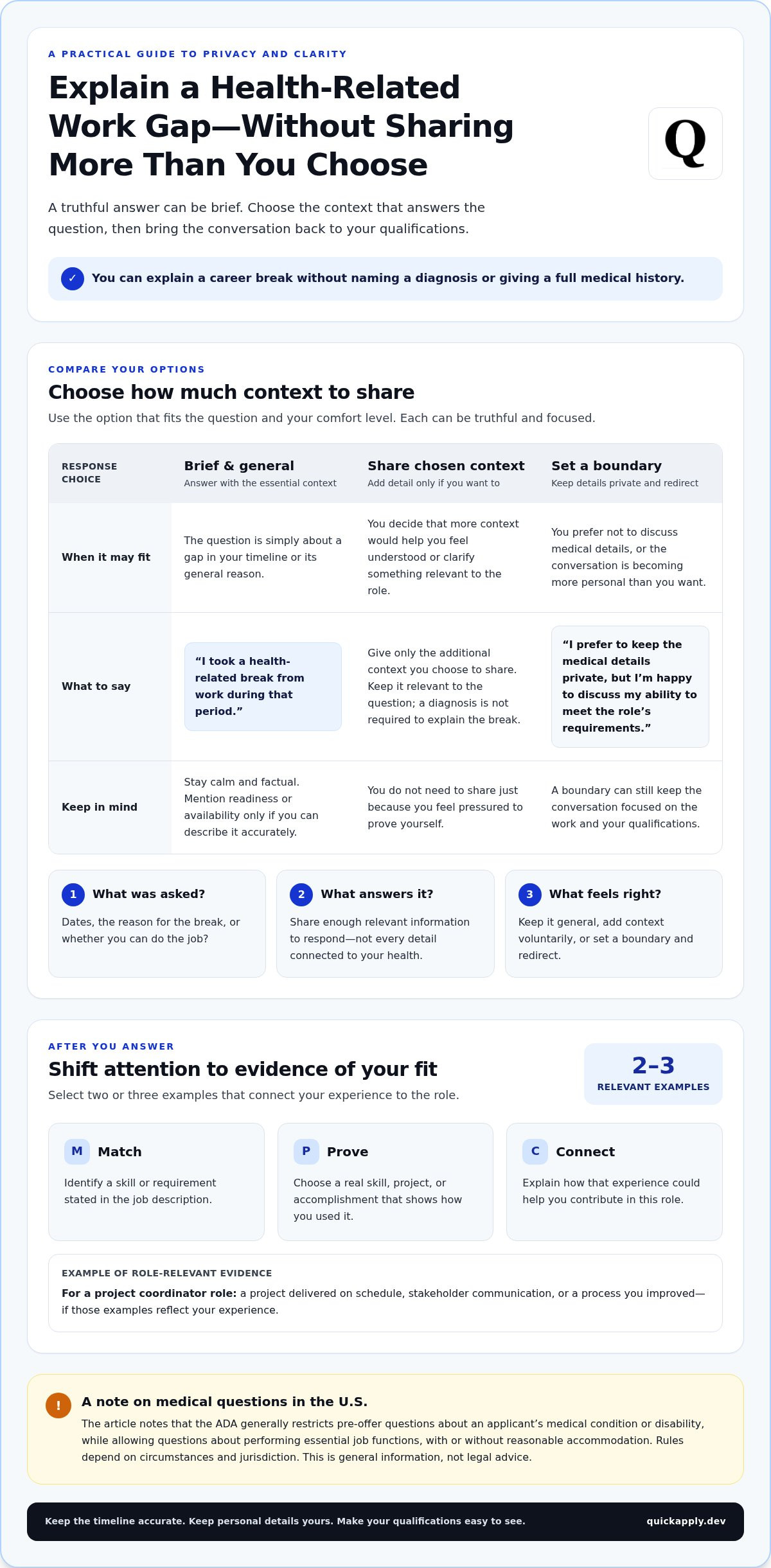
Once you’ve answered the question, bring the conversation back to evidence. Review the job description and select two or three examples that show you can meet its needs. Choose specific skills, projects, or accomplishments rather than trying to summarize your entire career. For a project coordinator role, for instance, you could highlight a project delivered on schedule, stakeholder communication, and a process you improved, if those examples reflect your experience.
Use this quick filter to make your examples relevant:
- Match: Identify a skill or requirement stated in the job description.
- Prove: Choose a real example that shows how you used that skill.
- Connect: Explain how that experience could help you contribute in this role.
This keeps the focus on demonstrated value, not speculation about the gap. You can also tailor your resume to a job description by foregrounding relevant experience and skills while keeping dates and details accurate. The goal isn’t to erase the break. It’s to make your qualifications easy to see alongside it.
Decide How Much to Share About a Health-Related Employment Gap
You can tell the truth without sharing details that aren’t needed for the conversation. To decide how much to disclose, use three filters: what was asked, what information would answer it, and what you’re comfortable sharing. This keeps your response relevant and lets you control how personal it gets.
You can explain a career break without narrating a diagnosis. A truthful answer can be brief and general, such as “I took time away from work for health reasons.” Don’t substitute a different explanation, such as caregiving or travel, if it isn’t accurate. The goal in how to explain employment gaps due to health issues is to communicate the relevant facts, not to create a story that hides or changes them.
- Identify the question. Are they asking about dates, the reason for the break, or whether you can do the job?
- Choose the minimum useful context. Share enough to answer the question, not every detail connected to your health.
- Decide what you’re ready to say. You can keep your response general, add context voluntarily, or set a boundary and redirect to role-related information.
When a brief, general explanation may be enough
If the question is simply about a gap in your timeline, a short factual response may be enough: “I took a health-related break from work during that period.” You don’t need to name a condition to be truthful. Keep your tone calm and your answer proportional to the question. Mention readiness or availability only if you can describe it accurately, and don’t imply that your health is fully resolved if that isn’t true.
When you choose to share more context
Sharing additional context is your choice. Consider whether it would help you feel understood or clarify something relevant to the role. Don’t share just because you feel pressured to prove yourself. You can prepare a boundary-setting sentence in advance, such as, “I prefer to keep the medical details private, but I’m happy to discuss my ability to meet the role’s requirements.”
Choosing to disclose is different from responding to a direct question. Employment protections and rules around medical inquiries depend on the circumstances and jurisdiction. In the United States, the ADA generally restricts pre-offer questions about an applicant’s medical condition or disability, while allowing questions about performing essential job functions, with or without reasonable accommodation. This is general information, not legal advice. For a specific concern, speak with a qualified employment lawyer.
Before an interview, practise both your short answer and your boundary phrase so you’re not deciding under pressure. QuickApply’s interview practice tools let you rehearse concise responses and keep the conversation centered on the role.
Write a Resume or Application Explanation That Stays Honest and Focused
Your resume should make your experience easy to follow, not make a gap disappear. Keep employment dates accurate and use a consistent format. A chronological, functional, or hybrid layout can emphasize different parts of your background, but none should imply that you worked during a period when you didn’t. Present the timeline clearly while giving relevant qualifications enough visibility.
You don’t have to explain every gap on the resume itself. A brief note may help if the break is recent, leaves a confusing date range, or is likely to prompt questions. If your timeline is already clear, you may prefer to address the gap if it comes up in an interview. Resume examples for 2026 can offer ideas for structure. Adapt the format to your experience rather than forcing your experience to fit the format.
Sample resume wording for a health-related break
Here’s an optional template to adapt only if it accurately reflects your circumstances: Career break for health reasons; now preparing to return to work. You can place a short entry under a separate “Career Break” heading or include a concise note beside the relevant dates. Don’t add a diagnosis, treatment details, or claims about availability unless you choose to share them and can support what you say.
The phrase “preparing to return to work” may not fit everyone. If you’re not ready to make that statement, leave it out or use a factual description of the break. Resume language should match what you can truthfully say now. This matters especially if an application asks for specific dates, activities, or current availability.
What to put in a cover letter or application field
Answer required application questions directly, and keep those answers consistent with your resume. If a form asks for employment dates, provide accurate dates. If it asks for context, a brief response such as “I took a health-related career break during this period” may be enough if it’s truthful and answers the question. Don’t give a different reason in one document to make the timeline seem simpler.
A cover letter needs a gap explanation only if it clarifies your chronology or transition. Keep it to a sentence, then return to your qualifications. For example: “After a health-related career break, I’m applying my experience in data analysis and process improvement to this role.” Use that wording only if it reflects your situation and strengths. Cover letter examples for tech jobs can help you frame relevant experience around the position without turning the letter into a personal account.
Before submitting, compare your resume, cover letter, and application. Check dates, descriptions, and any statement about readiness. Knowing how to explain employment gaps due to health issues also means using focused, accurate wording consistently across your materials.
Answer Interview Questions About a Health-Related Employment Gap
Your interview answer doesn’t need to cover every detail behind your time away. Use a repeatable sequence to stay focused: acknowledge the gap, share only the context you choose, describe your readiness truthfully, then connect your experience to the role. This gives you a clear way to answer without making your health the center of the interview.
- Acknowledge: State that you took time away from work.
- Share context: Give a brief explanation at the level of detail you’re comfortable with.
- Describe readiness: Say what’s true about your current capacity and work plans.
- Pivot to fit: Bring in a relevant strength, accomplishment, or example.
This structure can help you answer clearly, but it can’t control an interviewer’s assumptions or guarantee an outcome. The goal is to give an accurate response and make it easy to discuss your qualifications next.
A concise interview answer you can adapt
Template to personalize: “I took time away for health reasons. I’m ready to discuss how my experience fits this role.” Use the readiness statement only if it accurately reflects your situation. If your capacity or return plans are more specific, describe them truthfully without promising more than you can commit to.
Then connect your answer to evidence. For example: “In my last role, I improved the team’s reporting workflow, and I’d be glad to discuss how that experience applies here.” Choose a real project, accomplishment, or technical strength that matches the position. Keep the transition simple. You don’t need to fill the pause with extra personal details.
Set a boundary and redirect professionally
An interviewer may ask follow-up questions about the dates, your return, or your ability to meet the role’s responsibilities. You can prepare without assuming you must answer every personal question in detail. Decide in advance what you’re comfortable sharing, and practise a boundary phrase that feels natural.
For example: “I prefer to keep the medical details private. I can speak to my ability to handle the responsibilities of this position.” Then redirect to a work-related point, such as the role’s core duties, a relevant skill, or your availability for the stated schedule. If you need to clarify a work arrangement, focus on the requirement itself rather than disclosing information that isn’t necessary to answer it.
Practise aloud, but don’t memorize a script word for word. Try answering the same question in your own phrasing, then practise a follow-up and a redirect. This helps keep your response steady without making it sound rehearsed. With QuickApply’s structured interview practice, you can rehearse your answer alongside common role-specific questions and refine it until it feels clear, accurate, and like you.
Prepare Your Return-to-Work Story and Restart the Job Search
A clear plan can reduce the energy you spend rethinking the gap for every application. Settle on wording that feels accurate, check your dates, choose examples that show your strengths, and practise likely questions. This gives you a repeatable process without requiring you to share more personal information than you choose.
Use this checklist before applying:
- Settle on your wording: Write a brief version for forms and a spoken version for interviews. Keep both truthful and consistent.
- Check your timeline: Verify employment dates across your resume, application profiles, and other materials.
- Select evidence: Choose relevant accomplishments, projects, or skills that match the kinds of roles you’re targeting.
- Practise likely questions: Say your response aloud, including a boundary phrase for details you prefer to keep private.
Then set a job-search pace that fits your circumstances and priorities. You might focus on a small set of suitable openings at a time, schedule application tasks around your energy, or pause when needed. A manageable routine is more useful than a rigid target that doesn’t fit your life. For broader planning, the job application process guide can help you organize the steps from finding a role to tracking your application.
Build a consistent story across application stages
Your resume, application fields, cover letter, and interview response should agree on the basic facts. They don’t need identical wording, but dates and explanations shouldn’t contradict each other. Keep a private note with the versions you’ve chosen, including what you’ll say if asked for more context. That gives you a reliable reference when you’re applying to several roles or returning to an application later.
As you review each job description, identify which of your genuine qualifications are most relevant. Resume tailoring can bring those details forward without changing dates, inventing skills, or disguising a break. Keep the underlying record accurate; adjust emphasis, not facts.
Use tools to focus on role fit, not personal disclosure
QuickApply tailors your resume to a specific job description in about 30 seconds, helping you foreground relevant experience for that role. Its application tracker also helps organize your job search in one place. Use these tools to manage application details and focus your materials on role fit, not to obscure the gap or replace your judgment. Review every tailored version to make sure it remains accurate and sounds like you.
QuickApply also generates cover letters tailored to job descriptions, so you can keep application materials focused on relevant qualifications while maintaining an accurate account of your work history. Explore the QuickApply platform to tailor resumes and track applications in one place.
Make Your Next Application a Fresh Start
You don’t have to solve your entire job search at once. Choose one role that fits your priorities, then take the next practical step: review its requirements, identify the experience you want the employer to notice, and prepare to speak about your career path in your own words. A steady approach keeps your attention on the opportunity ahead, not on trying to control every assumption someone might make.
Knowing how to explain employment gaps due to health issues can help you enter the process with a plan. Your explanation can stay brief, your qualifications can take the lead, and you can decide what personal information belongs in the conversation one application at a time.
Ready to shape your next application around the role you want? Explore QuickApply and tailor your resume to your next role.
Your work history is one part of your story, not the measure of what you can contribute next. Move forward at a pace that works for you.
Frequently Asked Questions
How do you explain an employment gap due to health issues?
Give an accurate, concise explanation that matches the question, then add a detail that shows why you’re a fit. For example: “I took time away from work for health reasons. Before that, I managed customer accounts and improved renewal processes.” Adjust the context and accomplishment to match your actual history. Learning how to explain employment gaps due to health issues is about finding clear, truthful wording, not defending your private medical history.
Do I have to disclose my medical condition to an employer?
In a typical U.S. interview, you generally don’t need to volunteer a diagnosis just to explain time away from work. You may choose to share information if you need to discuss an accommodation, but the right approach can depend on the job, your circumstances, and applicable laws. Keep the conversation focused on what you’re comfortable sharing and the work-related information needed to discuss the position.
Should I put a health-related employment gap on my resume?
Not necessarily. A resume doesn’t need a separate explanation for every period without paid work, but its dates must remain accurate. If leaving the gap unexplained makes your timeline hard to follow, a brief, optional career-break entry may help. For instance, a resume with clear month-and-year dates may need less context than one showing only years, where the gap could be misread as overlapping employment.
What should I say if an interviewer asks why I was unemployed?
Answer the question directly without adding details you don’t want to share. You could say, “I stepped away from work for health reasons, and I’m now pursuing roles where I can use my experience in quality assurance.” Use the second part only if it accurately describes your situation. If the interviewer asks a follow-up, respond to the work-related point you can answer, then bring the discussion back to the position.
Can I explain a health-related gap without giving details?
Yes. A general but truthful description can explain the absence without naming a condition, treatment, or provider. For example: “I took time away for personal health reasons and prefer to keep the specifics private.” This works best when the question is about the gap itself. If an application asks for particular information, read the prompt carefully and provide an accurate response to what it requests.
What if I am not ready to return to work full-time?
Don’t describe yourself as available for full-time work if that isn’t accurate. Focus your search on roles with hours or arrangements that fit your current capacity, and state your availability plainly when asked. For example: “I’m looking for part-time work and can commit to the schedule listed in this posting.” Consider the role’s stated duties and schedule before applying so you can assess whether they align with what you can currently take on.
Can an employer ask about a health condition during an interview?
In the United States, the ADA generally restricts employers from asking applicants about medical conditions or disabilities before making a job offer. They may ask whether you can perform the job’s essential functions, with or without reasonable accommodation. After a conditional offer, medical exams may be required only under specific conditions, including for all new hires in the same job category. Rules can vary by situation, so consult qualified counsel for legal advice.


