

One hundred rejections can make a job search feel like a verdict on your ability. It isn’t. If you’re wondering how to stay confident after 100 rejections, start by separating what happened to your applications from what you’re worth. Rejection hurts, and you don’t have to pretend otherwise. Repeated no’s can also be a reason to review your approach, not a sign that you should give up.
After so many outcomes, it can be hard to know what to change. Your target roles may be too broad, your resume may not make the relevant experience easy to spot, or your application pace may be leaving you drained. Sending more applications without reviewing the process can make it harder to learn from what’s happening.
This guide offers a practical reset: review role fit, tailor your materials, and track outcomes so you can spot patterns without treating each rejection as a personal score. You’ll also build a sustainable pace for your next round, with steps you can control and room to protect your energy.
Key Takeaways
- Learn how to stay confident after 100 rejections by trusting your ability to adapt, not by expecting an offer every time.
- Review role fit, resume relevance, application pace, and interview progress as separate signals, not proof of personal failure.
- Reset with a manageable sequence: pause, review what you know, choose one adjustment, and take a small next step.
- Set process goals you can control, such as tailoring one application or practicing an interview answer.
- Build a weekly routine that balances targeted applications, skill practice, progress reviews, and rest.
How to Stay Confident After 100 Rejections: Start With a Reset
One hundred rejections can leave you exhausted, frustrated, and unsure whether you can keep going. That reaction makes sense. You’ve put time and effort into your search, and another no can make the next application feel heavier. You don’t need to minimize the experience or force yourself to feel positive before you’re ready.
Begin by separating the outcome from the meaning you attach to it. A rejection tells you that a particular application didn’t lead to an offer. By itself, it doesn’t establish your value, talent, or future prospects. Hiring decisions can reflect role requirements, timing, competition, and an employer’s process. One outcome rarely explains the whole picture.
Why repeated job rejections can feel personal
Each application carries some hope: this role might fit, this resume might land, this conversation might move forward. When the answer is no again, it’s easy to turn several outcomes into a judgment about yourself. Frustration, disappointment, and fatigue are understandable responses. They aren’t proof that you’re failing as a person.
Don’t assume every rejection has the same cause. A role may not match your experience closely enough, or other factors may have shaped the decision. Without useful feedback, you may not know which explanation applies. Treat each result as one data point, not a complete diagnosis of your skills or application.
What confidence means during a difficult job search
Confidence isn’t certainty that the next application will succeed. It doesn’t require constant optimism or pretending you don’t care. It means being able to look at what’s happening, adjust what you can, and continue at a pace that protects your energy. That ability to adapt is closely connected to psychological resilience.
Job-search confidence is trusting yourself to adapt and take the next useful step, even when you can’t control the outcome.
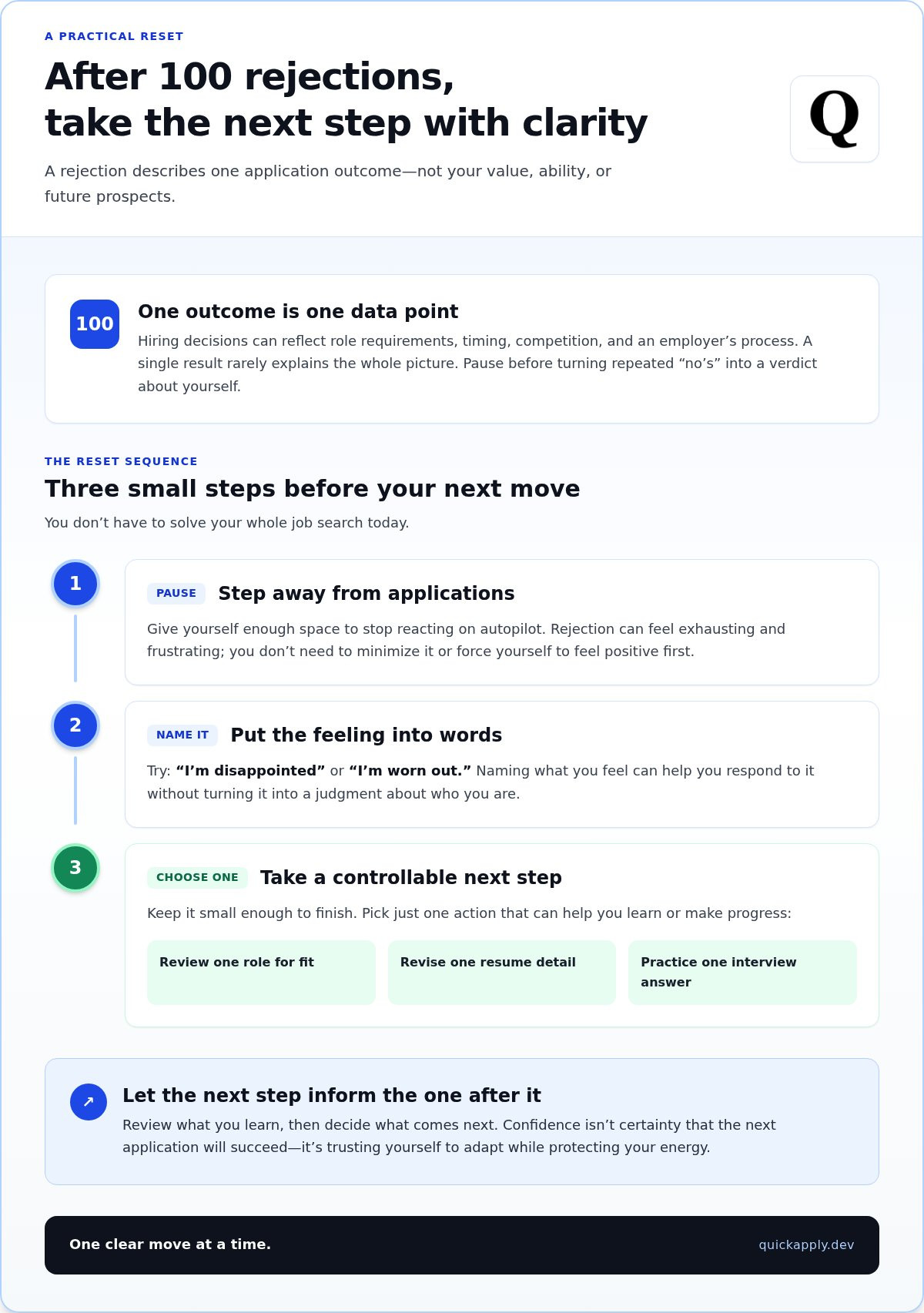
That makes how to stay confident after 100 rejections a practical question, not a demand to feel fearless. Try this compact reset before deciding what to do next:
- Pause. Step away from applications long enough to stop reacting on autopilot.
- Name the feeling. Say, “I’m disappointed,” or “I’m worn out.” Naming it can help you respond without turning it into a verdict about yourself.
- Choose one controllable action. Review one role for fit, revise one resume detail, or practice one interview answer. Keep the next step small enough to finish.
You don’t have to solve your whole job search today. Make one clear move, then use what you learn to decide what comes next.
Why 100 Rejections Do Not Define Your Ability or Potential
A hiring decision reflects more than one measure of your ability. Employers weigh role requirements, timing, other candidates, and their own processes. You may not know how each factor influenced the outcome, so a rejection alone can’t tell you exactly why you weren’t selected. It also can’t predict what will happen with a different role or employer.
That doesn’t make every outcome meaningless. Repeated results can help you identify what to review. Look for patterns across applications rather than turning one decision into a sweeping conclusion about your potential.
Separate the decision from the story you tell yourself
Try this reframe: an application outcome describes one decision, not the whole person. After a rejection, make two short lists. In the first, record what you know: the role, the stage you reached, and any feedback you received. In the second, note the interpretations or fears that came up, such as “I’m not qualified for this field.” Keeping facts separate from assumptions makes it easier to decide whether there’s anything you can learn from the result.
You don’t have to argue yourself into feeling fine. Just avoid treating an unknown as a confirmed explanation. If an employer gives no reason, “I don’t know why they chose someone else” is more accurate than “I’m not good enough.”
Review signals across applications
Review your job search by category. Are you targeting roles that match your experience? Does your resume make relevant skills easy to find? Which stages do your applications reach? Have you received specific feedback? These are useful questions, not automatic diagnoses. For instance, repeated early-stage rejections may prompt you to review role fit and resume alignment, but they don’t prove either caused each outcome.
Silence is incomplete information, too, as is a brief rejection with no explanation. Avoid filling those gaps with a single story. An application tracker can keep role details, stages, and feedback visible, making it easier to compare outcomes without relying on memory. Tailoring your resume to a specific job description also gives you a chance to check how clearly your experience relates to that role.
Application outcomes are data points, not a complete measure of your ability. Use an application tracker to organize roles and next actions. Then review what you’ve recorded and choose one focused adjustment instead of changing everything at once.
How to Diagnose Your Job Search Without Blaming Yourself
Use outcomes as prompts for review, not verdicts. A pattern can point to a question worth testing, but it rarely proves a single cause. Separate four parts of your process: whether the role fits, how clearly your resume shows relevant experience, how many suitable applications you’re completing, and how far you progress in interviews. Review each one separately so you can make a focused adjustment instead of rewriting your entire search strategy.
What different application outcomes may suggest
Use this table to generate possibilities, not instant diagnoses. One result can have several explanations, and employers don’t always provide enough information to identify the reason.
| Observed outcome | Questions worth reviewing |
|---|---|
| Few or no responses | Are the roles closely aligned with your skills and experience? Does your resume make the most relevant qualifications easy to find? |
| Responses arrive, but roles don’t progress | Are you applying selectively enough to focus on well-matched openings? Is there specific feedback you can use? |
| Interview invitations followed by rejections | Which interview questions felt difficult? Would practicing concise examples of your work help you explain your fit more clearly? |
| Different results across similar roles | What varies between the job descriptions, application materials, or interview stages? Is there a repeatable pattern, or simply different outcomes? |
For example, if you’ve applied to several roles with similar requirements and received little response, check whether your resume clearly reflects those requirements. Treat that as a useful experiment, not proof that your resume caused every outcome. This guide to tailoring a resume to a job description can help you review alignment role by role.
Turn feedback into a small test
Keep a simple record for each application: the role, application date, stage reached, and any specific feedback. An application tracker keeps those details together so you can compare outcomes more easily. Record what happened, not what you fear it means. “Rejected after the first interview” is observable; “I’m bad at interviews” is a conclusion that the record can’t establish.
Look for a pattern before changing several things at once. If interview-stage rejections recur, practice one answer or skill area before your next conversation, then review how it goes. If role fit seems inconsistent, focus your next applications on positions with clearer alignment. These are ways to test your approach, not guarantees of a different result.
A measured review is a practical part of how to stay confident after 100 rejections: gather evidence, choose one adjustment, and track what follows. You don’t have to force every rejection into a lesson. The goal is to make the next decision with better information and less self-blame.
How to Rebuild Confidence With a Manageable Job-Search Plan
A useful plan gives you structure without turning the search into a full-time measure of your worth. After a rejection, focus on the next controllable action rather than demanding an immediate burst of motivation. Use this five-step reset to turn disappointment into a clearer workflow.
A five-step reset after another rejection
- Pause. Step away from your inbox or application dashboard. Give yourself room to feel disappointed before deciding what the result means.
- Review what you know. Look at the stage reached and any specific feedback. Don’t invent an explanation where the employer hasn’t given one.
- Choose one adjustment. Refine how your experience matches a role, or practice answering one interview question. Keep the test focused.
- Set a small next action. Complete one tailored application, update one resume bullet, or schedule a short practice session. Completing the step counts, even without an immediate response.
- Pick a stopping point. Decide when you’ll finish for the day, then step away. Rest is part of a sustainable search, not a reward you have to earn.
This is one practical way to approach how to stay confident after 100 rejections: create a repeatable process that lets you adapt without demanding constant optimism. Set boundaries around job-search time and leave room for relationships, interests, and routines unrelated to work. Your search matters, but it isn’t your entire identity. If the strain feels difficult to manage alone, consider talking with someone you trust or seeking appropriate professional support.
Track progress you can control
Measure your actions alongside outcomes. Record tailored applications completed, follow-ups sent, interview practice sessions, and useful lessons from the process. A tracker keeps those actions visible and saves you from trying to remember every detail. Mark progress honestly: finishing a thoughtful application is an accomplishment, even though it can’t guarantee an interview or offer.
Use your record to set a realistic weekly rhythm. Choose a manageable number of roles to review, reserve time to tailor your materials, practice a skill, and check your progress. If the plan consistently leaves you depleted, adjust it. For a broader workflow, read this job application process guide.
QuickApply’s tools help you tailor resumes and cover letters, track applications, and practice interviews. Build a more structured job-search workflow and use it at a pace you can sustain.
Build a Sustainable Application System and Keep Moving Forward
A repeatable job-search system reduces the number of decisions you have to make from scratch. Set a weekly rhythm that includes reviewing suitable roles, preparing targeted applications, practicing a skill, checking your progress, and taking real breaks. Adjust the balance to your energy and other responsibilities. The goal is a routine you can maintain, not the highest possible application volume.
Use structure to reduce job-search friction
Keep each opportunity in one place, whether that’s an application tracker or another simple system. Record the company and role, application stage, follow-up date, resume version, and notes you’ll want before an interview. When the next action is visible, you won’t have to reconstruct your search from memory.
Prioritize roles that align with your skills and goals instead of applying indiscriminately. For each role, adapt your resume to make the most relevant experience clear. Save or label versions so you can tell which materials went with each application. Then set aside time to prepare examples for likely interview questions.
Match scores, resume and cover-letter tailoring, interview practice, and application tracking can support this workflow. Use them to organize and review your process, not as promises of interviews or employment. Tools can make information easier to manage; your experience and judgment still guide your decisions.
Choose the next step, not a verdict on your future
At the end of each search session, write down one specific next action: shortlist a role to review, tailor a resume, send a planned follow-up, or practice an interview answer. Give the task a clear stopping point, then step away. A manageable action helps maintain momentum without making job searching the measure of your day.
Confidence can grow through repeated actions you control, even when outcomes remain uncertain. Use your weekly review to notice what you completed, what you learned, and what you want to adjust. That’s a practical way to approach how to stay confident after 100 rejections: keep the process steady, flexible, and human-sized.
QuickApply brings resume and cover-letter tailoring, role match scores, an application tracker, and interview practice into one job-search workflow. Explore QuickApply’s job-search tools to organize your next steps.
Make Your Next Job-Search Step Count
One hundred rejections can shake your confidence, but they don’t define your ability or decide your future. The practical answer to how to stay confident after 100 rejections isn’t to ignore the sting. Separate your worth from hiring outcomes, review patterns without turning them into personal verdicts, and make one manageable adjustment at a time.
Keep your search focused and sustainable. Track roles and next actions in one place, prioritize relevant opportunities, and set process goals you can control. Tailored resumes and cover letters, role match scores, and interview practice tools can help organize your workflow, but no tool can promise an offer. Progress also includes the thoughtful steps you complete and the insights you gain.
Explore QuickApply’s job-search tools to bring application tracking, resume and cover-letter tailoring, role match scores, and interview practice into your process. Choose one next action, set a reasonable stopping point, and keep moving at a pace that protects your energy. Rejection is an outcome, not your identity. Your next step is still yours to choose.
Frequently Asked Questions
Is it normal to feel discouraged after 100 job rejections?
Yes. Feeling discouraged after repeated rejection is understandable, and it doesn’t mean you’re weak or unsuited to your field. Give yourself room to acknowledge the impact before deciding what to change. Write down what you know, such as the stage an application reached, separately from what you fear it means. Then choose one manageable next action. If distress is interfering with daily life, consider reaching out to someone you trust or a qualified professional.
How do I stay confident when every job application gets rejected?
Don’t make confidence depend on getting an offer. Focus on actions you can control, such as targeting relevant roles, tailoring your resume, or practicing an interview answer. Review outcomes for patterns, but treat them as incomplete information, not a verdict on your ability. For how to stay confident after 100 rejections, set a pace you can maintain, track process goals, and take breaks. You don’t need constant optimism to make thoughtful adjustments.
Should I stop applying for jobs after 100 rejections?
Not necessarily, but repeating the exact same approach may not be useful if it’s draining you. Consider taking a short pause, then review where applications are stalling and test one change at a time. You might narrow your target roles or ask someone you trust to review your materials. Decide what to do next based on your circumstances, energy, and the evidence you have. A reset can be part of continuing, not giving up.
What should I do after another job rejection?
Pause before reacting, then record the role, application date, and stage reached. Note any specific feedback and separate those facts from assumptions about why the employer decided as they did. If you see a repeated pattern, choose one adjustment to test in your next application or interview. If there’s no useful information, don’t invent a reason. Finish by choosing one small next action and a reasonable stopping point for the day.
Can tracking job applications help with confidence?
A tracker can make your search easier to review, but it can’t guarantee a better outcome. Record roles, dates, stages, follow-ups, and useful notes so you don’t have to rely on memory. Include process goals, too, such as completing a tailored application or practicing an interview answer. This gives you a clearer view of the work you’ve done and may reveal patterns worth exploring, without treating each employer response as a measure of your worth.
How many job applications should I submit each week?
There’s no universal weekly number that works for every job seeker. Choose a pace that fits your available time, target roles, and the effort needed to submit a thoughtful application. Prioritize relevant openings over a quota that pushes you into rushed submissions. Set a manageable goal, then review whether the quality and pace feel sustainable. Adjust it based on your circumstances, energy, and how well each application reflects your fit.
When should I take a break from job searching?
Consider a break if searching is consistently affecting your sleep, focus, or ability to manage everyday responsibilities. Make the pause deliberate: choose a timeframe, step away from applications, and decide when you’ll review your plan again. A break doesn’t have to mean abandoning the search. If the strain feels difficult to manage, reach out to someone you trust or a qualified professional. Returning with more energy may help you make clearer decisions about your next steps.


