

What if a layoff says more about a company’s priorities than your ability? Losing a job can still shake your confidence, especially when you’re unsure what recruiters will assume. Learning how to talk about your layoff without feeling like a failure starts with separating a business decision from your personal worth. A layoff is an event to explain, not a verdict on your career.
It’s understandable to worry that an interviewer will connect your departure to poor performance. You don’t need to hide what happened or overexplain it. A clear, honest answer about restructuring or budget cuts can address the question, then bring the conversation back to your skills, contributions, and next step.
This article will help you shape a concise explanation for interviews and networking conversations, respond to follow-up questions, and move forward with more confidence. You’ll learn how to adjust your wording for different situations without changing the facts. Then you can focus your search on suitable roles, tailor your resume to each opportunity, practise interview answers, and track applications in one place. One career event doesn’t define you. Your next move is still yours to make.
Key Takeaways
- Learn how to talk about your layoff without feeling like a failure by separating the employment change from your skills and professional value.
- Build a concise, truthful explanation that gives relevant context and keeps the conversation focused on what you’re ready to do next.
- Adjust the level of detail for recruiter screens, interviews, and networking conversations without changing the facts.
- Prepare for follow-up questions with direct answers and accurate examples of your contributions, not a memorized defense.
- Turn your next steps into a manageable search plan, from choosing target roles to tailoring materials and tracking applications.
Why a Layoff Does Not Define Your Value or Ability
Losing a job can trigger shame, uncertainty, and questions about who you are professionally. You may replay what happened and wonder whether it says something about your ability. Those feelings are real, but they aren’t proof that you failed. A layoff describes an employment event. On its own, it doesn’t explain why your position ended or measure your potential.
A layoff generally refers to an employment ending connected to business needs, such as restructuring or reduced budgets. That differs from a termination tied to an individual’s performance, but don’t assume which applies without knowing the facts. A role may have been eliminated, or the situation may be more complex. Explain only what you can verify, then direct attention to the skills and contributions relevant to your next role.
A layoff is one event in your career, not a complete measure of your professional value. You don’t have to pretend the experience feels positive. You can acknowledge the disappointment and still prepare a clear explanation and a practical next step. That’s the foundation of how to talk about your layoff without feeling like a failure.
What does a layoff say about your career?
The word tells someone that a job ended. It doesn’t provide a full assessment of your talent, past work, or future potential. Circumstances vary, so avoid guessing why a decision was made. If you know your team was reorganized, say so. If you don’t know the full reason, stick to the details you can support. Honest and measured beats forced positivity.
How to interrupt the “I failed” story
Separate the verifiable fact, such as “my position ended,” from the conclusion “I wasn’t good enough.” One is an event; the other is an interpretation. Before preparing your explanation, write down your contributions, skills, and outcomes from the role. Choose accurate examples that are relevant to the work you want next, not inflated claims. If saying the words still feels difficult, practise with someone you trust until you can explain the facts without turning the answer into a defense.
Keep the objective simple: state what happened briefly, add relevant context, then shift to what you can contribute next. You’re not required to tell your entire story in every conversation. A role-specific resume can help you connect your experience to the opportunities you’re pursuing, while interview practice can help you deliver your explanation calmly and naturally.
Build a Clear, Honest Explanation of Your Layoff
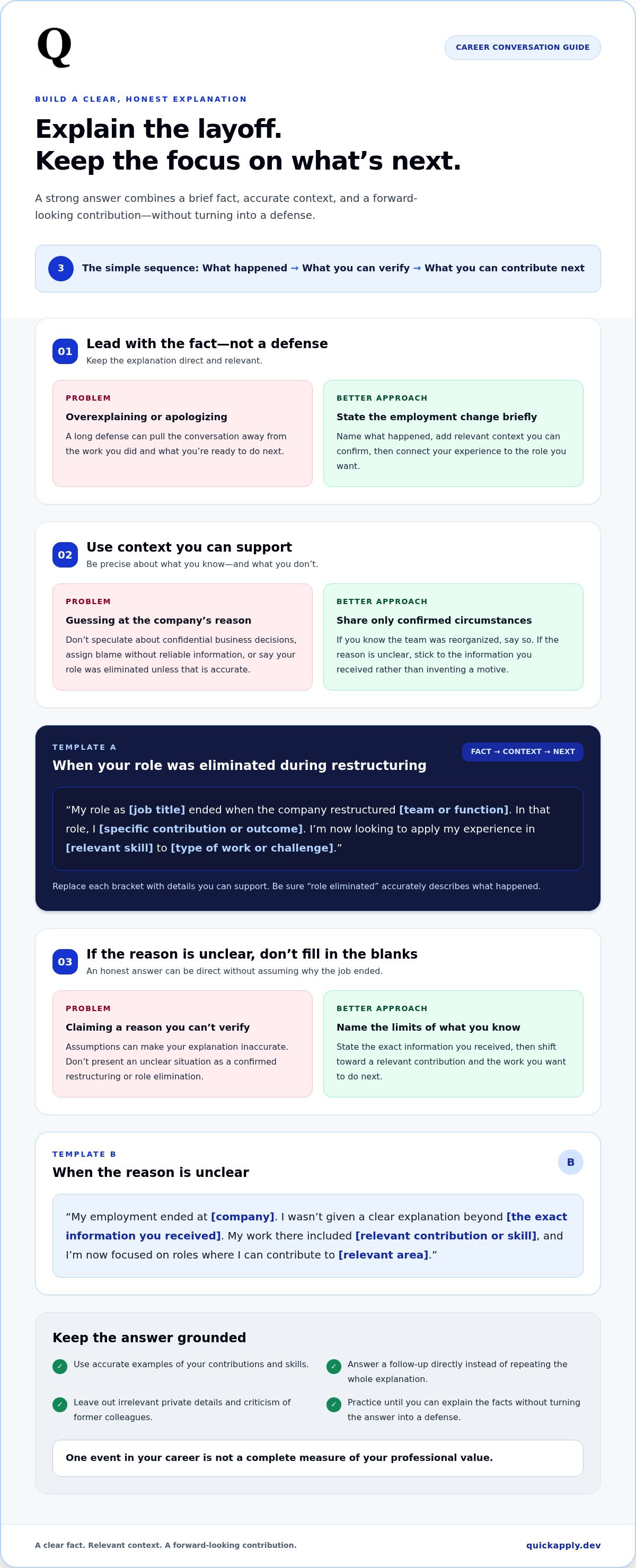
You don’t need a long defense. Use a simple sequence: state what happened, add relevant context you can verify, then connect your experience to what you’re ready to do next. A strong layoff explanation combines a brief fact, accurate context, and a forward-looking contribution. This structure keeps the conversation clear without asking you to explain decisions you weren’t part of.
What to include in a layoff explanation
Start with the employment change, explain only the confirmed circumstances, and add one skill or contribution that fits the role you want. End with the kind of work you’re interested in doing next. For more guidance on how to talk about a layoff, Western Governors University offers advice for discussing it in job-search materials and interviews.
Template for a role eliminated during restructuring: “My role as [job title] ended when the company restructured [team or function]. In that role, I [specific contribution or outcome]. I’m now looking to apply my experience in [relevant skill] to [type of work or challenge].”
Replace each bracket with details you can support. If the interviewer asks for more context, answer that question directly instead of repeating your full explanation.
What to leave out when discussing a layoff
Don’t speculate about confidential business decisions or assign blame without reliable information. Skip apologies, irrelevant private details, and criticism of former colleagues. Be precise: never say your role was eliminated unless that accurately describes what happened.
Template when the reason is unclear: “My employment ended at [company]. I wasn’t given a clear explanation beyond [the exact information you received]. My work there included [relevant contribution or skill], and I’m now focused on roles where I can contribute to [relevant area].”
This wording is direct without inventing a company motive. It also gives you room to describe your experience and next direction, which is the useful part of the conversation. Learning how to talk about your layoff without feeling like a failure doesn’t mean pretending the event was easy. It means choosing accurate words and keeping the focus on what you can offer.
Once your explanation is set, align your resume with the role you’re pursuing. Tailor your resume to a specific job so your relevant skills and experience are easy to identify.
Choose the Right Layoff Response for Interviews, Recruiters, and Networking
The facts stay the same; the level of detail changes with the conversation. A recruiter screen needs a quick, relevant answer. A formal interview may call for more context and a clear link to the role. Networking is less about defending your employment history and more about explaining what you’re looking for next.
| Audience | Response length | Useful next point |
|---|---|---|
| Recruiter screen | One or two sentences | Relevant skill or achievement |
| Formal interview | A few concise sentences | Experience that fits the role |
| Networking conversation | One brief sentence, then invite conversation | Role or connection you’re seeking |
What to say when a recruiter asks why you left
Answer “Why did you leave?” directly. Use the confirmed reason in plain language, then connect one relevant strength to the opportunity. For example: “My position ended during a team restructuring. I’ve built experience in [relevant skill], and I’m interested in applying it to [role or responsibility].” Keep more context ready in case the recruiter asks a specific follow-up. Don’t turn the first answer into a defense.
If asked whether performance played a part, answer truthfully and stay within what you know. If the confirmed explanation was a broad restructuring, you might say, “The information I received was that the team was changing. I can speak to my performance and contributions in the role.” Use that wording only if it matches your experience. If you received performance feedback, don’t imply otherwise. Address the relevant facts briefly, then explain what you learned or how you’ve strengthened that skill.
How to discuss a layoff while networking
Keep the focus on your direction, not the private details of your departure. Try: “My role ended as the team changed, and I’m now exploring [type of role]. I’d value any insight into teams working on [area].” If you don’t know why your employment ended, don’t assign a motive. Say what you know, or simply share that you’re exploring a new opportunity. You can keep personal details private.
If someone asks about a gap, give a straightforward update without apologizing: “I’ve been focusing on my search and targeting roles in [field].” Add a short explanation of any relevant learning, project, or responsibility only if it’s accurate. Practising audience-specific answers can make how to talk about your layoff without feeling like a failure more manageable. Interview practice tools can help you rehearse clear responses without memorizing a speech.
Handle Follow-Up Questions and Present Your Experience Confidently
A follow-up question can catch you off guard, especially if it sounds like a judgment. You don’t need a polished speech. Pause, answer what was asked, and stop there unless more detail is relevant. Practising a few direct responses can help you stay steady without sounding rehearsed.
How to answer uncomfortable questions without becoming defensive
Keep your answer anchored to facts you can support. If someone asks why your position ended and you genuinely don’t know the full reason, say so plainly: “I wasn’t given more detail than [what you were told].” Don’t fill the silence by guessing at management decisions or adding unrelated personal details. Connect your experience to the role after addressing the question.
Prepare for questions about performance, team changes, or results by choosing examples you can explain clearly. A useful achievement describes both the work you did and its outcome, such as “I streamlined [process], which reduced [measurable issue] by [verified amount].” If you can’t verify a number, describe the result without inventing one. Practising with interview tools can help you refine the answer while keeping it in your own words. This is a practical part of learning how to talk about your layoff without feeling like a failure: respond to the question, not to the fear behind it.
How to make your resume support your explanation
Your resume and interview answers should tell a consistent story. Check that role titles, employment dates, and descriptions match across your resume, LinkedIn profile, and application materials. Don’t disguise your work history or invent consulting work to cover a gap. If asked about time between roles, keep it neutral: “I’ve been focused on finding a role that fits my experience in [area], and I’m ready to bring those skills to [type of work].” Share additional details only if they’re relevant and you’re comfortable doing so.
Use your resume to show evidence of the capabilities you describe aloud. Prioritize accurate accomplishments that match the job description, then make your direction clear. You don’t need to frame every past choice as perfect. Show what you learned and what you’re prepared to contribute now. For a practical walkthrough, read how to tailor a resume to a job description.
Turn preparation into a repeatable process: refine your role-specific resume, practise likely follow-ups, and keep your applications organized. Tailor your resume and practise interview answers to prepare for your next conversation.
Turn the Layoff Conversation into a Practical Job-Search Plan
A clear explanation is one part of your next move. Turn it into a job-search workflow that gives you direction without demanding that you feel fine about the layoff. You can make progress and still need time to process what happened.
What to do in your first job-search session
Keep the first session focused. Choose a manageable set of target roles that fit your skills, experience, and current priorities. Then write one factual explanation of your layoff and prepare shorter versions for recruiter conversations, interviews, and networking. You’ll have a reliable starting point instead of needing to improvise each time.
Next, set up a simple application log. For each opportunity, record:
- Role and company, so you can track what you applied for.
- Application date and next action, such as preparing for a conversation or following up.
- Conversation notes, including useful details about the role or team.
Tailor your resume and cover letter to each job description instead of sending the same version everywhere. A match score can help you assess how closely your experience aligns with an opportunity, while an application tracker keeps your search organized. For a step-by-step approach, use this guide to organizing a job application process.
How to keep momentum without tying self-worth to responses
Set process goals you can control: identify relevant roles, prepare application materials, practise interview answers, or complete a follow-up. A reply is an outcome you can’t control, and it isn’t a measurement of your professional value. Interview practice can help you rehearse concise answers and notice where your wording feels unnatural. Adjust it until it sounds like you, not a script.
Some days, the right next step may be a pause or a conversation with someone you trust. Productivity doesn’t erase disappointment, and you don’t need to turn every feeling into a task. Building a process simply makes the practical parts easier to manage while you move forward at a sustainable pace.
If you’re ready to add structure, explore QuickApply to tailor resumes and cover letters, assess role fit, track applications, and practise interviews. Use the tools to organize your search, not as a promise of a hiring outcome. Learning how to talk about your layoff without feeling like a failure can help you explain what happened and focus on the opportunities ahead.
Make Your Next Career Move on Your Terms
A layoff is part of your work history, not a verdict on your ability. Keep your explanation honest and concise, adjust the detail to the conversation, and bring the focus back to the skills you’re ready to use. That’s how to talk about your layoff without feeling like a failure while still making room for the disappointment you may feel.
Then take the next step at a pace you can sustain. Choose roles that fit your experience, prepare application materials for each opportunity, and track your progress without measuring your worth by replies. Practical structure can make a job search easier to manage, even if it can’t erase the emotional impact of a layoff.
QuickApply can support that workflow with AI-powered resume and cover letter tailoring for specific job descriptions, application tracking, and interview practice. Explore QuickApply to organize and streamline your job search, and keep your attention on the experience and contribution you bring to your next role. One career event doesn’t define what comes next.
Frequently Asked Questions
How do you explain being laid off in an interview?
Explain the confirmed reason briefly, then connect your experience to the role. For example: “My position ended during a restructuring. In that role, I developed experience in [relevant skill], and I’m ready to apply it to [role responsibility].” Keep the wording factual and calm. If the reason or circumstances are unclear, don’t guess. Answer follow-up questions honestly and avoid turning the explanation into a defense.
Should I tell an interviewer I was laid off?
Be honest if an interviewer asks why you left, but you usually don’t need to make the layoff the focus of your introduction. State what happened accurately, share relevant context if useful, and move to your qualifications. If an application asks directly about your employment history or departure, answer truthfully. Keep your dates and role details consistent across your resume, application, and interview responses.
Can a layoff hurt your chances of getting hired?
A layoff doesn’t automatically determine whether you’ll be hired. Employers assess your experience, skills, and fit for the role, along with how clearly you communicate your background. You can’t control every hiring decision, but you can avoid speculation or blame and prepare relevant examples of your work. Keep the explanation concise, then focus on the value you can bring to the position.
What should I say if I do not know why I was laid off?
Say plainly that you weren’t given a clear reason, and don’t invent one. For example: “My employment ended, and I wasn’t given more detail than [what you were told]. I’m now focused on roles where I can use my experience in [skill or area].” Learning how to talk about your layoff without feeling like a failure means staying with what you know, not filling uncertainty with self-blame.
How do you talk about a layoff without sounding bitter?
Stick to neutral facts, avoid criticizing former colleagues, and don’t speculate about decisions you can’t verify. You can acknowledge the change without pretending it was easy: “My role ended during a team reorganization. I’m now looking for work that uses my experience in [relevant area].” Practise saying your answer aloud. If it starts to sound defensive, shorten it and return to your skills and next direction.
Should I mention a layoff on my resume?
Usually, list your role, employer, dates, and relevant accomplishments without adding a note that you were laid off. Your resume’s job is to show your experience and fit for the target role. Keep employment dates and titles consistent across your resume, LinkedIn profile, and applications. If someone asks why the role ended, explain it honestly in the conversation rather than trying to hide or disguise your work history.
How do I explain a layoff to a recruiter over the phone?
Keep your answer short and direct. State the confirmed reason, add one relevant point about your experience, then connect it to the role. For example: “My position ended as part of a restructuring. I’ve worked extensively with [relevant skill], which is why this opportunity caught my attention.” Pause afterward and let the recruiter guide the conversation. Have more detail ready for a relevant follow-up, but don’t lead with a long explanation.


